A particle physicist at CERN for 12 years, Barbara Storaci now coordinates UEFA’s competition draws. She recounts the move from academia to industry, and how her physics skills proved transferable.
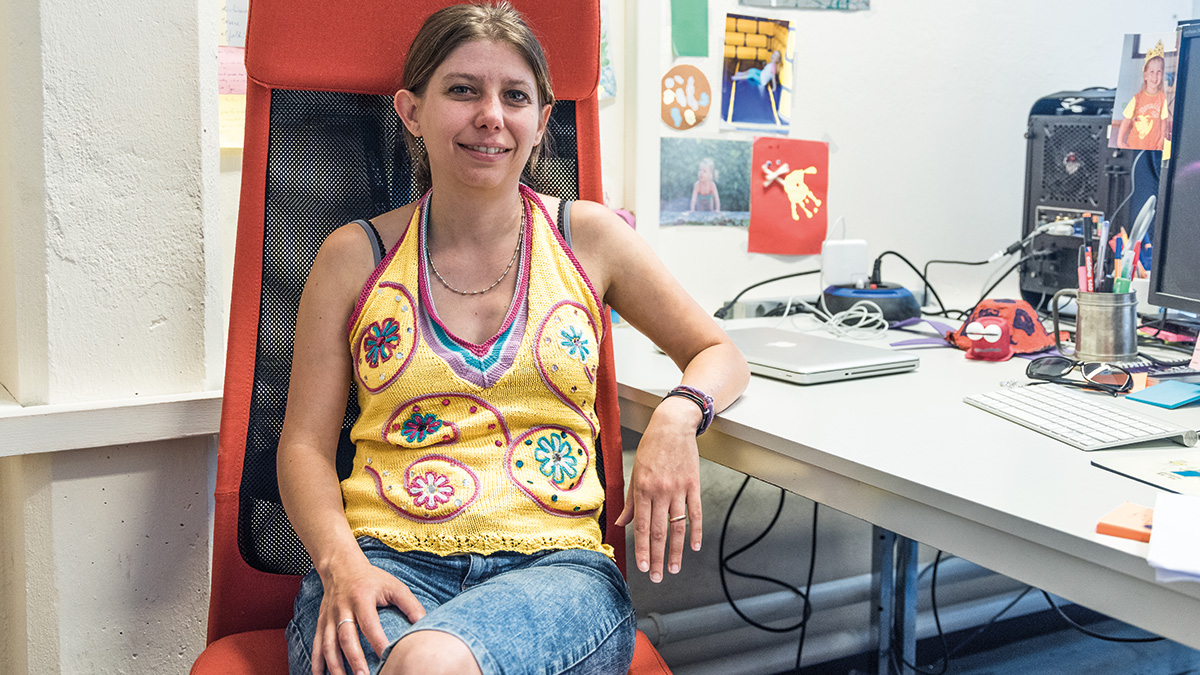
Some 30 kilometres from CERN, on the northern shore of Lac Léman, sits the home of European football. The Union of European Football Associations (UEFA) brings together 55 national associations from across the continent and organises its most prestigious tournaments, including the European Championship and the Champions League. It sets the rules for those competitions and allocates most of the revenue they generate back into the game.
“When I saw the job description, I remember thinking: oh my God, they are looking for a physicist,” recalls Barbara Storaci. “It didn’t make any sense, but the profile they wanted was exactly mine.”
Although the role did not explicitly mention physics, it demanded someone who could coordinate, code, analyse large volumes of information and thrive in an international environment. “Who in the world has all this in one person?” she asked. “Well, physicists do.”
From physics to football
Today, nine years on, Storaci is a senior project manager, responsible for the more than 50 draws UEFA conducts each year, as well as for coordinating projects across the organisation. Football, though, was not the original plan.
Storaci wanted to be a particle physicist from the age of 12. “I planned my studies to reach this goal. I started to collaborate with the LHCb experiment from my bachelor’s and master’s studies at the University of Milano-Bicocca, coming to CERN for the summer before my last year, and never going back.” Based at CERN throughout, she completed a PhD with Nikhef and a postdoc at the University of Zurich. Storaci spent 12 years at LHCb, rotating through nearly every role, from data analysis to data-acquisition coordination.
But the suspense of discovery came with the anxiety of instability. “At a certain point, I didn’t have fun anymore because it was more a matter of always looking for the next contract instead of actually doing research,” she says. “When I reached an age where I wanted more stability for family life, the short-term contracts made things extremely difficult.”
Getting a permanent academic position felt like a lottery. Storaci often found herself up against competent colleagues who made for tough competition, and the constant race for short-term contracts made her question whether it was wise – or healthy – to continue. She grappled with many doubts, and was hesitant to seek roles outside of academia. “For many years I wondered: am I giving up on my dream?” she recalls. “Is it a failure? Should I try a little longer?”
Curiosity is the key. If I had to select just one trait, that’s the one I’d choose
Her curiosity, and her willingness to take risks, led her to leave the lab. “All my life I have been outside my comfort zone,” she reflects. “That’s what I love about my present job: I know what I’m doing today, but I have no clue what I will be doing in two years. And that fits me extremely well.”
One of the biggest adjustments was learning to present herself as a strong candidate to people outside academia. “Physicists often believe we can do any job, but when you actually look for a job, you start wondering: is that really true?” Her advice to other researchers is to translate their skills into a language recruiters understand.
“Nobody outside of particle physics will care about your decay channel,” she says bluntly. “Forget about the jargon. What matters is what you developed to make that research happen: coding, managing projects, analysing huge datasets, coordinating teams. That’s what you have to explain.”
Practical preparation helped. Before her first UEFA interview, a friend outside academia offered to role-play as a recruiter. Storaci was sceptical. She had done plenty of academic interviews, and surely this would be no different. But when they met for coffee, some of her friend’s questions left her stumped.
“She asked me questions I had never thought about, like who my worst boss was,” she recalls. “How could anyone expect that question? It turns out I wasn’t ready at all! But it helped me approach the real interview much more calmly.”
Every job application is apt preparation for the next, she argues, even if it results in a rejection or seems out of your depth. What sets a candidate apart is the ability to demonstrate transferable skills, sustained work on long-term projects, time management and teamwork.
Same skills, new context
Storaci now applies the analytical mindset she honed at CERN to a very different environment. She insists the transition was less about leaving physics behind, and more about carrying those skills into new contexts. “It’s normal to be scared, but you have so many skills you don’t even realise you’ve developed. Once you learn how to show them, you’ll see you can succeed in very different worlds,” she says. “The ability to absorb and connect information, to see inconsistencies, to debug problems, these are skills physicists have, and they’re incredibly valuable outside academia too.”
Above all, she believes success comes down to two things: curiosity and courage. “Curiosity is the key. If I had to select just one trait, that’s the one I’d choose,” says Storaci. “If you’re curious, everything else will come. And you must be willing to step out of your comfort zone. It’s scary, of course, but that’s where growth happens.”