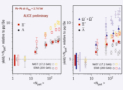
 Read article 'Strangeness and heavy flavours in Krakow'
Strangeness and heavy flavours in Krakow
The latest news on strangeness in heavy-ion collisions.

 Read article 'Strangeness and heavy flavours in Krakow'
The latest news on strangeness in heavy-ion collisions.
 Read article 'Trends in isotope discovery'
Michael Thoennessen did not realize where documenting the discovery of isotopes would lead.
 Read article 'Kaonic hydrogen casts new light on strong dynamics'
Hadronic bound systems with strange quarks, such as kaonic hydrogen, are well suited for testing chiral dynamics, especially in view of the interplay between spontaneous and explicit symmetry breaking...
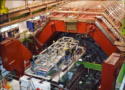 Read article 'ALICE revolutionizes TOF systems'
The ALICE TOF is made of 1593 MRPCs, each of which is 120 cm long and consists of a double-stack MRPC, with a total of 10 gaps 250 μm wide
 Read article '…and measures suppression of single jets in heavy-ion collisions'
While primarily designed for proton–proton collisions, the ATLAS detector is also an excellent tool to perform measurements in the hot, dense environment of heavy-ion collisions, where temperatures ...
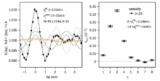 Read article 'ALICE measures the shape of
head-on lead–lead collisions'
Read article 'ALICE measures the shape of
head-on lead–lead collisions'
One the many surprises to have emerged from studies of heavy-ion collisions at Brookhaven's Relativistic Heavy Ion Collider (RHIC) and now at CERN's LHC concerns the extreme fluidity of the dense matt...
 Read article 'TOTEM probes new depths in pp elastic scattering'
Finding out more about the proton at LHC energies.
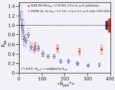 Read article 'ALICE goes in search of charmonium in the quark–gluon plasma'
The results, presented at the Quark Matter 2011 conference (Heavy ions in Annecy), hint at the recombination of charm and anticharm quarks in the quark–gluon plasma (QGP) formed in heavy-ion collisi...
 Read article 'COSY finds evidence for an exotic particle…'
Experiments at the Jülich Cooler Synchrotron, COSY, have found evidence for a new complex state in the two-baryon system, with mass 2.37 GeV and width 70 MeV.
 Read article 'Heavy ions in Annecy'
A turning point in understanding at Quark Matter 2011.