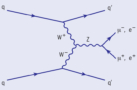
Read article 'CMS observes new single-top production mode'
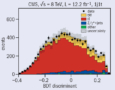
CMS observes new single-top production mode
The top quark remains, nearly 20 years after its discovery by the experiments at Fermilab’s Tevatron, the heaviest particle known.
Thank you for registering
If you'd like to change your details at any time, please visit My account
Read article 'CMS observes new single-top production mode'
The top quark remains, nearly 20 years after its discovery by the experiments at Fermilab’s Tevatron, the heaviest particle known.
Read article 'À la recherche du boson de Higgs'
Arnaud Marsollier reviews (in French) in 2014 À la recherche du boson de Higgs.
Read article 'ATLAS and CMS observe Higgs-boson decays to fermions'
Last year, the ATLAS and CMS collaborations confirmed that the new boson found in 2012 was indeed a Higgs boson with a mass around 125 GeV.
Read article 'Higgs. Le boson manquant'
Translated by Bertrand Nicquevert, a research engineer at CERN, this French edition also contains a preface by Lyn Evans, former LHC project leader, and a postface written by the translator together w...
Read article 'Le boson et le chapeau mexicain – Un nouveau grand récit de l’Univers'
Frédérick Bordry reviews (in French) in 2013 Le boson et le chapeau mexicain – Un nouveau grand récit de l'Univers.
Read article 'Conference time in Stockholm'
All about a Higgs boson and more at EPS-HEP 2013.
Read article 'Neutral currents: A perfect experimental discovery'
Forty years after the observation of weak neutral currents at CERN, Luciano Maiani reflects on their impact.
Read article 'Charmless baryonic B decays'
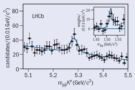
The LHCb collaboration has made the first sightings of the decay of B mesons into two baryons containing no charm quarks.
Read article 'GERDA sets new limits on neutrinoless double beta decay'
The GERDA collaboration has obtained new strong limits for neutrinoless double beta decay, which tests if neutrinos are their own antiparticles.
Read article 'CMS sees first direct evidence for γγ→WW'
In a small fraction of proton collisions at the LHC, the two colliding protons interact only electromagnetically, radiating high-energy photons that subsequently interact or "fuse" to produce a pair o...