 Read article 'Editor’s note'
Editor’s note
After 13 years as the Courier’s Astrowatch contributor, astronomer Marc Türler is moving to pastures new.

 Read article 'Editor’s note'
After 13 years as the Courier’s Astrowatch contributor, astronomer Marc Türler is moving to pastures new.
 Read article 'Euclid to pinpoint nature of dark energy'
Due for launch in 2020, ESA’s Euclid probe will track galaxies and large areas of sky to find the cause of the cosmic acceleration.
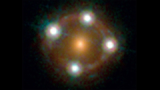 Read article 'Gravitational lens challenges cosmic expansion'
An international group of astronomers has made an independent measurement of how fast the universe is expanding.
 Read article 'WIMP no-show in gamma-ray background'
A possible additional contribution from WIMP annihilation could not be identified, using NASA’s Fermi Gamma-ray Space Telescope.
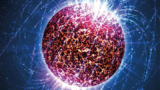 Read article 'Compact star hints at vacuum polarisation'
Astronomers may have found the first observational indication of a strange quantum effect called vacuum birefringence.
 Read article 'The dawn of a new era'
Gravitational waves open a profound new vista on nature.
 Read article 'General relativity at 100'
Testing Einstein’s masterpiece with ever increasing precision.
 Read article 'Catching a gravitational wave'
The technology behind LIGO’s epochal discovery.
 Read article 'Linking waves to particles'
Gravitational waves could also shed light on the microscopic world.
 Read article 'n_TOF deepens search for missing cosmic lithium'
CERN’s neutron time-of-flight (n_TOF) facility has filled in a missing piece of the cosmological-lithium problem puzzle.