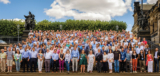
Read article 'Study comes full EuroCirCol'
Study comes full EuroCirCol
The meeting marked the final event of the Horizon 2020 project to produce a conceptual design study for a 100 TeV circular hadron collider.
Thank you for registering
If you'd like to change your details at any time, please visit My account
Read article 'Study comes full EuroCirCol'
The meeting marked the final event of the Horizon 2020 project to produce a conceptual design study for a 100 TeV circular hadron collider.
Read article 'The greatest lepton collider'
LEP was the highest energy e+e– collider ever built, with levels of precision that remain unsurpassed in accelerator physics. Former CERN director of accelerators Steve Myers tells LEP’s story fro...
Read article 'Tunnelling for physics'
John Osborne, Alexandra Tudora and Ben Swatton survey the geological, environmental and technical constraints of a post-LHC collider.
Read article 'Dipole marks path to future collider'
Researchers in the US have demonstrated an advanced accelerator dipole magnet with a field of 14.1 T.
Read article 'Tricky component? Use 3D printing…'
Embedded radio-frequency (RF) cavities such as those featured in spiral-shaped cooling channels are one example.
Read article 'FuSuMaTech initiative levels up'
Projects include new designs for MRI gradient coils, the design of 14 and 16 T MRI magnets, and a conceptual design for new mammography magnets.
Read article 'Accelerator community comes together in Melbourne'
The scientific programme was bookended by local Australian-grown talent.
Read article 'Niobium-tin cavities for smaller accelerators'
High-frequency superconducting radio-frequency cavities made from niobium–tin alloy are more efficient than conventional niobium designs.
Read article 'How many protons collided in ATLAS in Run 2?'
The uncertainty of several ATLAS Run-1 measurements was dominated by systematic uncertainty on the integrated luminosity.
Read article 'A unique vacuum environment'
Paolo Chiggiato describes the unparalleled vacuum developments that underpin CERN’s science.