A report from the LHCb experiment.
The LHCb collaboration has reported the observation of the doubly charmed baryon Ξ+cc, the first new particle found with the upgraded LHCb detector. The result completes the isospin doublet of the doubly charmed baryons, allowing the two states to be compared directly in mass, lifetime and decay channel. The Ξ+cc contains two charm quarks and a down quark, and is the isospin partner to the Ξ++cc baryon, much as the neutron is to the proton. Yet unlike the neutron, which is more massive than the proton, the Ξ+cc is expected to be lighter than the Ξ++cc, because electromagnetic effects outweigh the down–up quark mass difference.
The two states also differ in their lifetimes. The Ξ+cc is predicted to decay about six times faster than the Ξ++cc, owing to an additional W-exchange contribution and to interference between decay amplitudes. Precise measurements of their masses and lifetimes, therefore, test the heavy-quark dynamics at work inside baryons.
The experimental search for the Ξ+cc baryon has a long history. In 2002, the SELEX collaboration at Fermilab claimed to have observed it, a result that has not been confirmed by subsequent searches at FOCUS, BaBar, Belle and LHCb. Meanwhile, the LHCb collaboration observed the Ξ++cc baryon using proton–proton collisions recorded at a centre-of-mass energy of 13 TeV in 2016. The LHCb detector was then upgraded during the second long shutdown of the LHC (2019–2021), to maintain its performance while operating at around five times the instantaneous luminosity of Runs 1 and 2. The online trigger system, in which the interesting signals are selected from a huge number of proton–proton collisions at the LHC in real time, was also upgraded, increasing the efficiency for selecting hadronic decays by more than a factor of two.
The observation demonstrates the enhanced capabilities of the upgraded LHCb experiment
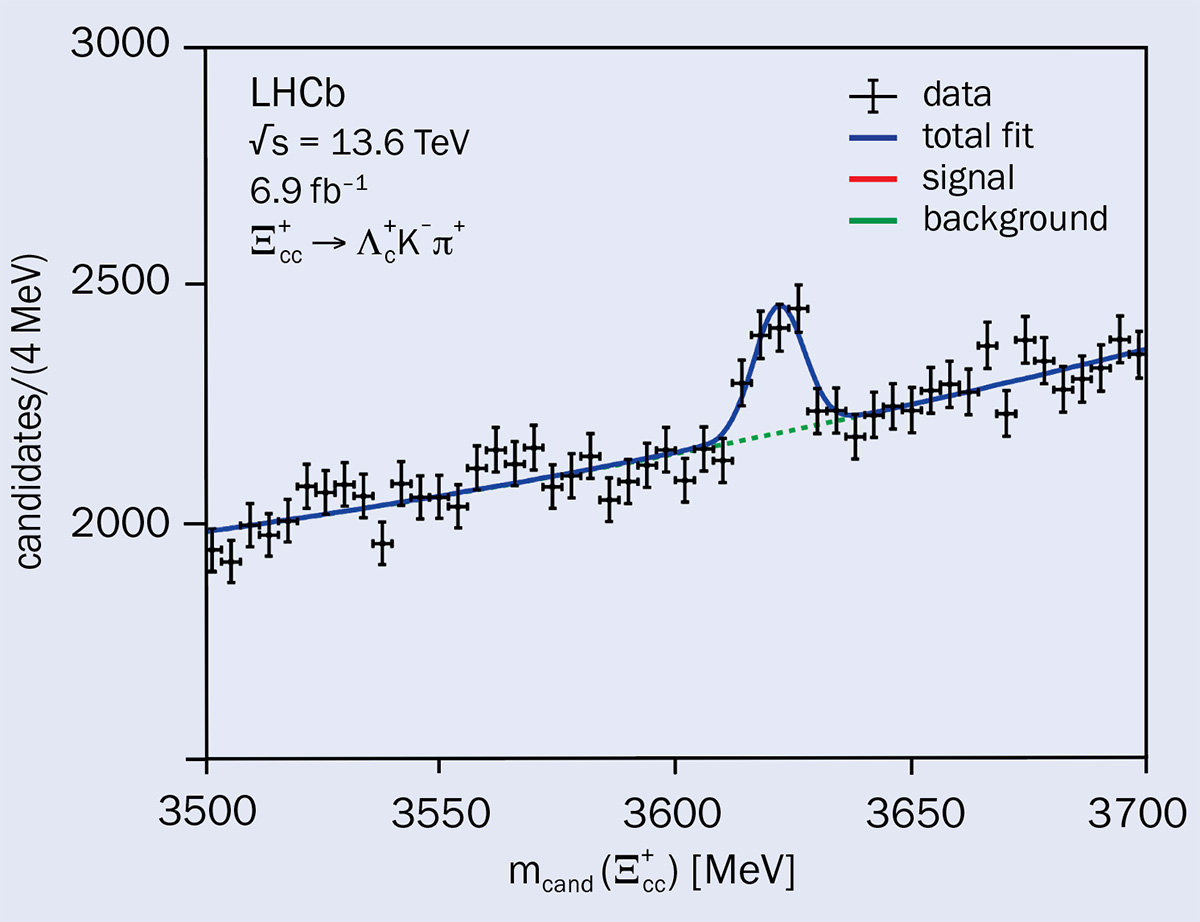
The new LHCb search used proton–proton collision data recorded at a centre-of-mass energy of 13.6 TeV in 2024. The Ξ+cc baryon was reconstructed through its decay to the Λ+cK–π+ final state in a blind analysis, designed to avoid any experimenter bias. A topologically similar decay of the Ξ++cc baryon, Ξ++cc → Λ+cK–π+π+, was used as a control mode for developing the event-selection strategy and calibrating the mass measurement. More than 8000 Ξ++cc candidates were reconstructed in the 2024 dataset, corresponding to an efficiency increase of about a factor of four relative to Run 2. The measured Ξ++cc mass was found to be consistent with the average of previous measurements.
Once the analysis was finalised, the Ξ+cc signal region was unblinded and examined. A structure with a statistical significance exceeding seven standard deviations was observed (see figure 1), corresponding to more than 900 Ξ+cc candidates. The corresponding efficiency is about two and a half times higher than that achieved during Run 2, with the smaller improvement relative to Ξ++cc reflecting the shorter lifetime of the Ξ+cc baryon.
The collaboration also performed a precision measurement of the Ξ+cc mass and the difference between the masses of the two doubly charmed baryons. The Ξ+cc mass was measured to be 3619.97 ± 0.83 (stat) ± 0.26 (syst)+1.90–1.30 (lifetime) MeV, with a difference of –1.77 ± 0.84 (stat) ± 0.15 (syst)+1.90–1.30 (lifetime) MeV from that of the Ξ++cc, compatible with theoretical predictions. It was also about 100 MeV higher than the one reported by the SELEX collaboration, disfavouring the interpretation of that state as the Ξ+cc baryon.
The observation of the Ξ+cc baryon completes the isospin doublet of the doubly charmed baryons. It also demonstrates the enhanced capabilities of the upgraded LHCb detector and its trigger system, laying the groundwork for hadron spectroscopy studies with data taken in Run 3.
Further reading
LHCb Collab. 2026 arXiv:2603.28456.