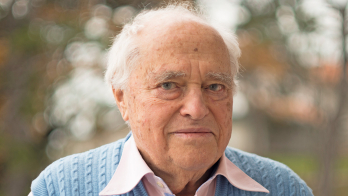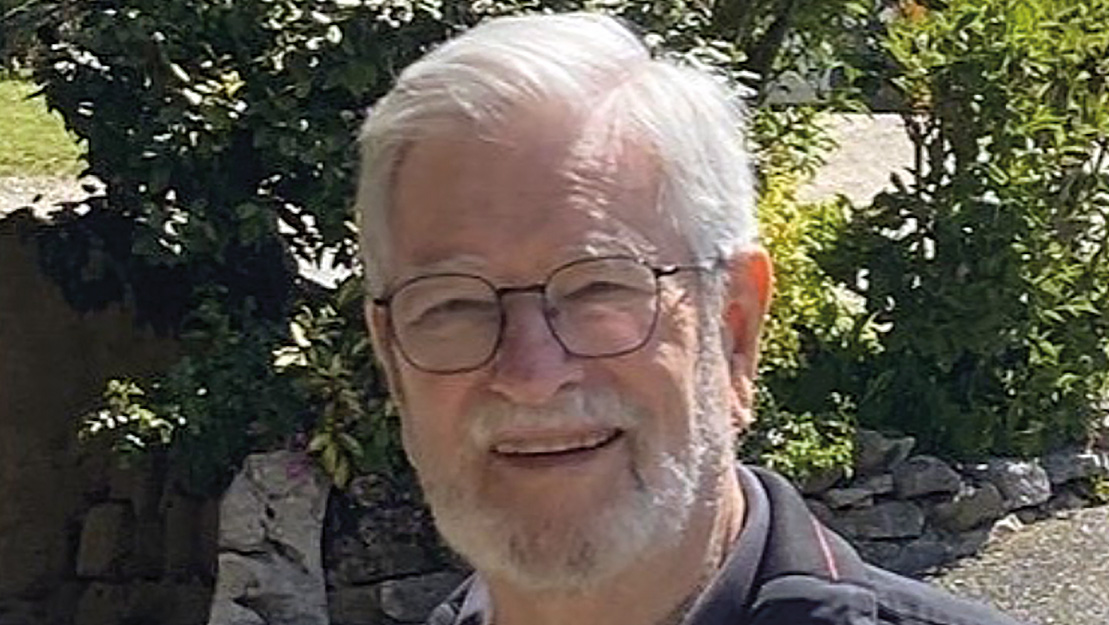
Fred James, a CERN expert on data analysis and statistics, a pioneer of numerical methods in particle physics and co-author of the popular text Statistical Methods in Experimental Physics, passed away on 31 July. For several decades, Fred served as a widely sought guide to experimentalists seeking statistical rigour, leaving a legacy that includes the optimisation tool MINUIT and notable contributions to pseudo-random number generation.
Fred was born in Detroit, in the United States, on 28 May 1939. He graduated from Princeton University in 1960 with a degree in physics and earned his PhD from Yale University in 1965 under the supervision of Henry Kraybill, researching strangeness production in pion–proton reactions at Brookhaven National Laboratory. In 1967 he joined CERN, where his deep affinity for mathematics placed him at the vanguard of numerical analysis in high-energy physics.
By the late 1960s, Fred was already deeply involved in simulation techniques. His early notes evolved into his definitive review article, “Monte Carlo theory and practice”, published in Reports on Progress in Physics in 1980. Meanwhile, Fred authored several mathematical algorithms in the CERN Program Library, CERNLIB.
Fred recognised the need for robust numerical methods for function minimisation, particularly for chi-square and negative log-likelihood evaluations. Together with Matts Roos, he developed MINUIT, first written in the era of punch cards and Fortran. MINUIT quickly became a standard function-minimisation package across particle physics and beyond. It has evolved over the decades, with a translation into C++ and integration in the ROOT data-analysis framework, and it remains a fundamental tool for negative log–likelihood minimisation in particle physics, used today for most of the results published by the LHC experiments. Among them is the discovery of the Higgs boson, for which it was the backbone of the significance computation. With MINUIT, Fred also provided MINOS, an essential tool for interpreting the negative log–likelihood function near its minimum and for computing confidence intervals and regions.
In 1971, Fred joined William Eadie, Daniel Drijard, Matts Roos and Bernard Sadoulet to write Statistical Methods in Experimental Physics, a graduate-level treatise covering both theory and practice. After it had served generations of young physicists, Fred gave it new life by single-handedly publishing a thoroughly revised and updated second edition in 2006 (CERN Courier November 2007 p49). In January 2000, Fred, Louis Lyons and Yves Perrin organised a landmark Workshop on Confidence Limits at CERN. The event filled the Council Chamber with physicists and statisticians diving deep into contentious methodological questions, and sparked the PHYSTAT workshop series, which continues to flourish.
His computational tools and textbooks will continue to guide scientific discovery for years to come
Philosophically, Fred was a strong advocate of the frequentist interpretation of probability. While Statistical Methods in Experimental Physics included Bayesian statistics, Fred firmly maintained that scientific inference is driven not by Bayesian decision theory, with its subjective degrees of belief, but by objective inferences rooted in the frequentist tradition. He championed this principle vigorously throughout his career and into retirement.
Fred’s work on Monte Carlo methods naturally extended to the mathematics of pseudo-random number generation. In the 1990s, with Martin Lüscher, he developed and promoted RANLUX, an influential implementation of Lüscher’s high-quality random-number algorithm, which has seen 30 years of intensive use in different branches of science. Fred continued this research after his retirement from CERN in 2004. He frequently came to CERN and collaborated with Lorenzo Moneta on pseudo-random number generators based on chaotic dynamical systems, culminating in a comprehensive review published in 2020.
Fred James was always available for discussion, and many of us enjoyed his friendship and his generosity. He was an accomplished cellist, and with his late wife Christa raised two daughters in Geneva, enjoying life with them and their families, as well as fine wines and leisure time at their solar-powered chalet in the rural French pre-Alps. He also had a passion for teaching, and for many years following his retirement he taught statistics to physics students at EPFL. His computational tools, textbooks and insistence on statistical precision have shaped the analytical toolsets of generations of researchers, and will continue to guide scientific discovery for years to come. He will be dearly missed, and our thoughts are with his daughters, grandchildren, friends and colleagues at this difficult time.