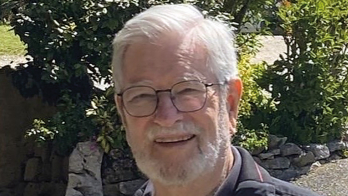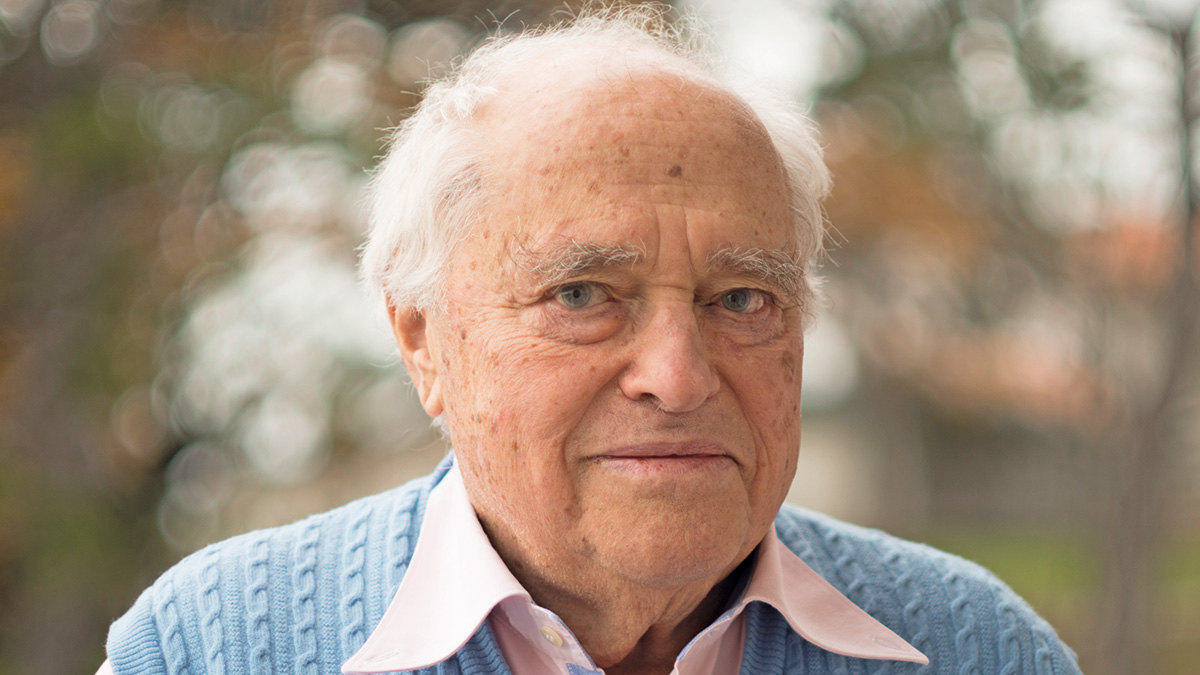
On 4 August, a week before his 95th birthday, Daniele Amati, one of the most charismatic and influential figures of modern theoretical physics, passed away in Trieste. Born in Rome on 11 August 1931, Amati was just eight when his Jewish family fled from fascist Italy for Argentina.
Studying in Buenos Aires, he developed a keen interest in theoretical physics, completing his studies in 1952. Soon after, together with his schoolmate Alberto Sirlin, he attended a course – in Portuguese – by Richard Feynman in Rio de Janeiro. It deeply influenced him. Amati occasionally boasted having been, with Sirlin, the first physicist to hear about the path-integral formulation of quantum mechanics from Feynman himself.
Strong interactions
In 1954 Amati returned to Italy as an assistant professor in Rome and attended a school, in Les Houches, where he met Enrico Fermi, who was lecturing there just a few months before his premature death. In this Roman period, his main interest was in the dynamics of strong interactions.
In 1959 Amati joined the newly formed Theory Division of CERN, which he later led from 1973 to 1975. Early in his CERN period (1959 to 1986), he was also a professor at the University of Trieste (1965 to 1967) – establishing very strong and long-lasting ties there. His research at CERN touched on many subjects at the cutting edge: in the early 1960s, he was part of the famous Amati–Fubini–Stanghellini collaboration, inventing the multi-peripheral model of multi-particle production and predicting what later became known as Feynman scaling. He also worked on Regge-pole theory and the analytic S-matrix approach to strong interactions.
A sudden jump in Amati’s line of research came around 1968–1969, with the advent of the dual-resonance model, later understood as a model of hadrons as strings. Amati worked enthusiastically in this new branch of theoretical physics, performing ground-breaking work within a group at CERN with David Olive, Victor Alessandrini and others, and influencing the research of many young theorists, until roughly 1973–1974. His famous qualification of string theory as “a piece of 21st-century physics that fell, by accident, into the 20th” goes back to those days.
String theory is a piece of 21st-century physics that fell, by accident, into the 20th
After the formulation of the Standard Model in the early 1970s, Amati, like many other string theorists of the time, turned his attention to quantum chromodynamics (QCD), justifying the QCD parton model and introducing the concept of pre-confinement in QCD jets, an important ingredient for current numerical jet simulators. In the mid-1980s, Amati and several colleagues investigated the non-perturbative properties of supersymmetric extensions of QCD, co-authoring a well-known review article on the subject. During those two decades Amati also had a leading role in the CERN Staff Association, where he helped to establish a tripartite structure in which the Association sits alongside the CERN Management and the Member States in personnel-related discussions.
The last turn in Amati’s interests in theoretical physics came with the so-called first string revolution of 1984, when string theory made a comeback as a “theory of everything” – quantum gravity included. Around that time, his plans to continue his career as director of the International School for Advanced Studies (SISSA) in Trieste were consolidating. Just as he was preparing for it, in 1986, Amati began a collaboration with Marcello Ciafaloni and myself on what became known as the ACV (Amati–Ciafaloni–Veneziano) approach to string scattering at trans-Planckian energies. Although its original motivation was purely theoretical, as a kind of thought experiment for quantum string gravity, this work found an application to the physics of coalescing black holes and the ensuing gravitational-wave emission some 30 years later.
As director of SISSA from 1986 to 2001, Amati brought about what a physicist would call a phase transition, a change not only quantitative but qualitative, broadening SISSA’s areas of research considerably to include, for instance, neuroscience and cognitive science. He also pioneered, with Loriano Bonora and Hector Rubinstein, the idea of open-access scientific publishing, launching in 1997 the entirely digital Journal of High Energy Physics (JHEP). Run “by scientists for scientists”, JHEP quickly became the most widely used journal in theoretical high-energy physics, disrupting the traditional academic-publishing industry. It was soon followed by its offspring, the Journal of Cosmology and Astroparticle Physics (JCAP), dedicated to (mostly theoretical) astrophysics and cosmology.
Amati had a many-sided personality, with interests that went far beyond physics and even science. If one had to summarise in two words the skill in which he most clearly excelled, he was an inspiring catalyst. He had an exceptional physical intuition for formulating interesting questions and a great ability to motivate and assemble the right people to carry the research through. A research project, he used to say, may or may not succeed, but even in the latter case there is much to learn from the failure. Above all, his motto was that having fun is the most important signature of good research.
Amati left an indelible mark on all those who had the opportunity and privilege of interacting closely with him. We all now feel orphans of the man often and affectionately referred to as “Babbo Daniele”.