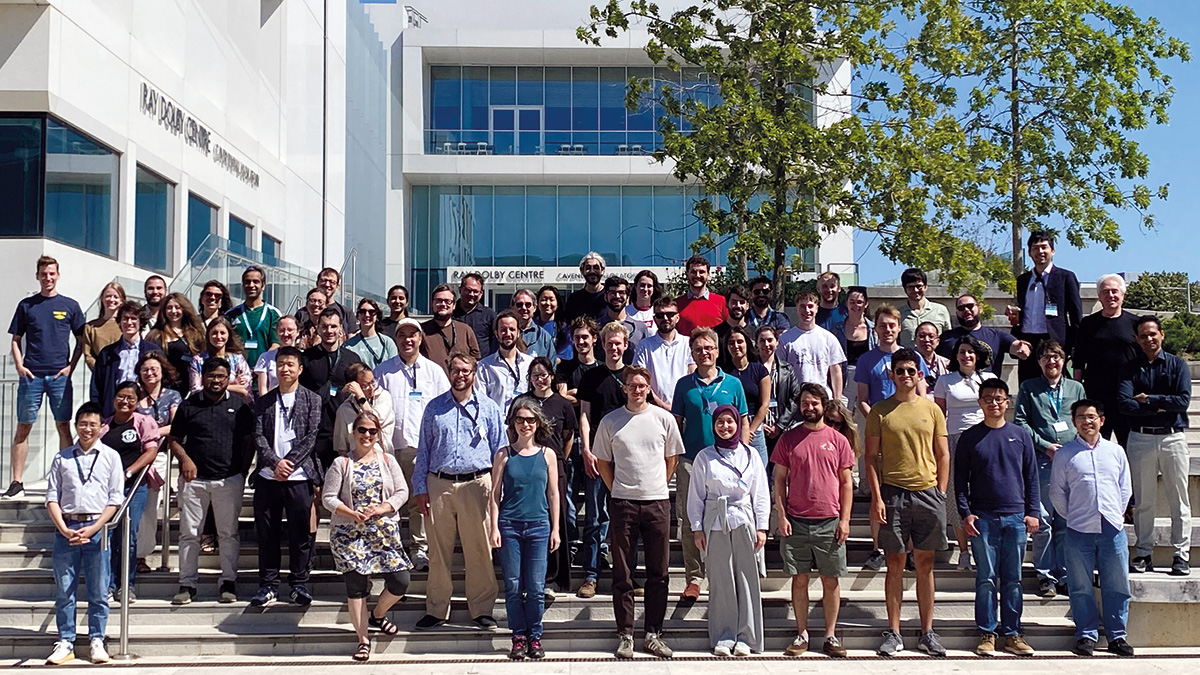
The 16th workshop of the Long-Lived Particle Community (LLP2026) gathered more than 70 theorists, phenomenologists and experimentalists at Cambridge’s Ray Dolby Centre, the new home of the Cavendish Laboratory, from 29 June to 3 July. Discussions centred on particles that live long enough to travel a measurable distance before decaying, and on the searches, algorithms and detectors designed to catch them.
Long-lived particles (LLPs) arise in a wide range of theories beyond the Standard Model (SM), from supersymmetry and extended Higgs sectors to models of neutrino masses or dark matter. Due to their long lifetimes, LLPs could decay far from the collision point and leave signatures that are exotic and hard to identify.
On the hunt
The CMS collaboration presented eight new searches in which displaced muons and dedicated LLP triggers played a central role. Anna Mascellani (ETH Zurich) presented a search for heavy neutral leptons (HNLs). Among the simplest and best-motivated LLP candidates, they could explain the origin of neutrino masses through the so-called “seesaw” mechanism. The new channel targets HNL decays beyond the tracker using standalone displaced muons, reconstructed exclusively in the muon system. The gain in sensitivity at longer lifetimes yields the best expected limits on HNL mixing with muon neutrinos for masses between 2.5 and 4.2 GeV. Celia Fernandez Madrazo (Boston University) presented a search for light, narrow resonances decaying to two displaced muons, recorded with a dedicated scouting trigger stream, in which events are kept at a high rate by recording only a reduced amount of trigger-level information. The saving in bandwidth allows muons with transverse momenta down to 3 GeV to be collected, and relaxed requirements on the number of hits give Run-3 scouting access – for the first time – to muons displaced by more than 11 cm. Together, the two extensions yield the most stringent limits to date on dark-shower models, which predict light, long-lived dark pions decaying after 10 cm or more.
The workshop showed how new triggers and analysis strategies are testing a wide range of theoretical models
ATLAS presented several results with 13 and 13.6 TeV data. Paul Swallow (University of Cambridge) reported a search for displaced vertices and missing transverse momentum built on a novel fuzzy-vertexing algorithm, optimised for displaced decays to heavy quarks. Since b quarks themselves travel a sizeable distance before decaying, an LLP decaying to them need not produce particles pointing back to a single vertex. Rather than forcing one, the algorithm reconstructs several nearby seed vertices and then merges them into a single one, improving efficiency for the high-mass, high-multiplicity displaced vertices expected from such decays.
Models predicting quirks, hypothetical particles charged both under the SM and a new confining force analogous to the strong force, drew particular interest. Produced in pairs and bound to each other by a confining string, quirks would cross a detector slowly, as charged long-lived particles. Arash Jofrehei (University of Geneva) presented the first direct LHC search for quirks with masses above the weak scale, performed with FASER, and Alejandro Novo Cal (IGFAE, University of Santiago de Compostela) proposed a search at LHCb, complementary in reach to those of heavy stable charged particles or monojets at ATLAS and CMS. Thanks to the forward acceptance and lack of magnetic field of the LHCb Vertex Locator (VELO), alongside a flexible trigger design, the approach could probe values of the new confining scale between 0.1 and 10 keV. The stakes reach into cosmology, as Graham Kribs (CERN and University of Oregon) stressed. If macroscopic dark-colour strings were observed, the reheating temperature at which the hot Big Bang began after inflation would have to lie below about 100 GeV, since a hotter start would have left long-lived bound states of dark gluons in conflict with early-universe observations.
Martin Hirsch (IFIC, CSIC and University of Valencia) showed that axion-like particles (ALPs) can couple HNLs to gluons, giving the LHC and proposed LLP detectors high sensitivity to long-lived HNLs for GeV-scale ALP masses. As Oleg Brandt (University of Cambridge) observed, the two candidates are usually treated separately, and their combination offers interesting new benchmarks.
Future facilities
On the facilities side, John Anders (University of Liverpool) reviewed design and detector studies for the proposed Forward Physics Facility, including a full simulation of its cavern. Updates followed from SHiP/NA67, CODEX-b, MATHUSLA and ANUBIS, with sensitivity studies for benchmark models ranging from HNLs and Higgs-portal scalars to dark photons and ALPs. Looking further ahead, Rhitaja Sengupta (BCTP, University of Bonn) presented dedicated LLP detector concepts for FCC-ee and FCC-hh, including DELIGHT, FOREHUNT and DELIGHT-SHIELD, stressing how a future collider’s design phase offers the best opportunity to integrate dedicated LLP detectors within the main detector designs.
Discussions extended beyond CERN. Zeren Simon Wang (Hefei University of Technology) presented prospects for searching for very long-lived HNLs through baryon-number-violating decays of charmed baryons at the Super Tau Charm Facility proposed in Hefei, China. The same symmetry violation motivated Patrick Adolf (TU Dortmund) to propose a new class of nucleon-decay observables involving LLPs, in which a vector mediator produced in the decay travels a macroscopic distance before turning into an electron–positron pair inside a detector such as Super-Kamiokande, leaving temporally correlated “echo” vertices.
LLP2026 opened just as the LHC entered Long Shutdown 3, and the results presented drew on only part of the Run-3 dataset. Even so, the workshop showed how new triggers and analysis strategies are testing a wide range of theoretical models. The detectors and facilities now taking shape promise to go further, so that no new physics remains hidden at the long-lifetime frontier.