A report from the ALICE experiment.
Over the past two decades, heavy-ion experiments have established that the quark–gluon plasma (QGP) expands collectively and behaves as an almost perfect fluid. Much like water swirling in a whirlpool, the QGP can develop vortices – regions where it circulates around an axis. The ALICE collaboration has now probed this local rotation using Λ and anti-Λ hyperons, weakly decaying particles containing a strange quark or antiquark, respectively.
When two nuclei collide off-centre, their overlap region is, on average, elongated rather than circular. Pressure is then higher along some directions, and the QGP formed in the collision expands unevenly. As a result, neighbouring regions of the fluid flow past one another, seeding many local vortices. Some of these rotate about axes parallel to the beam, in directions that alternate across the plane perpendicular to it. This local rotation tends to align the spins of the medium’s quarks. When the plasma cools and its components bind into hadrons, part of this alignment survives as a spin polarisation. Λ and anti-Λ hyperons are excellent probes of the phenomenon, since the proton emitted in the Λ decay tends to follow the parent’s spin direction, and the antiproton in the anti-Λ decay to oppose it.
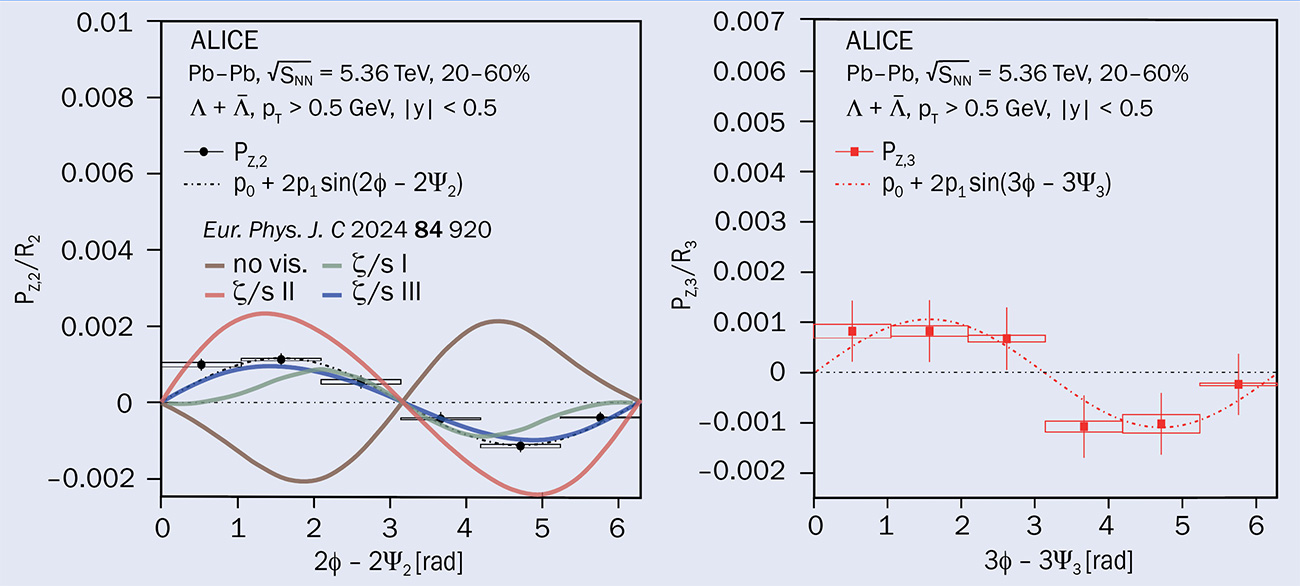
In the plane transverse to the beam, the direction of each hyperon’s momentum is specified by its azimuthal angle, measured with respect to reference directions known as “event planes” and inferred in each collision from the pattern of emitted particles. Each order of the collision shape defines its own such direction. The second-order plane follows the average elliptic shape of the overlap region, while the third-order one traces a triangular distortion, arising mainly from collision-by-collision variations. The longitudinal polarisation is predicted to rise and fall as the angle changes, with a distinct pattern relative to each plane.
Λ and anti-Λ hyperons are excellent probes of local QGP vortices
Using the high-statistics Run-3 data sample of Pb–Pb collisions at a centre-of-mass energy per nucleon pair of 5.36 TeV, the collaboration has studied the second-order polarisation with improved precision and, for the first time at the LHC, the third-order component (see figure 1). The improvement allows a more stringent comparison with recent viscous hydrodynamic calculations, which shows that polarisation is sensitive to bulk viscosity – the fluid’s resistance to uniform expansion or compression. Bulk viscosity does not generate the alignment directly, but modifies the space–time evolution of the medium and the velocity gradients that do.
The first measurement of the third-order polarisation gives access to the vortices arising from event-specific fluctuations, beyond those tied to the average collision geometry. An interesting feature of the measurement is that the second- and third-order polarisation signals are of comparable magnitude, although the corresponding anisotropic-flow harmonics – the patterns in the particle emission – exhibit a clear hierarchy. This suggests that hyperon polarisation is not simply a reflection of the system’s momentum anisotropy, but carries additional information about the local vortical structure and how viscosity affects the evolution of the QGP. While theoretical calculations for the third-order component are not yet available, the present measurement provides an important benchmark for future studies.
Further reading
ALICE Collab. 2026 arXiv:2606.18070.