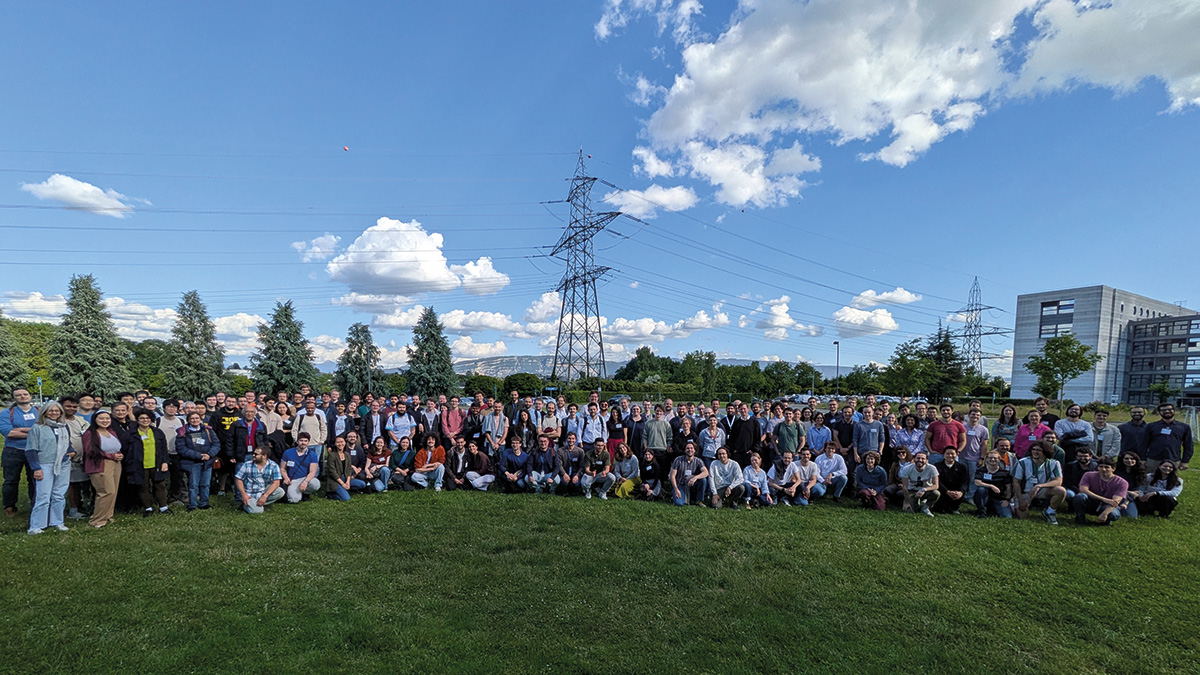
From 18 to 22 May 2026, the 28th annual PLANCK conference – held in conjunction with the 6th EuCAPT Symposium – brought more than 250 theoretical physicists to CERN to confront a set of dilemmas that are, at root, about scale. Where should the hunt for dark matter focus, when its mass might span 90 orders of magnitude? Why is the Higgs mass so tiny compared to the Planck scale, with no signs of a mechanism to stabilise the gap? Can one learn about particle production in the early universe, when evidence is spread thinly over the farthest sky?
Microscopic to galactic
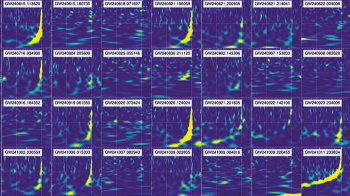
Faced with these puzzles, theorists are seeking answers from systems ranging from the microscopic to the galactic. Jordy de Vries (NIKHEF) discussed novel methods to look for subtle differences in how the strong force affects matter and antimatter using tiny molecular dipole moments. At the opposite end, Kai Schmitz (Münster University) reported on work using the rhythms of pulsars spread across the Milky Way to detect gravitational waves produced in the first moments after the Big Bang.
The framework of effective field theory (EFT) threaded through the conference. By capturing the physics at a given scale and folding higher-scale effects into a handful of parameters, it proves ubiquitously powerful for advancing complex calculations. Giulia Isabella (UCLA) presented new results applying scattering methods – originally developed for particle physics – to calculate gravitational-wave signals from black hole mergers. Mikael Chala (University of Granada) discussed the use of EFTs in calculations of thermal phase transitions, such as those that occurred in the early universe. Anders Eller Thomsen (University of Bern) presented precision calculations of the Standard Model EFT used to predict subtle effects of undiscovered particles with masses beyond the energy range of the LHC.
The electroweak scale, at which electroweak symmetry breaks and particles acquire mass through the Brout–Englert–Higgs mechanism, continues to play a unique role across a variety of fundamental puzzles. The possibility that a strong electroweak phase transition led to a universe filled with matter was discussed in talks by Jorinde van de Vis (CERN), Dave Sutherland (University of Glasgow) and Maria Cristina Fiore (University of Granada), anticipating future tests of this scenario with gravitational waves, Higgs measurements and resonance searches.
A highly varied field, united around big questions
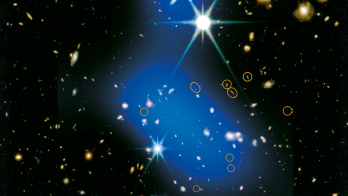
The idea of a “WIMP miracle”, in which the observed abundance of dark matter is due to a weakly interacting particle with mass around the electroweak scale, is one of the most compelling and long-standing dark-matter explanations. Weishuang Linda Xu (Stanford University) presented work interpreting gamma-ray observations of the galactic centre, arguing that this dark-matter framework can be fully tested once the next generation of telescopes comes online.
Many talks presented novel model-building ideas, including some related to the recent burst of activity around models explaining the observed hierarchies in fermion masses, many of which answer other theoretical puzzles. Marta Zamoro (Autonomous University of Madrid) showed how both the mass hierarchies and the strong CP problem could be explained through a model with extra copies of the Standard Model QCD group. Javier Lizana (University of Castilla–La Mancha) and Simone Marciano (University of Valencia) presented different models in which a dark-matter candidate arises within theories predicting hierarchical fermion masses. Each of these predicts novel phenomena, particularly in flavour-changing processes that could be measured at LHCb.
PLANCK 2026 presented a picture of a highly varied field, united around big questions and emerging techniques. Speakers and participants looked towards the new opportunities offered by upcoming measurements, colliders and telescopes, building a theoretical toolkit to interpret their insights across all scales.