On 27 June 2026, proton beams circulated through the LHC for the final time before the machine entered its third Long Shutdown (LS3). After four years of operation, the world’s highest-energy particle accelerator now begins an ambitious programme of upgrades that will transform it into the High-Luminosity LHC (HL-LHC).
“The performance of the LHC during Run 3 surpassed all expectations,” says Oliver Brüning, director for accelerators and technology at CERN. “The LHC delivered nearly 550 fb–1 of integrated luminosity since its first collisions – almost twice the original target of 300 fb–1. This amounts to 50 times the total combined dataset produced by all hadron colliders operating before the start of the LHC.”
The LHC was approved by the CERN Council in December 1994 and built in the 27 km tunnel previously occupied by LEP, the electron–positron collider that operated at CERN until 2000 (When particles went global). Collisions began in 2009, reaching the 7 TeV centre-of-mass energy milestone in 2010. The years since have brought the discovery of the Higgs boson, a wealth of new hadrons, detailed studies of the quark-gluon plasma and measurements of a wide range of Standard Model (SM) processes with steadily improving precision.
Expanded searches
The recently completed third run exploited the accelerator and detector systems upgraded during the machine’s second Long Shutdown (LS2), from 2019 to 2022 (CERN Courier May/June 2022 p29). “The LHC’s Run 3 benefits from an increased proton–proton collision energy of 13.6 TeV and a data volume that is far greater than that of Run 2,” says Gautier Hamel de Monchenault, director for research and computing at CERN. “This enabled detailed studies of the Higgs-boson’s properties through high-precision measurements and explorations of its self-coupling and rarest decays. Searches for dark matter and new phenomena expanded considerably to include new topologies, such as exotic long-lived heavy particles, through improvements in trigger systems and advances in analysis techniques.”
Run 3 also brought advances in flavour physics, with more precise measurements of rare decays and CP violation across the beauty and charm sectors, and in the heavy- and light-ion programmes. In summer 2025, the LHC successfully delivered its first oxygen–oxygen and neon–neon collisions (CERN Courier November/December 2025 p8). “The LHC provided the experiments with extensive samples of lead–lead collisions, as well as samples of events involving lighter nuclei of oxygen and neon, in order to map the properties of the primordial quark–gluon plasma with greater precision,” remarks Hamel de Monchenault.
The upgrades to the experiments are the largest since the start of the LHC
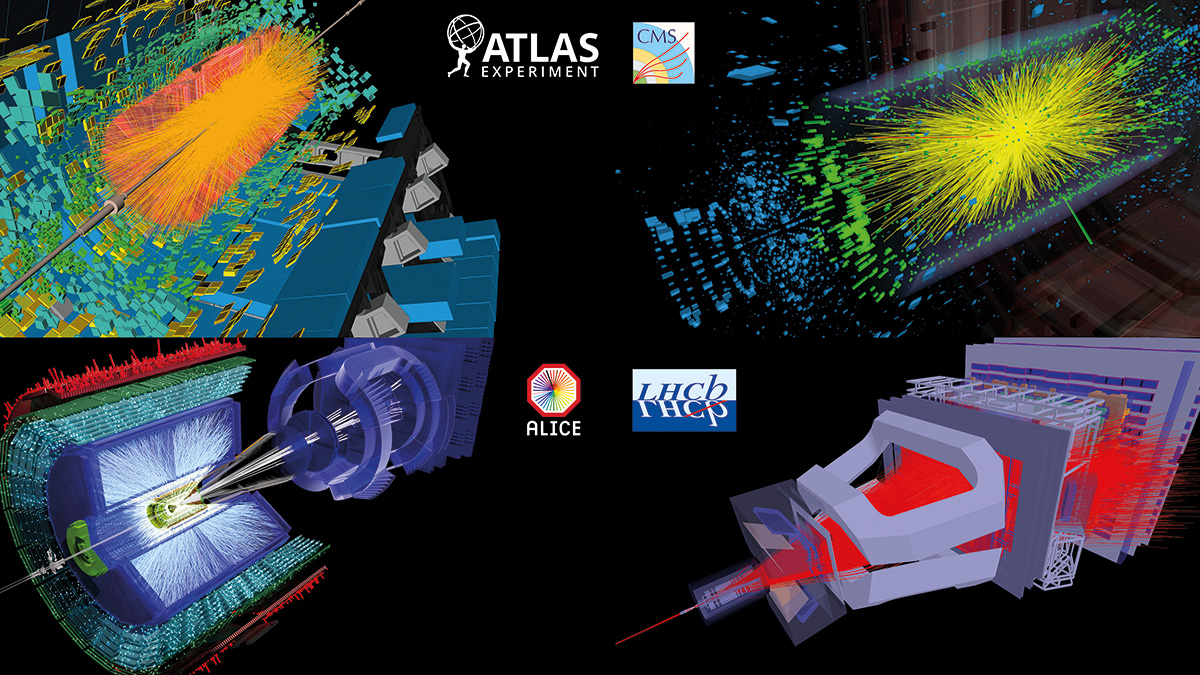
During Run 3, the proton–proton collisions delivered to each of the general-purpose experiments ATLAS and CMS amounted to about 4 × 10¹⁶, while the lead–ion programme delivered about 2 × 10¹¹ collisions to the four experiments – ALICE being the one designed specifically for heavy-ion physics. LHCb, primarily a flavour experiment and the only one to also operate in fixed-target mode, collided the beams with several gas species injected through its SMOG2 system. Together, the experiments generated exabytes of data for processing, storage and analysis through the Worldwide LHC Computing Grid.
The final proton–proton collisions took place on 16 May, followed by the final lead–lead collisions on 14 June. The beams continued circulating for another two weeks for high-intensity machine tests before the accelerator was shut down. “The success of the LHC Run 3 is a testimony of the quality and ingenuity of the LHC design and hardware, and to the dedication and competence of the teams looking after the operation of the accelerator,” says Brüning.
Although collisions have now ceased, analysis of the collected data will continue well into the 2030s. Meanwhile, the LHC and its experiments enter LS3, a four-year period during which extensive upgrades throughout the accelerator complex and the detectors will turn the machine into the HL-LHC.
Unprecedented efficiency
“The HL-LHC aims at increasing the data set produced by the LHC by an order of magnitude,” says Brüning. “This implies not only an increase in the instantaneous performance but also an unprecedented availability and efficiency of the machine. To this end, new underground galleries and caverns were created next to the LHC tunnel, reducing radiation exposure to the electronics and thus the machine’s downtime, and facilitating access for technical experts to intervene in case of problems. All these new underground structures have been completed during the LS2 and the Run 3 period. The production of the remaining components is in full swing, with more than half of them already available for installation in the tunnel and the new underground areas.”
The upgrades to the experiments are the largest since the start of the LHC. Large sections of the detectors are being rebuilt from scratch, with new tracking systems, upgraded calorimeters and muon detectors, and next-generation trigger and data-acquisition systems built for the far higher event rates. These upgrades will let the experiments match and exceed their current performance under HL-LHC conditions, where around 200 proton–proton collisions are expected per bunch crossing, compared with about 60 during Run 3.
The central prize remains the Higgs boson itself
The HL-LHC’s target of more than 3 ab–1, around six times the data collected so far, will open several fronts at once. In the Higgs sector, the experiments expect to observe rare decays such as H → μ+μ– and H → Zγ, and to pin down its couplings to fermions and vector bosons at the per cent level. More ambitious still are Higgs pair production, expected to be observed with the combined HL-LHC dataset, and the charm Yukawa coupling. The programme should establish longitudinally polarised vector-boson scattering and bring rare processes such as four-top-quark production into precision reach, while the sensitivity of direct and indirect searches will push well past that of Run 3.
In flavour physics, precision measurements of rare decays and CP violation will test the SM and probe for deviations that would point to new physics. The study of quark–gluon plasma will enter a higher-precision phase of its own, with larger samples of lead–lead and proton–lead collisions mapping its properties in finer detail and tracing the collective behaviour of strongly interacting matter and the emergence of nuclear structure.
For John Ellis, theoretical physicist at King’s College London and CERN, the central prize remains the Higgs boson itself: “Is the Higgs boson really what it seems? Experiments at the HL-LHC will measure accurately how it interacts with other particles and itself, searching for evidence of new physics that it may be hiding, and probing its role in the history of the universe.”