Stochastic Cooling of Particle Beams, by Dieter Möhl, Springer
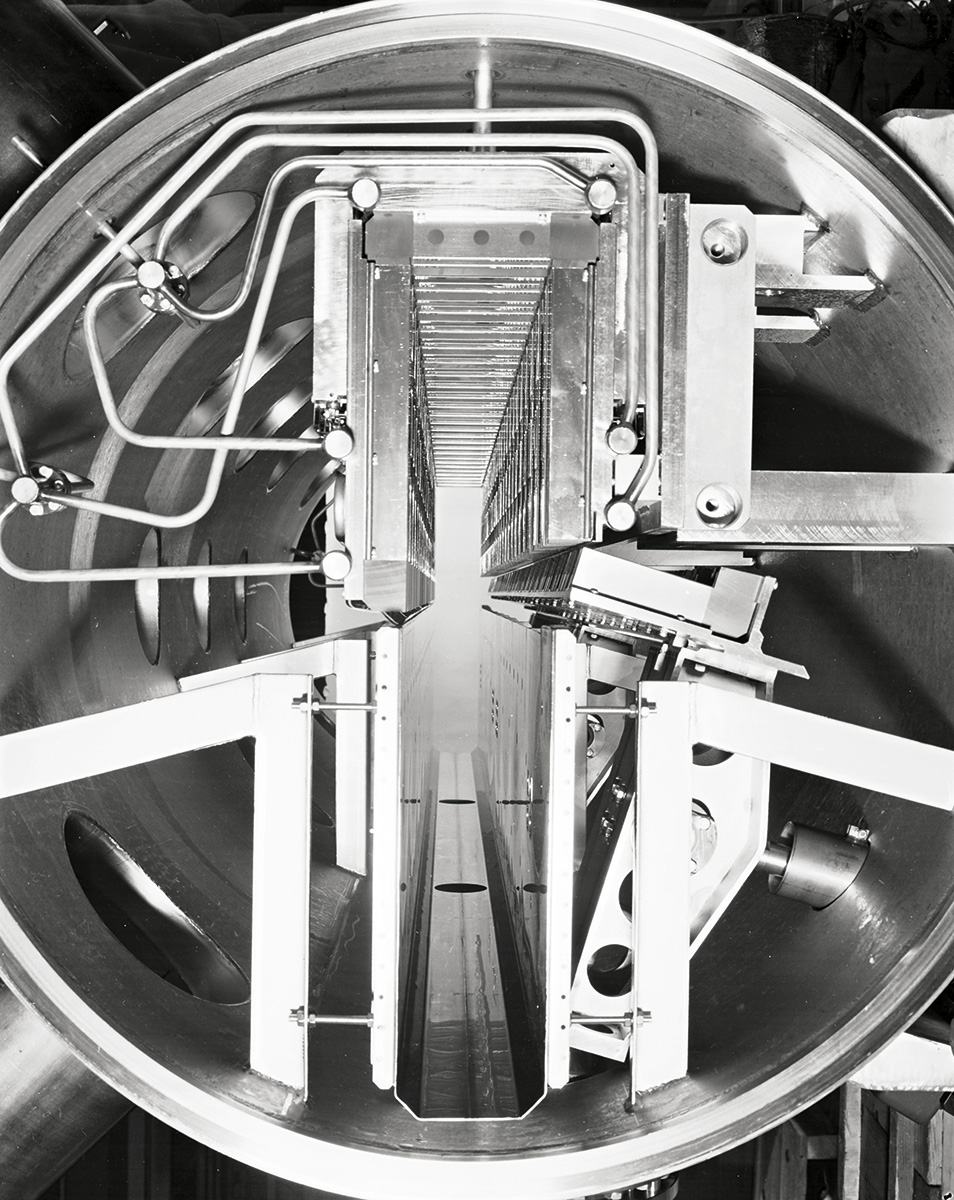
The monograph Stochastic Cooling of Particle Beams, by Dieter Möhl, is a remarkably thorough treatment of a technique that remains central to hadron-beam physics decades after its invention at CERN. In accelerator physics, cooling means reducing the spread of particle positions and momenta around the design orbit, and stochastic cooling does so by sensing each deviation at a pickup electrode and applying a corrective kick downstream. By enabling the accumulation of dense antiproton beams, it paved the way for the discovery of the W and Z bosons, which earned Carlo Rubbia and Simon van der Meer the 1984 Nobel Prize in Physics.
The book grew out of lectures given at the CERN Accelerator School, the laboratory’s training programme for accelerator physicists, and it reads that way. The pedagogy is deliberate, building from simplified time-domain models, in which a single particle is followed turn by turn and the corrective kick is derived directly from its measured error, toward progressively more complete descriptions that include the full beam ensemble. There is intentional repetition, which some readers will find slow but newcomers are likely to appreciate, since each pass also tightens the mathematical framework before adding the next layer of complexity.

Of particular interest is the frequency-domain treatment of coasting beams in chapter 4, in which the author constructs the Schottky noise spectrum of an unbunched beam from first principles, starting with the Fourier decomposition of a single circulating particle’s current and building up to the full band structure. The main result, that the integrated power of each Schottky band is constant while its bandwidth grows linearly with harmonic number, is laid out clearly.
Möhl then extends the treatment to transverse signals, showing how the betatron sidebands, the spectral lines associated with the transverse oscillations of the particles, arise naturally, and how their structure encodes machine parameters such as tune and chromaticity. This is especially relevant in practice, since Schottky signals are often the only non-invasive diagnostic available when the beam is unbunched, and most other instruments are blind. The contrast with bunched beams, taken up among the special applications in chapter 8, is also instructive: cooling depends on particles shuffling between samples, the so-called mixing, and correlated synchrotron motion in bunches undermines exactly that, leading to substantially worse cooling rates.
The book fills an important gap as a self-contained reference on stochastic cooling theory and is well worth reading for anyone working in accelerator physics or interested in the topic.