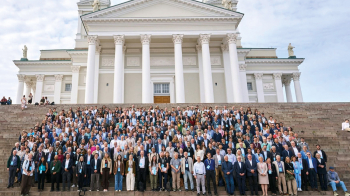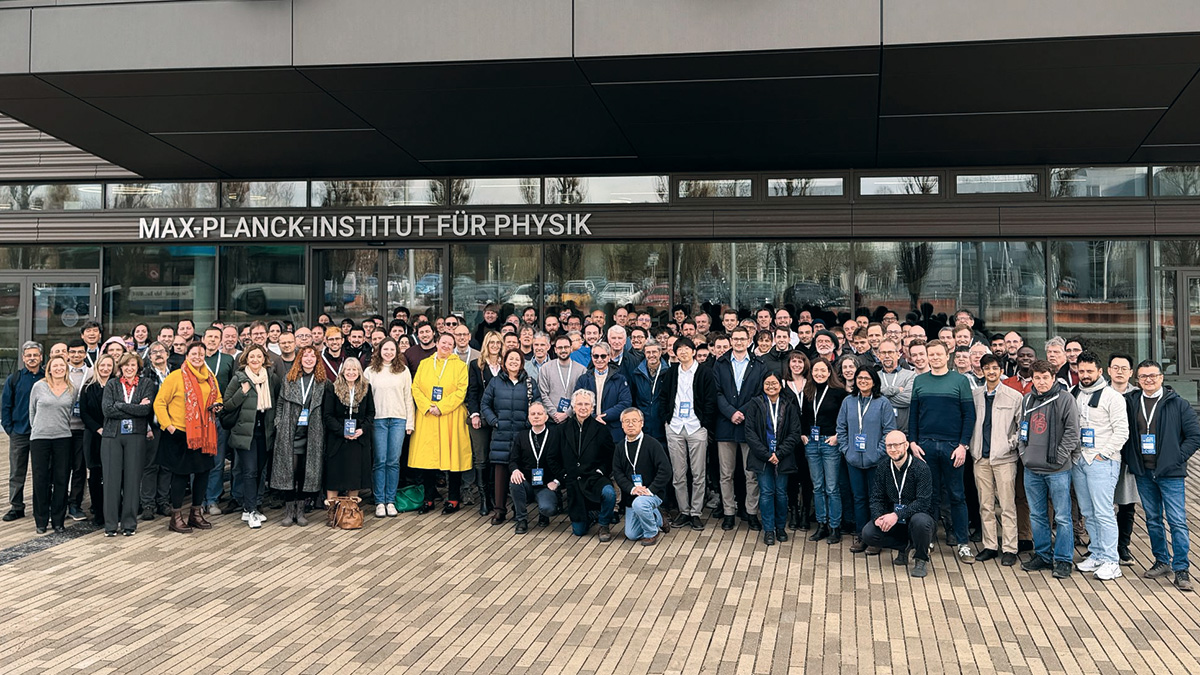
From 26 to 30 January 2026, the Max Planck Institute for Physics in Garching, near Munich, hosted the 9th FCC Physics Workshop, a major gathering of theorists and experimentalists advancing the physics case, addressing the experimental challenges and developing detector-concept candidates for the proposed Future Circular Collider (FCC). The event brought together hundreds of scientists from Europe and beyond to discuss the FCC and the broader strategy for the field after the LHC and its high-luminosity phase.
European physicists have recently recommended the electron–positron FCC (FCC-ee) as the preferred next flagship project in the ongoing update to the European Strategy for Particle Physics, with a final decision on construction anticipated around 2028 (CERN Courier January/February 2026 p7). This endorsement followed years of extensive design and feasibility studies, and provided an important backdrop to the Munich workshop, where participants worked to align physics goals with technical feasibility and long-term sustainability considerations.
The meeting marked a visible shift in tone and substance for the FCC programme, with conceptual exploration giving way to operational, benchmark-driven studies. Five days of discussion converged on a common message: if the FCC is to deliver as the next flagship collider at CERN, precision must be engineered at every level, from beam energy calibration and theoretical predictions to detector granularity, reconstruction algorithms, analysis software and governance structures.
The FCC’s first stage, FCC-ee, is conceived as a high-luminosity electron–positron collider operating at multiple centre-of-mass energies, including the Z pole, WW threshold, Higgsstrahlung maximum around 240–250 GeV and the top-quark pair threshold. The physics case has long emphasised unprecedented precision in electroweak observables, Higgs couplings and top-quark properties, alongside sensitivity to rare and exotic processes. What was striking in Munich was the degree to which this ambition is now translated into quantitative requirements and structured work plans.
The meeting marked a visible shift in tone and substance for the FCC programme
The Physics Studies work package presented a coordinated strategy across electroweak, Higgs, flavour, QCD, top and beyond-the-Standard Model (BSM) groups. The workshop highlighted the need for consistent benchmark processes, shared uncertainty frameworks and global fit strategies capable of combining hundreds of measurements into coherent constraints on new physics.
At FCC-ee luminosities, statistical uncertainties on many observables would improve by up to three orders of magnitude over previous electron–positron colliders. This shifts the limiting factor toward systematic effects: beam energy calibration, luminosity normalisation, detector alignment, flavour-tagging biases, uncertainties in higher-order calculations and parton-shower modelling. Matching this statistical power with equally ambitious control of systematics is a prerequisite for turning per-mil measurements into probes of new physics well beyond the direct kinematic reach.
The workshop made clear that the FCC physics case cannot be decoupled from detector performance. Precision Higgs and electroweak measurements demand excellent tracking momentum resolution and minimal material budgets to control multiple scattering and secondary interactions. Heavy-flavour and tau-physics programmes hinge on vertexing and impact-parameter resolution, with b- and c-tagging joined by emerging capabilities such as strange-quark tagging. Multi-jet final states from W, Z and Higgs decays bring jet-energy resolution to the fore. Meeting these goals favours highly granular calorimetry and particle-flow reconstruction, which combines information from all subsystems to identify and measure each particle in the event.
Beyond precision
At the same time, the programme also extends beyond canonical precision channels. Sensitivity to long-lived particles and feebly interacting states motivates continuous tracking and hermetic calorimetric coverage. Ultra-precise luminosity measurements at the 10–5 level are integral to the detector architecture, and particle-identification capable of K/π separation over wide momentum ranges supports flavour and QCD studies.
Four detector concepts – ALLEGRO, CLD, IDEA and ILD – are under active development, exploring complementary technologies toward shared performance goals. A fifth, ALFA, has recently emerged, and the workshop encouraged further proposals. The timeline outlined in Munich foresees optimisation studies through 2027, system demonstrators by around 2030, scalable prototypes in the early 2030s, and conceptual design reports in 2033. While the final political decision is still pending, detector R&D is advancing in lockstep with physics requirements.
The Physics Software and Computing (PSC) work package presented its vision for supporting physics and detector studies. At its core is Key4hep, a community-driven framework for HEP experiments, prototyped by FCC together with other future collider projects and increasingly adopted by related R&D efforts. Key4hep provides modularity, interoperability and long-term sustainability, integrating past work from linear-collider facilities and current CEPC and EIC work. In Munich, updates were presented on full simulation geometries for several detector subsystems, integrated digitisation and reconstruction chains, and improved user workflows.
Large-scale production campaigns, data-management strategies and distributed-analysis frameworks are being aligned with CERN IT services and GRID tools, with machine-learning methods increasingly embedded in reconstruction and analysis workflows. Realistic simulation studies, incorporating beam-induced backgrounds and detailed geometries, are gaining importance, alongside the development of robust analysis algorithms that can be validated across simulation levels.
Core contributors
The PSC session also addressed human infrastructure. Recognising computing experts as core scientific contributors – with appropriate career paths and visibility – was considered essential to the long-term success of a data-intensive programme like the FCC.
One of the most distinctive aspects of the Munich workshop was the visible role of early-career professionals. The FCC Early Career Forum presented a draft document synthesising discussions from FCC Week 2025 and subsequent exchanges. Its focus on sustainability, communication, careers and governance resonated across sessions.
One of the most distinctive aspects of the workshop was the visible role of early-career professionals
Sustainability emerged as a central design consideration: environmental, economic and social aspects must be integrated from the earliest design phases through operation and decommissioning. Participants stressed the importance of engaging local and regional communities, and of clearly articulating how the FCC could contribute to broader societal goals.
The Munich workshop made clear that the FCC programme is entering a new phase of maturity and consolidation. With coordinated efforts across physics, detectors, computing and accelerator physics, the community is laying the groundwork for a project that promises to extend our understanding of fundamental interactions and prepare particle physics for its next frontier.