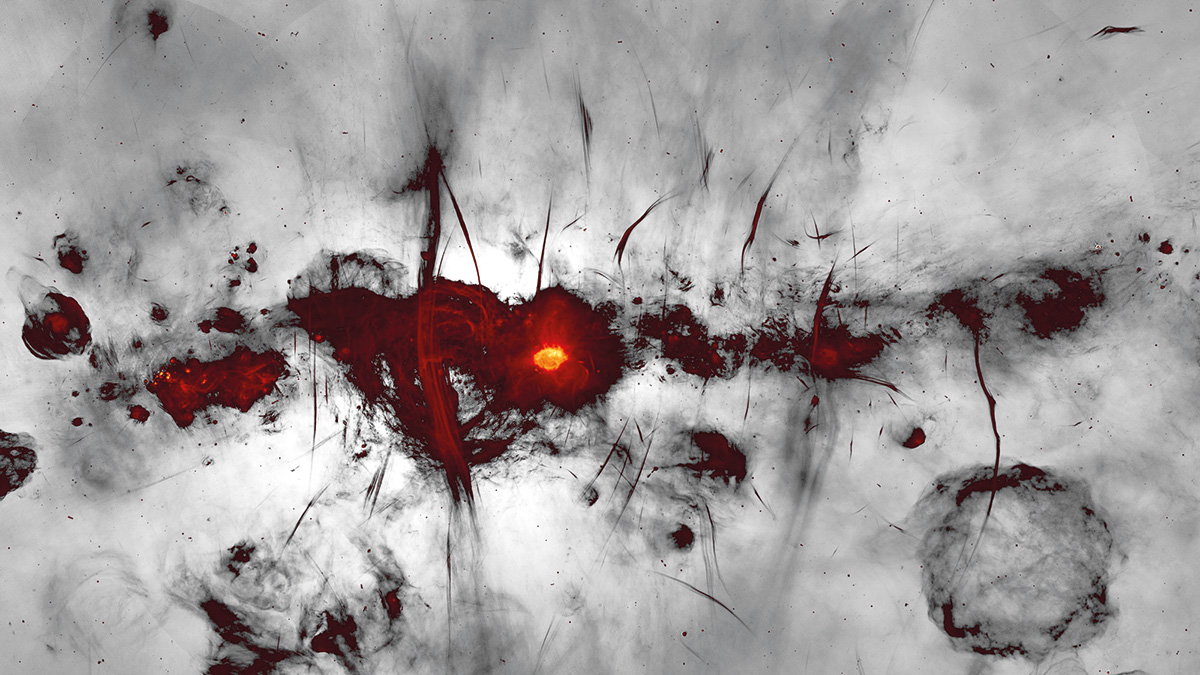
The galactic centre (GC) is one of the most extreme places we know – a dense stellar cluster filled with turbulent plasma, orbiting the four-million-solar-mass black hole Sagittarius A* (Sgr A*). For decades, astronomers have expected this region to host a rich population of pulsars. Yet only a handful have been detected, and none within a parsec of Sgr A*. A deep survey with the Green Bank Telescope, part of the Breakthrough Listen (BL) programme, has now delivered both a stringent non-detection of the expected population and an intriguing millisecond pulsar candidate near Sgr A*.
Pulsars are rapidly rotating, highly magnetised neutron stars, whose periodic radio emission sweeps across Earth like a cosmic lighthouse. Their stable periods make them among the most precise clocks in nature. Ever since Jocelyn Bell Burnell’s 1967 detection of the B1919+21 pulsar, more than three thousand have been catalogued in our galaxy.
Many should populate the GC. The region hosts a dense concentration of massive stars that evolve and die in supernovae, leaving behind neutron stars. Population-synthesis models estimate the number of pulsars within the central parsec at hundreds, perhaps thousands. Moreover, the 2013 discovery of a magnetar (J1745-2900) just arcseconds from Sgr A* confirmed that neutron stars can survive, and be detected, in this environment.
Delving deep
Why, then, are they so elusive? Radio pulses are scattered by clumps of ionised gas along the line of sight, blurring them in time. The effect is severe everywhere, but worse near the dense GC, where it can stretch millisecond pulses to seconds at standard observing frequencies. Higher frequencies are scattered far less, and so pass through more cleanly. The BL GC survey took advantage of this, focusing on high radio frequencies of 8–12 GHz, well above the band typically used for pulsar searches. The observations total more than 20 hours between 2021 and 2023, with 11 hours on the innermost 1.4 arcminutes around Sgr A*. The result is one of the deepest pulsar searches ever performed in this region.
At the achieved sensitivity, the survey should have detected roughly 10% of the millisecond pulsars, rotating hundreds of times per second, and up to half of the slower, canonical pulsars expected if the GC population resembled that of the wider galaxy. It came up empty – almost.
In a one-hour scan, the survey identified a candidate consistent with an 8.19 millisecond pulsar, dubbed the Breakthrough Listen Pulsar (BLPSR). The signal was coherent across both time and frequency throughout the observation, with statistical tests on randomised data giving a chance occurrence rate of roughly one in a thousand (about 3σ) from its statistical properties alone, and closer to one in a million (approaching 5σ) when its coherent signal power is included.
These figures make a chance-origin unlikely on a single trial, though they are not, on their own, sufficient to establish a pulsar. The candidate did not reappear in subsequent observations, and a much stronger case is required before asserting an astrophysical origin. If confirmed, BLPSR would be the first millisecond pulsar found in the immediate GC environment, and an encouraging sign that more may yet lurk in the central parsec, just below current detection thresholds.
Still, the shortage of detections raises real questions. GC pulsars could be intrinsically fainter, older, or differently distributed than expected. Strong scattering may persist at higher frequencies through complex, localised structures in the interstellar medium. Selection effects, including long periods and unfavourable beaming geometry, could also play a larger role than usually assumed.
Millisecond pulsars are extraordinarily stable rotators, and serve as precision clocks for measuring gravitational effects. A confirmed millisecond pulsar in close orbit around Sgr A* may open a new window on strong-field gravity, allowing precision tests of general relativity in the immediate vicinity of a supermassive black hole.
The connection to fundamental physics extends further. Wide-band, high-resolution radio data of the kind used here have also been turned to the search for axion dark matter, where axion-to-photon conversion in stellar magnetic fields would imprint narrow spectral features. Modern radio surveys are increasingly designed for this kind of breadth, with the same observations used to search for pulsars, signatures of dark matter, and potential signs of extraterrestrial technology.
The path forward needs deeper, more sensitive searches, supported by advances in instrumentation and analysis. The Square Kilometre Array and the next-generation Very Large Array promise to overcome the current sensitivity and frequency limitations. Open data are equally important. By releasing GC observations publicly, BL enables the broader community to pursue independent analyses and complementary science cases.
If confirmed, a millisecond pulsar near Sgr A* would be a step forward in our understanding of the GC, and a potential new probe of physics in its most extreme regimes.
Further reading
K I Perez et al. 2026 doi:10.3847/1538-4357/ae336c.
J M Cordes and T J W Lazio 1997 doi:10.1086/303569.
R P Eatough et al. 2021 doi:10.1093/mnras/stab2344.