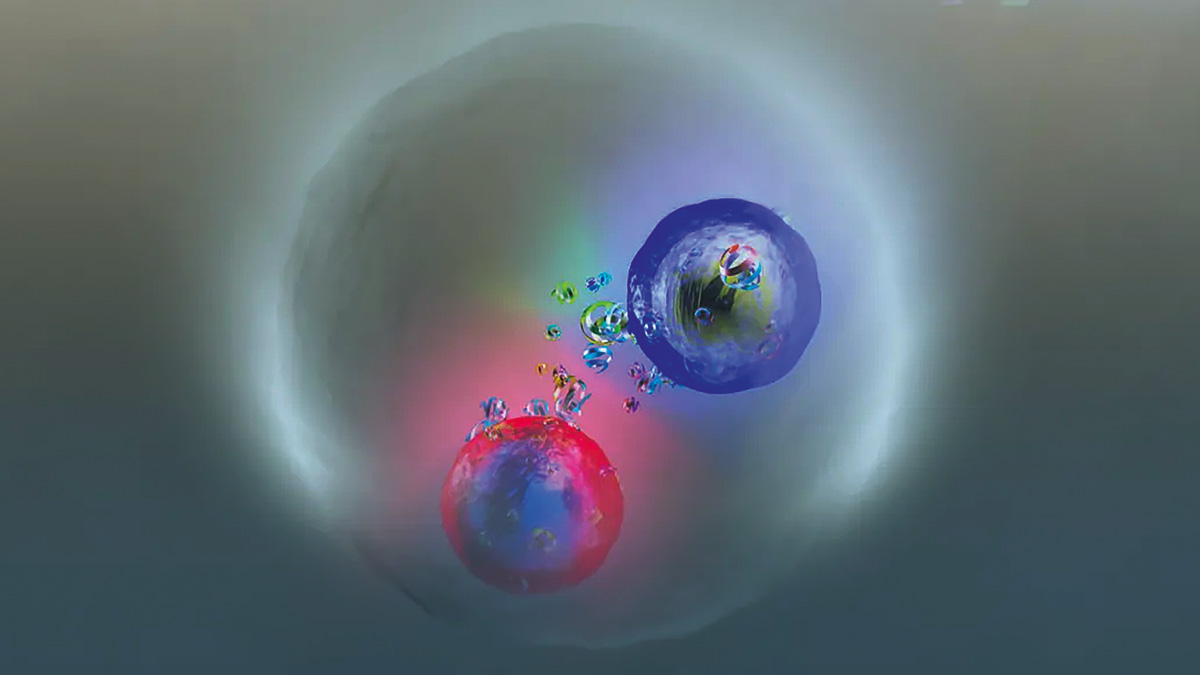
The top quark was never meant to bind. And yet a year ago, CMS reported an excess of top-quark–antiquark pairs in dilepton events near the production threshold, consistent with the fleeting formation of a top-quark–antiquark quasi-bound state: toponium. ATLAS confirmed the effect just a few months later, rejecting a pure perturbative QCD interpretation at 7.7σ (CERN Courier September/October 2025 p9). CMS has now extended the case to an independent decay process.
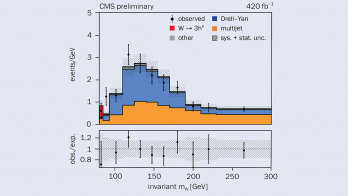
The analysis, presented at this year’s Rencontres de Moriond, looks at events in which one top decays into a charged lepton, a neutrino and a bottom quark, and the other into jets. In 138 fb–1 of Run 2 data at 13 TeV, the enhancement exceeds the pure-QCD prediction by more than five standard deviations, with an excess cross section of 5.1 ± 0.9 pb.
“Establishing a signal in both channels was very important,” says Regina Demina, who leads the University of Rochester CMS group. “The lepton + jets channel has higher statistics, thanks to the larger hadronic branching ratio of the W boson, and a single neutrino makes the kinematics easier to reconstruct. The systematic uncertainties differ from those in the dilepton channel.”
The charm and bottom quarks live long enough to bind tightly with their antiparticles, and the resulting mesons appear as sharp, narrow peaks in the cross section. The top quark, by contrast, decays too quickly, with a width comparable to the binding energy that would hold a top-quark–antiquark system together. Any such state would manifest as a broad threshold enhancement, smeared over the smooth QCD continuum.
“The formation of bound states of charm or bottom quarks is a well-established effect, which allowed theorists to refine our understanding of the QCD binding potential,” says Yu-Heng Yu, a graduate student at the University of Rochester who worked on the analysis. “Yet it came as a surprise that, given the very short lifetime of top quarks, such a quasi-bound state still manages to form in a small fraction of events.”
The lepton + jets channel demanded two methodological adjustments. The first replaces the invariant mass of the top-quark–antiquark pair, whose resolution is limited near threshold, with their relative velocity as the discriminating observable. “If they form a bound state, the relative velocity should be much smaller than when they are produced independently,” says Otto Hindrichs, also at Rochester. The second concerns the parity-sensitive observables that distinguish a pseudoscalar from a scalar interpretation of the bump. “These variables require a reconstruction method that identifies the down-type jet from the hadronic W decay,” explains Hindrichs. “To achieve this, we developed a machine-learning technique that improves the correct identification of the top-quark decay products.”
Some puzzles remain. The 5.1 pb cross section sits below the 8.8 pb measured in dilepton events, and the non-relativistic QCD reference of about 6.4 pb. “We do observe somewhat different signal strengths in the lepton + jets and dilepton channels, and we are actively investigating this difference,” says Yu.
“With the current sensitivity, interpretations beyond the Standard Model cannot be excluded,” Hindrichs adds. “A pseudoscalar heavy Higgs decaying into top-quark pairs would interfere strongly with the continuum, creating a characteristic peak-dip structure in the invariant tt mass. With enough statistics, this feature could be used to differentiate it from a quasi-bound state.”
The top-quark–antiquark threshold enhancement in e+e– collisions was analysed by Fadin and Khoze in 1987, and extended to hadron colliders by Fadin, Khoze and Sjöstrand in 1990, before the 1995 discovery of the top quark at Fermilab. The standard assumption was that any signal would have to wait for a next-generation e+e– collider reaching the threshold, which would provide the cleanest measurement of the top-quark mass. “Even with Run 3 data, we will not be able to resolve the structure of the threshold region itself, because the resolution on both the invariant mass and the relative velocity is too limited,” says Demina. “But the increased statistics should allow us to probe the spin-parity content of the bump, testing whether it carries scalar or vector contributions alongside the pseudoscalar one.”
Further reading
CMS Collab. 2026 CMS-PAS-TOP-25-002.