Neutrino beams lack the precision that modern oscillation experiments demand. Laura Munteanu, Mathieu Perrin-Terrin and Stephen Dolan describe how neutrino tagging, proposed in 1979 and demonstrated at CERN, promises to close the gap.
Born of one kind, a neutrino can die another. Its three flavours, electron, muon and tau, do not correspond to states of definite mass, but to quantum superpositions of three distinct masses. As neutrinos propagate, the mixture reshuffles and the flavour at arrival can differ from the one at production. None of this is predicted by the Standard Model, making the observation of neutrino oscillations one of the clearest signals of physics beyond it.
Neutrino oscillations provide a unique probe of new physics, acting as an interferometer that is sensitive to neutrino mass differences down to the sub-eV level. Precise measurements at the next-generation accelerator-based oscillation experiments, Hyper-Kamiokande in Japan and DUNE in the US, are poised to answer several critical questions. What is the ordering of the three neutrino masses, given their two measured mass-squared differences? Do neutrinos and antineutrinos oscillate differently? Are there additional, as yet undetected, neutrino states? These long-baseline neutrino facilities, in which a beam of neutrinos is sent to a detector hundreds of kilometres away, will produce much larger datasets than current-generation experiments. However, they suffer from a fundamental limitation: we do not know the precise energy or intensity of the neutrino beams when they set out. Reaching ultimate precision on neutrino-oscillation parameters is therefore no longer a matter of statistics, but one of messy nuclear-physics questions related to the details of weak-interaction cross sections and proton-induced hadron production.
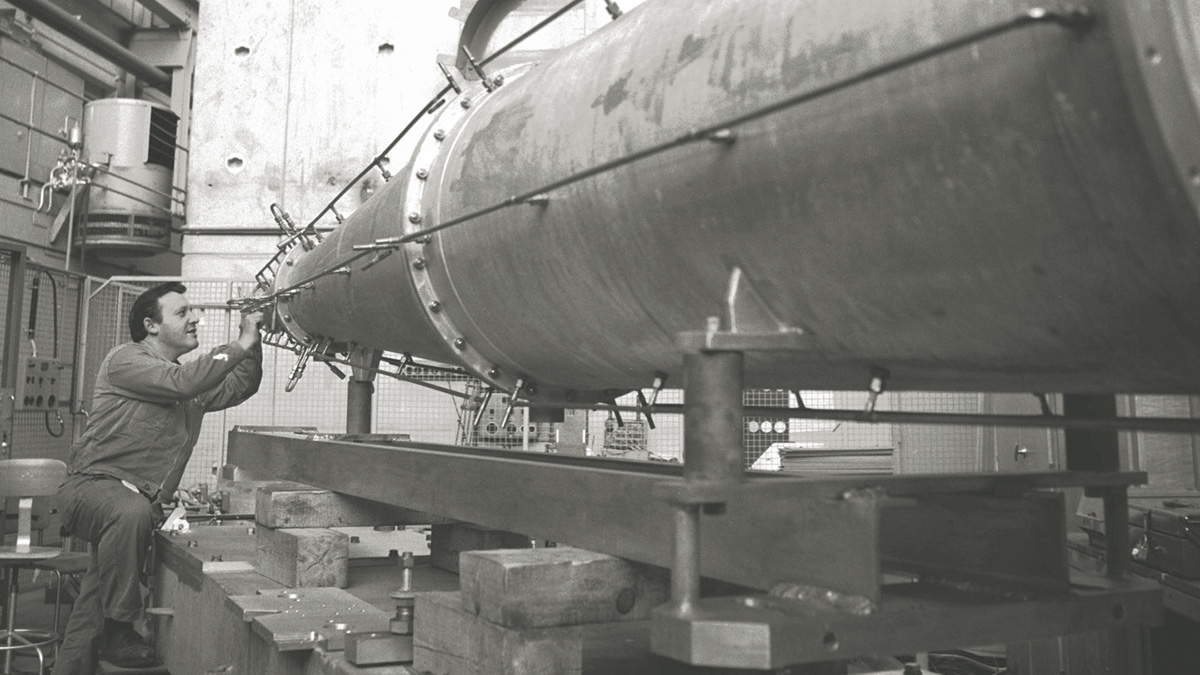
Modern neutrino beams use the famous “magnetic horn” design, developed by Simon van der Meer at CERN in 1961 (see “In focus” image). Protons strike a target to produce pions, which the horn focuses into a volume for them to decay to neutrinos and leptons. The trouble is, the resulting neutrino beam covers a wide range of energies (about 0.5 GeV and 2.5 GeV for Hyper-K and DUNE, respectively), with a shape and intensity that depend on the details of tough-to-model proton–nucleus collisions. To make matters worse, the broadband neutrino flux forces the neutrino energy to be estimated from the products of neutrino–nucleus interactions, which are notoriously difficult to model accurately. Together, these challenges form a barrier to ultimate precision in neutrino-oscillation measurements.
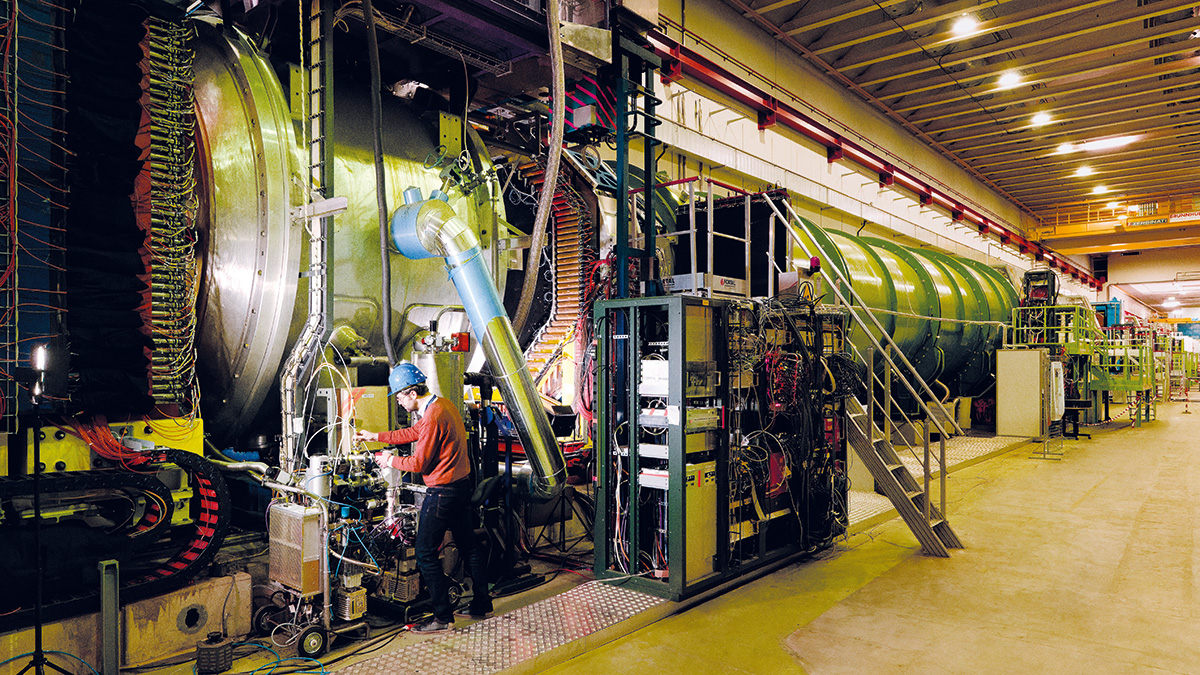
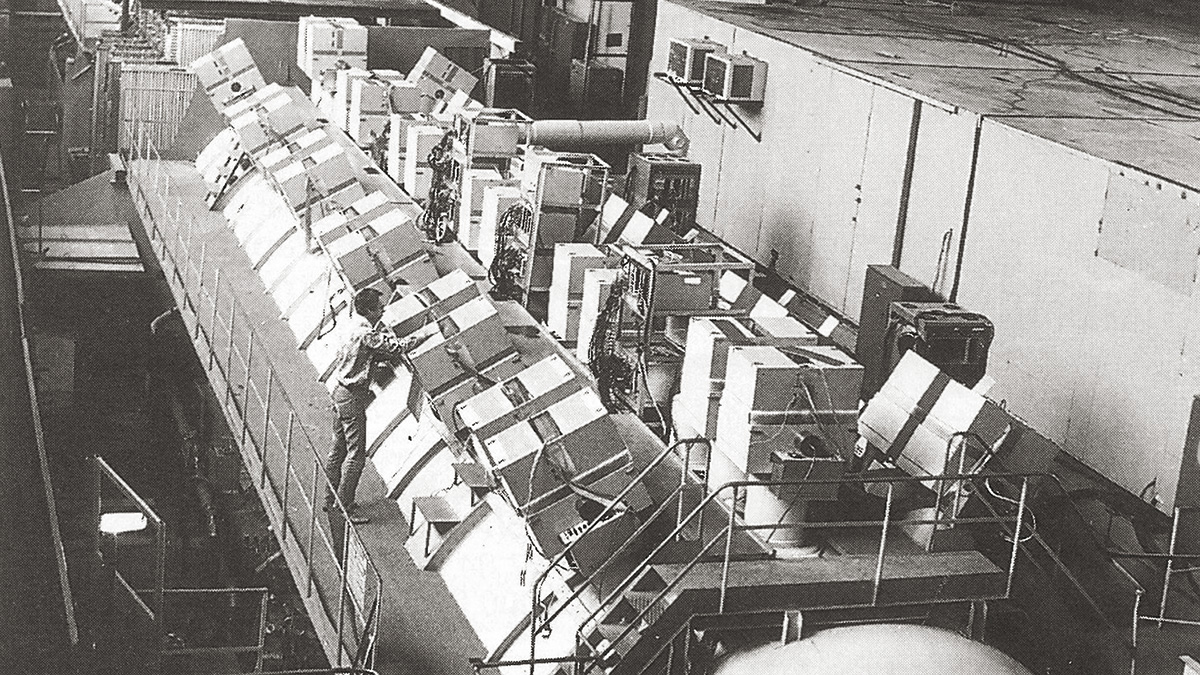
There is, in principle, a way around both problems: neutrino tagging. Proposed by Bruno Pontecorvo in 1979, this technique associates a measurement of the four momenta of the pion and muon in a π+ → μ+νμ decay with a measurement of a neutrino in a downstream detector. Four-momentum conservation then fixes the neutrino kinematics event-by-event. As a result, the neutrino energy is known for each interaction and the flux is perfectly constrained, nullifying the key challenges for neutrino-oscillation experiments and producing well-controlled muon, pion and kaon beams as byproducts. The idea was first attempted in the 1990s at the dedicated Tagged Neutrino Facility (TNF) at the Serpukhov accelerator in Protvino (see “Dream, deferred” image). TNF recorded two candidate events in its brief pilot run, before the dissolution of the Soviet Union brought the work to a halt.
The downside with neutrino tagging is one of scale: for every neutrino seen in a massive, 100-tonne detector close to the beam, there are about 1013 pion decays. To collect a reasonable 105 neutrino interactions per year, one would therefore need to identify at least 1011 individual muons per second and successfully identify the minute fraction of them that are associated with observed neutrinos. Such a measurement demands beamline detectors with timing resolutions of 10 to 100 ps and a neutrino detector with sub-ns timing resolution, with the beamline detectors operating in a high-radiation environment.
Promising performance
These challenges proved too much for the 1990s, and the idea lay dormant for three decades after the closure of TNF. However, a revolution in detector and electronics technology has since changed what is possible (see “The fast-timing revolution” panel) – beginning with the NA62 experiment at CERN.
The fast-timing revolution
R&D for the high-luminosity phase of the LHC are expected to push fast-timing sensors beyond the performance of NA62’s GigaTracker. With bunches crossing every 25 ns and up to 200 proton collisions in each, the ATLAS and CMS upgrades require timing resolutions below 50 ps to disentangle overlapping vertices. In a silicon detector, incoming particles release small electric charges, with internal electric fields then steering them toward electrodes to be collected and measured. Faster timing demands more charge, a shorter drift for the signal to form quickly and smaller collection electrodes for sharper and stronger pulses. In conventional planar sensors, these requirements are often in conflict with one another. Since the collected charge is proportional to the sensor thickness, which also sets the drift distance, thinner sensors give faster signals but fewer carriers. Potential solutions span a wide range of architectures. Low-gain avalanche detectors (LGADs), for instance, combine thin, 50 μm sensors with a gain layer to amplify charge, compensating for the lower number of carriers produced in a thin substrate while preserving a short drift. They achieve resolutions of 20 to 50 ps and will equip the new ATLAS and CMS timing layers.
Many roads to fast timing
For the upgrade of the LHCb vertex locator, which must resist radiation levels of 1016 to 1017 1 MeV neutron equivalents per cm2 (neq/cm2), a gain layer would erode too quickly. Three-dimensional sensors sidestep the problem geometrically. Their electrodes run along the sides of each pixel rather than on the top and bottom surfaces, so charges move sideways over distances below 50 μm while the sensor remains thick enough to generate large signals. Initially developed for radiation-hard pixel detectors for ATLAS and CMS, these sensors were later redesigned for timing and have reached resolutions as good as 10 ps. The remaining challenge lies in the electronics. Readout chips must match the sensors’ speed and radiation tolerance, and recent prototypes in 28 nm CMOS have achieved 30 ps resolution over areas of a few mm2. Large-area designs are currently underway.
Depleted monolithic active pixel sensors integrate the sensor and readout electronics on the same chip. With resolutions of 10 to 200 ps and pixels smaller than 100 × 100 μm2, they are much cheaper than three-dimensional sensors and LGADs, and therefore better suited to instrumenting large surfaces and achieving a lower material budget. Some R&D initiatives are also exploring the use of Cherenkov radiation to detect charged particles, a process much faster than ionisation in silicon. In these detectors, the prompt Cherenkov light is converted into photoelectrons and amplified in a thin gaseous detector, producing signals with time resolutions of a few tens of picoseconds. While highly promising, extending this approach to finely segmented detectors operating at very high rates remains an open problem. All these new tracking technologies offer promising perspectives beyond high-energy physics, for example in real-time monitoring of the proton and ion beams used in cancer therapy.
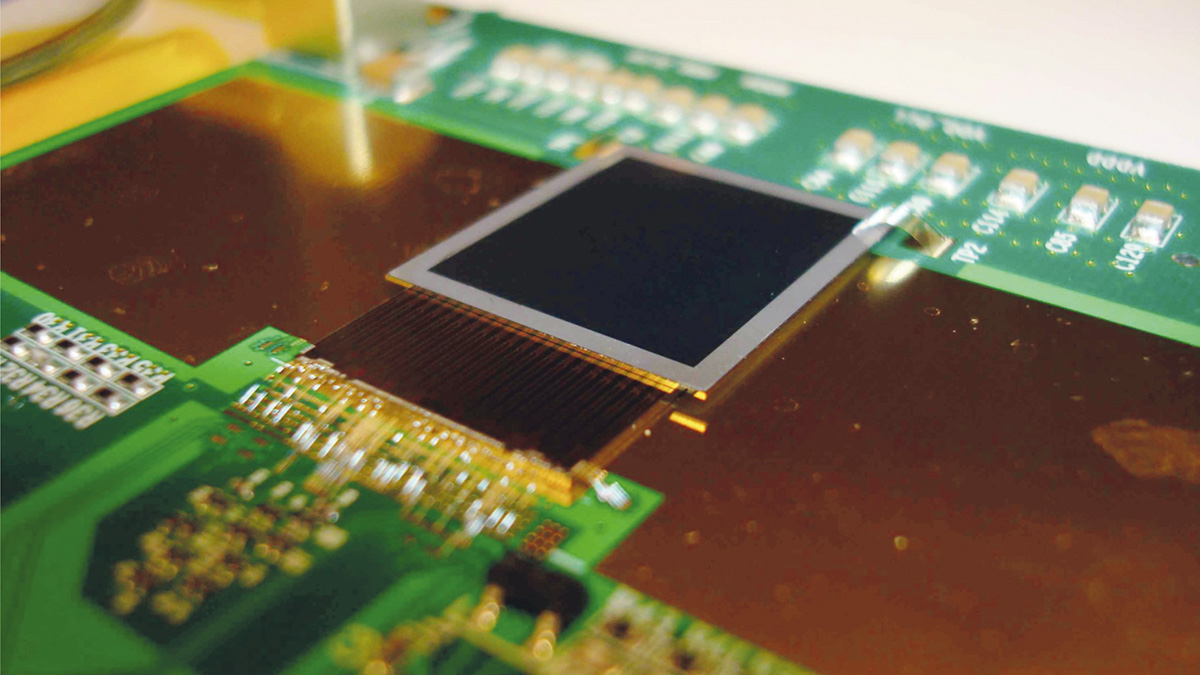
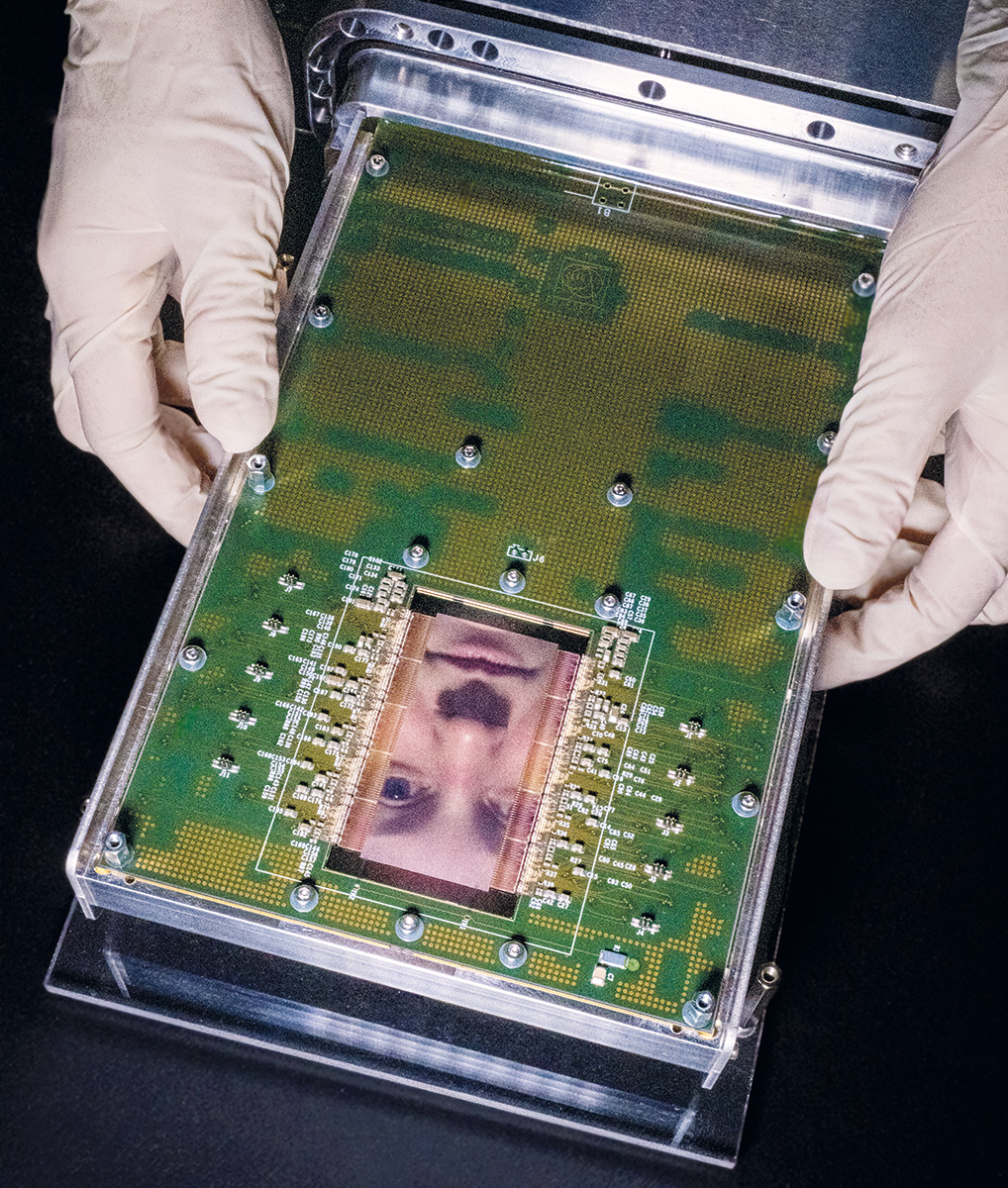
In order to study the very rare kaon decay K+ → π+νν, the NA62 collaboration faced a similar timing challenge in the late 2010s. At the time, pixel detectors, mainly developed for experiments at the LHC, were only recording the position of particles, their time being given by the proton bunch crossing (50–25 ns). New R&D was started to face the challenge of integrating timing capabilities into every pixel (of which there are more than one thousand per cm2). Within a few years, the “TDCPix” chip was designed (see “Pixel timekeeper” image), achieving a hit time resolution of 130 ps and starting a new field of 4D tracking (measuring particle trajectories in space and time). The price to pay for this performance was a significant increase in the power density absorbed by the pixel, exceeding 2W/cm2. Absorbing this power required developing an innovative cooling technology: a 200 μm-thin silicon plate integrating a dense microfluidic cooling circuit. These two innovations led to the GigaTracker beam spectrometer (see “Fourth dimension” figure) – the first 4D tracking detector in high-energy physics, which has been in operation since 2015.
With the GigaTracker in hand, the NA62 collaboration achieved the main goal of measuring the K → πνν decay, and was able to put neutrino tagging to the test. The facility’s high-intensity kaon beam also serves as a neutrino source, since the kaons predominantly decay as K+ → μ+ν. Due to the intensity of the neutrino beam and its mean energy of 40 GeV, a non-negligible number of neutrinos interact in the experiment’s electromagnetic calorimeter, a 20-tonne volume of liquid krypton. The analysis of data collected in 2022 revealed one neutrino interaction candidate that could be matched to a detected parent decay. The neutrino’s energy was estimated to be 52 GeV, with a record relative precision of 0.3%. For reference, with a few exceptions (such as pion and kaon decays at rest), neutrino energies from conventional neutrino beams are known with an uncertainty of at least 10%, and not event-by-event.
NA62’s proof-of-concept for neutrino tagging, combined with the broader advance of fast-timing detectors, have together made it possible to revisit the original TNF idea. Developed in parallel with the first tagged-neutrino analysis by NA62, the NuTag collaboration investigated the conditions under which a tagged beam would enable measurements inaccessible with conventional neutrino beams. These efforts have led to the proposed nuSCOPE facility at CERN, which emerged within CERN’s Physics Beyond Colliders study group by combining the tagged-beam concept from NuTag with the slow-extraction-driven monitored neutrino beam pioneered by the ENUBET collaboration. Rather than using a pulsed magnetic horn, the ENUBET setup relies on slow extraction from the SPS and lines the decay tunnel with particle detectors that identify the charged leptons produced with neutrinos, constraining the flux at the percent level.
Legacy measurements
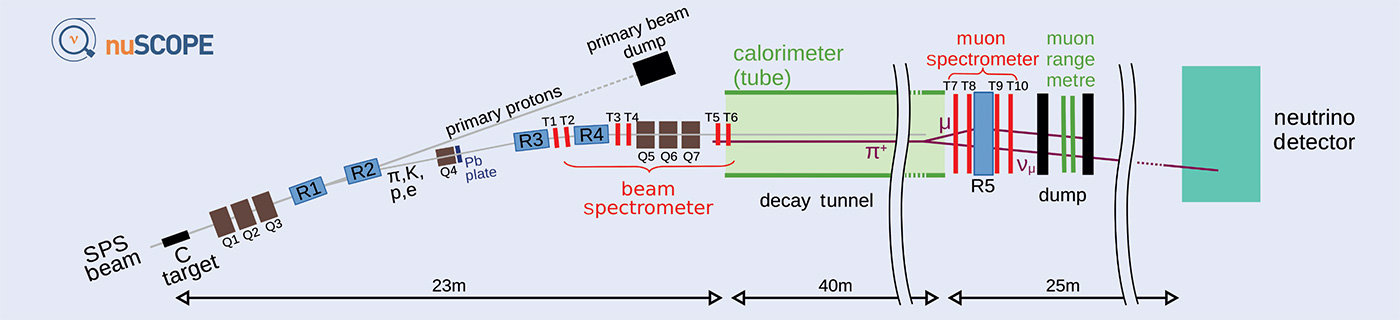
The idea of nuSCOPE echoes that of TNF (see “Beam to neutrino” figure). The first step is to direct a slow-extracted proton beam from the SPS onto a target to produce secondary pions and kaons that are then momentum-selected, using a series of dipoles and quadrupoles, to form an 8.5 GeV meson beam with a narrow momentum range. The mesons then traverse a set of ultra-fast detectors before decaying to predominantly muons and neutrinos. The muons reach a second set of fast detectors, whilst a few neutrinos interact in a dedicated detector 25 metres downstream. With sufficient timing and spatial resolution, each neutrino interaction can be associated with a measured individual meson decay. For the first time, the energy of the incoming neutrino would be known at the sub-percent level on an event-by-event basis. Measurements of neutrino cross sections, currently the dominant source of systematic uncertainty projected for DUNE and Hyper-Kamiokande, may then reach an accuracy of about 1%. Such datasets could serve as reference, “legacy” measurements for neutrino physics for decades to come.
The implications extend well beyond standard oscillation physics. Short-baseline oscillations induced by sterile neutrinos, for instance, could produce rapid patterns that would get washed out by energy smearing in conventional beams. The facility would also deliver intense, well-characterised muon and pion beams, opening additional avenues for rare process searches and precision measurements. Looking further ahead, one can even imagine how such techniques might reshape future long-baseline experiments. Depending on what DUNE, Hyper-Kamiokande and the reactor-based JUNO experiment in China will discover, the next leap in precision may not come just from higher intensities, but from beams whose properties are known with exquisite accuracy.
Further reading
NA62 collab. 2025 Phys. Lett. B 863 139345.
F Acerbi et al. 2025 arXiv:2503.21589.