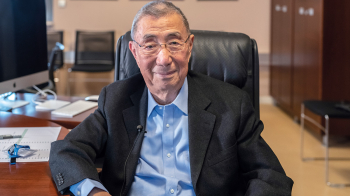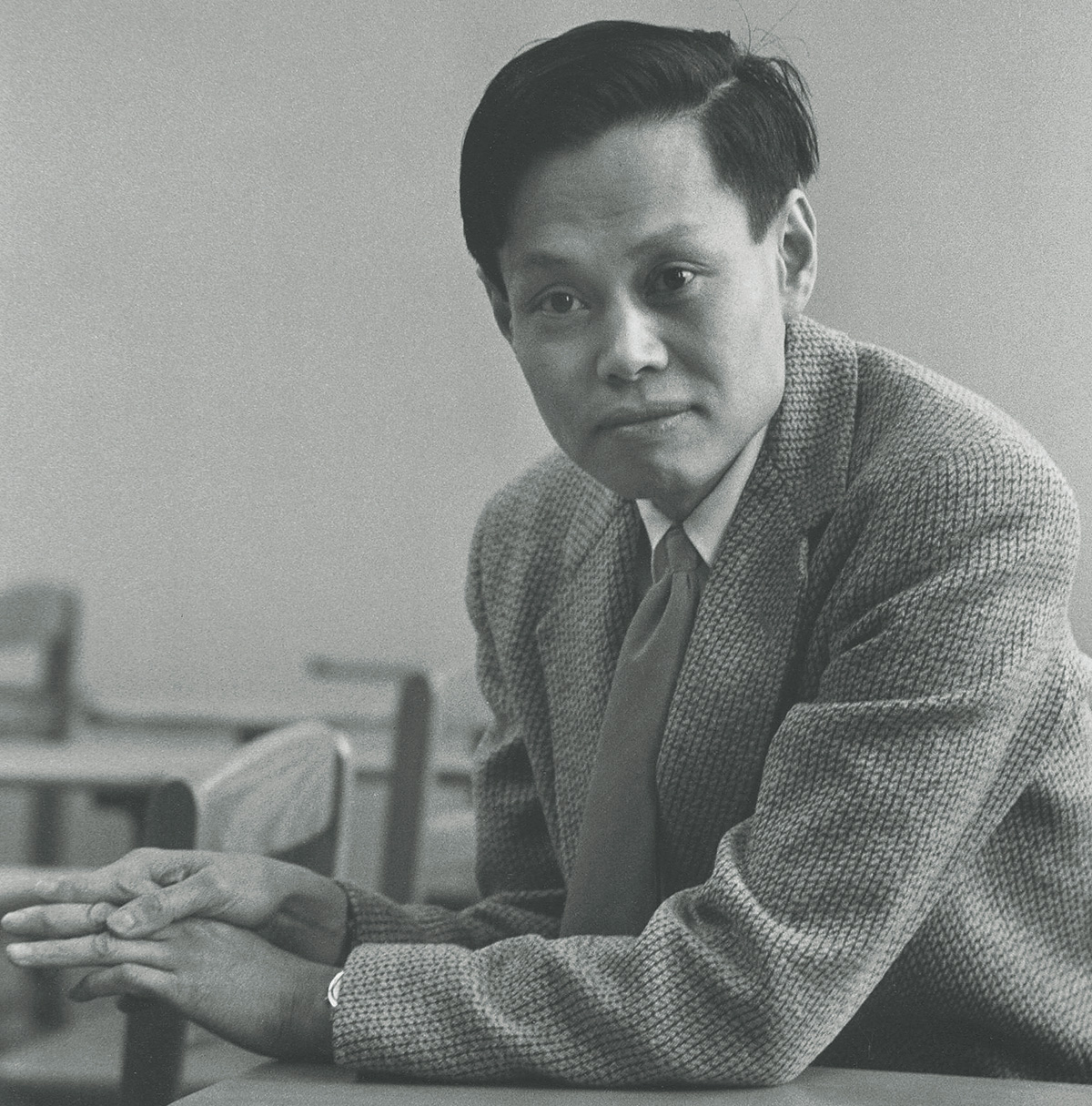
Chen-Ning Yang, a towering figure in science whose numerous insights shaped contemporary theoretical physics, passed away in Beijing on 18 October 2025 at the age of 103. Yang was one of the greatest physicists of the 20th century, whose profound contributions, often based on principles of symmetry, are central to our contemporary understanding of nature.
Yang was born in 1922 in China’s Anhui province, moving as a child to Tsinghua University in Beijing, when his father was appointed professor of mathematics. Displaced by war, in 1938 he enrolled at the National Southwest Associated University in Kunming, where he earned his Master of Science in 1944, not fully removed from ongoing hostilities in the Second Sino–Japanese War. Yang wrote that his taste in physics was already formed from his education in Kunming.
He was awarded a fellowship for further graduate study in the US and enrolled in 1945 at the University of Chicago. He studied with Enrico Fermi and wrote his thesis on applications of group theory to nuclear physics in 1948 with Edward Teller as his advisor. In 1949, Yang joined the Institute for Advanced Study in Princeton, New Jersey, where he emerged as one of the world’s leading scientists. He wrote that he would probably have taken Fermi’s advice and returned to Chicago, but remained in Princeton to be nearer to Chih Li Tu, whom he married in 1951.
Landmark papers
His years in Princeton were extraordinarily productive, with many landmark papers in particle physics, including a famous analysis of particle decays into two photons, and statistical mechanics, including the celebrated Ising model Lee–Yang circle theorem. Most significantly of all, Yang developed non-abelian gauge theories with Robert Mills in 1954. These have the property that once the gauge groups are identified, new gauge particles and their interactions are determined. Over the subsequent 30 years, a combination of theoretical advances and experimental discoveries identified the gauge particles of our world, establishing Yang–Mills theories as a cornerstone of modern physics, alongside Maxwell’s equations and Einstein’s theory of general relativity. A spontaneously broken Yang–Mills theory, incorporating the Higgs boson, and combined with a Maxwell field, describes the electromagnetic and weak interactions, while a fully unbroken theory, quantum chromodynamics, describes the strong interactions. None of this could have been foreseen in 1954, but as Yang later wrote, “we thought it was beautiful and should be published”.
Yang’s collaboration with Tsung-Dao Lee in 1956 on the groundbreaking possibility of parity non-conservation in weak interactions earned them the 1957 Nobel Prize in Physics, making them the first Nobel laureates of Chinese origin. The confirmation of non-conservation in the experiments of Chien-Shiung Wu and other groups led to further work, with Lee and Rudolf Oehme, on the possibility of charge conjugation and time reversal non-invariance, which were subsequently observed and are now recognised as relevant to the predominance of matter over antimatter in the universe. Around the time of the Nobel Prize, Yang, now famous, reunited with his father from China at CERN. This was their first time together since he left for his doctoral studies in Chicago.
In 1966, Yang accepted the position of Albert Einstein Professor at the new State University of New York at Stony Brook, to which he relocated with his family. In the same year, the Institute for Theoretical Physics, now the C.N. Yang Institute for Theoretical Physics, was founded, and he led it until his retirement from Stony Brook in 1999. At Stony Brook, he continued work in particle physics, and broke new ground in the quantum structure of integrable models and the geometry of gauge field theories. He also profoundly shaped statistical physics, in 1967, discovering the pivotal relation for one-dimensional quantum many-body problems, the Yang–Baxter equation, which opened new directions for research in statistical physics, integrable models, quantum groups and related fields of physics and mathematics.
Building bridges
In 1971, his visit to China sparked a wave of visits there by other well-known scholars, earning him recognition as a pioneer in building bridges of academic exchange between China and the US. As a prominent public figure, he went on to support the restoration and strengthening of basic scientific research in China. He also helped inspire a renaissance of fruitful interplay between physics and mathematics, through his work on the geometry of gauge fields, relating gauge theories to the mathematical concept of fibre bundles, a realisation that grew out of conversations in the 1970s with the mathematician James Simons.
Starting in 1997, he served as honorary director of the newly established Center for Advanced Study at Tsinghua University, now the Institute for Advanced Study, and became a professor at Tsinghua University in 1999. In 2003, he returned as a widower to his childhood home, the campus of Tsinghua University, also spending time at the Chinese University in Hong Kong. In his words, his “life can be said to form a circle”, including a second marriage, with Fan Weng. He took on developing the Institute for Advanced Study as his new mission. Yang poured immense effort into advancing fundamental disciplines and cultivating talents at Tsinghua, making contributions that greatly impacted the reform and development of Chinese higher education.
Yang was elected member or foreign member of more than 10 national and regional academies of sciences, received honorary doctorates from more than 20 prestigious universities worldwide, and was honoured with numerous awards.
In his collected papers, Yang wrote that “taste and style are so important in scientific research, as they are in literature, art and music.” With his own taste having served as his guide, Chen-Ning Yang leaves an opus of exceptional creativity and breadth, providing tools that have enabled generations of physicists to make new discoveries of their own.