A report from the ATLAS experiment.
The origin of the observed asymmetry between matter and antimatter in the universe, of the order of one part in 10 billion, is one of the open questions in particle physics. In 1967, Andrei Sakharov showed that one of the necessary conditions to generate such an imbalance in the early universe is the violation of the combined charge-conjugation and parity (CP) symmetry. In the Standard Model (SM), CP violation arises from a complex phase in the quark mixing matrix, but this contribution is too small to account for the observed asymmetry. Additional sources of CP violation are therefore required, such as contributions from the neutrino sector or from other sources beyond the SM.
The discovery of the Higgs boson has opened a new sector in which to search for additional CP-violating interactions. The ATLAS experiment at the LHC recently reported the results of two new analyses that probe the CP properties of Higgs-boson interactions with electroweak gauge bosons, including the structure of its couplings to longitudinally and transversely polarised W and Z bosons.
The first comes from a measurement of Higgs production through the vector boson fusion mechanism (VBF), with the Higgs boson decaying into two photons. It is the first ATLAS measurement to use Run 3 data, collected between 2022 and 2024, to probe CP violation in the interaction between the Higgs boson and electroweak gauge bosons.
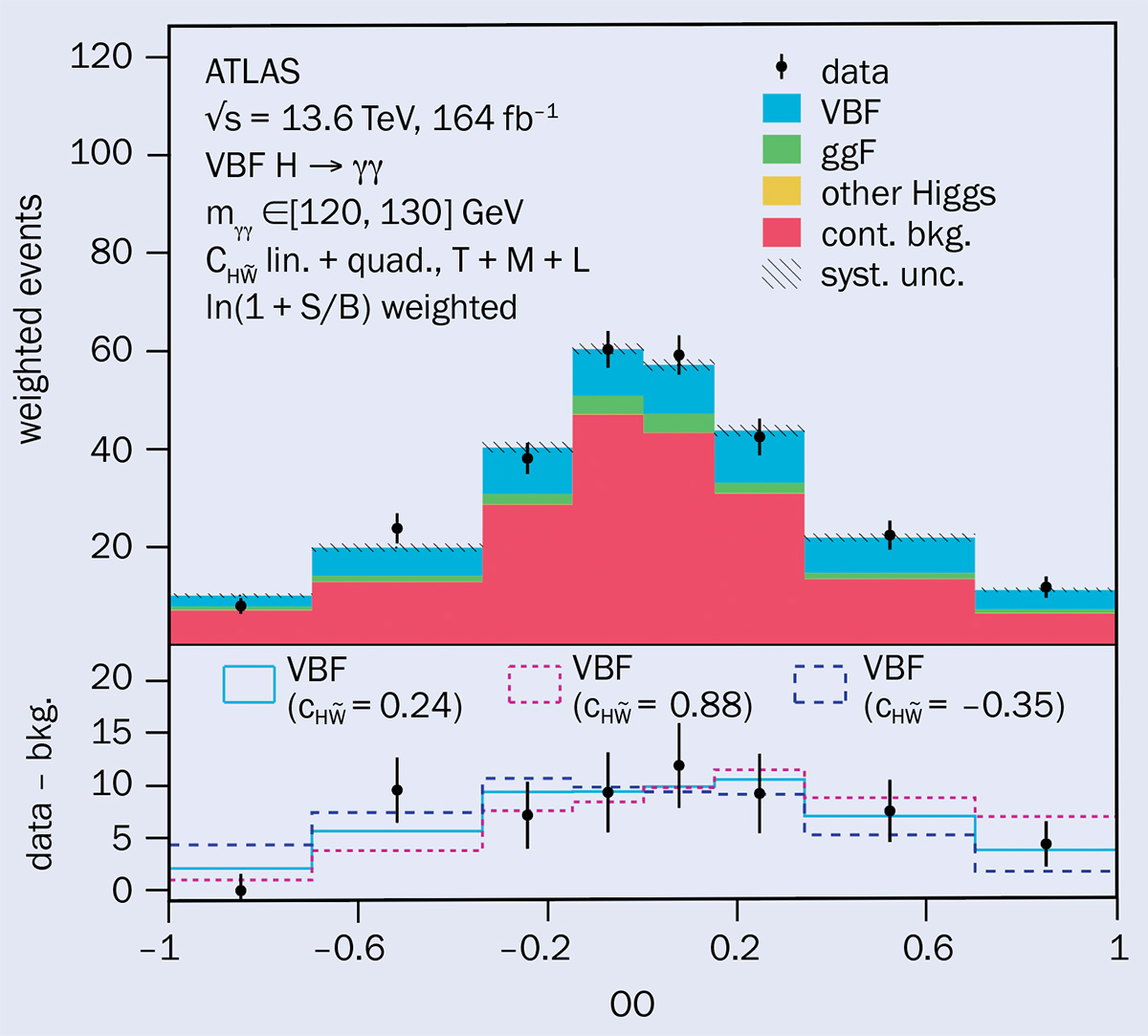
The Higgs decay into two photons provides a clean experimental signature with a large sample of Higgs events. The analysis exploits CP-odd observables, which change sign under a CP transformation, and whose average over the full phase space vanishes in the absence of CP violation. Any observed asymmetry would therefore signal a violation of CP symmetry. One such quantity, used in this analysis, is the optimal CP-odd observable. It is constructed from the per-event ratio of the CP-odd SM–BSM interference term to the SM matrix element squared, evaluated from the reconstructed four-momenta of the Higgs boson and the two jets.
No asymmetry was observed (see figure 1), and results were interpreted in the Standard Model effective field theory (SMEFT) framework. SMEFT provides a systematic, model-independent parameterisation of potential new-physics effects at energy scales beyond those directly accessible at the LHC, by extending the SM Lagrangian with higher-dimensional operators parameterised by Wilson coefficients. Constraints on these coefficients are broadly reinterpretable across a wide class of BSM scenarios. This new result improves the Run 2 limits by more than a factor of two.
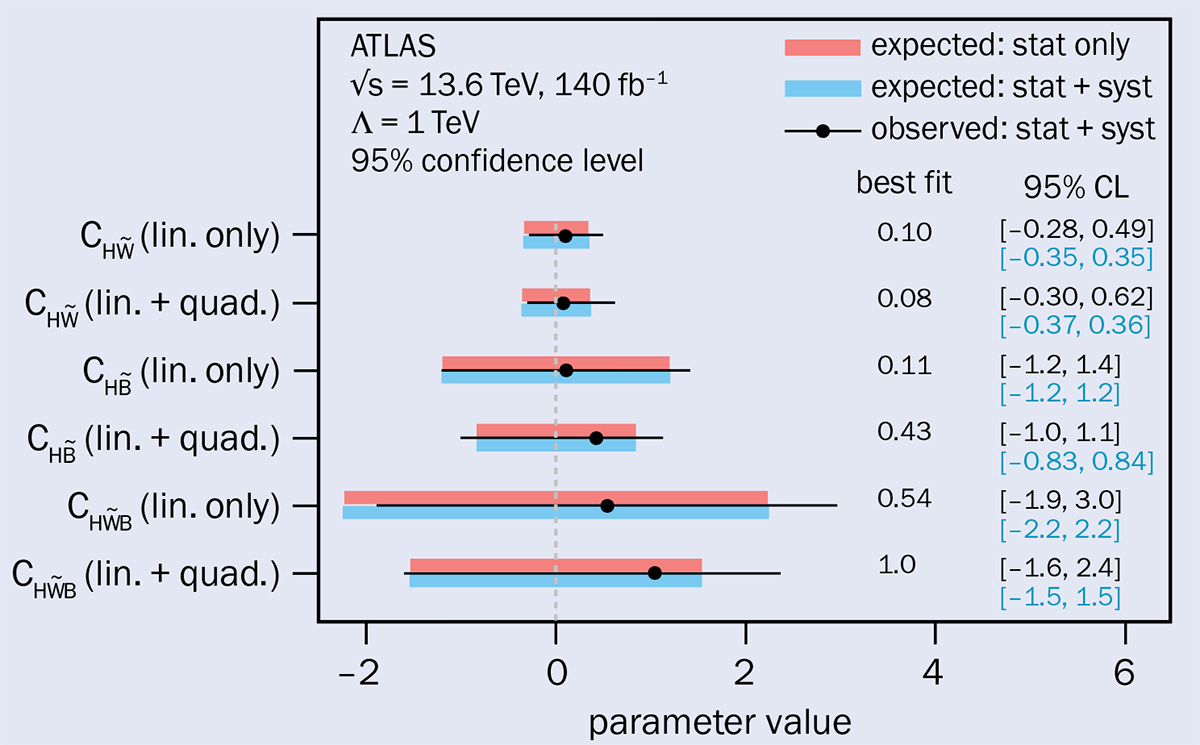
The second result combines measurements from several Higgs-boson decay channels and production modes recorded during Run 2 to extract even stronger limits on possible CP-violating interactions. This combination uses the full Run 2 results from VBF H → ττ, H → WW*, VBF H → γγ, H → ZZ* and WH with H → bb̅. A strategy similar to that of the Run 3 VBF H → γγ analysis was employed in all the single channels by looking for asymmetries in CP-odd observables and interpreting the results in terms of SMEFT. In addition to constraining individual sources of CP violation, the combination disentangles the effects from multiple sources, since different channels probe different combinations of operators. This allows simultaneous limits to be set on three CP-violating Wilson coefficients, yielding the most stringent constraints to date (see figure 2).
These new results highlight the breadth of the ATLAS programme aimed at understanding the CP properties of the Higgs boson and its interactions with electroweak gauge bosons. They also demonstrate the growing potential of the Run 3 dataset to address open questions in the Higgs sector of the SM.
Further reading
ATLAS Collab. arXiv:2603.20087.
ATLAS Collab. arXiv:2603.20117.