A report from the ATLAS experiment.
The LHC’s increased collision energies have opened new territory for TeV-scale searches, but its vast datasets also provide unparalleled opportunities to thoroughly explore the electroweak scale. A new ATLAS result uses an unconventional trigger-level analysis (TLA) of the full Run 2 dataset to achieve record sensitivity to low-mass particles decaying into quarks or gluons. ATLAS employs a two-stage trigger system, with a fast hardware-based first-level trigger selecting about 100 kHz of events from the 40 MHz bunch-crossing rate, followed by a software high-level trigger (HLT) that performs detailed event reconstruction and further reduces the accepted event rate by about two orders of magnitude. By recording a much reduced event format at the trigger level, TLA preserves a substantially larger fraction of events than would normally be output by the HLT.
New particles that decay with a two-jet final state feature in many Standard Model (SM) extensions. For example, the properties of “dark mediators” that couple to both quarks and dark matter could explain the present abundance of dark matter by controlling how much of it remains after falling out of equilibrium with normal matter in the early universe. At the LHC, the coupling of dark mediators to quarks would enable both production and decay into quark–antiquark pairs. This should appear as resonances in the dijet mass distribution.
Searching for dijet resonances at low mass is challenging. Dijet production from strong interactions is one of the LHC’s most abundant signatures. Beyond requiring a precise understanding of these enormous backgrounds and the detector response, the low-mass dijet rate far exceeds what ATLAS can record. Only the most energetic dijet events can be kept, limiting conventional dijet searches to masses above approximately 1 TeV.
To access the low-mass region, ATLAS used TLA to record multi-jet events throughout Run 2. By dropping the raw detector data from the readout, these TLA events were ~200 times smaller than standard events while retaining all high-level jet and calorimeter-based variables reconstructed in real-time by the HLT.
The size reduction allowed ATLAS to record TLA events at rates of up to 27 kHz – compared to an average 1.2 kHz for the full detector readout. This rate was achieved in conjunction with the additional trigger bandwidth allocated to TLA at the end of LHC fills and a more efficient use of this bandwidth for dijet events. In Run 2, this was aided by ATLAS’s L1Topo trigger processor, which applies simple topological selections – such as angular correlations between jets – already at first level. The new result uses 1 billion dijet events, or up to 75 times the data sample available to the equivalent conventional search, achieving unprecedented statistical precision.
The new result achieves record sensitivity to low-mass particles decaying into quarks or gluons
This enormous dataset demands excellent control of systematic uncertainties. ATLAS developed a dedicated multi-step calibration for trigger-level jets, achieving a jet energy scale precision of 1 to 4%, comparable to calibrations using full detector readout. The overwhelming SM background was modelled using a data-driven fitting technique, reaching a relative precision better than 1 part in 104.
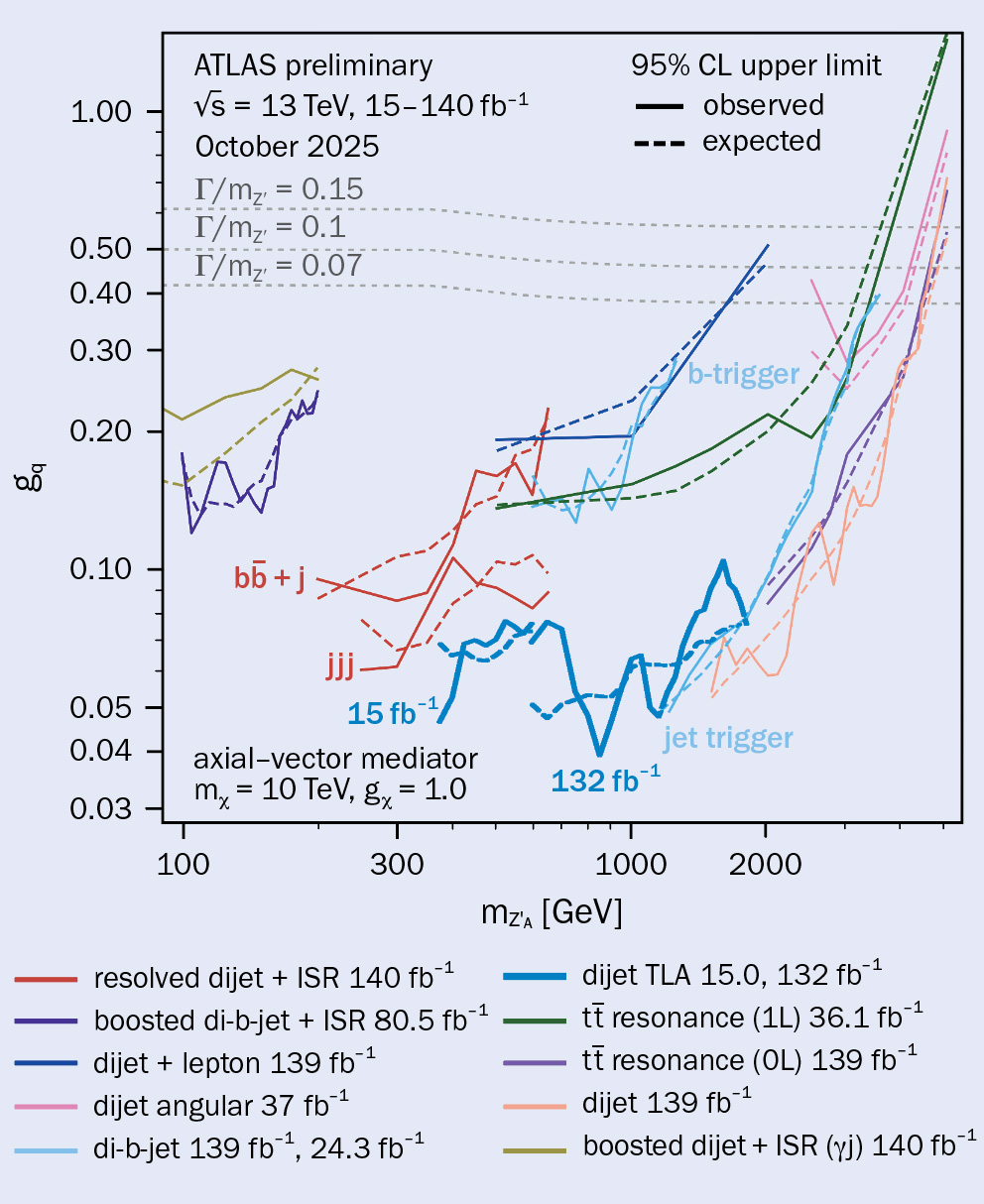
The search has found the dijet invariant-mass distribution to be consistent with the background expectation. The analysis provides numerical results that can be used to constrain any of the numerous models of dijet resonances, as well as explicit constraints on a specific dark mediator model used as a common benchmark for many ATLAS and CMS searches. The result sets ATLAS’s most stringent exclusion limits to date on the potential coupling of such a mediator to quarks, across a broad range of mediator masses reaching as low as 375 GeV (see figure 1).
The dijet TLA during Run 2 has established a foundation for an expanded trigger-level physics programme. In Run 3, trigger-level jets incorporate tracking information, allowing flavour tagging and improving jet energy resolution and robustness against pile-up. ATLAS also records trigger-level photons and uses them in combination with partial detector readout at full granularity. These and other advances in TLA should enable future ATLAS searches to probe a wider variety of signatures at the electroweak scale.
Further reading
ATLAS Collab. 2025 Phys. Rev. D 112 092015.
ATLAS Collab. 2024 JINST 19 P06029.
CMS Collab. 2025 arXiv:2510.21641.