Space Radiobiology: Synergies Between Astroparticle and Medical Physics, by Alessandro Bartoloni and Lidia Strigari, World Scientific
Astronauts are exposed to elevated levels of cosmic radiation during spaceflight. As missions become longer and venture farther from Earth, understanding how this radiation affects the human body has become a pressing scientific challenge. This emerging field of space radiobiology has strong and perhaps unexpected links to the far better established discipline of radiobiology in medical physics, where physicists work closely with clinicians to design and optimise cancer treatments using ionising radiation. In both contexts, the central question is the same: how does radiation interact with living cells, and how can its harmful effects be predicted, mitigated and controlled?
Space Radiobiology is authored by Alessandro Bartoloni (INFN Bologna) and Lidia Strigari (University Hospital of Bologna), whose combined expertise spans astroparticle physics, radiation transport and clinical radiobiology. The book explores a meeting point between two fields that have long followed separate paths but are now clearly converging around shared questions in radiation science.
At its core, the book argues for a closer integration of astroparticle physics and medical physics, demonstrating how both fields benefit from a common radiobiology perspective and a shared concern for radiation protection. At the heart of the volume is a thorough and well balanced discussion of space radiation and its implications for human spaceflight. The authors guide the reader through the complexity of the space-radiation environment – galactic cosmic rays, solar-particle events and their interactions – without losing clarity. These elements are consistently linked to real concerns for astronaut health, both for short missions and for the long-duration journeys that are becoming increasingly realistic. By connecting radiation sources, transport mechanisms and biological effects, the book builds a clear picture of where the risks lie and how they might be managed, making it especially relevant at a time when deep-space missions are moving from concept to planning.
What makes the book particularly engaging is that it never treats space research as an isolated niche. Instead, it repeatedly shows how ideas and tools developed for space can feed back into medical physics. From dosimetry and radiation monitoring to risk assessment, the authors highlight how methods refined for astroparticle experiments can be applied in clinical and research settings on Earth. Advances in detectors, modelling and data analysis developed for space missions are presented not as abstract achievements, but as practical contributions that can improve radiation therapy and diagnostic imaging.
From space to the hospital
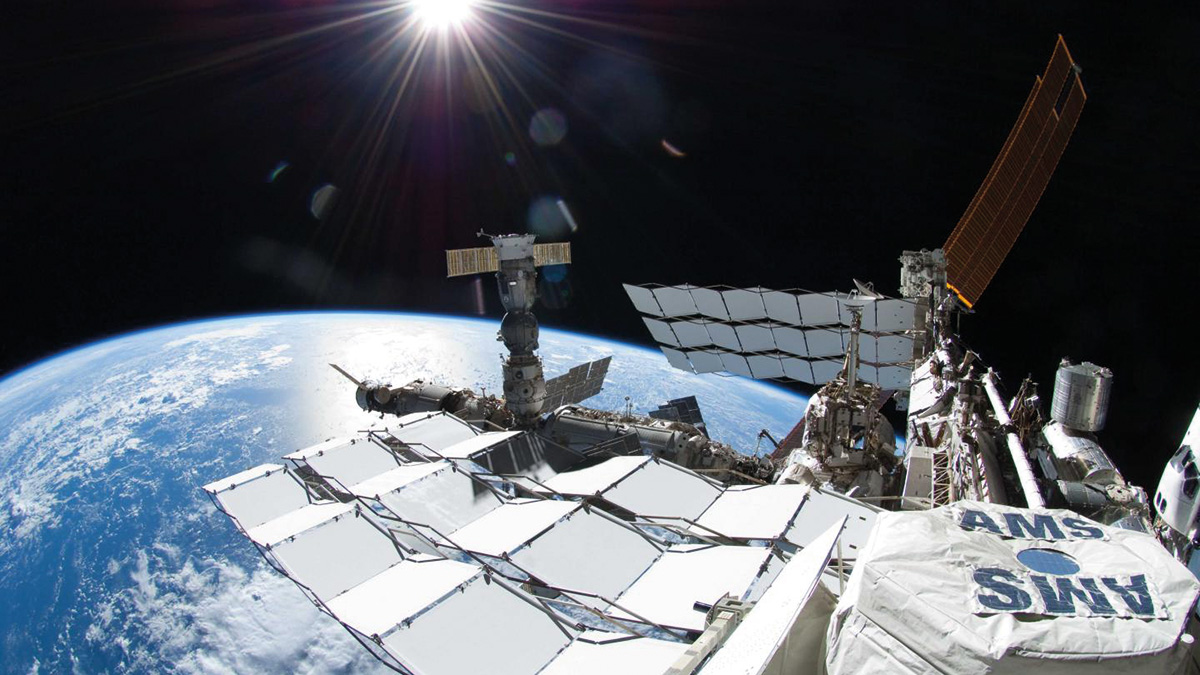
This interdisciplinary spirit comes through especially well in the case study of the Alpha Magnetic Spectrometer group at INFN Roma Sapienza. Operating aboard the International Space Station, AMS was designed to study cosmic rays and search for signs of dark matter and antimatter. The book shows, however, that its high-precision measurements of charged-particle spectra, particle composition and energy deposition in low-Earth orbit have direct relevance for space radiobiology and radiation-protection research. In particular, AMS data helped characterise the flux, charge and energy distribution of galactic cosmic rays and solar energetic particles, key parameters for modelling dose, dose-rate and track-structure effects in biological tissue. These measurements inform risk assessments for astronaut exposure, improve shielding models, and support more realistic simulations of DNA damage and long-term health effects associated with chronic low-dose, high-energy radiation in space. Rather than serving as a standalone example, this case study acts as a concrete illustration of how cross-disciplinary collaboration actually works in practice: how shared technologies, experimental approaches and theoretical frameworks can produce insights that matter across fields.
The sections on radiobiology strike a careful balance between accessibility and depth. Topics such as DNA damage, cellular responses and long-term health effects are explained clearly, without oversimplifying issues that are inherently complex (CERN Courier November/December 2025 p27). One of the book’s strongest messages is that space radiobiology, with its extreme and unconventional exposure conditions, offers a unique lens for understanding radiation effects that are also relevant to clinical and occupational environments on Earth.
By focusing on shared biological endpoints and common dosimetric challenges, the book shows how progress in one area can meaningfully inform the other. The discussion on developing common platforms for radiation measurement and monitoring reinforces this point, arguing that integrated approaches are not only efficient but scientifically necessary in increasingly complex radiation environments.
Space Radiobiology succeeds in bringing together different scientific communities around a common language and set of challenges. It will resonate with researchers in physics, space science, radiobiology and medical physics, as well as with graduate students looking for a broader, more connected view of radiation science. At a moment when deep-space exploration is becoming a tangible goal rather than a distant idea, the book offers a thoughtful and convincing picture of how lessons learned beyond Earth can shape safer and more effective uses of radiation here at home.