A report from the CMS experiment.
Despite decades of searches, experiments have yet to find evidence for a new particle that could account for dark matter on its own. This has strengthened interest in richer “dark-sector” scenarios featuring multiple new states and interactions, potentially analogous to those of the Standard Model (SM). The CMS collaboration targeted one of the most distinctive possible signatures of a dark strong force in proton–proton collisions: a dense, nearly isotropic cloud of low-momentum particles known as a soft unclustered energy pattern (SUEP).
Searches in the LHC proton–proton collision data for events with many low-momentum particles are plagued by overwhelming backgrounds from pileup and soft QCD interactions. The CMS collaboration has recently overcome this challenge by using large-radius clusters of charged particle tracks and relying on quantities that characterise the expected isotropy of SUEP decays.
The 125 GeV Higgs boson serves in many theoretical models as a natural mediator between the SM and a hidden sector, and current experimental constraints still leave room for exotic decays. Motivated by this possibility, CMS focused on Higgs-boson production in association with a vector (W or Z) boson that decays into leptons. While these modes account for < 1% of Higgs bosons produced at the LHC, the leptons provide significant handles for triggering and background suppression.
Rather than relying on SM simulations, which face modelling and statistical challenges for such soft interactions, the background was extrapolated from events with low isotropy or relatively few charged-particle tracks per cluster, using a method that accounts for small correlations between the quantities used in the extrapolation. To validate the approach, an orthogonal sample of events with a high-momentum photon was studied, taking advantage of the Higgs boson’s minuscule coupling to photons and the similarity of background processes in W/Z + jet and photon + jet events that could mimic a SUEP signal.
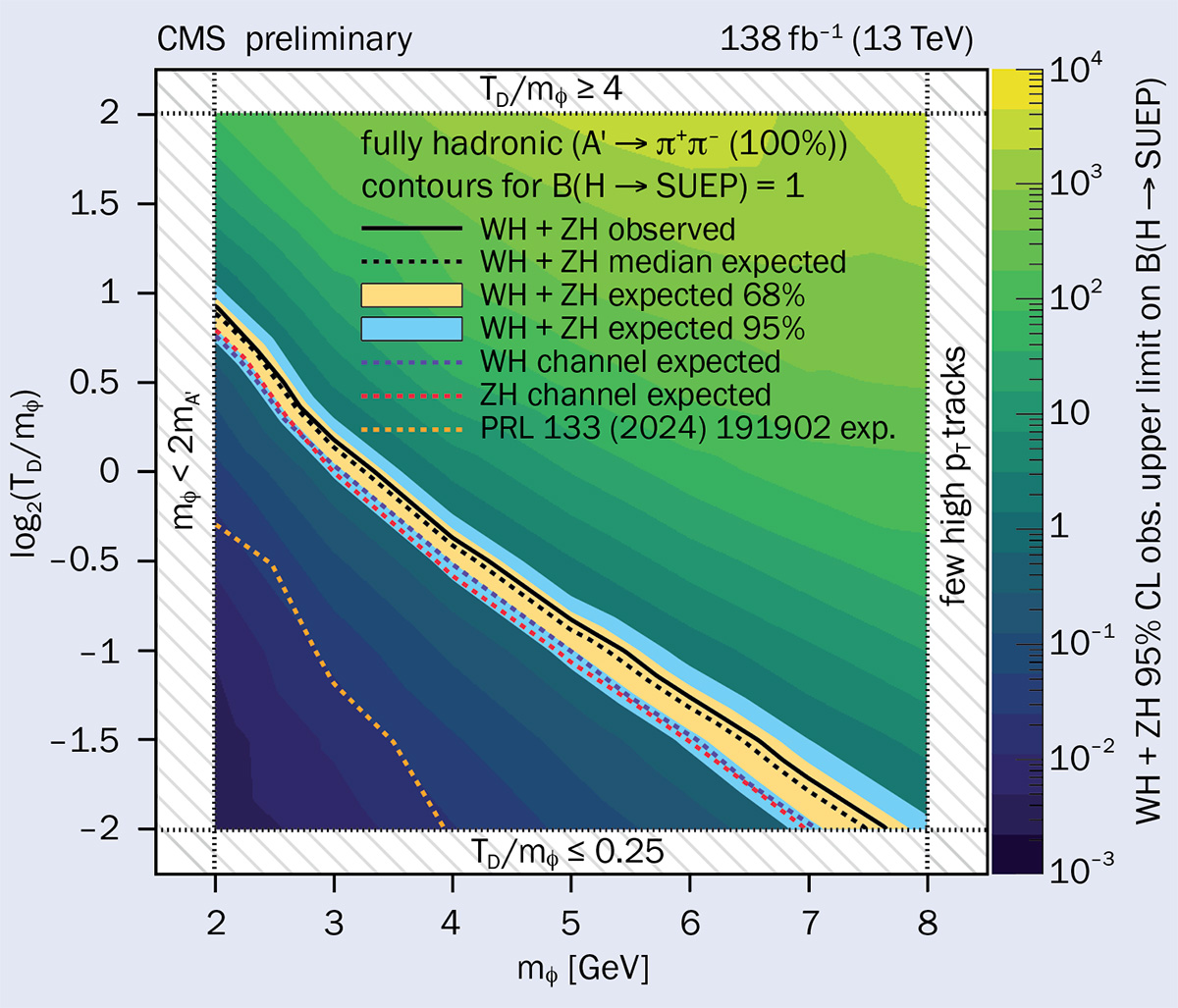
The data in the search region, consisting of events with a W or Z boson candidate and many isotropically distributed charged particles, was found to be consistent with the SM expectation. Stringent limits were placed on the branching ratio of the 125 GeV Higgs boson decaying to a SUEP shower for a wide range of parameters (see figure 1).
This analysis complements a previous CMS search that primarily targeted much heavier mediators produced via gluon fusion, improving limits on the H → SUEP branching ratio by two orders of magnitude. It additionally provides model-agnostic limits and detailed reinterpretation recipes, maximising the usability of this data for testing alternative theoretical frameworks.
SUEP signatures are not unique to the benchmark scenarios under scrutiny. They naturally emerge in hidden-valley models, where mediators connect the SM to a new, otherwise isolated sector. If the hidden states interact through a “dark QCD”, proton–proton collisions would trigger a crowded cascade of dark partons rather than the familiar collimated showers.
Crucially, unlike in ordinary QCD – where the coupling quickly weakens at energies above confinement – the dark coupling could remain large well beyond its typically low confinement scale. This sustained strong coupling would drive frequent interactions and efficiently redistribute momentum, producing an almost isotropic radiation pattern. As the system cooled, it would then hadronise into numerous soft dark hadrons whose decays back to SM particles would retain this softness and isotropy – yielding the characteristic SUEP probed by CMS.
Further reading
CMS Collab. CMS-PAS-EXO-25-007.