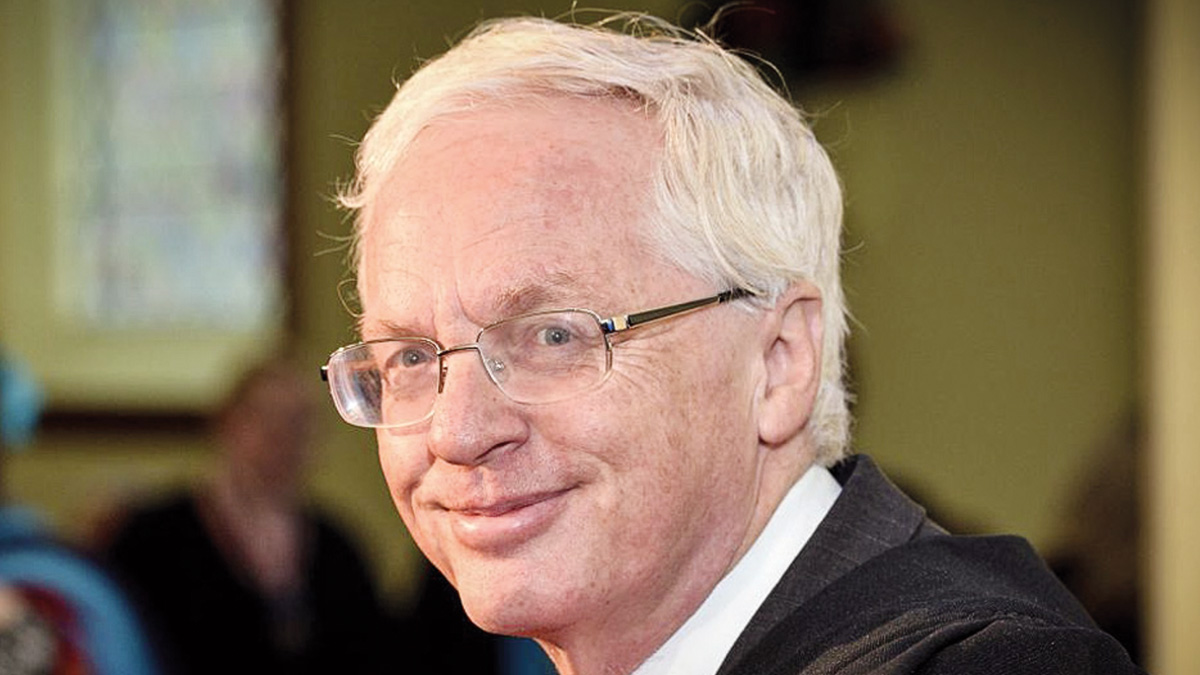
Roger Barlow passed away suddenly on 1 February 2026 at his home in Wales. Roger had an illustrious career in particle physics and, latterly, also in accelerator physics. He was well known internationally for his work in statistics, in particular for his widely used textbook, Statistics: A Guide to the Use of Statistical Methods in the Physical Sciences, published in 1989.
Roger was born on 14 April 1951 in Canterbury. After attending Edinburgh Academy, he obtained a place to study for his first degree at Oxford. He then went to Cambridge, where he completed his PhD in 1977 on proton–deuteron interactions at CERN’s 2 metre bubble chamber. Roger then took up a research post at Oxford, working on the TASSO experiment, and contributed to the discovery of the gluon in 1979.
In 1980, Roger was appointed to a lectureship at the University of Manchester and joined the JADE Collaboration, where his work on event reconstruction and Monte Carlo simulation led to one of the early measurements of the B-meson lifetime. During his early years at Manchester, Roger moved on to the OPAL experiment, becoming leader of the Manchester team in 1991. On OPAL, he helped design, build, commission and operate the muon chambers, which were crucial for many Standard Model physics studies, including precision measurements of the Z boson.
Roger became the overall leader of the Manchester particle-physics group in 2005, after the retirement of Robin Marshall. The group was then also involved in ATLAS, D0, several neutrino experiments and BaBar, which Roger had joined. Under his leadership, the particle-physics group grew to more than 100 members. As a collaborator on BaBar, he helped design the electromagnetic endcap, and he supervised the construction of half of the detector in Manchester. His data analyses included setting new limits on the existence of second-class weak currents in tau–lepton decays. As BaBar wound down, he took his group into LHCb.
In the early 2000s, Roger began researching accelerator science, forming an accelerators group in Manchester and becoming a founding member of the Cockcroft Institute of Accelerator Science and Technology. He was principal investigator for the CONFORM project that led to the successful operation of EMMA, the world’s first non-scaling FFAG accelerator. This provided a proof of principle for a new type of accelerator with many potential applications. In 2011, he left Manchester for a post at the University of Huddersfield, where he formed another accelerator-science group.
In addition to his textbook, Roger produced several influential works on statistics, including a description of extended maximum likelihood, a highly cited paper on fitting using finite Monte Carlo samples, and a detailed paper on the treatment of systematic uncertainties.
Roger was a dedicated and skilled teacher, who cared deeply about educating the next generations. Among his many contributions to the public understanding of science, he introduced the Particle Physics Masterclasses for high-school students, which quickly expanded across the UK, before becoming truly international. In recognition of this, he was awarded the Institute of Physics’ Lise Meitner Medal and Prize in 2022.
Roger retired from Huddersfield in 2017, but continued to work on BaBar and LHCb, and to publish papers and lecture on statistics, right up until his passing.
Outside of physics, Roger was active in UK national politics as a member of the Liberal Democrats. He was selected three times to stand as a candidate for the UK parliament. He will be greatly missed by his wife, Ann, his children Edward and Eleanor, his extended family, and his many friends and colleagues across the world.