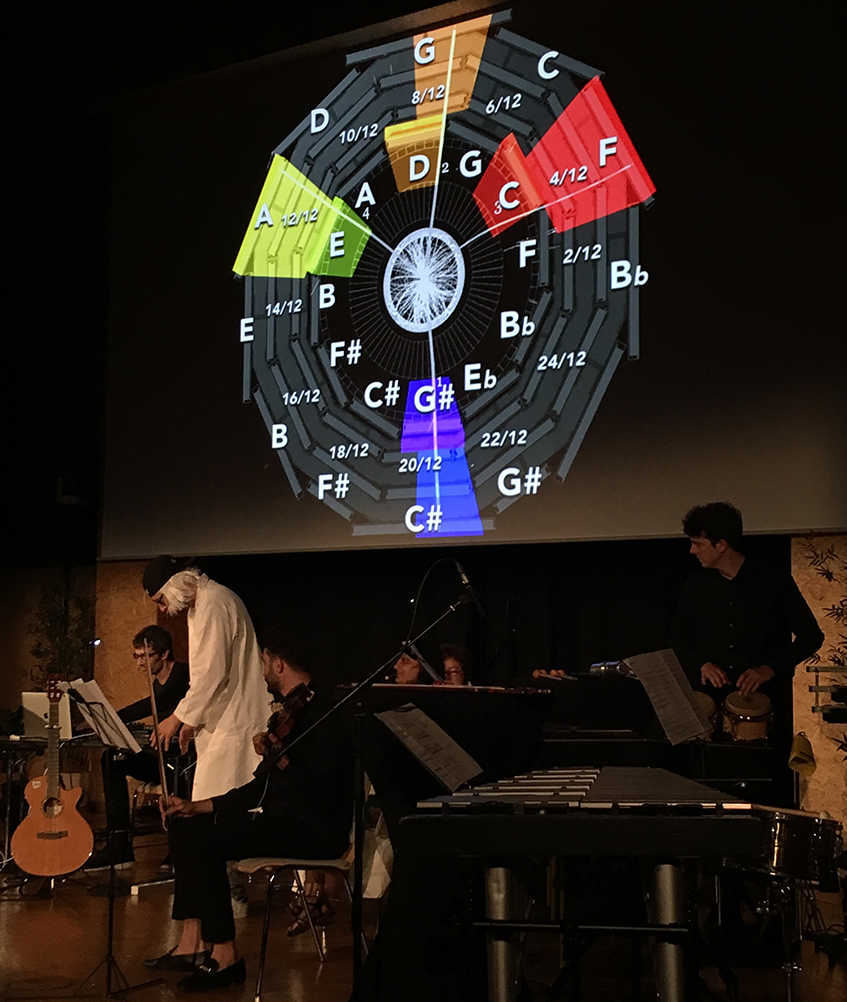
Swiss composer Alexandre Traube and the Genevan video-performer Silvia Fabiani have collaborated to form music and dance troupe Les Atomes Dansants, with the aims of using CMS data to explore the links between science and art, and of establishing a dialogue between Eastern and Western culture. Premiering their show Subatomic Desire at CERN’s Globe of Science and Innovation on 21 June during Geneva’s annual Fête de la Musique, they took the act to the detector that served as their muse by performing in the hangar above the CMS experiment.
Muon tracks from W, Z and Higgs events served as inspiration for Traube, who was advised by CMS physicist Chiara Mariotti of INFN. He began by associating segments of the CMS’s muon system to notes. Inspired by the detectors’ arrangement as four nested dodecagons, he assigned a note from the chromatic scale to each of the 12 sides of the innermost layer, and to each note a sonorous perfect fourth above to the corresponding segment in the outer layer. Developing an initial plan to also link the intermediate two layers of the muon system to specific frequencies, he associated two intermediate microtonal notes to the transverse momentum and rapidity of the tracks. At several moments during the performance the musicians improvise using the resulting four-note sequences: an expression of quantum indeterminacy, according to Traube. Fabiani’s video projections add to the surreal atmosphere by transposing the sequences into colours, with an animation of bullets referencing the Russian Second World War navy shells that were used to build the CMS’s hadronic calorimeter.
Clad in lab coat, Einstein wig and reversed baseball cap, Doc MC Carré raps formulas and boogies around the stage
In concert with the audiovisual display, three performers sing about their love for the microcosm. Clad in lab coat, Einstein wig and reversed baseball cap, Doc MC Carré (David Charles) raps formulas and boogies around the stage. He is accompanied by Doc Lady Emmy, played by the soprano Marie-Najma Thomas, and Poète Atomique – the Persian singer Taghi Akhabari – who peppers the performance with mystical extracts from Sufi poets Rûmi and Attâr, and medieval German abbess Hildegard of Bingen, each of whom explores themes of the natural world in their writings. The performers contend that the lyrics speak about desire as the fuel for everything at the micro- and macroscale. Elaborate, contemporary and rich in metaphors, this is an experience that some will find abstruse but others will love.
Subatomic Desire will next be performed in Neuchâtel, Switzerland on 14 September.
Following the discovery of gravitational waves by the LIGO and Virgo collaborations, there is great interest in observing other parts of the gravitational-wave spectrum and seeing what they can tell us about astrophysics, particle physics and cosmology. The European Space Agency (ESA) has approved the LISA space experiment that is designed to observe gravitational waves in a lower frequency band than LIGO and Virgo, while the KAGRA experiment in Japan, the INDIGO experiment in India and the proposed Einstein Telescope (ET) will reinforce LIGO and Virgo. However, there is a gap in observational capability in the intermediate-frequency band where there may be signals from the mergers of massive black holes weighing between 100 and 100,000 solar masses, and from a first-order phase transition or cosmic strings in the early universe.
This was the motivation for a workshop held at CERN on 22 and 23 July that brought experts from the cold-atom community together with particle physicists and representatives of the gravitational-wave community. Experiments using cold atoms as clocks and in interferometers offer interesting prospects for detecting some candidates for ultralight dark matter as well as gravitational waves in the mid-frequency gap. In particular, a possible space experiment called AEDGE could complement the observations by LIGO, Virgo, LISA and other approved experiments.
The workshop shared information about long-baseline terrestrial cold-atom experiments that are already funded and under construction, such as MAGIS in the US, MIGA in France and ZAIGA in China, as well as ideas for future terrestrial experiments such as MAGIA-advanced in Italy, AION in the UK and ELGAR in France. Delegates also heard about space – CACES (China) and CAL (NASA) – and sounding-rocket experiments – MAIUS (Germany) – using cold atoms in space and microgravity.
A suggestion for an atom interferometer using a pair of satellites is being put forward by the AEDGE team
ESA has recently issued a call for white papers for its Voyage 2050 long-term science programme, and a suggestion for an atom interferometer using a pair of satellites is being put forward by the AEDGE team (in parallel with a related suggestion called STE-QUEST) to build upon the experience with prior experiments. AEDGE was the focus of the CERN workshop, and would have unique capabilities to probe the assembly of the supermassive black holes known to power active galactic nuclei, physics beyond the Standard Model in the early universe and ultralight dark matter. AEDGE would be a uniquely interdisciplinary space mission, harnessing cold-atom technologies to address key issues in fundamental physics, astrophysics and cosmology.
The 10th Higgs Hunting workshop took place in Orsay and Paris from 29–31 July, attracting 110 physicists for lively discussions about recent results in the Higgs sector. The ATLAS and CMS collaborations presented Run 2 analyses with up to 140 fb–1 of data collected at a centre-of-mass energy of 13 TeV. The statistical uncertainty on some Higgs properties, such as the production cross-section, has now been reduced by a factor three compared to Run 1. This puts some Higgs studies on the verge of being dominated by systematic uncertainties. By the end of the LHC’s programme, measurements of the Higgs couplings to the photon, W, Z, gluon, tau lepton and top and bottom quarks are all expected to be dominated by theoretical rather than statistical or experimental uncertainties.
Several searches for additional Higgs bosons were presented. The general recipe here is to postulate a new field in addition to the Standard Model (SM) Higgs doublet, which in the minimal case yields a lone physical Higgs universally associated with the particle discovered at the LHC with a mass of 125 GeV in 2012. Adding a hypothetical additional Higgs doublet, however, as in the two Higgs doublet model, would yield five physical states: CP-even neutral Higgs bosons h and H, the CP-odd pseudoscalar A, and two charged Higgs bosons H±; the model would also bequeath three additional free parameters. Other models discussed at Higgs Hunting 2019 include the minimal and next-to-minimal supersymmetric SMs and extra Higgs states with doubly charged Higgs bosons. Anna Kaczmarska from ATLAS and Suzanne Gascon-Shotkin from CMS described direct searches for such additional Higgs bosons decaying to SM particles or Higgs bosons. Loan Truong from ATLAS and Yuri Gershtein from CMS described studies of rare – and potentially beyond-SM – decays of the 125 GeV Higgs boson. No significant excesses were reported, but hope remains for Run 3, which will begin in 2021.
Nobel laureate Gerard ’t Hooft gave a historical talk on the role of the Higgs in the renormalisation of electroweak theory, recalling the debt his Utrecht group, where the work was done almost 50 years ago, owed to pioneers like Faddeev and Popov. Seven years after the particle’s discovery, we now know it to be spin-0 with mainly CP-even interactions with bosons, remarked Fabio Cerutti of Berkeley in the experimental summary. With precision on the Higgs mass now better than two parts per mille, all of the SM’s free parameters are known with high precision, he continued, and all but three of them are linked to Higgs-boson interactions.
Give me six hours to chop down a tree and I will spend the first four sharpening the axe.
Abraham Lincoln
Hunting season may now be over, Cerutti concluded, but the time to study Higgs anatomy and exploit the 95% of LHC data still to come is close at hand. Giulia Zanderighi’s theory summary had a similar message: Higgs studies are still in their infancy and the discovery of what seems to be a very SM-like Higgs at 125 GeV allows us to explore a new sector with a broad experimental programme that will extend over decades. She concluded with a quote from Abraham Lincoln: “Give me six hours to chop down a tree and I will spend the first four sharpening the axe.”
The next Higgs Hunting workshop will be held in Orsay and/or Paris from 7–9 September 2020.
Theorists Sergio Ferrara (CERN), Dan Freedman (MIT/Stanford) and Peter van Nieuwenhuizen (Stony Brook) have been awarded a Special Breakthrough Prize in Fundamental Physics for their 1976 invention of supergravity. Supergravity marries general relativity with supersymmetry and, after more than 40 years, continues to carve out new directions in the search for a unified theory of the basic interactions.
“This award comes as a complete surprise,” says Ferrara. “Supergravity is an amazing thing because it extends general relativity to a higher symmetry – the dream of Einstein – but none of us expected this.”
Supergravity followed shortly after the invention of supersymmetry. This new symmetry of space–time, which enables fermions to be “rotated” into bosons and vice versa, implies that each elementary particle has a heavier supersymmetric partner and its arrival came at a pivotal moment for the field. The Standard Model (SM) of electroweak and strong interactions had just come into being, yet it was clear from the start that it was not a complete: it is not truly unified because the gluons of the strong force and the photons of electromagnetism do not emerge from a common symmetry, and it leaves out gravity, which is described by general relativity. Supersymmetry promised a way to tackle these and other problems with the SM.
It was clear that the next step was to extend supersymmetry to include gravity, says Ferrara, but it was not obvious how this could be done. During a short period lasting from autumn 1975 to spring the following year, Ferrara, Freedman and van Nieuwenhuizen succeeded – with the help of state-of-the-art computers – in producing a supersymmetric theory that included the gravitino as the supersymmetric partner of the graviton. The trio published their paper in June 1976. Chair of the prize selection committee, Edward Witten, says of the achievement:
“The discovery of supergravity was the beginning of including quantum variables in describing the dynamics of space–time. It is quite striking that Einstein’s equations admit the generalisation that we know as supergravity.”
It is quite striking that Einstein’s equations admit the generalisation that we know as supergravity
Despite numerous searches at ever higher energies during the past decades, no supersymmetric particles have ever been observed. But the importance of supergravity and its influence on physics is already considerable – especially on string theory, of which supergravity is a low-energy manifestation. Supergravity was a crucial ingredient in the 1984 proof by Michael Green and John Schwarz that string theory is mathematically consistent, and it was also instrumental in the M-theory string unification by Edward Witten in 1995. It played a role in Andrew Strominger and Cumrun Vafa’s 1996 derivation of the Bekenstein–Hawking entropy for quantum black holes, and is also important in the holographic AdS/CFT duality discovered by Juan Maldacena in 1997.
“Supergravity led to great improvements in mathematical physics, especially supergroups and supermoduli, and in the growing field of string phenomenology, which attempts to include particle physics in superstring theory,” adds Ferrara.
Ferrara, Freedman and van Nieuwenhuizen have received several awards for the invention of supergravity, including the 1993 ICTP Dirac Medal and the 2006 Dannie Heinemann Prize for Mathematical Physics. The Breakthrough Prize, founded in 2012 by former theoretical particle physicist and founder of DST Global, Yuri Milner, rewards achievements in fundamental physics, life sciences and mathematics. The $3m Special Breakthrough Prize can be awarded at any time “in recognition of an extraordinary scientific achievement”, and is not limited to recent discoveries. Previous winners of the Special Breakthrough Prize in Fundamental Physics are: Stephen Hawking; seven physicists whose leadership led to the discovery of the Higgs boson at CERN; the LIGO and Virgo collaborations for the detection of gravitational waves; and Jocelyn Bell Burnell for the discovery of pulsars.
The new laureates, along with the winners of the Breakthrough Prize in Life Sciences and Mathematics, will receive their awards at a ceremony at NASA’s “Hangar 1” on 3 November.
MedAustron, an advanced hadron-therapy centre in Austria, has treated its first patient with carbon ions. The medical milestone, which took place on 2 July 2019, elevates the particle-physics-linked facility to the ranks of only six centres worldwide that can combat tumours with both protons and carbon ions.
When protons and carbon ions strike biological material, they lose energy much more quickly than photons, which are traditionally used in radiotherapy. This makes it possible to deposit a large dose in a small and well-targeted volume, reducing damage to healthy tissue surrounding a tumour and thereby reducing the risk of side effects. While proton therapy has been successfully used at MedAustron since December 2016, treating more than 400 cancer patients so far, carbon-ion therapy opens up new opportunities to target tumours that were previously difficult or impossible to treat. Carbon ions are biologically more effective than protons and therefore allow a higher dose to be administered to the tumour.
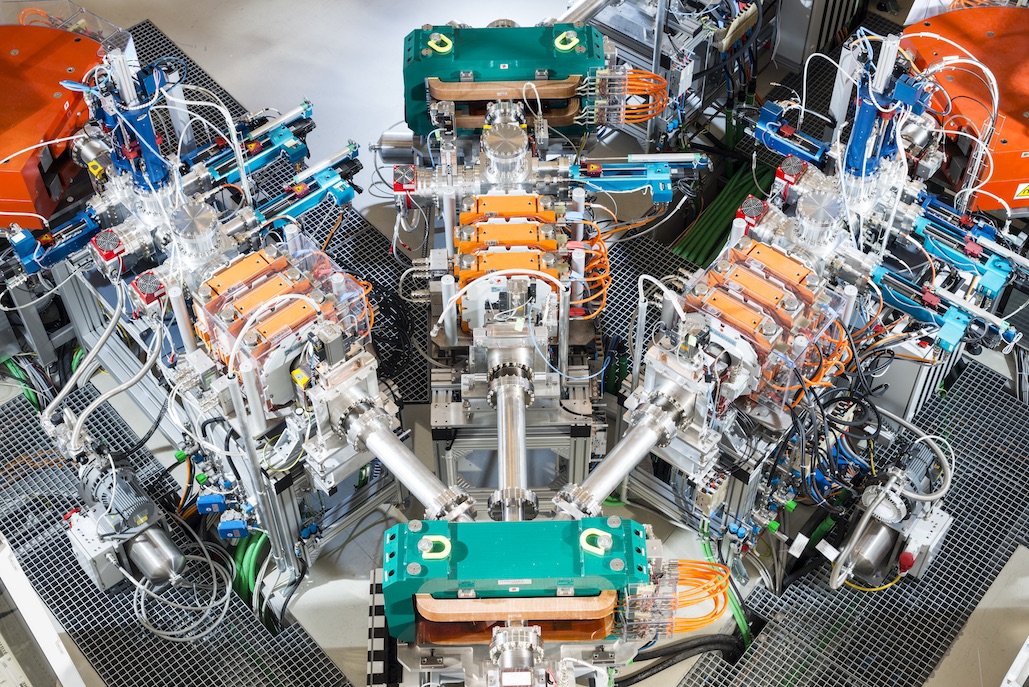
MedAustron’s accelerator complex is based on the CERN-led Proton Ion Medical Machine Study, the design subsequently developed by CERN, the TERA Foundation, INFN in Italy and the CNAO Foundation (see “Therapeutic particles”). Substantial help was also provided by the Paul Scherrer Institute, in particular for the gantry and beam-delivery designs. The MedAustron system comprises an injector, where ions from three ion sources are pre-accelerated by a linear accelerator, a synchrotron, a high-energy beam transport system to deliver the beam to various beam ports, and a medical front-end, which controls the irradiation process and covers all safety aspects with respect to the patient. Certified as a medical product, the accelerator provides proton and carbon ion beams with a penetration depth of about up to 37 cm in water-equivalent tissue, and is able to deliver carbon-ions with 255 different energies ranging from 120 to 400 MeV with maximum intensities of up to 109 ions per extracted beam pulse.
“The first successful carbon-ion treatment unveils MedAustron’s full potential for cancer treatment,” says Michael Benedikt of CERN, who co-ordinated the laboratory’s contributions to the project. “The realisation of MedAustron, through the collaboration with CERN for the construction of the accelerator facility, is an excellent example of large-scale technology transfer from fundamental research to societal applications.”
Particle therapy with carbon ions was first used in Japan in 1994, and a total of almost 30,000 patients worldwide have since been treated with this method. Initially, treatment with carbon ions at MedAustron will focus on tumours in the head and neck region, and at the base of the skull. But the spectrum will be continuously expanded to include other tumour types. MedAustron is also working on the completion of an additional treatment room with a gantry that administers proton beams from a large variety of irradiation angles.
“Irradiation with carbon ions makes it possible to maintain both the physical functions and the quality of life of patients, even with very complicated tumours,” says Piero Fossati, scientific and clinical director of MedAustron’s carbon ion programme.
Murray Gell-Mann and I were born a few days apart, in September 1929. Being born on almost the same date as a genius does not help much, except for the fact that by having the same age there was a non-zero probability that we would meet. And, indeed, this is what happened; furthermore, we and our families became friends.
Murray’s family was heavily affected by the economic crash of October 1929. His father had to change job completely. However, if this had not happened, it is possible that Murray might have become a successful businessman instead of a brilliant physicist. Everybody knows that Murray was immensely cultured and had multiple interests. I can quote a few at random: penguins, other birds (tichodromes for instance), Swahili, Creole, Franco- Provençal (and more generally the history of languages), pre-Columbian art and American–Indian art, gastronomy (including French wines and medieval food), the history of religions, climatic change and its consequences, energy resources, protection of the environment, complexity, cosmology and the quantum theory of measurement. However, it is in the field of theoretical particle physics that he made his most creative and important contributions. For these, up until 24 May 2019, I personally considered him to be the best particle-physics theoretician alive.
Bright beginnings
I met Murray for the first time at Les Houches in 1952, one year after the foundation of the school by Cecile Morette-DeWitt. It was immediately obvious that he was extremely bright. Although I never had the occasion to collaborate with Murray, there was a time when his advice was very precious to me. Most of my own research in theoretical physics was extremely rigorous work but, for a time in 1980, I became a phenomenologist: I proposed a naïve potential model to calculate the energies of quarkonium, b–b̅ and c–c̅ systems. My colleagues were divided about this. In particular, my Russian friends were very critical. When I gave a talk about this in Aspen, Murray said: “We don’t understand why it works, but it works and you should continue.” I followed his advice, including treating strange quarks as “heavy”. Again it worked, and my colleague Jean Marc Richard adapted this model to baryons. It enabled the mass of the Ω– baryon to be calculated with great accuracy, and also correctly predicted the mass of the b–s̅ meson, which was discovered years later by ALEPH. This is typical of Murray’s philosophy: if something works, go ahead: “non approfondire” as Italian writer Alberto Moravia says.
In 1955 I attended my first physics conference, in Pisa. After a breakfast with Erwin Schrödinger, I took the tram and met Murray. In the afternoon, at the University of Pisa, he made the first public presentation of the strangeness scheme. The auditorium was packed. I was completely bewildered by this extraordinary achievement, with its incredible predictive power (which was very soon checked), including the KK̅ system. I had already left Ecole Normale-Orsay for CERN when he and Maurice Levy wrote their famous paper featuring, for the first time, what was later called the “Cabibbo angle”.
I then had the good fortune to be sent to the La Jolla conference in 1961. There I met Nick Khuri for the first time, who also became a close friend, and I heard Murray presenting “the eightfold way” – i.e. the SU(3) octet model. Also attending were Marcel Froissart, who derived the “Froissart bound”, and Geoff Chew, who presented his version of the S-matrix programme. Both were most inspiring for my future work (sadly, both also passed away recently). What I did not realise at the time was that the Chew programme had been largely anticipated by Murray, who first was involved in the use of dispersion relations and then noticed, in 1956, that the combination of analyticity, unitarity and crossing symmetry could lead to field theory on the mass shell, with some interesting consequences.
In 1962, during the Geneva “Rochester” conference, I was again present when Murray, after a review of hadron spectroscopy by George Snow, stood up and pointed out that the sequence of particles Δ, ∑*, Ξ* could be completed by a particle that he called Ω– to form a decuplet in the SU(3) scheme. He predicted its mode of production, its decay (which was to be weak) and its mass. This was followed by a period of deep scepticism among theoreticians, including some of the best. However, at the end of 1963, while I was in Princeton, Nick Samios and his group at Brookhaven announced that the Ω– had been discovered, with exactly the correct mass within a few MeV. Frank Yang, one of the sceptics, called it “the most important experiment in particle physics in recent years”. I missed the invention of the quarks, being in Princeton, far from Caltech where Murray was, and from CERN where George Zweig was visiting. I met Bob Serber but was completely unaware of his catalytic role in that discovery.
My next important meeting with Murray was in Yerevan in Armenia in 1965, where Soviet physicists had invited a group of some eight western physicists. This time Murray came with his whole family: his wife, Margaret – a British archaeology student whom he met in Princeton – and his children, Lisa and Nick. During the following summer, which the Gell-Manns spent in Geneva, our families met several times. The Gell-Manns spent another year at CERN before Harold Fritzsch, Gell-Mann and Heinrich Leutwyler wrote the “Credo” of QCD.
Margaret and Murray came to Geneva again for the academic year 1979/1980. They were living in an apartment in the same group of buildings as us. Schu, my wife, who died at the same age as Murray from a similar disease, became a close friend of Margaret, who was a typically British girl: very reserved, very intelligent and possessing a good sense of humour. An extraordinary friendship grew between Margaret and Schu. When the Gell-Manns left Geneva for Pasadena, Margaret knew that there was something wrong with her health. Back in the US she discovered that she had cancer. I do not know the number of transatlantic trips that we made – sometimes both of us, sometimes Schu alone – to help. In between, Schu and Margaret had an extensive correspondence. It is nice that the ashes of Murray will be close to Margaret.
After Margaret’s death, we all kept in touch. We met in many places: Paris, Pasadena, Beyrouth, Geneva and Bern. Of these, two stand out. In 2004 Murray attended a meeting of linguists at the University of Geneva. He proposed to give a talk at CERN on the origin and evolution of languages. Luis Alvarez-Gaumé and I accepted. It was absolutely fantastic. I regret that we don’t have a written version, but we certainly have tapes. The second occasion was in Bern. Every year the Swiss confederation gives the Einstein Medal to someone suggested by the University of Bern. The 2005 medal was a special one because this was 100 years after Einstein’s trilogy of fundamental discoveries. The candidate had to be of an extremely high level, so Murray was chosen. At the ceremony in Bern, Schu decided to wear a brooch that had been given to her by Murray to thank her for what she did for Margaret. The brooch represented Hopi “skinwalkers”. During lunch, however, the brooch disappeared. Either it had been lost or stolen. We were extremely unhappy and could not refrain from telling this to Murray. Some time later, Schu received a parcel containing a new brooch; an illustration of Murray’s faithfulness in friendship.
This article is an updated version of a tribute published on the occasion of Gell-Mann’s 80th birthday (CERN Courier April 2010 p27).
CERN has 65 years of history and more than 13,000 international users. The CERN Alumni Network, launched in June 2017 as a strategic objective of the CERN management, now has around 4600 members spanning all parts of the world. Alumni pursue careers across many fields, including industry, economics, information technology, medicine and finance. Several have gone on to launch successful start-ups, some of them directly applying CERN-inspired technologies.
So far, around 350 job opportunities, posted by alumni or companies aware of the skills and profiles developed at CERN, have been published on the alumni.cern platform. Approximately 25% of the jobs posted are for software developer/engineer positions, 16% for data science and 15% for IT engineering positions. Several members have already been successful in finding employment through the network.
Another objective of the alumni programme is to help early-career physicists make the transition from academia to industry if they choose to do so. Three highly successful “Moving out of academia” events have been held at CERN with the themes finance, big data and industrial engineering. Each involved inviting a panel of alumni working in a specific field to give candid and pragmatic advice, and was very well attended by soon-to-be CERN alumni, with more than 100 people at each event. In January the alumni network took part in an academia/industry event titled “Beyond the Lab – Astronomy and Particle Physics in Business” at the newly inaugurated Higgs Innovation Centre at the University of Edinburgh.
The data challenge
The network is still in its early days but has the potential to expand much further. Improving the number of alumni who have provided data (currently 37%) is an important aim for the coming years. Knowing where our alumni are located and their current professional activity allows us to reach out to them with relevant information, proposals or requests. Recently, to help demonstrate the impact of experience gained at CERN, we launched a campaign to invite those who have already signed up to update their profiles concerning their professional and educational experience. Increasing alumni interactions, engagement and empowerment is one of the most challenging objectives at this stage, as we are competing with many other communities and with mobile apps such as Facebook, WhatsApp and LinkedIn.
One very effective means for empowering local alumni communities are regional groups. At their own initiative, members have created seven of them (in Texas, New York, London, Eindhoven, Swiss Romandie, Boston and Athens) and two more are in the pipeline (Vienna and Zurich). Their main activities are to hold events ranging from a simple drink to getting to know each other at more formal events, for example as speakers in STEM-related fields.
One of the most rewarding aspects of running the network has been getting to know alumni and hearing their varied stories. “It’s great that CERN values the network of physicists past and present who’ve passed through or been based at the lab. The network has already led to some very useful contacts for me,” writes former summer student Matin Durrani, now editor of Physics World magazine. “Best wishes from Guyancourt (first office) as well as from Valenciennes (second office) and of course Stręgoborzyce (my family home). Let’s grow and grow and show where we are after our experience with CERN,” writes former technical student Wojciech Jasonek, now a mechanical engineering consultant.
After two years of existence we can say that the network is firmly taking root and that the CERN Office of Alumni Relations has seen engagement and interactions between alumni growing. Anyone who has been (or still is) a user, associate, fellow, staff or student at CERN, is eligible to join the network via alumni.cern.
MC Escher’s 1941 woodcut Plane-Filling Motif with Reptiles depicts two tessellating tetrapods, one black and one white, with intertwined legs and feet on the adjacent sides. Reflect the image horizontally and vertically, and the result is a photo negative: maximal parity violation. A black–white transformation – charge conjugation in the metaphor that inspired Steven Vigdor’s book – and, as in nature, we return to the original. Well, almost. We can tell the difference from the position and colouration of Escher’s stylised initials in the corner. The only imperfection is the signature of the artist.
Vigdor’s idea is that such deviations from perfect symmetry are not in fact “bugs”, but are beautiful and essential. In the case of CP violation – an essential ingredient in Sakharov’s baryogenesis recipe – the artist’s signature is indispensable to our very existence, and the subject of a glut of searches for physics beyond the Standard Model.
Taking no position on the existence of a creator artist per se, Vigdor’s aim is rather to complement books that speculate on new theories with an exposition of the “painstaking and innovative” efforts of generations of experimentalists to establish the weird and wonderful physics we know. His book is a romp from quantum mixing to the apparent metastability of the vacuum (given current measurements of the Higgs and top masses), with excursions into cosmology, biology and metaphysics. The intended audience is university students. As they cut their way through a jungle of mathematical drills in 19th-century physics, many lose sight of the destination. Cheerful and down to earth, this book offers an invigorating glimpse through the foliage.
“From my vast repertoire …” is a rather peculiar opening to a seminar or a lecture. The late CERN theorist Guido Altarelli probably intended it ironically, but his repertoire was indeed vast, and it spanned the whole of the “famous triumph of quantum field theory,” as Sidney Coleman puts it in his classic monograph Aspects of Symmetry. There can be little doubt that a conspicuous part of this triumph must be ascribed to the depth and breadth of Altarelli’s contributions: the HERA programme at DESY, the LEP and LHC programmes at CERN, and indeed the current paradigms of the strong and electroweak interactions themselves, bear the unmistakable marks of Guido’s criticism and inspiration.
From My Vast Repertoire … is a memorial volume that encompasses the scientific and human legacies of Guido. The book consists of 18 well-assorted contributions that cover his entire scientific trajectory. His wide interests, and even his fear of an untimely death, are described with care and respect. For these reasons the efforts of the authors andeditors will be appreciated not only by his friends, collaborators and fellow practitioners in the field, but also by younger scientists, who will find a timely introduction to the current trends in particle physics, from the high-energy scales of collider physics to the low-energy frontier of the neutrino masses. The various private pictures, which include a selection from his family and friends, make the presence of Guido ubiquitous even though his personality emerges more vividly in some contributions than others. Guido’s readiness to debate the relevant physics issues of his time is one of the recurring themes of this volume; the interpretation of monojets at the SPS, precision tests of the Standard Model at LEP, the determination of the strong coupling constant, and even the notion of naturalness, are just a few examples.
While lecturing at CERN in 2005, Nobel prize-winning theorist David Gross outlined some future perspectives on physics, and warned about the risk of a progressive balkanisation. The legacy of Guido stands out among the powerful antidotes against a never-ending fission into smaller subfields. He understood which problems are ripe to study and which are not, and that is why he was able to contribute to so many conceptually different areas, as this monograph clearly shows. The lesson we must draw from Guido’s achievements and his passion for science is that fundamental physics must be inclusive and diverse. Lasting progress does not come by looking along a single line of sight, but by looking all around where there are mature phenomena to be scrutinised at the appropriate moment.
Ilya Obodovskiy’s new book is the most detailed and fundamental survey of the subject of radiation safety that I have ever read.
The author assumes that while none of his readers will ever be exposed to large doses of radiation, all of them, irrespective of gender, age, financial situation, profession and habits, will be exposed to low doses throughout their lives. Therefore, he reasons, if it is not possible to get rid of radiation in small doses, it is necessary to study its effect on humans.
Obodovskiy adopts a broad approach. Addressing the problem of the narrowing of specialisations, which, he says, leads to poor mutual understanding between the different fields of science and industry, the author uses inclusive vocabulary, simultaneously quoting different units of measurement, and collecting information from atomic, molecular and nuclear physics, and biochemistry and biology. I would first, however, like to draw attention to the rather novel section ‘Quantum laws and a living cell’.
Quite a long time after the discovery of X-rays and radioactivity, the public was overwhelmed by “X-ray-mania and radio-euphoria”. But after World War II – and particularly after the Japanese vessel Fukuryū-Maru experienced the radioactive fallout from a thermonuclear explosion at Bikini Atoll – humanity got scared. The resulting radio-phobia determined today’s commonly negative attitudes towards radiation, radiation technologies and nuclear energy. In this book Obodovskiy shows that radio-phobia causes far greater harm to public health and economic development than the radiation itself.
The risks of ionising radiation can only be clarified experimentally. The author is quite right when he declares that medical experiments on human beings are ethically evil. Nevertheless, a large group of people have received small doses. An analysis of the effect of radiation on these groups can offer basic information, and the author asserts that in most cases results show that low-dose irradiation does not affect human health.
It is understandable that the greater part of the book, as for any textbook, is a kind of compilation, however, it does discuss several quite original issues. Here I will point out just one. To my knowledge, Obodovskiy is the first to draw attention to the fact that deep in the seas, oceans and lakes, the radiation background is two to four orders of magnitude lower than elsewhere on Earth. The author posits that one of the reasons for the substantially higher complexity and diversity of living organisms on land could be the higher levels of ionising radiation.
In the last chapter the author gives a detailed comparison of the various sources of danger that threaten people, such as accidents on transport, smoking, alcohol, drugs, fires, chemicals, terror and medical errors. Obodovskiy shows that the direct danger to human health from all nuclear applications in industry, power production, medicine and research is significantly lower than health hazards from every non-nuclear source of danger.
To provide the best experiences, we use technologies like cookies to store and/or access device information. Consenting to these technologies will allow us to process data such as browsing behavior or unique IDs on this site. Not consenting or withdrawing consent, may adversely affect certain features and functions.
Functional
Always active
The technical storage or access is strictly necessary for the legitimate purpose of enabling the use of a specific service explicitly requested by the subscriber or user, or for the sole purpose of carrying out the transmission of a communication over an electronic communications network.
Preferences
The technical storage or access is necessary for the legitimate purpose of storing preferences that are not requested by the subscriber or user.
Statistics
The technical storage or access that is used exclusively for statistical purposes.The technical storage or access that is used exclusively for anonymous statistical purposes. Without a subpoena, voluntary compliance on the part of your Internet Service Provider, or additional records from a third party, information stored or retrieved for this purpose alone cannot usually be used to identify you.
Marketing
The technical storage or access is required to create user profiles to send advertising, or to track the user on a website or across several websites for similar marketing purposes.