Comsol -leaderboard other pages

Topics

Mexico hosts dynamic LHCP week

The seventh edition of the Large Hadron Collider Physics (LHCP) conference took place in Puebla, Mexico, from 20 to 25 May, hosted by the Benemérita Universidad Autónoma de Puebla (BUAP). With almost 400 participants, the week involved dynamic discussions between experimentalists and theorists on an assortment of topics related to LHC research. These ranged from heavy-ion physics to precision measurements of the Standard Model (SM), including Higgs-sector constraints and searches for hints of physics beyond the SM such as supersymmetry and model-independent high-mass resonance searches.

Results from the wealth of LHC data collected at 13 TeV during Run 2 (from 2015–2018) are beginning to be published. The ATLAS and CMS collaborations presented new results in the search for supersymmetry, setting new limits on supersymmetric parameters. The latest CMS search for top squarks in events with two tau leptons in the final state excludes top-squark masses above 1 TeV for nearly massless neutralinos. The first ATLAS Run 2 measurement for the production of tau sleptons was also presented, excluding masses between 120 and 390 GeV for a massless neutralino. Both of these challenging analyses contain a high amount of missing momentum, originating from the lightest supersymmetric particle and the neutrinos from the tau decays.

Studies involving unusual signatures were popular at the Mexico conference. Disappearing tracks, emerging jets, displaced vertices and out-of-time decays, which would each be indications of new processes or particles being present in the event, were all discussed. These signatures also provide a challenge for detector and algorithm designs, especially at the high-luminosity LHC (HL-LHC).

The recent observation of CP violation in charm quarks (CERN Courier May/June p7) published by the LHCb Collaboration in March was presented. “Long awaited, finally observed!” was the statement from LHCb-spokesperson Giovanni Passaleva. This result, which shows the different decay rates of charm quarks and charm anti-quarks, opens up new avenues of investigation for testing the SM.

The final two days of the conference featured open discussions on recent progress in the upgrades of the LHC and the detectors for the HL-LHC, and on various proposals and design challenges for future colliders. The HL-LHC will be a very challenging environment in which to distinguish particles of interest, as the average number of proton–proton collisions will increase from around 50 to about 200 each time the bunches in the LHC beams cross. For future colliders, circular and linear, delegates agreed that the community must better communicate the motivations and goals for such future machines with governments and the public.

The next edition of the conference will take place in Paris in 2020. Though also taking place during the current long shutdown, many new results with the full LHC Run-2 statistics will be presented, as well as progress on preparing the detectors and the accelerator for Run 3.

Heavy ions and hidden sectors

The first dedicated workshop on searches for new physics in heavy-ion collisions took place at the Université Catholique de Louvain, Belgium, on 4–5 December 2018. The meeting was inspired by several recent proposals to take advantage of the unique environment of heavy-ion collisions at the LHC to search for new phenomena. A key topic was the exploration of “hidden” or “dark” sectors that couple only feebly to ordinary matter and could explain the dark-matter puzzle, neutrino masses or the matter–antimatter asymmetry of the universe. This is currently a hot topic in the search for physics beyond the Standard Model that has gained increasing interest in the heavy-ion community. The purpose of this workshop was to spark ideas and initiate exchanges between theorists, experimentalists and accelerator physicists.

A key question was how to optimise the choice of ions and the beam parameters for new-physics searches without compromising the study of the quark–gluon plasma

Discussions at the workshop first focused on particle production mechanisms unique to heavy-ion collisions. Simon Knapen from the IAS at Princeton University and Oliver Gould of the University of Helsinki emphasised the strongly enhanced production cross-sections for axion-like particles and magnetic monopoles in ultra-peripheral heavy-ion collisions compared to proton–proton collisions. This enhancement is due to the collective action of up to 82 charges (for lead ions), thereby generating the strongest electromagnetic fields ever produced in the laboratory, as the heavy ions pass each other at ultra-relativistic energies. David d’Enterria of CERN discussed the experimental potential to exploit such unique opportunities in searches for new physics by using the LHC as a “photon–photon collider”. In contrast to these studies of ultra-peripheral collisions, Glennys Farrar of New York University motivated interest in head-on collisions: thermal production in the quark–gluon plasma could be used to search for non-conventional dark-matter candidates such as “sexaquarks”.

Jan Hajer of the Université Catholique de Louvain stressed that not only the production mechanisms but also the backgrounds are qualitatively different in heavy-ion collisions. This can, for example, allow searches for long-lived particles in parameter regions that are hard to probe in proton collisions due to limitations related to the high pile-up during future LHC runs.

A key question that emerged from the workshop was how to optimise the choice of ions and the beam parameters for new-physics searches without compromising the study of the quark–gluon plasma. The discussion was extremely helpful for elucidating the hard engineering restrictions within which any novel proposals must fit, such as the capacity of the injectors and the beam lifetime.

The workshop was very successful and triggered many discussions, including the proposal to submit an input for the update of the European Strategy for Particle Physics and for a follow-up event in 2020. The topic is still young, and we are very much looking forward to input from the wider community.

High-energy physics flourishes in Latin America

The 10th edition of the CERN–Latin- American School of High-Energy Physics (CLASHEP) hosted 75 students from 13 to 26 March in Villa General Belgrano in the Argentinian province of Cordoba. CLASHEP is a biennial series that takes place in different Latin-American locations. Since the first school in 2001, there has been a dramatic increase in the involvement of Latin-American groups in experimental HEP, including collaboration in the ALICE, ATLAS, CMS and LHCb experiments at CERN. The schools have played an important role in fostering this increased interest and participation in HEP in the region, as well as reinforcing existing activities and training young scientists.

The first schools in 2001 and 2003 took place in Brazil and Mexico, two countries in Latin America that already had substantial involvement in experimental HEP, followed by Argentina in 2005. María Teresa Dova of the Universidad Nacional de La Plata (UNLP) recalled that this first Argentinian school was a “strong catalyst” for Latin-American groups joining the LHC experimental programme. In due course, both UNLP and the Universidad de Buenos Aires formally joined ATLAS with support from the national funding agencies ANPCyT and CONICET.

The fourth school in Chile in 2007 gave unprecedented visibility for CERN and the LHC in a country which, until then, had no experimental HEP activity. Claudio Dib, the local director of the school, remarked that this was a key event in reaching agreements for the inclusion of Chile in the ATLAS experiment, and CERN and ATLAS representatives who were present were personally introduced to the authorities of the universities and the national funding agency, Conicyt. Following the fifth event in Colombia, in 2009, where there were also constructive meetings with the national funding agency and universities, the school returned to Brazil for a second time in 2011.

The Pontificia Universidad Católica del Perú celebrated the seventh school in Peru in 2013 with a special supplement of the university magazine dedicated to the work of local school director Alberto Gago’s group, which participates in the ALICE experiment and in neutrino experiments at Fermilab. Gago commented that the impact of the school had been “impressive and far beyond [his] expectations”. Similarly, discussions connected with the eighth school in Ecuador in 2015 were very important in stimulating interest in HEP within the universities and government agencies. This advanced the plans for the Escuela Politécnica Nacional and the Universidad San Francisco de Quito (USFQ) to join the CMS collaboration, supported by the national funding agency, Senescyt. USFQ’s rector Carlos Montúfar Freile described the school as a milestone for physics in Ecuador. In 2017 the school returned to Mexico for a second time, with strong interest and encouragement from the national funding agency, CONACyT.

There has been a dramatic increase in the involvement of Latin-American groups in experimental HEP

The 75 students attending this year’s school were of 17 different nationalities and more than 30% were women. Most came from universities in Latin America, while 15 were from European institutes. Lectures on HEP theory and experiment were given by leading scientists from both sides of the Atlantic, with special lectures on gravitational waves and cosmological collider physics by prominent Argentinian physicists Gabriela González (spokesperson of LIGO when gravitational waves were discovered in 2016) and Juan Martín Maldacena (winner of the 2012 Breakthrough Prize in Fundamental Physics). In addition to 50 hours reserved for plenary lectures, parallel group discussions were held for 90 minutes most afternoons. CERN Director-General Fabiola Gianotti took part in a lively Q&A session by video link.

The school also received visits from senior representatives of the Universidad Nacional de Córdoba (UNC), including Gustavo Monti, who is president of the Argentinean Physical Society, and Francisco Tamarit, a director of the national research council CONICET.

Building on the tradition of the last few schools in the series, outreach activities were organised at UNC in the city of Cordoba. María Teresa Dova from UNLP, again the local director of the school, explained experimental particle physics to a general audience, and Juan Martín Maldacena, who was awarded an honorary doctorate, talked about black holes and the structure of space–time.

The next CLASHEP is set to take place in 2021.

FuSuMaTech initiative levels up

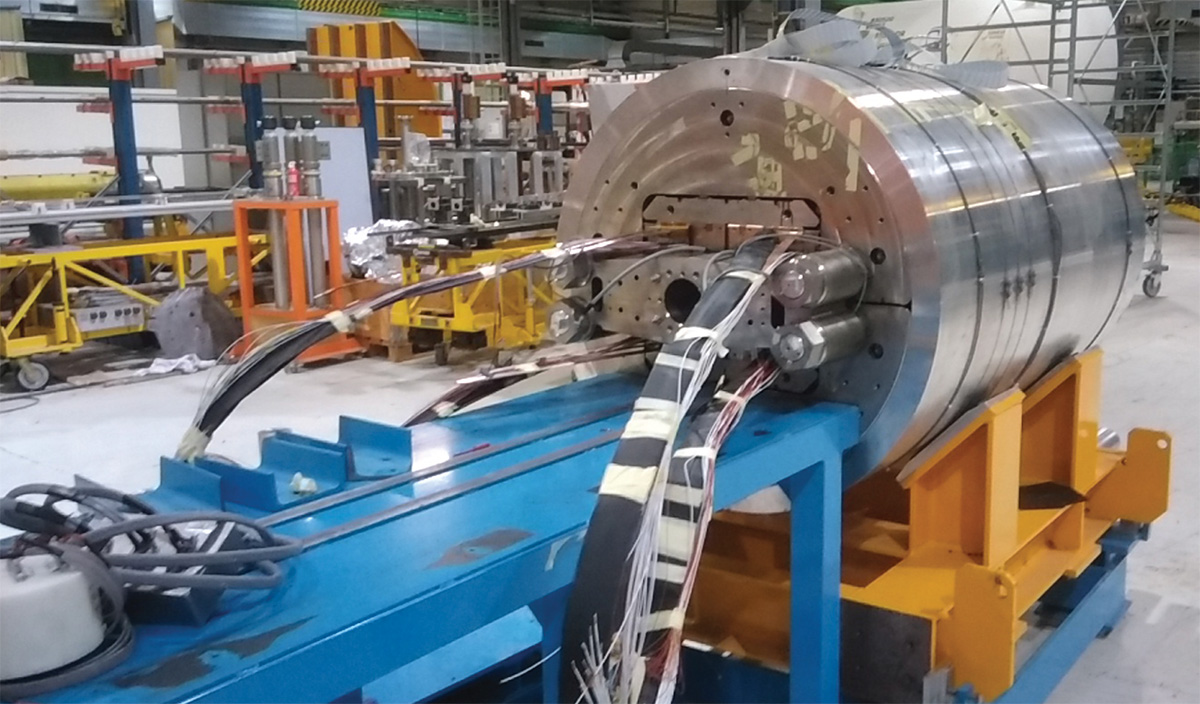
On 1 April more than 90 delegates gathered at CERN to discuss perspectives on superconducting magnet technology. The workshop marked the completion of phase 1 of the Future Superconducting Magnet Technology (FuSuMaTech) Initiative, launched in October 2017.

FuSuMaTech is a Horizon 2020 Future Emerging Technologies project co-funded by the European Commission, with the support of industrial partners ASG, Oxford Instruments, TESLA, SIGMAPHI, ELLYT Energy and BILFINGER, and academia partners CERN, CEA, STFC, KIT, PSI and CNRS. It aims to strengthen the field of superconductivity for projects such as the High-Luminosity LHC and  Future Circular Collider, while demonstrating the benefits of this investment to society at large.

“The need to develop higher performing magnets for future accelerators is certain, and cooperation will be essential,” said Han Dols of CERN’s knowledge transfer group. “The workshop helps reiterate common areas of interest between academia and industry, and how they might benefit from each other’s know-how. And just as importantly,” continued Dols, “FuSuMaTech is seeking to demonstrate the benefits of this investment by setting up demonstrator projects.”

The successful preparation of 10 project proposals for both R&D actions and industrial applications is one of the main achievements of FuSuMaTech Phase-1, noted project coordinator Antoine Dael. These projects include new designs for MRI gradient coils, the design of 14 and 16 T MRI magnets, and a conceptual design for new mammography magnets. New developments are also included in the proposals, with the design for a hybrid low–high temperature superconductor magnet, an e-infrastructure to collect material properties and a pulsed-heat-pipe cooling system.

In phase 2 of FuSuMaTech, launched with the signing of a declaration of intention between the FuSuMaTech partners on April 1, the 10 project proposals prepared during phase 1 will evolve into independent projects and make use of other European Union programmes. “We were really impressed with the interest we got from organisations outside of the project,” said Dael. “We currently have six industrial partners, two more have already contacted us today, and we expect others.”

Accelerator community comes together in Melbourne

More than 1100 accelerator professionals gathered in Melbourne, Australia, from 19 to 24 May 2019 for the 10th International Particle Accelerator Conference, IPAC’19. The superb Melbourne Convention and Exhibition Centre could easily cater for the 85 scientific talks, 72 industrial exhibitors and sponsors, 1444 poster presentations and several social functions throughout the week. Record levels of diversity at IPAC’19 saw 42 countries represented from six continents, and a relatively high gender balance for the field, with a quarter of speakers identifying as women.

In the wake of the update of the European Strategy for Particle Physics in Granada in May, accelerator designs that advance the energy and intensity range of a next-generation discovery machine were discussed, but there is no clear statement as to which is best. It will be up to the particle-physics community to decide which capability is needed to reach the most interesting physics. Reports on mature hadron facilities such as Japan’s J-PARC and the LHC were balanced by the photon sources and electron accelerators that are becoming an increasingly robust presence at IPAC, and which comprised a fifth of contributions in 2019. Presentations on the most recently commissioned accelerators were a particular highlight, with Japan’s SuperKEKB collider, Korea’s PAL-XFEL free-electron laser and Sweden’s MAX IV light source taking centre stage.

Exciting progress in the field of plasma- wakefield accelerators was also reported. In particular, Europe’s EuPRAXIA collaboration is aiming to create a laser wakefield accelerator to drive a free-electron laser facility for users in the next few years. The scientific programme was bookended by local Australian-grown talent. Suzie Sheehy from the University of Melbourne described the successes of particle accelerators and some of the future challenges, while Henry Chapman, a director of the Center for Free-Electron Laser Science at DESY and the University of Hamburg, gave the closing plenary on how particle accelerators have enabled groundbreaking work in coherent X-ray science.

“In Unity” was chosen as the theme for IPAC’19 and art was commissioned from Torres Strait islander Kelly Saylor to symbolise this coming together of the particle-accelerator community. The success of IPAC’19 demonstrates the ongoing need for face-to-face meetings to share and communicate ideas and collaborate on pressing scientific problems. In a pioneering effort for the IPAC series, the opening and closing sessions were live-streamed to the world. The aim is to broaden the impact of the conference and highlight the importance of particle accelerators to many fields of science, industry and medical applications.

Student poster prizes were won by Nazanin Samadi, an Iranian PhD student at the University of Saskatchewan, Canada, and Daniel Bafia of Fermilab and IIT. Among other awards, the Xie Jialin Prize went to Vittorio Vaccaro of the University of Naples, the Nishikawa Tetsuji Prize was won by Vladimir Shiltsev of Fermilab, the Hogil Kim Prize went to Xueqing Yan of Peking University, and the Mark Oliphant Prize was taken by Stanford PhD student James MacArthur.

IPAC takes place annually and alternates between Asia, Europe and the Americas. Next year it will move to Caen in France, and then to Brazil in 2021.

Topological avatars of new physics

Topologically non-trivial solutions of quantum field theory have always been a theoretically “elegant” subject, covering all sorts of interesting and physically relevant field configurations, such as magnetic monopoles, sphalerons and black holes. These objects have played an important role in shaping quantum field theories and have provided important physical insights into cosmology, particle colliders and condensed-matter physics.

In layman’s terms, a field configuration is topologically non-trivial if it exhibits the topology of a “mathematical knot” in some space, real or otherwise. A mathematical knot (or a higher-dimensional generalisation such as a Möbius strip) is not like a regular knot in a piece of string: it has no ends and cannot be continuously deformed into a topologically trivial configuration like a circle or a sphere.

One of the most conceptually simple non-trivial configurations arises in the classification of solitons, which are finite-energy extended configurations of a scalar field behaving like the Higgs field. Among the various finite-energy classical solutions for the Higgs field, there are some that cannot be continuously deformed into the vacuum without an infinite cost in energy, and are therefore “stable”. For finite-energy configurations that are spherically symmetric, the Higgs field must map smoothly onto its vacuum solution at the boundary of space.

The ’t Hooft–Polyakov monopole, which is predicted to exist in grand unified theo­ries, is one such finite-energy topologically non-trivial solitonic configuration. The black hole is an example from general relativity of a singular space–time configuration with a non-trivial space–time topology. The curvature of space–time blows up in the singularity at the centre, and this cannot be removed either by continuous deformations or by coordinate changes: its nature is topological.

Such configurations constituted the main theme of a recent Royal Society Hooke meeting “Topological avatars of new physics”, which took place in London from 4–5 March. The meeting focused on theoretical modelling and experimental searches for topologically important solutions of relativistic quantum field theories in particle physics, general relativity and cosmology, and quantum gravity. Of particular interest were topological objects that could potentially be detectable at the Large Hadron Collider (LHC), or at future colliders.

Gerard ’t Hooft opened the scientific proceedings with an inspiring talk on form­ulating a black hole in a way consistent with quantum mechanics and time-reversal symmetry, before Steven Giddings described his equally interesting proposal. Another highlight was Nicholas Manton’s talk on the inevitability of topological non-trivial unstable configurations of the Higgs field – “sphalerons” – in the Standard Model. Henry Tye said sphalerons can in principle be produced at the (upgraded) LHC or future linear colliders. A contradictory view was taken by Sergei Demidov, who predicted that their production will be strongly suppressed at colliders.

One of the exemplars of topological physics receiving significant experimental attention is the magnetic monopole

A major part of the workshop was devoted to monopoles. The theoretical framework of light monopoles within the Standard Model, possibly producible at the LHC, was presented by Yong Min Cho. These “electroweak” monopoles have twice the magnetic charge of Dirac monopoles. Like the ’t Hooft–Polyakov monopole, but unlike the Dirac monopole, they are solitonic structures, with the Higgs field playing a crucial role. Arttu Rajantie considered relatively unsuppressed thermal production of generic monopole–antimonopole pairs  in the presence of the extreme high temperatures and strong magnetic fields of heavy-ion collisions at the LHC. David Tong discussed the ambiguities on the gauge group of the Standard Model, and how these could affect monopoles that are admissible solutions of such gauge field theories. Importantly, such solutions give rise to potentially observable phenomena at the LHC and at future colliders. Anna Achucaro and Tanmay Vachaspati reported on fascinating computer simulations of monopole scattering, as well as numerical studies of cosmic strings and other topologically non-trivial defects of relevance to cosmology.

One of the exemplars of topological physics currently receiving significant experimental attention is the magnetic monopole. The MoEDAL experiment at the LHC has reported world-leading limits on multiply magnetically charged monopoles, and Albert de Roeck gave a wide-ranging report on the search for the monopole and other highly-ionising particles, with Laura Patrizii and Adrian Bevan also reporting on these searches and the machine-learning techniques employed in them.

Supersymmetric scenarios can consistently accommodate all the aforementioned topologically non-trivial field theory configurations. Doubtless, as John Ellis described, the story of the search for this beautiful – but as yet hypothetical – new symmetry of nature, is a long way from being over. Last but not least, were two inspiring talks by Juan Garcia Bellido and Marc Kamionkowski on the role of primordial black holes as dark matter, and their potential detection by means of gravitational waves.

The workshop ended with a vivid round-table discussion of the importance of a new ~100 TeV collider. The aim of this machine is to explore beyond the historic watershed represented by the discovery of the Higgs boson, and to move us closer to understanding the origin of elementary particles, and indeed space–time itself. This Hooke workshop clearly demonstrated the importance of topological avatars of new physics to such a project.

Niobium-tin cavities for smaller accelerators

A team at Cornell University in the US has demonstrated that high-frequency superconducting radio-frequency (SRF) cavities made from niobium–tin alloy can be operated more efficiently than conventional niobium designs, representing a step towards smaller and more economical particle accelerators.

SRF cavities are the gold standard for the acceleration of charged-particle beams and are used, for example, in the LHC at CERN and the upcoming LCLS-II free-electron-laser X-ray source at SLAC. Currently, the material of choice for the best accelerating cavities is niobium, which frequently has to be operated at a temperature of around 2 K and requires costly cryogenic equipment to cool the cavity in a bath of superfluid liquid helium. The technology is only heavily used at large-scale accelerators, and not at smaller institutions or in industry due to its complexity and costs.

Researchers around the world are striving to remove some of the barriers prohibiting broader uptake of SRF technology. Two major obstacles still need to be overcome to make this possible: the temperature of operation, and the size of the cavity.

Earlier this year, a team at Cornell led by Matthias Liepe demonstrated that small, high-frequency triniobium-tin (Nb3Sn) cavities can be operated very efficiently at a temperature of 4.2 K. While seemingly only slightly warmer than the 2 K required by niobium cavities, this small rise in temperature omits the need for superfluid-helium refrigeration.

The size of the cavity is inversely related to the frequency of the oscillating radio-frequency electromagnetic field within it: as the frequency doubles, the necessary transverse size of the cavity is halved. A smaller cavity with a higher frequency also demands a smaller cryo­module; what was once 1 m in diameter, the typical size of an accelerating SRF cryomodule, can now be roughly half that size.

The vast majority of SRF cavities currently in use operate at frequencies of 1.5 GHz and below – a region favoured because RF power losses in a superconductor rapidly decrease at lower frequency. But this results in large SRF accelerating structures. Cornell graduate student Ryan Porter successfully made and tested a considerably smaller proof-of-principle Nb3Sn cavity at 2.6 GHz with promising results. “Niobium cannot operate efficiently at 2.6 GHz and 4.2 K,” Porter explains. “But the performance of this 2.6 GHz Nb3Sn cavity was just as good as the 1.3 GHz performance. Compared to a niobium cavity at the same temperature and frequency, it was 50 times more efficient.”

“This is really the first step that shows that you can get good 4.2 K performance at high frequency, and it is quite promising,” adds Liepe. “The dream is to have an SRF accelerator that can fit on top of the table.”

Clocking the merger of two white dwarfs

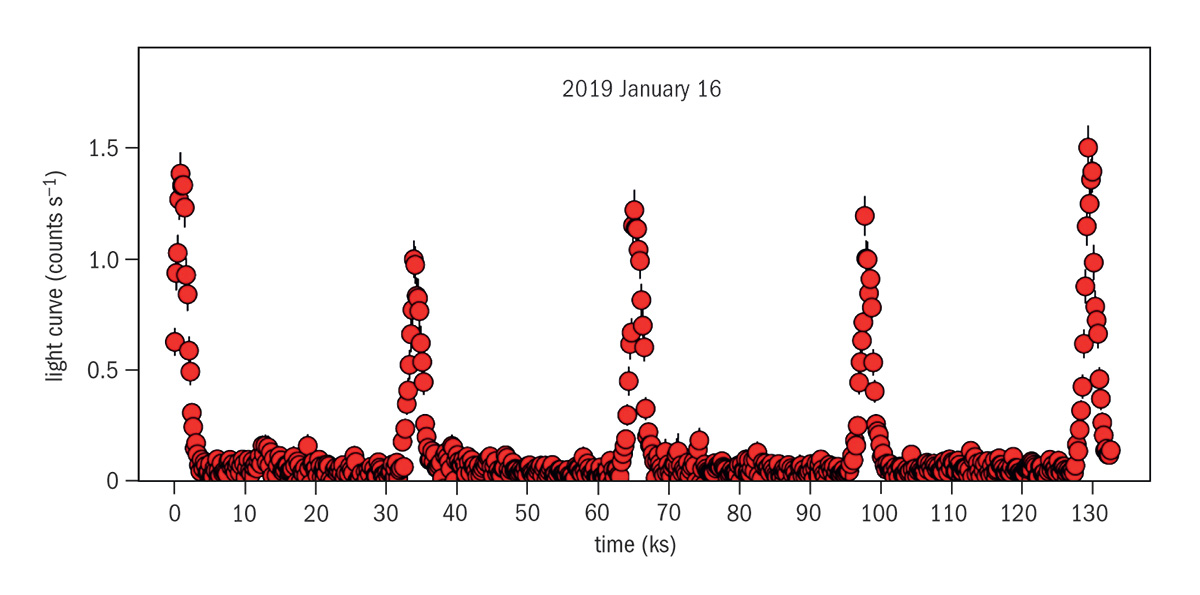
A never-before-seen object with a cataclysmic past has been spotted in the constellation Cassiopeia, about 10,000 light years away. The star-like object has a temperature of 200,000 K, shines 40,000 times brighter than the Sun and is ejecting matter with velocities up to 16,000 km s–1. In combination with the chemical composition of the surrounding nebula, the data indicate that it is the result of the merger of two dead stars.

Astronomers from the University of Bonn and Moscow detected the unusual object while searching for circumstellar nebulae in data from NASA’s Wide-Field Infrared Survey Explorer satellite. Memorably named J005311, and measuring about five light years across, it barely emits any optical light and radiates almost exclusively in the infrared. Additionally, the matter it emits consists mostly of oxygen and does not have any signs of hydrogen or helium, the two most abundant materials in the universe. All this makes it unlike a normal massive star and more in line with a white dwarf.

White dwarfs are “dead stars” that remain when typical stars have used up all of their hydrogen and helium fuel, at which point the oxygen- and carbon-rich star collapses into itself to form a high-mass Earth-sized object. The white dwarf is kept from further collapse into a neutron star only by the electron degeneracy pressure of the elements in its core, and its temperature is too low to enable further fusion. However, if the mass of the white dwarf increases, for example if it accretes matter from a nearby companion star, it can become hot enough to restart the fusion of carbon into heavier elements. This process is so violent that the radiation pressure it produces blows the star apart. Such “type 1A” supernovae are observed frequently and, since they are unleashed when a white dwarf reaches a very specific mass, they have a standard brightness that can be used to measure cosmic distances.

Despite having the chemical signature of a white dwarf, such an object cannot possibly burn as bright as J005311. By comparing the characteristics of J005311 with models of what happens when two white dwarfs merge, however, the explanation falls into place. As two white dwarfs, likely produced billions of years ago, orbited one another they slowly lost momentum through the emission of gravitational waves. Over time, the objects came so close to each other that they merged. This would commonly be expected to produce a type 1A supernova, but there are also models in which carbon is ignited in a more subtle way during the merging process, allowing it to start fusing without blowing the newly formed object apart. J005311’s detection appears to indicate that those models are correct, marking the first observation of a white-dwarf merger.

The rejuvenated star is, however, not expected to live for long. Based on the models it will burn through its remaining fuel within 10,000 years or so, forming a core of iron that is set to collapse into a neutron star through a violent event accompanied by a flash of neutrinos and possibly a gamma-ray burst. Using the speed of the ejected material and the distance it has reached from the star by now, it can be calculated that the merger took place about 16,000 years ago, meaning that its final collapse is not far away.

How many protons collided in ATLAS in Run 2?

The large amount of Run-2 data (collected in 2015–2018) allows the LHC experiments to probe previously unexplored rare processes, search for new physics and improve Standard Model measurements. The amount of data collected in Run 2 can be quantified by the integrated luminosity – a number which, when multiplied by the cross section for a process, yields the expected number of interactions of that type. It is a crucial figure. The uncertainty of several ATLAS Run-1 cross-section measurements, particularly of W and Z production, was dominated by systematic uncertainty on the integrated luminosity. To minimise this, ATLAS performs precise absolute and relative calibrations of several luminosity-sensitive detector systems in a three-step procedure.

The first step is an absolute calibration of the luminosity using a van-der-Meer beam-separation scan under specialised beam conditions. By displacing the beams horizontally and vertically and scanning them through each other, it is possible to measure the combined size of the colliding proton bunches. Determining in addition the total number of protons in each colliding bunch from the measurement of the beam currents, the absolute luminosity of each colliding bunch pair can be derived. Relating this to the mean number of interactions observed in the LUCID-2 detector – a set of photomultiplier tubes located 17 m in either direction along the beam pipe that detect the Cherenkov light of particles which come from the interaction – the scale for the absolute luminosity measurement of LUCID-2 is set.

The second step is to extrapolate this calibration to LHC physics conditions, where the number of interactions increases from fewer than one to around 20–50 interactions per crossing, and the pattern of proton bunches changes from isolated bunches to trains of consecutive bunches with 25 ns spacing. The LUCID-2 response is sensitive to these differences. It is corrected with the help of a track counting algorithm, which relates the number of interactions to the number of tracks reconstructed in ATLAS’s inner detector.

The final step is to monitor the stability of the LUCID-2 calibration over time. This is evaluated by comparing the luminosity estimate of LUCID-2 to those from track counting in the inner detector and various ATLAS calorimeters over the course of the data-taking year (figure 1). The agreement between detectors quantifies the stability of the LUCID-2 response.

Using this three-step method and taking into account correlations between years, ATLAS has obtained a preliminary uncertainty on the luminosity estimate for the combined Run-2 data of 1.7%, improving slightly on the Run-1 precisions of 1.8% at 7 TeV and 1.9% at 8 TeV. The full 13 TeV Run-2 data sample corresponds to an integrated luminosity of 139 fb–1 – about 1.1 × 1016 proton collisions.

New constraints on charm–quark hadronisation

One of the most useful ways to understand the properties of the quark–gluon plasma (QGP) formed in relativistic heavy-ion collisions is to study how various probes interact when propagating though it. Heavier quarks, such as charm, can provide unique insights as they are produced early in the collisions, and their interactions with the QGP differ from their lighter cousins. One important input to these studies is a detailed understanding of hadronisation, by which quarks form experimentally detectable mesons and baryons.

The lightest charm baryon and meson are the Λ+c (udc) and the D0 (cu̅). In proton– proton (pp) collisions, charm hadrons are formed by fragmentation, in which charm quarks and antiquarks move away from each other and combine with newly generated quarks. In heavy-ion collisions, hadron production can also occur via “coalescence”, whereby charm quarks combine with other quarks while traversing the QGP. The contribution of coalescence depends strongly on the transverse momentum (pT) of the hadrons, and is expected to be much more significant for charm baryons than for charm mesons, as they contain more quarks.

The CMS experiment has recently determined the Λ+c/D0 yield ratio over a broad range of pT using the Λ+c→ pKπ+  and D0 → Kπ+ decay channels in both pp and lead–lead (PbPb) collisions, at a nucleon–nucleon centre-of-mass energy of 5.02TeV. Comparing the behaviour of the Λ+c/D0 ratio in different collision systems allows physicists to study the relative contributions of fragmentation and coalescence.

The measured Λ+c/D0-production cross-section ratio in pp-collisions (figure 1) is found to be significantly larger than that calculated in the standard version of the popular Monte-Carlo event generator PYTHIA, while the inclusion of an improved description of the fragmentation (“PYTHIA8+CR”) can better describe the CMS data. The data can also be reasonably described by a different model that includes Λ+c baryons produced by the decays of excited charm baryons (dashed line). However, an attempt to incorporate the coalescence process characteristic of hadron production in heavy-ion collisions (solid line) fails to reproduce the pp-collision measurements.

The CMS collaboration also measured Λ+c production in PbPb collisions. The Λ+c/D0-production ratio for pT>10GeV/c is found to be consistent with that from pp collisions. This similarity suggests that the coalescence process does not contribute significantly to charm hadron production in this pT range for PbPb collisions. These are the first measurements of the ratios at high pT for both the pp and PbPb systems at a nucleon–nucleon centre-of-mass energy of 5.02TeV.

In late 2018, CMS collected data corresponding to about 10 times more PbPb collisions than were used in the current measurement. These will shed new light on the interplay between the different processes in charm–quark hadronisation in heavy-ion collisions. In the meantime, the current results highlight the lack of understanding of charm–quark hadronisation in pp collisions, a subject that requires further experimental measurements and theoretical studies.

bright-rec iop pub iop-science physcis connect