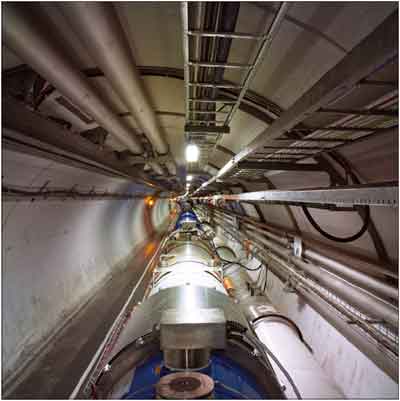
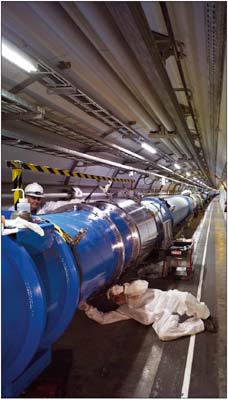
The cool-down and commissioning of the LHC continues to progress well. Six of the eight sectors were at a nominal temperature of 1.9 K by the end of the first week of October, and the final two sectors, 3-4 and 6-7, were on course to be fully cold two weeks later. Teams are starting to power the magnets as each sector reaches 1.9 K, so the machine should be fully powered soon after the cool-down is completed.
The new layer of the quench detection system (QDS), installed in four sectors, is functioning well. In particular, the new software and hardware QDS components allowed teams to measure the resistance of all of the splices in sector 1-2 quickly and with unprecedented accuracy. All of the measured resistances showed small values and most are significantly below the original specifications. Teams were also able to test the new energy-extraction system that dumps the stored magnetic energy twice as quickly as previously. This provides better protection for the whole machine.
Preparations are thus continuing towards the planned restart, with the injection of the first bunches of protons into the machine scheduled for mid-November. The procedure will be to establish stable beam initially in each direction, clockwise and anticlockwise, just as with LEP 20 years ago (When LEP, CERN’s first big collider, saw beam). This will be followed by a short period of collisions at the injection energy of 450 GeV per beam. Commissioning will then begin on ramping the energy to 3.5 TeV, again working first with each beam in turn. After this, LHC physics will finally begin with collisions at this energy.
Remember the night of 24 November 1959? Of course I do. I was sitting in the canteen eating supper with John Adams, as we had done many times that fall. There was not a wide choice of food in those days – spaghetti or ravioli or, occasionally, fried eggs – but our thoughts were not on the meal. We had hardly spoken, our spirits were low, then John lit his pipe and said, “Well, now that we’ve finished eating, we might as well walk over and see if anything is happening.” As we went in the direction of the PS buildings, I asked him, “Shall we go to the Main Control Room or over to the Central Building? Chris Schmelzer said that Wolfgang Schnell has that radial phase-control thing working.” John pulled on his pipe, “Probably doesn’t matter, it may not do much good.” Our hopes had been dashed fairly often. Then, after a few more steps, he added, “Let’s go to the Central Building and see what they’re up to.” It was about quarter to seven.
Trudging along, I thought back over the past weeks, back to 16 September when, during the Accelerator Conference at CERN, Adams had made the electrifying announcement that protons injected into the PS had gone one turn round the magnet ring. Since that time, attempts to put the PS into operation had brought a few triumphant moments but most of the time we had been discouraged, puzzled by the beam’s behaviour, frustrated by faulty equipment or, after quick trials of this remedy or that, in despair over the lack of success. The protons just didn’t want to be accelerated.
I had to go back soon to help on the AGS. Pressure for high-energy protons in the United States was mounting even higher with the imminent production of European ones, so I had already booked passage to sail home. For some time I had been saying to everyone that we must get the protons through “transition” before I left. Now it was 24 November, I must leave Geneva the following day, but the prospects were bleak. Would this beam-night be any different?
Although the PS had been ready to accept protons from the linac in September, a great deal of final testing had not been completed and installation and cabling was going on in the ring and the Main Control Room. Consequently, for the first few weeks, beam tests could be scheduled only for Tuesdays and Thursdays from six to ten in the evening; during the final weeks of my stay there was also some time on Friday evenings. During these sessions, our spirits ranged from high to low as the beam behaved somewhat as expected or baffled us completely.
Early in October, the programmed part of the r.f. system was ready for trial. Schmelzer and Hans Geibel were in the Central Building and Pierre Germain was peering at scopes in the Main Control Room. Linac said beam was ready and inflector working. Hine was in the MCR, looking at the injected beam, adjusting quadrupoles, changing inflector voltage, rushing from one scope to another. The beam isn’t spiralling properly… wait… all right, go ahead r.f…. Central Building says it’s on, programme on. Yes, beam is being captured… it’s accelerated… but lost after a few milliseconds. Changes in the r.f. programming… is the beam better… yes, now it goes for 10 milliseconds… no, it’s 15… now it’s gone again. But we went home satisfied – some beam had been captured, there had been some acceleration.
More evenings with trials of the r.f. programme followed. The r.f. system had been designed to run with a frequency programme to a few GeV, then to switch over to an automatic system with a phase-lock and with errors in the beam’s radial position fed back to the r.f. amplitude for correction. When this automatic system was ready, it was tried with switching-in much earlier than planned and this did succeed in accelerating the beam somewhat longer. But then it was lost, usually in a series of steps and all gone after a few tens of milliseconds. I don’t remember if we reached 2 or 3 GeV on an occasional pulse, but certainly no more. The behaviour of the beam remained erratic and unstable. What was wrong?
Measurements of the beam’s position on the radial pickup electrodes were hastily plotted by Adams to show that the closed orbit was off in some places, but only by a few centimetres, surely not enough to prevent some beam from going to transition. The rate of rise of the magnetic field was varied to look for eddy-current troubles. Colin Ramm and the Magnet Group rushed round the ring in the daytime, searching for stray fields or remanence effects. Jean Gervaise scanned the survey data for possible errors in magnet positions while Jack Freeman hunted for signs of beam disappearances with radiation monitors. More trials of the r.f., with and without phase-lock, more diagnostic equipment hurriedly inserted, more measurements. But the protons made no progress.
During those Tuesday and Thursday evenings in October and early November, many of the PS builders gathered round the tables in the centre of the Main Control Room. At one stage, to save (or prevent?) people from going home to eat and being late for the scheduled 6 p.m. start-up, Hine arranged cold meats, cheese and bread to be sent to the MCR. As I recall this was not a rousing success. There were periods of frantic activity. But there were also long periods of waiting. We sat at the tables and waited and waited. One night, just as beam came on, all of the lights went out – trouble at the CERN main power house – and we groped our way out in darkness, Adams striking matches all the way.
I had a desk in Mervyn Hine’s office where, in the mornings, particularly after beam-nights, one after another would come in – Johnsen, Hereward, Schoch, Schmelzer, sometimes Adams, many others – and the talk would start. Are the closed-orbit deviations causing serious trouble? Is the linac emittance all right? What about the missing bunches, caused by the poor performance of the inflector? Every Monday morning, in the PS Conference Room, there was a meeting of the “Running-in Committee”, starting at 9 a.m. sharp and lasting until well after 1 p.m., or even 2 p.m. Discussions and arguments – on and on.
Occasionally, on a Sunday, I would go along the lake to visit my good friends, Kjell and Aase Johnsen, and we would recall the days in 1953 when the first designs for the PS were being worked out by groups in various places (Harwell, Paris, Heidelberg, Bergen etc.) all under the leadership of Odd Dahl in Bergen. John Blewett and I had spent some months in Bergen in the summer of 1953 and, during that time, Johnsen had been working on the behaviour of the beam at transition energy (where there is no phase stability). His calculations had given us the first confidence that beam could be accelerated through this dangerous region.
Many of these things were in my thoughts as Adams and I approached the Central Building. I was depressed about having to leave the next day, with the protons still balking. I had wanted so much to see this machine operate successfully before I left. All through the years, I had been so involved with CERN and its PS that I had felt a glow of pride with each milestone passed during construction. More than ever, over these past weeks, I had felt that it was partly my machine too. John interrupted my thoughts with, “Well, Hildred, we haven’t done much during your stay. It’s hardly been worthwhile, you haven’t learnt…”. I broke in, “Wolfgang thinks this radial phase-control will really work, he’s very optimistic, and maybe…”. But I knew that no-one else had great hopes for any improvement. Even Schmelzer had thought it was hardly worth the effort, but Schnell had gone ahead over the last couple of weeks wiring it up for a quick test. Just a few days before, I had been down in the basement lab, listening to his enthusiasm. The idea was to use the radial-position signal from the beam to control the r.f. phase instead of the amplitude. With this system, the sign of the phase had to be reversed at transition and, in his haste, Schnell had built this part into a Nescafe tin, the only thing of the right size.
Adams opened the door to the Central Building. For a moment the lights blinded us, then we saw Schmelzer, Geibel and Rosset – they were smiling. Schnell walked towards us and, without a word, pulled us over to the scope. We looked… there was a broad green trace… What’s the timing… why, why the beam is out to transition energy? I said it out loud – “TRANSITION!”
Just then a voice came from the Main Control Room. It was Hine, sounding a bit sharp (he was running himself ragged, as usual, and more frustrated than anyone), “Have you people some programme for tonight, what are you planning to do? I want to…”. Schnell interrupted, “Have you looked at the beam? Go and look at the scope.” A long silence… then, very quietly, Hereward’s voice, “Are you going to try to go through transition tonight?” But Schnell was already behind the racks with his Nescafe tin, Geibel was out in front checking that the wires went to the right places, not the usual wrong ones. Quickly, quickly, it was ready. But the timing had to be set right. Set it at the calculated value… look at the scope… yes, there’s a little beam through… turn the timing knob (Schnell says that I yelled this at him, I don’t remember)… timing changed, little by little … the green band gets longer… no losses. Is it… look again… we’re through… YES, WE’RE THROUGH TRANSITION!
How far? What’s the energy? Something below 10 GeV because the magnet cycle is set for lower fields and a one-second repetition rate for testing. Hurried call to Georgijevic in the Power House. Change the magnet cycle to full field. Beam off while we wait. The long minutes drag by. Will the beam come on again? This is just the time for that dratted inflector to go off again, or the high-voltage set to arc over. Hurry up, Power House!
I remember Schnell murmuring, “I promised you we’d get through transition.” But we were all rather awed by it. No one spoke – Schmelzer lit a cigar, Adams relit his pipe, we waited.
Finally, the call came through – magnet on again, pulsing to top field. Call the linac for beam. Beam on, it’s injected, inflector holding, beam spiralling, r.f. on, all set as before, with the blessed phase-control and the Nescafe tin. Change timing on the scopes, watch them and hold your breath. One second (time for acceleration) is a long time. The green band of beam starts across the scope… steadily, no losses… to transition… through it… on, on how far will it go… on, on IT’S ALL THE WAY! Can it be? There it goes again, all the way as before… and again… and again. Beautiful, smooth, constant, no-loss green band… Look again at the timing… all the way… it must be 25 GeV! I’m told that I screamed, the first sound, but all I remember is laughing and crying and everyone there shouting at once, pumping each other’s hands, clapping each other on the back while I was hugging them all. And the beam went on, pulse after pulse.
Slowly, we came back to Earth. John Adams was first. Looking very calm, he went to the phone to ring up the director-general, C J Bakker, to tell him the news but Bakker didn’t seem to grasp it right away. (Could it be that John was just a little incoherent?) Schmelzer was beaming, for once even his cigar forgotten, cold on the ashtray. Schnell looked supremely happy, he was the hero of the hour. Gradually, I collected my wits enough to write out a telegram to Brookhaven that Geibel dashed off to send immediately. We went over to the Main Control Room and found Hine calling round to locate some sort of counter for checking the energy. Johnsen was saying, heatedly, “Did someone change the timing on this scope? I just turned away from it for a moment and here is the beam going out…” How could it be 25 GeV without poleface windings on? But all of the scopes showed the same smooth, green trace, one-second long – it really was 25 GeV. Even more unbelievable, the signal on the pickup electrodes gave an intensity of about 1010 protons a pulse. No, that can’t possibly be right, we’re lucky if it’s 109. Check and recheck… look at the calibrations… yes, that number is right, 1010.
The rest of that evening has been described many times. People came flooding in, I don’t know who told them the news. Polaroid pictures of the scope traces were passed around for signatures on the back, cherished souvenirs. Bottles appeared, by magic, including the famous bottle of vodka given to Adams by Nikitin (PS and LEP: a walk down memory lane). Bakker arrived with a bottle of gin under his arm. Bernardini bounded in, hugged Adams and Hine, launched into a description of what he wanted to do as a first experiment, then lapsed into pure Italian. Miss Steel and the secretaries were there, smiling happily – they had had to put up with our complaints and bad humours. I remember Colin Ramm muttering, “Where do we go from here? What about two or three hundred GeV?” (He was ahead of the times.) I left shortly before midnight to pack my suitcases.
Early next morning (at 2 a.m. New York time) I had a phone call from John Blewett offering congratulations from Brookhaven and asking questions. My telegram had come as a bombshell and the word had spread rapidly across the United States. What had brought success? I told him about the phase-control system and, since it was similar to the one being built for the AGS, it was a relief to know that this was just what the protons liked.
Then out to the Lab for final goodbyes, over to the auditorium to hear Adams tell the story to all of CERN, my PS friends grinning proudly but no one happier than I.
• Hildred Blewett (1911–2004) joined Brookhaven National Laboratory at its start in 1947 and in the early 1950s became one of the team who collaborated on the design of CERN’s first high-energy accelerator, the Proton Synchrotron (PS), while also working on the similar machine proposed for Brookhaven, the Alternating Gradient Synchrotron (AGS). In the summer of 1959 she was invited to CERN to observe the commissioning and start-up of the PS, several months before the AGS would be ready.
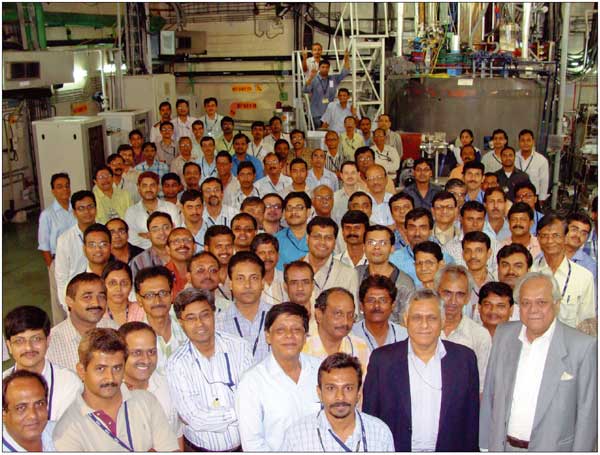
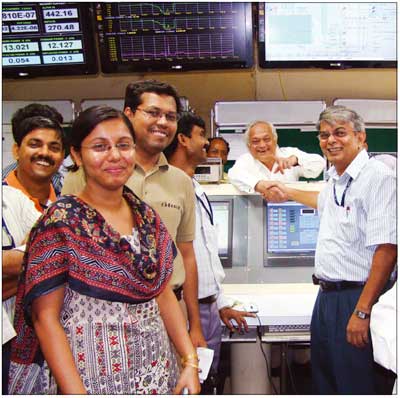
A beam of Ne+3 has been accelerated by K-500 Superconducting Cyclotron at the Variable Energy Cyclotron Centre (VECC), Kolkata, up to the extraction radius of 650 mm. At 3.00 a.m. on 25 August, the beam probe monitored a beam current of around 40 nA. This measurement was confirmed by a beam viewer that uses a boroscope and through the observation of neutron and gamma radiation by the radiation monitor located outside the superconducting magnet. The energy of the Ne+3 beam at a radius of 650 mm is calculated to be 88 MeV. The presence of beam was further confirmed by activation analysis of an aluminium target probe in tests at a radiochemistry laboratory.
VECC’s superconducting cyclotron is the most advanced, hi-tech accelerator ever constructed in India. The cyclotron’s main structure, a 100-tonne iron-core superconducting magnet, is the largest in the country and has been operating virtually non-stop for more than three years. It produces a magnetic field of around 5 T over an area of about 1.3 m2. Its cold mass of about 8 t, consisting of the niobium-titanium superconducting coil and stainless-steel bobbin, has been kept continuously cooled at –269 °C inside a sophisticated cryostat. More than 35 km of superconducting wire was used to construct the coil at VECC. About 300 l of liquid helium is required to keep the coil cooled to its operating temperature, together with hundreds of litres of liquid nitrogen at –195 °C, every day. It is the first large-scale iron-core superconducting system in India.
The “3-Dee” RF system, which provides the acceleration kicks to the beam, has also functioned very satisfactorily. This system delivers more than 100 kW of radiofrequency power per cavity.
The main control room of the accelerator has been a hive of activity since 11 May when the first beam of low-energy charged particles was injected for acceleration. Since then all of the cyclotron systems have undergone continuous endurance tests. At the same time, the cyclotron team has also carried out all possible critical tests to ensure that the cyclotron is functioning with a circulating internal beam.
With very few such superconducting cyclotrons in the world, VECC has joined an exclusive club. The accelerator’s high-energy beams will be used for frontline basic and applied research in nuclear sciences. The facility will soon be dedicated to the nation and will open for research to the international community.
On 2 September the cool down of LHC sector 6-7 got underway, following some minor repair work. As the last sector to be cooled down, this marked a major milestone towards the restart of the collider later this year.
The cool down of sector 6-7 began two weeks earlier but it was interrupted by the detection of a short-circuit on the main dipole circuit. The cause of the short-circuit was later tracked down to poor insulation in a magnet busbar, which had been degraded by friction against a screw as the structure contracted during the cool down. After repair work followed by electrical and vacuum validation, the sector was once again ready to cool down.
In sector 8-1, the flexible hose that caused the helium leak into the insulation vacuum has been replaced and the sector is now being cooled down again. The cool down of sector 3-4, the one affected by the incident on 19 September 2008, also began at the end of August, thus marking the end of a complex phase of repair work.
Meanwhile consolidation work on the LHC has continued. On 26 August, the first two fully tested crates for the new quench-protection system (QPS) were installed in sector 1-2. These are the first of a total of 436 crates to be installed around the ring. The two crates include detectors for both the enhanced busbar protection and the symmetric quench protection.
Training quenches on magnets in sector 5-6 in June 2008 revealed that heat transfer to a neighbouring magnet can cause a quench that develops identically in two magnet coils. The original detection system compared voltage signals from two coils to detect a resistive build-up in either one, but if the signals develop in the same way, the quench would go unnoticed. The new protection system monitors the voltage across four adjacent dipoles (or two adjacent quadrupoles), allowing a symmetric quench to be detected, as well as providing a back-up detection method for normal, asymmetric quenches.
To test the crates before installation, a dedicated test bed has been created, capable of simulating all of the conditions in the LHC, from a symmetric quench to an increase in busbar resistance. The teams are working two shifts a day, including weekends, to test the new crates. Two more test benches are also being built to increase the production rate. The whole task is on target for completion in mid-October.
Another important new task for the QPS team is to speed up the energy extraction from the magnets. The quicker the energy can be extracted, the lower the risk of dangerously high temperatures in the event of a quench. The time constant for the dipoles will be halved to about 50 s. The decision to run at 3.5 TeV, and therefore with lower current in the magnets, has made this task relatively straightforward. Switching two of the three “dump” resistors into a series circuit, instead of having all three resistors in parallel, allows the energy to be converted into heat much faster. In the quadrupole circuits, the task is more complex. Reducing the time constant to the desired 10 s, from a previous 35 s, requires adding extra, newly designed resistors.
The new QPS system will also allow accurate resistance measurements to be taken remotely. This will save a huge amount of time and effort for the next rounds of interventions – for example when the energy of the LHC is increased.
AMS-02, the experiment that will seek dark matter, missing matter and antimatter in space aboard the International Space Station (ISS), has recently received the green light to be part of the STS-134 NASA mission in 2010.
NASA has announced that the last or last-but-one mission of the space shuttle programme will be the one that is to deliver the Alpha Magnetic Spectrometer (AMS) to the ISS. The space shuttle Discovery is due to lift off in July 2010 and its mission will include the installation of AMS to the exterior of the space station, using arms on both the shuttle and station. Last year both the US House of Representatives and the Senate unanimously approved a bill requesting NASA to install AMS on the ISS, which was signed by president George W Bush a month later.
AMS is a cosmic-ray detector based on technologies developed at CERN, where it is currently based. The installation of the detector to the right side of the space station’s truss will be a delicate operation. It will be lifted out by the shuttle’s robotic arm and handed on to the station’s robotic arm, which will then install AMS in its location.
The astronauts selected for this flight include the European astronaut Roberto Vittori, a colonel in the Italian air force with a degree in physics. He will come to CERN in October with the rest of the crew to learn more about the experiment. The data collected by AMS will be transmitted instantly from the ISS to the Marshall Space Flight Center in Huntsville, Alabama, and finally to CERN, where all of the detector controls and physics analyses will be performed.
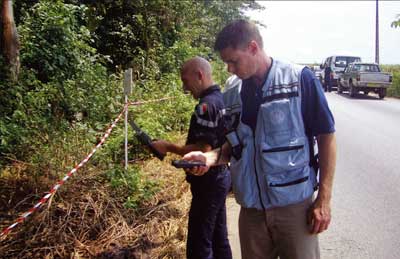
Much of the interesting work that happens at CERN is underground – but not all. Since 2002, the team that runs UNOSAT, the Operational Satellite Applications Programme of the United Nations Institute for Training and Research (UNITAR), has been based at the laboratory’s Meyrin site. This hosting arrangement, which has support from the Swiss government, resulted from a pioneering institutional agreement between CERN and the UN. The programme demonstrates the potential for collaboration between these two international bodies in areas of mutual interest.
The mission of UNITAR, established by the UN General Assembly, is to deliver innovative training and to conduct research on knowledge systems and methodologies. Through adult professional training and technical support, the institute contributes towards developing the capacities of tens of thousands of professionals around the world using face-to-face and distance learning.
UNOSAT is a technology-based initiative supported by a team of specialists in remote-sensing and geographic-information systems. It is part of UNITAR’s Department of Research, mainly because of its groundbreaking innovations in the use of satellite-derived solutions in the context of the UN work. As a result of its research and applications, UNOSAT offers very high-resolution imagery to enhance humanitarian actions; monitors piracy using geospatial information; connects the world of the UN to Grid technology; and it has introduced objective satellite images into the assessment of human-rights violations.
A vital source of information
Initially created to explore the potential of satellite Earth observation for the international community, this programme has developed specific mapping and analysis services that are used by various UN agencies and by national experts worldwide. UNOSAT’s mission is to deliver integrated satellite-based solutions for human security, peace and socioeconomic development. Its most important goal, however, is to make satellite data and geographic information easily accessible to an increasing number of UN and national experts who work with geographic information systems (GIS).
The UNOSAT team combines the experience of satellite imagery analysts, database programmers and geographic-information experts with that of fieldworkers and development experts. This unique set of skills gives the UNOSAT team the ability to understand the needs of a variety of international and national users and to provide them with suitable information anywhere and anytime. Anywhere, because – thanks to CERN’s IT support – UNOSAT can handle and store large amounts of data and transfer maps as needed directly via the web; anytime, because UNOSAT is available 24 hours a day, every day of the year.
In simple terms, UNOSAT acquires and processes satellite data to produce and deliver information, analysis and observations, which are used by the UN and national entities for emergency response and to assess the impact of a disaster or conflict, or to plan sustainable development. The main difference between this programme and other UN undertakings is that UNOSAT uses high-end technology to develop innovative solutions. It does this in partnership with the main space agencies and commercial satellite-data providers.
One such innovation was the creation in 2003 of a new humanitarian rapid-mapping service. Now fully developed, the service has been used in more than 100 major disasters and conflict situations, and has produced more than 900 satellite-derived analyses and maps. The work requires the rapid acquisition and processing of satellite imagery and data for the creation of map and GIS layers. These are then used by the headquarters of UN agencies to make decisions and in the field during an emergency response to co-ordinate rescue teams and assess the impact of a given emergency. This type of map was of great use in the aftermath of the Asian Tsunami of 2004 and in response to the 2005 earthquake in Pakistan. Similar maps have been used to monitor the impact of the conflict between Israel and the Hezbollah in Southern Lebanon and during the Middle East crisis in Gaza. They have also been valuable in monitoring the flux of displaced populations, most recently, during the conflict this year in Sri Lanka (figure 1).
There are tens of less publicized crises every year in which the UN is involved because of their humanitarian consequences on thousands of innocent civilians in developing countries. UNOSAT supports the work of relief workers and NGO volunteers with timely and accurate analysis of a situation on the ground, and responds to requests from the field for particular geographic information.
The work of UNOSAT is not solely related with emergencies, although the maps available on the website all refer to humanitarian assistance. This publication policy is linked to enabling humanitarian workers in various field locations to download maps prepared by UNOSAT at CERN via internet or satellite telecommunications. In addition, there are a large number of maps and analyses that are not publicly available on the UNOSAT website because they are part of project activities requested by UN agencies, such as the UN Development Programme, the International Organization for Migration and the World Health Organization.
Once an emergency is over, the work of the UN continues with assistance to governments in rehabilitation and reconstruction. UNOSAT remains engaged beyond the emergency phase by supporting early recovery activities that are undertaken to help local populations get back to normality following a disaster or conflict. Satellites are helpful in these circumstances: think of the work required to reconstruct an entire cadastre, for example, without appropriate geographic information; or to plan the re-establishment of road and rail networks without accurate information on the extent of damage suffered.
UNOSAT’s experience in mapping and analysis – and its innovative methodologies – are regularly transferred to the world beyond, thanks to training modules and information events that are organized by the UN or directly by UNITAR. At CERN, for example, UNOSAT hosts and trains national experts from Indonesia, Nicaragua and Nigeria, to mention a few recent cases. These experts receive intensive two-week training sessions, during which they stay at CERN. In other cases, UNOSAT sends its trainers abroad to train and provide technical support to fieldworkers in developing countries. All of the experts trained by UNOSAT then become part of a global network of skilled staff who can be connected to work together when needed.
The technical work of UNOSAT is made possible by the agreement between UNITAR and CERN, so CERN’s support is of fundamental importance. The recognition – and even the awards that UNOSAT enjoys in return for its relentless work – go in part also to all those at CERN who help and support UNOSAT work.
Conscious of the potential held by this success story, CERN and UNITAR took the opportunity of the renewal of their agreement in December 2008 to begin a series of consultations to strengthen their collaboration in areas of mutual interest. The realm of scientific applications to advance international agendas that guide the work of the UN is being discussed at senior level and ideas for joint undertakings are currently being considered.
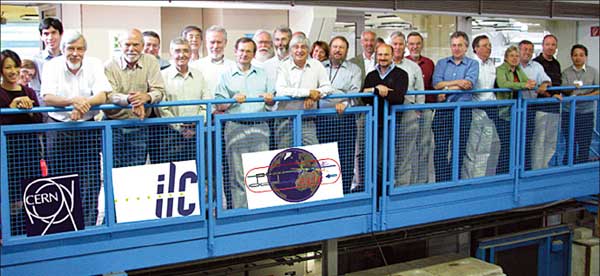
This meeting at CERN [on 12 June] represented another step in bringing the CLIC and ILC efforts closer together. CERN’s director-general, Rolf Heuer, the CERN research director, Sergio Bertolucci, and the secretary of the CERN Council strategy group, Steiner Stapnes, attended part of the meeting and expressed their support. The meeting itself was constructive and productive in that we agreed on several important new initiatives, including plans to combine future workshops and to begin discussions on developing and articulating a joint strategy towards a linear collider.
In one sense, these efforts are in competition with each other. Each one has dedicated proponents and teams, and works hard to develop the competing technologies. But, in a more overriding sense, we are all working towards the same goal: to prepare for the next-energy-frontier machine for our field. Independent physics studies in Asia, the Americas and Europe have each given the highest priority for the future of the field to develop a lepton collider that complements the LHC while exploiting fully the terascale. These parallel R&D programmes are all needed to determine the technical capabilities, readiness, risks and costs of these options, while the LHC discoveries will determine the desired technical requirements and energy range.
Although the CLIC technology for the main linac is totally different from the superconducting RF technology of the ILC, other aspects of the design – including the sources, damping rings, beam delivery and detectors, as well as civil engineering and conventional facilities, and cost and schedule – have large overlaps. For that reason, last year we initiated a set of seven joint working groups in those areas where we can pool our resources and work together for the benefit of both teams.
During the meeting we reviewed the progress of the joint working groups and discussed future plans and ideas for specific work and deliverables for these groups. In addition to the obvious benefits of combining resources for joint problems, we have agreed on some other new longer-term goals. In particular, we have agreed to take a step towards bringing our managements closer together by adding a CERN/CLIC representative as a member of the GDE executive committee, and vice versa for the equivalent CLIC steering committee. Another step we have agreed on is to investigate the integration of our major CLIC and ILC workshops into common Linear Collider Workshops, from which the first one is foreseen tentatively at CERN on 20–24 September 2010.
There are two major efforts underway to develop a linear electron–positron collider to complement CERN’s LHC in the exploration of physics in the region of the “terascale” – energies of around 1 tera-electron-volt (TeV) and higher. The concept pursued by the International Linear Collider (ILC) Global Design Effort (GDE) is based on superconducting RF technology for collisions up to 1 TeV in energy. The Compact Linear Collider Study (CLIC) on the other hand, is developing a novel technological approach based on two-beam acceleration, which is potentially capable of achieving collisions at energies of multi-tera-electron-volts. Now these two efforts are coming closer together with the aim of combining resources on areas of common interest.
On 12 June the first joint meeting of the ILC GDE executive committee, the CLIC steering committee and the CERN directorate took place at CERN. The GDE’s executive committee consists of the GDE’s director, Barry Barish, together with three regional directors (for the Americas, Asia and Europe), three project managers and three accelerator experts, who include the chairman of the CLIC steering committee (Jean-Pierre Delahaye). The CLIC steering committee comprises accelerator, detector and particle-physics experts as well as the chairman of the CLIC/CTF3 collaboration board (Ken Peach) and the ILC representative (Brian Foster).
The meeting proved to be a successful start to bringing the ILC and CLIC efforts closer together, particularly in areas linked to the construction and implementation of a future collider (see box). Following the meeting, a statement of common CLIC/ILC intent is under discussion. The aim is to promote and develop scientific and technical preparations for a linear collider as well as exploit possible synergies that enable the design concepts for the ILC and CLIC to be prepared efficiently in the best interest of linear colliders and more generally of high-energy physics.
Higher energies
One area of common ground is the development of suitable detectors for the particular environment of a terascale e+e– linear collider. CERN joined this worldwide detector–development effort through its newly established Linear Collider Detector (LCD) project, which targets physics and detectors at a future collider, be it ILC or CLIC.
Currently most of the effort at CERN is going into the preparation of the conceptual design report for CLIC, which will be delivered by the end of 2010. Earlier studies have shown that the layout of an experiment exploiting the physics potential of a 3 TeV CLIC machine is in many ways similar to an experiment designed for sub-tera-electron-volt energies. Therefore, the ILC detector concepts (named ILD and SiD) form an excellent starting point for the CLIC study. Adaptations concentrate on a few essential differences: the higher CLIC energy, the increased beam-induced background rates and the ultra-fast 0.5 ns bunch spacing.
Compared with the ILC, outgoing particles will generally have higher energies at CLIC and will often group closely together in highly boosted jets. To preserve a good performance level this normally calls for an increase in lever-arm of the tracking system and more depth for the calorimeters. In practice this increase in size can be limited by optimizing the choice of detector materials and granularity, thereby restricting the corresponding increase in the inner radius of the detector’s solenoid coil.
The electron- and positron-beam bunches in CLIC are extremely small, with sizes of just 40 nm wide and 1 nm high. Their close encounter gives rise to strong electric fields, leading to the emission of numerous beamstrahlung photons, most of which will leave the detector through the outgoing beam pipe. Some subsequent secondary-beamstrahlung products will nonetheless enter the main detector volume. Because bunch crossings take place every 0.5 ns, the resulting background hits in the detector will overlay quickly while genuine high-energy e+e–-physics interactions will take place at a much smaller rate. This means that to preserve the capability to recognize the physics signatures with good precision, the electronic-signal readout of most detectors at CLIC will require time stamping. Current studies indicate that a time–stamping resolution in the 20 ns range will be sufficient.
Low power consumption will be a “must” for all future linear-collider detectors because this allows for low-mass detectors and, therefore, excellent track and vertex precision. Turning the power of the detectors on and off at the pace of the incoming bunch-trains can potentially reduce the on-detector power dissipation by nearly two orders of magnitude. The corresponding power-pulsing rate will be 5 Hz for the ILC and 50 Hz for CLIC.
Given the similarity between the ILC and CLIC detectors, the new LCD-physics and detector project is an important cornerstone of the ILC–CLIC collaboration. It integrates fully into the worldwide detector and physics studies – and profits from the tremendous developments made for the ILC and its predecessors. It uses the ILC-experiment concepts and detector technologies as a basis and makes use of the same simulation tools. As of 2010, hardware R&D will start in a number of critical areas for a CLIC detector, such as very dense hadron calorimetry, time stamping of tracking and calorimeter signals, power pulsing of detector electronics and reinforced conductors for a large solenoid.
Motivated by the case of an e+e– collider as the next machine to explore particle physics at the terascale, work towards a common linear-collider-physics community is underway. The LHC results will tell us whether this will be a sub-tera-electron-volt machine (ILC) or whether an energy reach to multi-tera-electron-volts is needed (CLIC).
The LHC will initially run at an energy of 3.5 TeV per beam when it starts up in November this year. This decision has comes after all tests on the machine’s high-current electrical connections were completed at the end of July, indicating that no further repairs are necessary for safe running.
“We’ve selected 3.5 TeV to start,” explained CERN’s director-general, Rolf Heuer, “because it allows the LHC operators to gain experience of running the machine safely while opening up a new discovery region for the experiments. The LHC is much better understood than it was a year ago. We can look forward with confidence and excitement to a good run through the winter and into next year.”
Following the incident of 19 September 2008 that brought the LHC to a standstill, testing has focused on the 10,000 high-current superconducting electrical connections of the kind that led to the fault. These consist of two parts: the superconductor itself, and a copper stabilizer that carries the current in case of a quench – when the superconductor warms up and stops superconducting. There is negligible electrical resistance across these connections when they are in their normal superconducting state, but in a small number of cases tests have revealed abnormally high resistances in the superconductor. These have been repaired. However, there remain a number of cases where the resistance in the copper stabilizer connections is higher than it should be for running at full energy.
The latest round of tests has looked at the resistance of the copper stabilizer. As a result, many copper connections showing anomalously high resistance were repaired. The tests on the final two sectors, which concluded at the end of July, revealed no further anomalies. This means that no more repairs are necessary for safe running this year and next.
The procedure for the 2009 start-up will be to inject and capture beams in each direction, take collision data for a few shifts at the injection energy, and then commission the ramp to higher energy. The first high-energy data should be collected a few weeks after the first beam of 2009 is injected. The LHC will run at 3.5 TeV per beam until a significant data sample has been collected and the operations team has gained experience in running the machine. Thereafter, with the benefit of that experience, the energy will be taken towards 5 TeV per beam. At the end of 2010, the LHC will be run with lead ions for the first time. After that, the LHC will shut down and work will begin on moving the machine towards 7 TeV per beam.
Earlier in July leaks of helium into the vacuum insulation were found in Sectors 8-1 and 2-3 while they were being prepared for the electrical tests on the copper stabilizers at around 80 K. In both cases the leak occurred at one end of the sector, where the electrical feedbox, DFBA, joins Q7, the final magnet in the sector. The end vacuum subsectors – a 200 m stretch of the LHC sealed off by vacuum barriers – will be warmed to room temperature in order to locate the leaks and repair them. Suspicion rests in both cases on flexible hose in the liquid-helium transport circuits; two years ago, a similar leak occurred during the first cool-down of Sector 4-5. Unfortunately, the repair necessitates a partial warm-up of both sectors, with a consequent impact on the schedule for the restart. It is now foreseen that the LHC will be closed and ready for beam injection by mid-November.
DESY’s new synchrotron radiation source PETRA III generated the first X-ray light for research on the weekend of 18–19 July. The electron storage ring, 2.3 km in circumference, went through a two-year upgrade costing €225 million, which converted into the world’s most brilliant storage ring X-ray source. Following test runs of individual instruments, PETRA III will start regular user operation in 2010.
As the most powerful light source of its kind, PETRA III will offer excellent research possibilities, in particular to researchers who investigate ever smaller samples with ever finer details, or those who require tightly focused and very short-wavelength X-rays for their experiments. PETRA III first stored its first positron beam in April. Following this milestone, the undulators were put in place to force the beam to oscillate and emit the high brilliance synchrotron radiation.
PETRA was originally built as an electron–positron collider for particle physics and more recently was used as a pre-accelerator for the electron/positron–proton collider, HERA, which closed down in June 2007. In less than two years PETRA has been completely refurbished and modernized, the remodelling funded mainly by the German Federal Ministry of Education and Research, the City of Hamburg and the Helmholtz Association. A 300 m long experimental hall was built over the PETRA storage ring, to house 14 synchrotron beamlines and up to 30 experimental stations. To ensure that the samples under study are not affected by vibrations, the experiments will be installed on the largest monolithic concrete slab in the world.
After months of preparation and two intensive weeks of continuous operation in June, the LHC experiments celebrated the achievement of a new set of goals aimed at demonstrating full readiness for the data-taking with collisions expected to start later this year. The Scale Testing for the Experiment Programme ’09 (STEP ’09) was designed to stress the Worldwide LHC Computing Grid (WLCG), the global computing Grid that will support the experiments as they exploit the new particle collider. The WLCG combines the computing power of more than 140 computer centres, in a collaboration between 33 countries.
While there have been several large-scale data-processing tests in recent years, this was the first production demonstration to involve all of the key elements from data-taking through to analysis. This allowed different records to be established in data-taking throughput, data import and export rates between the various Grid sites, and in huge numbers of analysis, simulation and reprocessing jobs. The ATLAS experiment ran close to 1 million analysis jobs and achieved 6 GB/s of Grid traffic – the equivalent of a DVD’s worth of data a second, sustained over long periods. This result coincides with the transition of Grids into long-term sustainable e-infrastructures that will be of fundamental importance to projects with the lifetime of the LHC.
With the restart of the LHC only months away, there will be a large increase in the number of Grid users, from several hundred unique users today to several thousand when data-taking and analysis commence. This will happen only through significant streamlining of operations and the simplification of end-users’ interaction with the Grid. STEP ’09 involved massive-scale testing of end-user analysis scenarios, including “community-support” infrastructures, whereby the community is trained and enabled to be largely self-supporting, backed a core of by Grid and application experts.
To provide the best experiences, we use technologies like cookies to store and/or access device information. Consenting to these technologies will allow us to process data such as browsing behavior or unique IDs on this site. Not consenting or withdrawing consent, may adversely affect certain features and functions.
Functional
Always active
The technical storage or access is strictly necessary for the legitimate purpose of enabling the use of a specific service explicitly requested by the subscriber or user, or for the sole purpose of carrying out the transmission of a communication over an electronic communications network.
Preferences
The technical storage or access is necessary for the legitimate purpose of storing preferences that are not requested by the subscriber or user.
Statistics
The technical storage or access that is used exclusively for statistical purposes.The technical storage or access that is used exclusively for anonymous statistical purposes. Without a subpoena, voluntary compliance on the part of your Internet Service Provider, or additional records from a third party, information stored or retrieved for this purpose alone cannot usually be used to identify you.
Marketing
The technical storage or access is required to create user profiles to send advertising, or to track the user on a website or across several websites for similar marketing purposes.