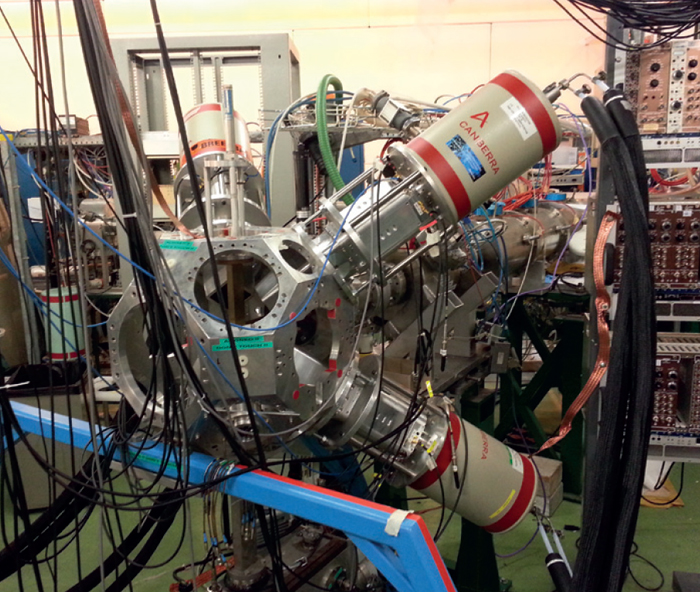
The US Department of Energy Office of High Energy Physics and the National Science Foundation Physics Division have announced their joint programme for second-generation dark-matter experiments, aiming at direct detection of the elusive dark-matter particles in Earth-based detectors. It will include ADMX-Gen2 – a microwave cavity searching for axions – and the LUX-Zeplin (LZ) and SuperCDMS-SNOLAB experiments targeted at weakly interacting massive particles (WIMPs). These selections were partially in response to recommendations of the P5 subpanel of the US High-Energy Physics Advisory Panel for a broad second-generation dark-matter direct-detection programme at a funding level significantly above that originally planned.
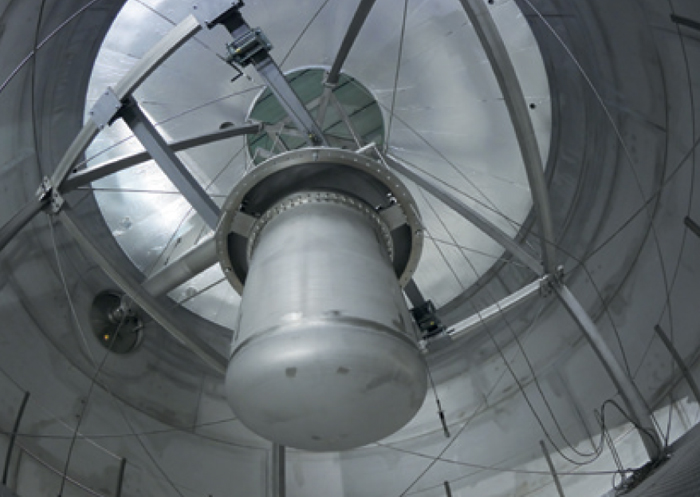
While ADMX-Gen2 consists mainly of an upgrade of the existing apparatus to reach a lower operation temperature of around 100 mK, and is rather inexpensive, the two WIMP projects are significantly larger. SuperCDMS will initially operate around 50 kg of ultra-pure germanium and silicon crystals at the SNOLAB laboratory in Ontario, for a search focused on WIMPs with low masses, below 10 GeV/c2. The detectors will be optimized for low-energy thresholds and for very good particle discrimination. The experiment will be designed such that up to 400 kg of crystals can be installed at a later stage. The massive LZ experiment will employ about 7 tonnes of liquid xenon as a dark-matter target in a dual-phase time-projection chamber (TPC), installed at the Sanford Underground Research Facility in South Dakota. It is targeted mainly towards WIMPs with masses above 10 GeV/ c2. The timescale for these experiments foresees that the detector construction will start in 2016, with commissioning in 2018. All three experiments need to run for several years to reach their design sensitivities.
Meanwhile, other projects are operational and taking data, and several new second-generation experiments, with target masses beyond the tonne scale, are fully funded and currently being installed. The Canadian–UK project DEAP-3600, installed at SNOLAB, should take its first data with a 3.6-tonne single-phase liquid-argon detector by the end of this year. Its sensitivity goal is a factor 10–25 beyond the current best limit, depending on the WIMP mass. XENON1T, a joint effort by US, European, Swiss and Israeli groups, aims to surpass this goal using 3 tonnes of liquid xenon, of which 2 tonnes will be inside a dual-phase TPC. Construction is progressing fast at the Gran Sasso National Laboratory, and first data are expected by 2015. These experiments and their upgrades, the newly funded US projects, and other efforts around the globe, should open up a bright future for direct-dark-matter searches in the years to come.
In November 2006, the last LHC dipole and quadrupole cold masses arrived at CERN, signalling the end of the industrial construction of the major components of the new 27-km particle collider (CERN CourierOctober 2006 p28 and January/February 2007 p25). The LHC then entered the installation and the commissioning phases. In the same month, at the Elysée Palace in Paris, the ITER Agreement was signed by seven parties: China, the EU, India, Japan, Korea, Russia and the US. The agreement’s ratification on October the following year marked the start of a new mega-science project – ITER, standing originally for the International Tokamak Experimental Reactor – that in many respects is the heir of the LHC. Both machines are based on, for example, a huge superconducting magnet system, large cryogenic plants of unmatched power, a large volume of ultra-high vacuum, a complex electrical powering system, sophisticated interlock and protection systems, high-technology devices and work in highly radioactive environments.
The two projects share many technologies and operating conditions and are both based on large international collaborations. These elements constitute the basis for a natural collaboration between the two projects, despite there being distinct differences between their managerial and sociological models.
In the years 2007–2012, CERN could not engage in new large projects, not only because effort was focussed on installation and commissioning of the LHC – and repair and consolidation (CERN Courier April 2009 p6) – but also because of budgetary constraints set by the repayment of loans for its construction. Many groups and departments at CERN faced a related reduction of personnel. In contrast, the new ITER organization had to be staffed and become immediately operational to organize the procurement arrangements between ITER and the domestic agencies acting for the seven members. Indeed, some new staff members were recruited from laboratories that had just finished their engagement with the LHC, such as the CEA in France and CERN itself. However, the number of staff, compounded by the need to train some of them, was not sufficient to satisfy ITER’s needs. For example, the ITER magnet system – perhaps the largest technical challenge of the whole project – required many further detailed studies before the design could be brought to sufficient maturity to allow hand-over to the domestic agencies for construction. The ITER magnet management was also interested in benefitting from the technical skills and project-management experience for large-scale procurement from industry that CERN had accumulated during construction of the LHC.
In addition to the primary reasons for collaboration between CERN and ITER, there were additional reasons that made it interesting to both parties. For CERN there was the possibility of conducting R&D and studies in key domains, despite the lack of new projects and internal funding. Examples include:
– the superconductor reference laboratory, set up for the ITER organization, which has proved to be useful for CERN’s internal programme, formally launched in 2011, for the new High Luminosity LHC;
– qualification of new commercial nuclear-radiation-hard optical fibres, with measurements also at cryogenic temperatures;
– design of high-temperature superconductor (HTS) 70-kA-class current leads, with sophisticated 3D simulations and experimental mock-ups;
– setting up a unique high-voltage laboratory for cryo-testing insulation and instrumentation equipment;
– new concepts and controllers for the HTS current leads and magnet protection units; and
– activities in metallurgy, welding and material testing, which have helped to increase CERN’s already world-renowned competence in this domain.
The list could be longer. Only a minor part of the activity was supplying a “service” or the transfer of knowledge. In many cases the activity was new design, new R&D or validation of beyond-state-of-the-art concepts.
For ITER, the benefit lay not only in receiving the services and studies, for which it paid. It was also in having access to a large spectrum of competence in a single organization. CERN could react promptly to the demands and needs stemming from contracts and unexpected difficulties in the multiparty complex system set up for ITER construction.
Discussions between CERN and ITER management started in 2007 and were formalized with a framework co-operation agreement signed at CERN by the director-generals of the two organizations on 6 March 2008. This agreement foresaw a co-ordination committee that was in fact not set up until 2012, and has met only twice so far, because the collaboration is working so smoothly that no issues have been raised. The collaboration was then implemented through contracts, called implementing agreements (IAs) to the co-operation agreement. Each IA contract details the specific content, goals, deliverables, time duration and resources.
Table 1 lists the 18 IAs signed so far between CERN and ITER. Each year from 2008, an IA was signed according to the needs of ITER and the possibilities and interest at CERN. Standard annual IAs span one calendar year and contain a variety of different tasks – these are annual IAs. However, IAs with extended durations of up to five years soon became necessary to secure long-term service by giving CERN the possibility of hiring new personnel in excess of those allowed by the internal budget. In total, CERN has had eight annual contracts so far, one short-term contract (IA12) and nine multiyear contracts, two of them lasting five years – one for operation of the superconductor reference laboratory (IA4) and one for metallurgy and material testing for the magnet system (IA14).
As already mentioned, the Co-ordination Committee was not set up until 2012, so the various agreements were overseen by a Steering Committee – later renamed the Technical Committee to distinguish it better from the Co-ordination Committee – which is composed of two members per party. The membership of these committees has been relatively constant and this continuity in management, with smooth changes, is probably one of the reasons for the success of the collaboration. Also, some IAs started outside the usual entry points and were later adjusted to report inside the framework. The CERN-ITER collaboration is a textbook case of how managing relations between complex organizations that are at the centre of a network of institutes is an endless job.
The steering and technical committees meet twice a year and each session is prepared carefully. The committee members review the technical work and resolve resource problems by reshuffling various tasks or setting up amendments to the IAs – which has happened only five times and never for extra costs, only to adjust the execution of work to needs. Long-term planning of work and of future agreements is done in the meetings for the best use of resources, and problems are tackled at their outset. So far, no disputes, even minor ones, have occurred.
As in any sustainable collaboration, there are deep discussions on the allocation of resources, most being personnel related, with only a minor part being about consumables. Figure 1 shows the budget that was allocated for the execution of the agreement. The total of more than CHF14 million engaged corresponds approximately to 80–90 full-time equivalent years used by CERN to fulfil the agreement. Most personnel are CERN staff, in some cases recruited ad hoc, but fellows and associated personnel are also involved.
The examples in figure 2 show a few of the most important technical achievements. One of the key ingredients of the success of the CERN-ITER collaboration is that checks are done on deliverables, rather than on detailed accounting or time-sheet reporting. This has been possible because of the technical competence of both the management and the technical leaders of the various tasks, as well as of the personnel involved, on both sides. Goals and deliverables, even the most difficult ones, were evaluated correctly and reasonable resources allocated at the outset, with a fair balance and good appreciation of margins. This leads to the conclusion that – despite modern management guidelines – technical competence is not a nuisance: it can make the difference.
Following the restart of the first elements in CERN’s accelerator complex in June, beams are now being delivered to experiments from the Proton Synchrotron (PS) and the PS Booster.
First in line were experiments in the East Area of the PS, where the T9 and T10 beam lines are up and running. These test beams serve projects such as the Advanced European Infrastructures for Detectors at Accelerators (AIDA), which looks at new detector solutions for future accelerators, and the ALICE collaboration’s tests of components for their inner tracking system. By the evening of 14 July, beam was hitting the East Area’s target and the next day, beams were back in T9 and T10.
Next to receive beams for physics were experiments at the neutron time-of-flight facility, n_TOF, and the Isotope mass Separator On-Line facility, ISOLDE. On 25 July, detectors measured the first neutron beam in n_TOF’s new Experimental Area 2 (EAR2). It was a low-intensity beam, but it showed that the whole chain – from the spallation target to the experimental hall, including the sweeping magnet and the collimators – is working well. Built about 20 m above the neutron production target, EAR2 is a bunker connected to the underground facilities via a vertical flight path through a duct 80 cm in diameter, where the beamline is installed. At n_TOF, neutron-induced reactions are studied with high accuracy, thanks to the high instantaneous neutron flux that the facility provides. The first experiments will be installed in EAR2 this autumn and the schedule is full until the end of 2015.
A week later, on 1 August, ISOLDE restarted its physics programme with beams from the PS Booster, after a shutdown of almost a year and a half during which many improvements were made. One of the main projects was the installation of new robots for handling the targets that become very radioactive. The previous robots were more than 20 years old and beginning to suffer from the effects of radiation. The long shutdown of CERN’s accelerator complex, LS1, provided the perfect opportunity to replace them with more modern robots with electronic-sensor feedback. On the civil engineering side, three ISOLDE buildings have been demolished and replaced with a single building that includes a new control room, a data-storage room, three laser laboratories, and a biology and materials laboratory. In the ISOLDE hall, new permanent experimental stations have also been installed. Almost 40 experiments are planned for the remainder of 2014.
After the PS, the Super Proton Synchrotron (SPS) will be next to receive beam. On 27 June, the SPS closed its doors to the LS1 engineers, bringing almost 17 months of activities to an end. The machine has now entered the hardware-testing phase, in preparation for a restart in October.
Meanwhile at the LHC, early August saw the start of the cool down of a third sector – sector 1-2. By the end of August, five sectors of the machine should be in the process of cooling down, with one (sector 6-7) already cold. Meanwhile, the copper stabilizer continuity measurements (CSCM) have been completed in the first sector (6-7), with no defect found. CSCM tests are to start in the second sector in mid-August. Elsewhere in the machine, the last pressure tests were carried out on 31 July, and the last short-circuit tests should be complete by mid-August.
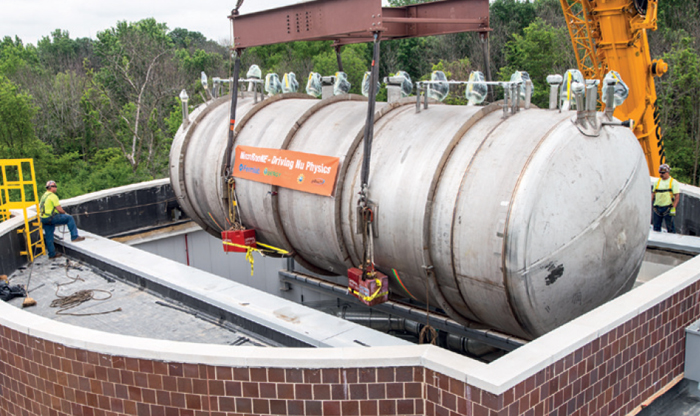
The particle detector for MicroBooNE, a new short-baseline neutrino experiment at Fermi National Accelerator Laboratory, was gently lowered into place on 23 June. It is expected to detect its first neutrinos this winter.
The detector – a time-projection chamber surrounded by a 12-m-long cylindrical vessel – was carefully transported by truck across the Fermilab site, from the assembly building where the detector was constructed to the experimental hall nearly 5 km away. The 30-tonne object was then hoisted up by a crane, lowered through the open roof of a new building and placed into its permanent home, directly in the path of Fermilab’s Booster neutrino beamline.
When filled with 170 tonnes of liquid argon, MicroBooNE will look for low-energy neutrino oscillations to help to resolve the origin of a mysterious low-energy excess of particle events seen by the MiniBooNE experiment, which used the same beam line and relied on a Cherenkov detector filled with mineral oil.
The MicroBooNE time-projection chamber is the largest ever built in the US and is equipped with 8256 delicate gold-plated wires. The three layers of wires will capture pictures of particle interactions at different points in space and time. The superb resolution of the time-projection chamber will allow scientists to check whether the excess of MiniBooNE events is due to photons or electrons.
Using one of the most sophisticated processing programs ever designed for a neutrino experiment, computers will sift through the thousands of neutrino interactions recorded every day and create 3D images of the most interesting ones. The MicroBooNE team will use that data to learn more about neutrino oscillations and to narrow the search for a hypothesized fourth type of neutrino.
MicroBooNE is a cornerstone of Fermilab’s short-baseline neutrino programme, which could also see the addition of two more neutrino detectors along the Booster neutrino beamline, to refute or confirm hints of a fourth type of neutrino first reported by the LSND collaboration at Los Alamos National Laboratory. In its recent report, the Particle Physics Project Prioritization Panel (P5) expressed strong support for a short-baseline neutrino programme at Fermilab. The report was commissioned by the High Energy Physics Advisory Panel, which advises both the US Department of Energy and the National Science Foundation on funding priorities.
The detector technology used in MicroBooNE will serve as a prototype for a much larger liquid-argon detector that has been proposed as part of a long-baseline neutrino facility to be hosted at Fermilab. The P5 report strongly supports this larger experiment, which will be designed and funded through a global collaboration.
The recent discovery of a Higgs boson at CERN appears to represent the summit in the successful experimental verification of the Standard Model of particle physics. However, although essentially all of the data from particle accelerators are so far in perfect agreement with the model’s predictions, a number of important theoretical and observational considerations point to the necessity of physics beyond the Standard Model. An especially powerful argument comes from cosmology. The currently accepted cosmological model invokes two exotic ingredients – dark matter and dark energy – which pervade the universe. In particular, the observational evidence for dark matter (via its gravitational effects on visible matter) is now overwhelming, even though the particle-physics nature of both dark matter and dark energy remains a mystery.
At the same time, the theoretical foundations of the Standard Model have shortcomings that prompt theorists to propose and explore hypothetical ways to extend it. Supersymmetry is one such hypothesis, which also naturally provides particles as candidates for dark matter, known as weakly interacting massive particles (WIMPs). Other extensions to the Standard Model predict particles that could lie hidden at the low-energy frontier, of which the axion is the prototype. The fact that supersymmetry has not yet been observed at the LHC, and that no clear signal of WIMPs has appeared in dark-matter experiments, has increased the community’s interest in searching for axions. However, there are independent and powerful motivations for axions, and dark matter composed of both WIMPs and axions is viable, implying that they should not be considered as alternative, exclusive solutions to the same problem.
After more than a decade of searching for solar axions, CAST has put the strongest limits yet on axion–photon coupling
Axions appear in Standard Model extensions that include the Peccei–Quinn mechanism, which provides the most promising solution so far to one of the problems of the Standard Model: why do strong interactions seem not to violate charge–parity symmetry, while according to QCD, the standard theory of strong interactions, they should do? Unlike many particles predicted by theories that go beyond the Standard Model, axions should be light, and it might seem that they should have been detected already. Nevertheless, they could exist and remain unnoticed because they naturally couple only weakly with Standard Model particles.
A generic property of axions is that they couple with photons in a way that axion–photon conversion (and vice versa) can occur in the presence of strong magnetic or electric fields. This phenomenon is the basis of axion production in the stars, as well as of most strategies for detecting axions. Magnets are therefore at the core of any axion experiment, as is the case for axion helioscopes, which look for axions from the Sun. This is the strategy followed by the CERN Axion Solar Telescope (CAST), which uses a decommissioned LHC test magnet (CERN Courier April 2010 p22). After more than a decade of searching for solar axions, CAST has put the strongest limits yet on axion–photon coupling across a range of axion masses, surpassing previous astrophysical limits for the first time and probing relevant axion models of sub-electron-volt mass. However, to improve these results and go deep into unexplored axion parameter space requires a completely new experiment.
The International Axion Observatory (IAXO) aims for a signal-to-noise ratio 105 better than CAST. Such an improvement is possible only by building a large magnet, together with optics and detectors that optimize the axion helioscope’s figure of merit, while building on experience and concepts of the pioneering CAST project.
The central component of IAXO is a superconducting toroid magnet. The detector relies on a high magnetic field distributed across a large volume to convert solar axions to detectable X-ray photons. The magnet’s figure of merit is proportional to the square of the product of magnetic field and length, multiplied by the cross-sectional area filled with the magnetic field. This consideration leads to a 25-m-long and 5.2-m-diameter toroid assembled from eight coils, generating 2.5 T in eight bores of 600 mm diameter, thereby having a figure of merit that is 300 times better than the CAST magnet. The toroid’s stored energy is 500 MJ.
The design is inspired by the barrel and endcap toroids of the ATLAS experiment at the LHC, which has the largest superconducting toroids ever built and currently in operation at CERN. The superconductor used is a NbTi/Cu-based Rutherford cable co-extruded with aluminum – a successful technology common to most modern detector magnets. The IAXO detector needs to track the Sun for the longest possible period, so to allow rotation around the two axes, the 250-tonne magnet is supported at its centre of mass by a system used for large telescopes (figure 1). The necessary services for vacuum, helium supply, current and controls rotate together with the magnet.
Each of the eight magnet bores will be equipped with X-ray focusing optics that rely on the fact that at X-ray energies the index of refraction is less than unity for most materials. By working at shallow (or grazing) incident angles, it is possible to make mirrors with high reflectivity. Mirrors are commonly used at synchrotrons and free-electron lasers to condition or focus the intense X-ray beams for user experiments, but IAXO requires optics with much larger apertures. For nearly 50 years, the X-ray astronomy and astrophysics community has been building telescopes following the design principle of Hans Wolter, employing two conic-shaped mirrors to provide true-imaging optics. This class of optics allows “nesting” – that is, placing concentric co-focal X-ray mirrors inside one another to achieve high throughput.
IAXO will use CERN’s expertise efficiently to venture deep into unexplored axion parameter space
The IAXO collaboration envisions using optics similar to those used on NASA’s NuSTAR – an X-ray astrophysics satellite with two focusing telescopes that operate in the 3–79 keV band. NuSTAR’s optics consist of thousands of thermally formed glass substrates deposited with multilayer coatings to enhance the reflectivity above 10 keV (figure 2). For IAXO, the multilayer coatings will be designed to match the softer 1–10 keV solar-axion spectrum.
At the focal plane in each of the optics, IAXO will have small time-projection chambers read by pixelized planes of Micromegas. These detectors (figure 2) have been developed extensively within the CAST collaboration and show promise for detecting X-rays with a record background level of 10–8–10–7 counts/keV/cm2/s. This is achieved by the use of radiopure detector components, appropriate shielding, and offline discrimination algorithms on the 3D event topology in the gas registered by the pixelized read-out.
Beyond the baseline described above, additional enhancements are being considered to explore extensions of the physics case for IAXO. Because a high magnetic field in a large volume is an essential component in any axion experiment, IAXO could evolve into a generic “axion facility” and facilitate various detection techniques. Most intriguing is the possibility of hosting microwave cavities and antennas to search for dark-matter axions in mass ranges that are complementary to those in previous searches.
The growing IAXO collaboration has recently finished the conceptual design of the experiment, and last year a Letter of Intent was submitted to the SPS and PS Experiments Committee of CERN. The committee acknowledged the physics goals of IAXO and recommended proceeding with the next stage – the creation of the Technical Design Report. These are the first steps towards the realization of the most ambitious axion experiment so far.
After more than three decades, the axion hypothesis remains one of the most compelling portals to new physics beyond the Standard Model, and must be considered seriously. IAXO will use CERN’s expertise efficiently to venture deep into unexplored axion parameter space. Complementing the successful high-energy frontier at the LHC, the IAXO facility would open a new window on the dark universe.
CERN was conceived in the late 1940s and early 1950s, when two ambitions came together – to enable construction of scientific facilities that were beyond the means of individual countries, and to foster collaboration between peoples who had recently been at war. The network of CERN users, which already included scientists from Eastern Europe and the USSR during the Cold War, expanded in the LEP era. Today, scientists from 74 countries around the world work together on LHC experiments, producing good science and also gaining a better appreciation of each other’s cultures and values.
Following in CERN’s footsteps, many other pan-European scientific organizations have been established. However, the organization most closely modelled on CERN is perhaps SESAME, which shares CERN’s original aims and its governance structure. SESAME (Synchrotron-light for Experimental Science and Applications in the Middle East) is a third-generation light source under construction in Jordan, which will enable research in subjects ranging from biology and medical sciences through materials science, physics and chemistry to archaeology (much focussed on regional issues, e.g. related to the environment, health and agriculture). SESAME will foster collaboration between its very diverse members (currently Bahrain, Cyprus, Egypt, Iran, Israel, Jordan, Pakistan, the Palestinian Authority and Turkey), some of which are in conflict.
Following a suggestion by Gus Voss (DESY) and Herman Winick (SLAC), Sergio Fubini (CERN and University of Turin, who chaired a Middle East Scientific Co-operation group) and Herwig Schopper (director-general of CERN in the years 1981–1987) persuaded the German government to donate the components of the then soon-to-be-dismantled Berlin synchrotron BESSY I for use at SESAME. At a meeting at UNESCO in 1999, an interim council was established with Schopper as president, and a Jordanian (Khaled Toukan, who has served as director since 2005) and a Turk (Dincer Ülkü) as co-vice-presidents. Many others, e.g. Eliezer Rabinovici (Hebrew University), played important roles in SESAME’s history – see http://mag.digitalpc.co.uk/fvx/iop/esrf/sesamebrochure/.
Progress was initially slow due to lack of funding, but has accelerated since the SESAME building came into use in 2008. The (upgraded) BESSY I microtron injector is producing a 22 MeV beam, which has been successfully stored in the (refurbished) booster synchrotron. In 2002 it was decided to build a completely new 2.5 GeV main ring, which will be installed in 2015. Four “day-one” beamlines are being constructed, and SESAME is on track technically for commissioning to begin in early 2016.
The scientific programme has been developed in user meetings that bring together scientists in the region. Regional interest and scientific capacity have been fostered by an extensive training programme, involving schools, workshops and work at operating light sources and other laboratories, which has been supported generously by international agencies (particularly the IAEA), national agencies, professional scientific societies, the world’s synchrotron laboratories, and small charitable foundations.
SESAME was created bottom-up by scientists, who in some cases dragged their governments outside their comfort zones.
SESAME’s major problem is obtaining funding. The members became involved before it was agreed to build a new main ring with no obligation to contribute to the capital cost, which would be beyond the means of the many who have limited science budgets and find it very hard to pay their rapidly increasing contributions to operational costs. The richer countries in the region are currently unwilling to join for political reasons. However, Iran, Israel, Jordan and Turkey have each agreed to make voluntary contributions of $5 million, the EU has contributed €7.5 million (including €5 million for construction of the magnets of the main ring which, very helpfully, is being managed by CERN), Italy has pledged €2 million with more possibly to come, and many of the observers (Brazil, China, France, Germany, Greece, Italy, Japan, Kuwait, Portugal, the Russian Federation, Spain, Sweden, Switzerland, the UK and the USA) have donated equipment that was surplus to requirements and support the training programme.
SESAME and CERN exemplify the “Science for Peace” mission of UNESCO, which served as a midwife for both, by fostering better understanding between scientists and engineers, building on the respect they develop for each other’s professional abilities. There are of course political hurdles to be jumped (visa restrictions prevent many of the members hosting SESAME meetings; sanctions are holding up payments by Iran; frequent changes of government have so far prevented Egypt joining the other voluntary donor members; etc). However, provided SESAME is a first-class scientific instrument, leading scientists from across the region will wish to work there and the political mission will look after itself.
SESAME needs funding for a hostel and a small conference centre, which could also be used for international meetings on issues such as water resources, agriculture or the environment. I dream that, as other European organizations followed CERN, this will give birth to other international organizations in the Middle East.
SESAME was created bottom-up by scientists, who in some cases dragged their governments outside their comfort zones, but it now needs external top-down help and encouragement to ensure timely completion. I hope that this article will inspire other countries (without geographical limitations) to join SESAME, and further contributions from governments in other regions, charitable foundations and philanthropists.
Beams of protons are back in CERN’s Proton Synchrotron (PS), having circulated around the accelerator on 20 June for the first time in more than 15 months. The PS restart followed on from the restart of beam in Linac 2 and then the PS Booster (PSB) on 2 June.
The beam made it into the PS on schedule, thanks to the efforts of the PSB specialist teams, who were called upon on many occasions for hardware interventions during the preceding weeks of hardware commissioning and “cold” tests. These included fixing vacuum leaks, re-configuring timing links, correcting magnet connections and, in one instance, replacing an entire magnet with a spare, owing to a water leak. Operations, radiofrequency and instrumentation teams then needed to adjust the settings for beam acceleration and extraction from the PSB to the PS. With beam back in the PS, beam commissioning tests could begin. During this final phase, all of the beam diagnostics – from beam current to bunch spacing – need to be checked, first with low-intensity beams (1011 protons) before moving to higher-intensity levels (1012 protons). The PS will then be ready to send beams to the East Area and the neutron facility, nToF, where physics is planned to start in late July. ISOLDE, the only experimental facility connected directly to the PSB, will be the first user to receive its beams, with physics set to restart in mid-July. The physics programme in the Super Proton Synchrotron is set to restart in the autumn.
At the LHC, the teams closed the last of the 1695 outer magnet bellows on 18 June, marking the end of the Superconducting Magnets And Circuits Consolidation (SMACC) project. Leak tests on the entire machine are proceeding well, and by late June they had been completed in sector 5-6 and were under way in sector 7-8. At the same time, sector 6-7 – the first to be cooled – had reached 20 K, and will be maintained at this temperature during continuity testing of the copper stabilizer. Four sectors should be cool by the end of the summer, and all eight sectors of the LHC are scheduled to be cooled to the nominal temperature of 1.9 K in late autumn.
Beam is expected back into the LHC early in 2015, and the restart of the LHC physics programme is planned for spring 2015, with a collision energy of 13 TeV instead of the previous 7–8 TeV.
On 7 May, the newly upgraded Continuous Electron Beam Accelerator Facility (CEBAF) delivered the first electron beams to its new experimental complex at the US Department of Energy’s (DOE’s) Jefferson Lab. The success capped a string of accelerator commissioning milestones that were needed for approval to restart experimental operations following CEBAF’s first major upgrade.
CEBAF is an electron-accelerator facility that employs superconducting radiofrequency (SRF) technology to investigate the quark structure of the nucleus. The first large-scale application of SRF technology in the US, it was originally built to circulate electrons through 1–5 passes to provide 4 GeV electron beams. As a result of the operators’ experience in running the machine at its peak potential, the original installation eventually achieved operational energies of 6 GeV.
In May 2012, the accelerator was shut down for its 12 GeV upgrade. This $338-million project, which will double CEBAF’s maximum energy, includes the construction of a fourth experimental hall (Hall D), as well as upgrades to equipment in three existing halls (Halls A, B and C).
Accelerator operators began the painstaking task of bringing the accelerator back online last December. By 5 February, they had achieved the full upgrade-energy acceleration of 2.2 GeV in one pass through the machine. Then on 1 April, the operators exceeded CEBAF’s previous maximum energy. The accelerator delivered three-pass, 6.11-GeV electron beams with 2 nA average current onto a target in Hall A, and recorded the first data of the 12-GeV era, holding the pattern for more than an hour.
The operators continued to push the upgraded machine, and early on 7 May the energy was increased to 10.5 GeV through the entire 5.5 passes. In the last minutes of the day, 10.5 GeV beam was delivered into the new Hall D complex. Having met all of the major milestones in the 12-GeV project for the DOE approval step, Critical Decision-4A (Accelerator Project Completion and Start of Operations), staff and users are now looking forward to demonstration of 12-GeV energy and beam delivery to Jefferson Lab’s experimental halls for commissioning and the start of experiments.
Supernova explosions, triggered when the fuel within a star reignites or its core collapses, launch a shock wave that sweeps through a few light-years of space in only a few hundred years. The remnants of these explosions are now recognized widely as one of nature’s major particle accelerators. The theory is that charged particles increase in energy through repeated encounters with magnetic “mirrors” or changing magnetic fields in the shocks. Now, a team of researchers has brought some of these processes down to Earth, in an experiment to investigate the turbulent amplification of magnetic fields in the supernova remnant, Cassiopeia A, which was first seen about 300 years ago in the constellation Cassiopeia.
Radio observations of Cassiopeia A have revealed regions within the expanding remnant that are consistent with synchrotron radiation emission from giga-electron-volt electrons spiralling in a magnetic field of a few milligauss – 100 times higher than expected from the standard shock compression of the interstellar medium. The origin of such high magnetic fields, which help to make Cassiopeia A a particularly effective particle accelerator and bright radio source, appears to lie with regions of turbulence that could amplify the magnetic field and that could be related to puzzling irregular “knots” seen in optical observations. One explanation for these knots is that the shock produces turbulence as it passes through a region of space that already contains dense clumps or clouds of gas.
To investigate these possibilities, an international team led by Gianluca Gregori at Oxford University used the Vulcan laser facility at the UK’s Rutherford Appleton Laboratory to focus three laser beams onto a carbon rod 0.5 mm thick in a chamber filled with low-density gas. The heat generated made the rod explode, creating a blast that expanded through the surrounding gas, mimicking a supernova shock wave. To simulate the clumps that might surround an exploding star, the team introduced a mesh of fine plastic wires 0.4 mm thick with cells 1.1 mm square at a distance of 1 cm from the rod. Using hydrodynamical scaling relations, the team can relate the experimental conditions 0.3 μs after the laser burst to Cassiopeia A as it is now, about 310 years after the supernova explosion. With the same scaling, the wire thickness corresponds to a distance of about one parsec in the remnant.
The researchers used various techniques to monitor the evolution of the shock wave, including an induction coil to measure the magnetic fields produced. The measurements show that the grid produces additional turbulent flow and gives rise to magnetic-field components that are 2–3 times larger than without it. The results are also in good agreement with the output from numerical simulation code, in particular, the magnetohydrodynamic code FLASH, developed by Don Lamb at Chicago University. The simulations reproduce well the position of the shock, the peak electron density and temperature – with and without the grid – and confirm that the magnetic field is indeed enhanced as a result of induced turbulence created as the shock moves through the grid.
These results demonstrate that the amplification of the magnetic field within the Cassiopeia A “particle accelerator” might indeed arise from the interaction of the shock with a clumpy interstellar medium. Importantly, the experiment also gives valuable confirmation of the simulations, providing for the first time an experimental means to validate the simulation codes used for many astrophysical phenomena.
NOvA, Fermilab’s new flagship neutrino-oscillation experiment, has recorded its first neutrinos and is now poised to make precision measurements of electron-neutrino (νe) appearance and muon-neutrino (νμ) disappearance. These data will help to unravel remaining unknowns in understanding neutrino masses and mixing. In the now standard picture of neutrinos, the three electroweak flavour states (νe, νμ and ντ) are mixtures of the mass eigenstates (ν1, ν2 and ν3) related by a unitary matrix that is parameterized by three mixing angles and a charge-parity (CP) violating phase. Neutrinos are produced and detected in flavour eigenstates but propagate in mass eigenstates. Interference among the mass states means that a neutrino created in a definite flavour state can later be detected in a different flavour state. This oscillation probability is determined by the sizes of the mixing angles, the splittings in the neutrino masses, the energy of the neutrino and the distance it has travelled. Measurements of the oscillation probabilities of neutrinos of known energy that travel a known distance reveal the underlying mass-splittings and mixings.
Thanks to experiments using neutrinos produced in the Sun, in the atmosphere, at particle accelerators and in nuclear reactors, researchers have found out a great deal about neutrino masses and mixing. We know that two neutrinos are relatively close in mass and that the third is relatively far away in mass. We know that the mixing angles are all relatively large, in contrast to mixing angles in the quark sector, which are small. We also know that the two neutrinos that are relatively close in mass contain most of the electron-neutrino flavour, and that the third is a nearly equal combination of muon and tau flavour. However, we do not know if the third mass eigenstate is composed of more νμ or ντ, or if a new symmetry keeps these two contributions equal. We do not know if neutrinos violate CP symmetry, and we do not know the ordering of the neutrino masses.
Neutrinos could follow a normal hierarchy, with most of the νe content contained in the lightest two states, or they could follow an inverted hierarchy with the νe content predominantly in the heaviest two states. The neutrino-mass hierarchy is one specific prediction of different grand-unification theories, with implications for cosmological measurements of the absolute scale of neutrino mass. The hierarchy, in combination with results from neutrinoless double-beta decay experiments, plays an important role in determining the Dirac or Majorana nature of the neutrino.
NOvA will use two detectors to measure oscillation probabilities in Fermilab’s NuMI (Neutrinos at the Main Injector) muon-neutrino beam. When neutrinos travel the 810 km between Fermilab and Ash River, Minnesota, through the crust of the Earth, scattering of νe on atomic electrons can either enhance or suppress the oscillation probability, depending on the mass hierarchy. The effect is opposite in neutrinos compared with antineutrinos, so by comparing the oscillation probability measured in neutrinos with that measured with antineutrinos, NOvA can determine the mass hierarchy, resolve the nature of ν3, and begin the study of CP violation in neutrinos.
To achieve these goals, NOvA requires an intense neutrino and antineutrino source. NuMI had routinely delivered 320 kW of beam power to the MINOS and MINERvA experiments during operation of the Tevatron. However, with Tevatron operations now ended, the accelerator complex has been reconfigured to provide twice the beam power to the NuMI beamline. During a shutdown of a year and a half starting in the spring of 2012, a major RF upgrade in the Main Injector was accomplished, reducing its cycle time from 2.2 s to 1.67 s. Additionally, the Recycler ring, which was key to antiproton generation for the Tevatron, was converted to a proton accumulator so that protons can be integrated and stored during the Main Injector ramp from 8 GeV at injection to 120 GeV.
At the same time, the NuMI beamline underwent a transformation to accommodate the higher proton intensities required for NOvA. The neutrino target and focusing horns were replaced and repositioned. The new beam provides higher-energy neutrinos on-axis, but at 14 mrad off the beam axis – where the NOvA detectors are located – the neutrino energy spectrum is peaked narrowly at 2 GeV, the perfect energy for the long-baseline oscillations that NOvA will study.
Beam began circulating again in the Main Injector in September 2013 and work started on commissioning the new accelerator in the Recycler ring. The Recycler is now normally included in operations, and work is underway to “slip stack” routinely in this new machine – a delicate manoeuvre where one bunch is injected then shifted to a different orbit to make room for a second bunch in the same RF bucket. Once the two bunches are merged, they are accelerated together. This work is expected to bring the NuMI intensity to 450 kW by the end of the year, and ongoing upgrades to the Booster ring that feeds this complex are expected to bring the intensity to 700 kW within another year. Since coming back up from the shutdown, the complex has achieved a peak beam power of more than 300 kW and delivered almost 2.5 × 10²⁰ protons to NOvA and the other two neutrino experiments sharing the beam, MINOS+ and MINERvA.
The NOvA detector must be big to overcome the small size of the neutrino-interaction cross-section and the 810 km distance from the neutrino source
In addition to an intense beam, NOvA also requires a massive far detector and a functionally identical near detector. Like all neutrino detectors, the NOvA detector must be big to overcome the small size of the neutrino-interaction cross-section and the 810 km distance from the neutrino source. Being big, however, is not enough. The detector must also be highly segmented to prevent the numerous cosmic rays that cross the detector from interfering with neutrino events from Fermilab. Furthermore, to separate electromagnetic showers from electron-neutrino events from similar showers from other sources, especially the decays of π0 mesons, heavy materials of high atomic number (Z) such as steel – which are normally used to build large structures – have not been employed.
The NOvA detectors (figures 1 and 2) are a unique solution to the particular challenges of observing νe appearance using the NuMI neutrino beamline. The NOvA far detector is a 14,000 tonne detector, using 9000 tonnes of liquid scintillator – the largest quantity of liquid scintillator ever produced for a physics experiment – to record the tracks of charged particles. The scintillator is contained in a 15.6 × 15.6 × 60 m3, 5000-tonne PVC structure constructed from modules assembled at a factory operated by collaborators at the University of Minnesota. A crew of more than 700 undergraduate students directed by 10 full-time staff members ran the factory. These pieces were shipped to the Ash River Laboratory in Northern Minnesota, where another 45 full-time staff members built the 28 free-standing blocks that make up the detector. The 190-tonne blocks were constructed horizontally on an enormous table, which later pivoted them into a vertical position and placed them in the experimental hall.
In addition to containing the scintillator, the PVC structure segments the detector into 4 cm × 6 cm × 15.6 m channels. Light produced in these channels by the charged particles that traverse them bounces 10 times, on average, before it is captured in a wavelength-shifting fibre. To ensure that enough light is captured in the fibre, a special PVC formulation with enhanced reflectivity had to be developed. The large size of the detector and the large number of channels required more than 10,000 km of wavelength-shifting fibre – enough to stretch from the supplier in Japan to the Ash River Laboratory in a single unbroken thread.
This large-scale assembly project is now finished. The last detector block was put in place in February of this year and the last of the 11 million litres of scintillator made for the experiment was delivered in April. While the task of outfitting the detector with electronics is continuing through the summer, the experiment recorded its first neutrino event in November last year, and has analysed millions of cosmic-ray tracks. This analysis has verified that the scintillator, PVC, fibre and electronics work together as designed to move the scintillation light from the far end of the detection channels to where it can be recorded. As figure 3 shows, the efficiency for detecting a minimum-ionizing particle crossing a cell at the furthest end from the read-out is above 90%, which is key to the tracking and particle-identification performance of the detector.
First events
Cosmic-ray interactions are an excellent source for detector calibration, but they are also a potential background to the neutrino selection. While the NuMI beam is delivered in regular bursts, 10 μs in duration, the high cosmic rate on the surface means that about 1.5 cosmic interactions are expected in the detector during the spill. On the other hand, after oscillations, a NuMI neutrino interacts in the far detector once every 12,000 spills, or only about once every four hours. Containment and directional cuts suppress the cosmic rate by about a factor of 105, with only minimal loss of neutrino events. Figure 4 shows a charged-current νμ interaction identified in the NOvA far detector, along with two cosmic-ray muons zipping through during the beam spill. Figure 5 shows the same event, reconstructed, as well as a timing distribution of other neutrino candidates found in the far detector. The neutrino candidates pile up at the arrival time measured in the NOvA prototype detector delayed by the neutrino flight time between the two sites, confirming that NOvA can identify neutrinos among the cosmic-ray backgrounds.
In May, one sixth of the full near detector was turned on for the first time, and neutrinos were seen in the first spills
While relatively simple cuts can be used to separate beam neutrino events from cosmogenic events, further suppression of cosmic rays is required to achieve the oscillation physics goals. Multivariate event-selection algorithms tuned to recognize the differing topologies of νμ and νe charged-current and and neutral-current interactions suppress the cosmic-ray background rate by a further two orders of magnitude. Data collected when the beam is known to be off confirm that the necessary level of rejection can be achieved: the cosmic-ray background in a one-year exposure is predicted to be one event in the νμ sample and 0.5 events in the νe sample, well below the expected signal rates of 75 and 15 neutrinos in these samples.
The NOvA collaboration is now eagerly awaiting data from the near detector, which are needed to measure the beam composition and energy spectrum before oscillations have developed. The near-detector data will set the background expectation in the far detector for the νe appearance channel, and determine the unoscillated event rate as a function of energy for the νμ disappearance channel. In May, one sixth of the full near detector was turned on for the first time, and neutrinos were seen in the first spills. NOvA researchers are looking forward to an exciting summer.
To provide the best experiences, we use technologies like cookies to store and/or access device information. Consenting to these technologies will allow us to process data such as browsing behavior or unique IDs on this site. Not consenting or withdrawing consent, may adversely affect certain features and functions.
Functional
Always active
The technical storage or access is strictly necessary for the legitimate purpose of enabling the use of a specific service explicitly requested by the subscriber or user, or for the sole purpose of carrying out the transmission of a communication over an electronic communications network.
Preferences
The technical storage or access is necessary for the legitimate purpose of storing preferences that are not requested by the subscriber or user.
Statistics
The technical storage or access that is used exclusively for statistical purposes.The technical storage or access that is used exclusively for anonymous statistical purposes. Without a subpoena, voluntary compliance on the part of your Internet Service Provider, or additional records from a third party, information stored or retrieved for this purpose alone cannot usually be used to identify you.
Marketing
The technical storage or access is required to create user profiles to send advertising, or to track the user on a website or across several websites for similar marketing purposes.