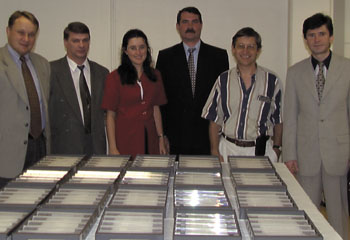
A spaceborne particle physics experiment has come up with new information on the distribution of cosmic-ray particles.
On 2-12 June 1998, the primary payload of NASA’s Space Shuttle Discovery in orbit, 400 km above the Earth, was the Alpha Magnetic Spectrometer (AMS), a sophisticated detector of the type that is normally used in high energy physics laboratories.
During the 10 day voyage, the AMS recorded the tracks of millions of cosmic particles. It was the first time that such a sophisticated physics detector had been deployed in space and the first time so much information on cosmic particles had been collected.
After careful analysis, the data now reveals that subnuclear particles in outer space behave in unexpected ways, especially in how they react to the variation of the Earth’s magnetic field with latitude. They behave as though they are confined in a large magnetic toroid around the Earth’s equator.
Outer space is filled with cosmic-ray particles, the debris being released by subnuclear explosions in distant stars. Viewing these particles from the Earth is difficult because of the shield of the Earth’s atmosphere (the particles are transformed as they crash into atmospheric nuclei). With the AMS, for the first time a major physics experiment was able to view cosmic rays above this atmospheric barrier.
The particle tracks recorded by the AMS show how different cosmic particles respond to the magnetic field of the Earth. In orbit, the AMS was able to scan cosmic rays arriving at different latitudes as the Earth moved. According to previous mappings, this magnetic field was expected to repel less energetic particles arriving around the equator. This terrestrial magnetic repulsion becomes weaker at higher latitudes, so that more particles of lower energy would be seen nearer the North Pole and South Pole.
From the recorded data, the AMS finds an unexpectedly high level of lower energy protons at almost all altitudes, and particularly near the equator. This first deployment of an experiment equipped with a powerful magnet above the Earth’s atmosphere reveals that the distribution of cosmic particles 400 km above the Earth is more complex than had previously been thought.
Even more surprising is that, for protons at less than 6 GeV and in an equatorial arc extending over 4000 km at an altitude of 400 km, the AMS detector sees as many particles moving upwards (away from the Earth) as coming down. It is as though, at this energy, cosmic protons are constrained around the Earth inside a magnetic toroid.
A similar effect is seen with cosmic electrons and their antiparticles positrons except here the energy is approximately 3 GeV. These electrons and positrons are also not primordial they are continuously produced by high-energy cosmic radiation. This should produce as many cosmic positrons as electrons. However, in the equatorial band, the AMS sees about four times as many positrons as electrons! This discrepancy is not understood.
Another puzzle is that in the equatorial toroid, AMS also finds the rare isotope helium-3 rather than the more common helium-4.
The advertised goal of the AMS was to search for signs of cosmic antimatter. In a universe created from a Big Bang that presumably created matter and antimatter in equal amounts, there should be signs of this primordial antimatter, with antinuclei built of antiprotons and antineutrons.
However, our universe appears to be built up entirely of matter and no experiment has ever detected any primordial antimatter. The AMS set out to look for antinuclei above the screen of the atmosphere, but a sample of almost three million cosmic helium nuclei arriving from outer space revealed not one helium antinucleus. AMS sees no primordial antimatter.
AMS, led by Sam Ting of MIT, is a major international collaboration. Important contributions came from groups led by Roberto Battiston in Perugia, Maurice Bourquin in Geneva, Hans Hofer at ETH Zurich, Klaus Luebelsmeyer in Aachen, Antonino Zichichi in Bologna, Shih-Chang Lee in Taipei, Jean-Pierre Vialle in Annecy, Carlos Mana in Madrid, Gaspar Barreira in Lisbon, Jarmo Torsti in Turku and Hesheng Chen in Beijing.
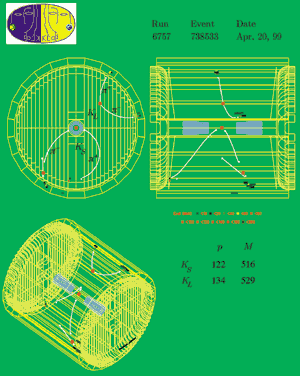
The DAFNE electronpositron collider at Frascati and its KLOE detector are flexing their muscles. On 14 April, during the first DAFNE tune-up using two beams and with the KLOE superconducting detector solenoid in operation, a luminosity of 1.2 x 1029 per sq. cm/s was reached in single bunch mode with 11 mA in the positron beam and 7 mA for electrons, corresponding to some 70% of the expected luminosity for this current.
The first electronpositron scattering events were seen in the KLOE detector. A preliminary estimate of the event rate is in agreement with indications from the machine luminosity monitor.
DAFNE operates at the phi meson resonance (1020 MeV). The ensuing scan of the phi peak produced the first CP-violating decays of long-lived kaons. Such decays will provide more information on the mystery of CP violation, through which nature is able to discriminate between matter and antimatter.
The phi is only slightly heavier than a pair of neutral kaons (498 MeV each), and kinematically this decay is very constrained. At first sight, phi decay via a rho meson (770 MeV) and a pion (140 MeV) should be easier. However, the phi prefers to decay into two kaons, which produces strange results.
The phi meson was first seen in bubble chamber experiments at Brookhaven in 1962. Its decay behaviour motivated George Zweig, who was then at Caltech, to propose his model of “aces”, which paralleled the invention of quarks by Murray Gell-Mann (see the story next month, and more news of DAFNE commissioning).
A theme that is common to many new particle colliders is the determined push to extend the physics reach by boosting the collision rate (luminosity).
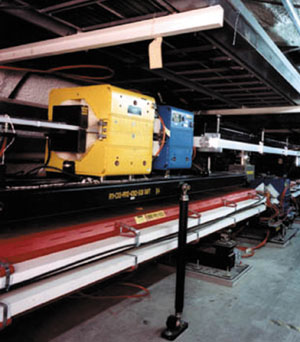
In a particle collider ring, the counter-rotating beams are able to “sense” the electromagnetic effects of each other even before the particles collide. This infamous “beambeam effect” is complex and can have all kinds of results, sometimes unexpected. These can include decreased collision rates through beam blow-up, and orbit distortions and instabilities.
With CERN’s LHC proton collider aiming for very high collision rates (luminosity), such effects could easily degrade performance. To boost the particle supply and the collision rate, today’s colliders use ingenious bunched beams that interlace as they collide.
To minimize deleterious beambeam effects, new colliders using many bunches make them cross each other at an angle rather than colliding head-on. However, even a few long-range effects can couple all circulating bunches.
For the LHC, progress was summarized at an LHC99 BeamBeam workshop at CERN in April. The discussions were organized in two working groups.The first was on incoherent or weakstrong beambeam effects and was chaired by Eberhard Keil of CERN. The other was on coherent or strongstrong beam-beam effects and was chaired by Kaoru Yokoya of the Japanese KEK laboratory.
A vital part of this work is to decide on an optimal beam bunch scenario to fill the LHC rings with particles. With beambeam effects being hard to predict, experience as new machines explore new energy regimes is extremely valuable. For the LHC, the new working conditions at Fermilab’s Tevatron protonantiproton collider, which is also striving for very high collision rates, will provide valuable input. Further experience will come from another new collider Brookhaven’s RHIC. Like the LHC, this uses two beam pipes.
Experimental data from the PEP-II electronpositron collider at SLAC, Stanford, US, which uses head-on collisions, and from the KEKB electronpositron collider at KEK, Japan, which uses a beam-crossing angle, will also be highly relevant. Complementary input comes from simulation program, which try to predict beambeam effects. This work is not easy, but different approaches seem to be converging.
Last year marked the 30th anniversary of the inception of the scientific research programme of the Mirabelle liquid-hydrogen bubble chamber, which was a joint effort between the Institute for High-Energy Physics in Protvino, Russia, CERN and CEA-Saclay in France.
A superb technological achievement in its time, Mirabelle was at that time the largest electrophysics structure of its kind in the world. Measuring 11 x 5 x 14 m, representing about 3000 tons of instrumentation and a useful volume of 6 m3, it was designed, prepared and experimented on by a Saclay research team under the leadership of Pierre Prugne.
Nicknamed “the little prune”, the chamber became the apple of Prugne’s eye. In 1970-1971 it was installed on the 70 GeV proton beam accelerator at Protvino, which was at that time the most powerful accelerator in the world.
The fast ejection system and, in particular, the particle beam separator for Mirabelle were created at Protvino with the assistance of specialists from CERN . The first photographs were obtained in June 1971. From then on, physicists from Protvino, Saclay and CERN carried out investigations into photon and meson interactions.
Recently at Protvino, specialists from Saclay (many now pensioners), members of their families and their Russian colleagues celebrated Mirabelle’s 30th anniversary. At the official ceremony, Pierre Prugne received the honorary degree of doctor of science.
As a souvenir, the chamber’s cold piston – which was the heart of the Mirabelle chamber – was symbolically erected in the town centre, in a square that was appropriately renamed Mirabelle Square.
An initial report from the recent Particle Accelerator Conference (PAC) in New York was published last month. The PAC parallel sessions spanned a range of accelerator activities, which are summarized here.
Magnets
Most of the PAC magnet session covered the status and progress on the research and development for superconducting magnets. For CERN’s LHC collider, a large effort is devoted to the optimization of the dipole for series production. C Wyss presented the updated version of the dipole parameters, featuring stainless steel collars and six-block coils. He also discussed the aim and status of the short model and full-size prototype dipole programmes and the schedule for series manufacture.
D Tommasini described in detail the scope of the 20 short models, some of which have been rebuilt in different variants, with more than 35 versions already having been tested. The aims are to compare the five-block and six block coil geometry, training behaviour, temperature margin, mechanical stability and magnetic field quality.
In the US the post-SSC period has seen a renewed interest in high-field dipole development. R M Scanlan presented an extensive review of the activities in various laboratories, including Brookhaven; Fermilab; KEK, Japan; LASA/INFN, Milan; Berkeley; Texas A&M; and Twente, the Netherlands. He stressed the common requirement to exceed 10 Tesla the practical limit for niobium-titanium superconductors.
Potential applications include a Very Large Hadron Collider (VLHC), a Muon Collider and upgrades to the LHC. The cosine theta coil-winding approach is replaced in recent work by block coil designs, which may be more compatible with the brittle superconductors and high Lorentz field stresses that are inherent in high-field magnets.
The new block designs include the “common coil” designs that are being explored at Brookhaven and Berkeley, as well as a segmented block design with reduced winding stresses at Texas A&M. In addition to magnet design work, several new superconductors are being developed for use in high-field accelerator magnets. These include niobium-aluminium as well as the high-temperature superconductors in both tape and cable configurations.
S Gourlay and A Zlobin gave more details on the dipoles proposed at Berkeley and Fermilab respectively. At Berkeley, a prototype niobium-tin superconducting magnet,utilizing a racetrack coil design, has been built and tested. This was constructed with coils wound from conductor developed for the ITER fusion project, limiting the magnet to a field of approximately 6 Tesla. Subsequent magnets will utilize improved conductor, culminating in a design that is capable of approaching 15 Tesla. The simple geometry is more suitable for the brittle superconductors that are needed to reach high fields.
At Fermilab, high-field magnets of between 10 and 12 T are proposed in view of the VLHC. The main aims are to exploit the relatively small machine circumference and emittance damping owing to synchrotron radiation and still be able to accommodate the radiation power absorbed in the beam tube. Recent progress in the development of niobium-tin superconducting strands makes it possible to design cost-effective accelerator magnets based on a cosine-theta coil geometry above 10 T.
A 1 m high-field dipole model with 1011 T nominal field in a 50 mm bore is being developed at Fermilab in collaboration with Berkeley and KEK as part of the effort for a VLHC.
P Lee presented the prospects for the use of high-temperature superconductors (HTS) in high-field accelerator magnets. In the short term the most promising high-field magnet application is 2212. However, HTSs are still at an early stage of development and continued improvement over the next 10 years should reveal other HTSs for accelerator application.
The Bi-2212 recipe appears to have the greatest potential today, because it can be made in round wire form with a reasonably high critical current, thus permitting access to the cabling technology of low-temperature materials. A dipole is being made at Berkeley using round wire Bi-2212. Among other recipes being explored, Bi-2223 and YBCO are both largely committed to wide-tape designs, for which cabling is a significant challenge.
G Foster described the Transmission Line Magnet a dual-aperture warm-iron superferric magnet, built around an 80 kA superconducting transmission line. He pointed out that the large inventory of surplus cable manufactured for the defunct Superconducting Supercollider could be used for the construction of a VLHC injector with an energy up to 3 TeV.
R Goupta described the tuning shims technique that is used in the interaction region quadrupoles of Brookhaven’s Relativistic Heavy Ion Collider (RHIC) to obtain much lower field errors. Measurements have shown that both systematic and random error harmonics have been reduced to several parts in 100 000 instead of a few parts in 10 000 at two-thirds of the coil radius. The ultimate field errors are now limited by the “changes” in harmonics after quenching and thermal cycling rather than measurements, design or magnet construction errors. These changes appear to depend on the details of the magnet.
J Plueger was one of the few to describe high-technology warm magnets. He presented an overview of an insertion designed for the next generation of free flectron faser (FEL) synchrotron light sources using the principle of self -amplified spontaneous emission. Very long undulators are needed to reach saturation, easily exceeding 100 m for the X-ray FELs. To minimize thetotal length and maximize output, an optimum overlap must be foreseen between electron and laser beam, as well strong external focusing fields to keep the electron beam size small over the whole undulator length.
Walter Scandale.
Current and future machines
Many PAC papers covered machines that are under construction or undergoing major upgrades. News of the RHIC heavy ion collider at Brookhaven and the PEP-II and KEKB electronpositron collider B-factories was included in our PAC preview last month.
Design studies for the next generation of colliders linear electronpositron colliders, muon colliders and very large hadron colliders were well covered.
R Brinkmann of DESY talked about technology and challenges of linear colliders. The session chairman J Peoples paid tribute to B Wiik (April), who had been scheduled to give this talk. T Raubenheimer of SLAC covered the accelerator physics challenges of linear colliders; M Pekeler of DESY the experience of superconducting cavity cperation in the TESLA test facility; and J P Delahaye of CERN the CLIC study of a multi-TeV linear collider.
K T McDonald of Princeton reported on the status of research and development and future plans relating to muon colliders, mentioning that 40 PAC papers were related to muon colliders. G Dugan of Cornell described reseach and development work for Very Large Hadron Colliders.
Quite a few posters also treated various aspects of these machines.
Radiofrequency technology
Striking in the PAC radiofrequency sessions was the remarkable and encouraging progress made in the maximum hold-off voltage in superconducting cavities. A reliable technique to attain the necessary accelerating gradient of 34 MV/m is of paramount importance for the TESLA approach. Electropolishing (EP), jointly studied at KEK in Japan and CEA-Saclay in France, is a clear candidate.
Tests on three sample cavities showed an increase of the maximum accelerating field from 25 to 33 MV/m (in one case a record 37 MV/m was attained), at full TESLA pulse length.
It is interesting that, in contrast with the established methods of high-pressure rinsing and chemical polishing (CP), EP does not seem to act on the residual resistance ratio. Once this is high enough, EP pushes the maximum gradient right up. Even a cavity with bad initial performance attained 33 MV/m. The fact that these cavities turned “bad” again when doing CP after EP can be considered as a validation of the EP approach.
Even though ideas on photonic bandgap (PBG) structures were already presented in PAC three years ago, they now appear interesting for future multi-TeV electronpositron colliders. Of primary concern in these accelerators are the transverse wakefields fields that are left behind in the accelerating structure by the passing bunches, which, in turn, can kick subsequent bunches so violently that they eventually get lost before the collision point.
The damping and detuning of these detrimental transverse modes are the techniques deployed and investigated until now to alleviate this serious problem. (See MOBC2, THAL6 on the PAC Web site.
The PBG structure now sheds light on accelerating structures from a different viewpoint The cell of a PBG structure consists of a transverse periodic lattice of metallic rods between a pair of metal plates. Thus it can be described like a two-dimensional crystal, the central beam hole being a “defect” in this lattice.
If the fundamental, accelerating mode frequency lies in the bandgap of the PBG structure, it cannot propagate transversely and thus remains well confined around the defect. The structure can, however, be made so that it is (transversely) transparent to all higher-order modes, which in turn can quite easily be damped by absorbing material at the periphery a few lattice constants from the central beam hole. (See MOP72, MOP73.)
For anyone who thought that vacuum tubes were history, the development of high-power RF tubes, especially for modern accelerator applications, would prove them wrong. High-power klystrons will be needed in large numbers for future accelerators. For gridded tubes, the technology is still advancing.
Efficiency and high average power at moderate anode voltages and good operational stability are of increasing importance. For klystrons, this leads to multibeam devices, like the one being developed at Thomson Tubes (TTE) for TESLA (seven beams, 10 MW, 1.5 ms, 1.3 GHz). An interesting novel device being developed at Communications and Power Industries (formerly Varian Electron Device Group) is higher-order mode inductive output tube (HOM IOT), which has been around since 1982 under the name klystrode (i.e. a gridded input, klystron type output device). Its promising design data aim for 1 MW continuous wave at 700 MHz with (only) 45 kV anode voltage, and with an efficiency of 73% (THBL3).
An impressive gridded tube was on display at TTE’s stand in the industrial exhibit. The company’s Diacrode is a tetrode with optimized current distribution, which allows for larger surfaces compared with the wavelength, and thus with higher power. This tube has now been built and tested, producing 1 MW in continuous wave, 4.1 MW for 1 ms pulses, both at 200 MHz.
Leaving high-power RF, an impressive realization of a modern low-level RF system is that of the asymmetric B factory PEP-II now being commissioned at SLAC, Stanford.
Since the advent of feedback in accelerators in the 1970s, many systems have been realized that are conceptionally similar, but this is a beautiful example of feedback at work in a modern environment the VXI(VME)-based, completely digital control system. Both storage rings are longitudinally unstable, but, as if this were not enough trouble, the control system has to handle heavy transient beam loading.
The beam is a more powerful source of induced voltages in the cavities than the power amplifier and “transient” refers in this case to the ion-clearing gap the ring is not homogeneously filled, but the beam current changes drastically during a single turn. Many interwoven control loops are necessary to handle this nightmare situation, the fastest having a group delay of less than 500 ns, 150 of which are contributed by the klystron alone. Another loop deploys digital comb filters. Its signal is fed back exactly one turn later to control the longitudinal vibration of particles in exactly the same bunch where they were detected.
Since the control systems have to have such a hard grip on the beam, some amplifiers risk saturation. This is prevented by learning algorithms for the creation of reference signals. In addition, a fibre-optic system distributes the signal of yet another control loop longitudinal multibunch feedback to the different RF stations around the rings. Network analysers are integrated in the part of the control (see THBL1).
Status reports from leading laboratories accounted for a major part of the programme of the International Conference on High Energy Accelerators, which was held at the Joint Institute for Nuclear Research (JINR) in Dubna near Moscow.
G Jackson described the increased luminosity for Fermilab’s Tevatron. An additional ring, the recycler, which utilizes permanent focusing magnets in the main injector tunnel, should be able to triple the antiproton intensity and provide luminosities as high as 1033 cm-2s-1.
The participation of JINR in international accelerator projects, such as CERN’s LHC collider and the TESLA superconducting linear collider, and the most recent results of the operation of the Nuclotron at JINR, was reported by A Sissakian. Deuteron beams from the Nuclotron for experiments with a thin internal target attain 3.2 GeV/nucleon, the intensity of circulating particles being 1.2 x 10¹⁰.
D Trines of DESY covered the HERA electron(positron)proton collider and the DORIS synchrotron radiation source and their improvements. He reported results from the TESLA international project for a linear electron positron collider and spoke on future plans for the Tesla Test Facility.
All of CERN’s machines set new records in 1998. With a new extraction channel, a beam from the SPS synchrotron could be used for generating neutrinos for an experiment in the underground laboratory of Gran Sasso, Italy, 732 km away from CERN (November 1998).
Record run
J Dorfan of SLAC reported from the Stanford Linear Collider where a record 10 month run had just ended. Investigation of the neutron and proton spin structure continues in the fixed-target SLAC programme. For the future the B-factory based on the PEP II electronpositron collider will open a new physics programme.
The Relativistic Heavy-Ion Collider at Brookhaven, with 100 GeV per nucleon for heavy ions and 250 GeV for protons, is nearing completion, reported S Ozaki. The first experiments with colliding beams (gold ions) will be followed by investigations with polarized beams, beginning in the year 2000.
The Budker Institute of Nuclear Physics operates the VEPP-4 electronpositron collider at 5.5 GeV and a luminosity of 1032, according to A Skrinsky of Novosibirsk. Development continues for the VLEPP linear electronproton collider. BINP takes an active part in the development of the electronnucleus collider that is proposed at GSI in Darmstadt.
From Japan, with the operation of the KEKB asymmetric electronpositron collider (8 GeV electrons, 3.5 GeV positrons, design luminosity 1034) imminent, S Kurokawa described experiments for this storage ring and the K2K experiment on the oscillations of neutrinos generated by the 12 GeV beam from the KEK proton synchrotron and using the SuperKamiokande detector 250 km west of KEK.
Increased beam intensity
E Troyanov of IHEP reported the main recent results from the 70 GeV Serpukhov proton synchrotron and the status of the Accelerator Storage Complex (UNK). The U-70 accelerator is being upgraded, the ultimate goal being to increase the beam intensity to 5 x 10¹³ and to prepare the accelerator for an UNK injector. Despite a lack of funds, measures are being taken to maintain 21 km of UNK tunnel, and the manufacture and installation of equipment for the “warm” 600 GeV UNK proton synchrotron is under way.
A Temnykh of Cornell covered the Cornell Electron Storage Ring, which is operating as an electronpositron collider with 6 GeV beams. The available maximum luminosity is 6 x 1032. The replacement of copper cavities by superconducting ones and vacuum improvement will soon boost its luminosity to 1033.
Progress towards CERN’s LHC was reported by P Lebrun. The first full-scale prototype dipole has been built and successfully tested in cooperation with INFN of Italy. Short, straight sections of the ring and their quadrupoles have been designed in co-operation with CEA and CNRS of France. The first prototype magnets for the injection beamline have been designed and manufactured at Budker INP. Other elements of the LHC magnetic system are being designed in co-operation with Canadian, Japanese and US laboratories.
GSI Darmstadt’s ElectronNucleus Collider project was discussed by K Blasche. Its main aim would be to investigate deep inelastic electronnucleon and electronnucleus scattering at collision energies of 10-30 GeV. The design luminosity is 1033 for electronproton collisions and 4 x 1032 for collisions with uranium nuclei.
The beginning of work for the MUSES project for a radioactive ion Beam Factory at RIKEN, Japan, was reported by T Katayama. This involves four new accelerating facilities. One, a double storage ring, will be used as an ionion and electronion collider for ions of 1.5 GeV per nucleon and 2.5 GeV electrons. The calculated luminosity for ions of isotopes with a lifetime of 1 min is 1032.
A Kovalenko of JINR and Fermilab’s E Malamud discussed future projects, among them the Very Large Hadron Collider, with beam energies of 2 x 50 GeV using Nuclotron-type magnets. Progress for muon colliders was reviewed by R Palmer of Brookhaven.
S Mitsunobu of KEK and DESY’s D Proch and W Singer described the development of superconducting cavities for future linear colliders. Accelerating fields could reach 40 MV/m.
Linear colliders based on normal conducting cavities (for which the maximum accelerating field strength is 100 200 MV/m) were discussed by V Balakin of Budker INP.
For CERN’s CLIC collider with a maximum energy of 5 TeV and a luminosity of 1034-1035, reported by I Wilson, a new, potentially more effective and cheaper, method uses two-beam acceleration for generating radiofrequency power with the hope of achieving accelerating fields of 150 MV/m. The NLC, TESLA/SBLC and JLC collider projects also envisage gamma gamma and gammaelectron collisions. Photon colliders can appreciably increase the research potential of linear colliders for insignificant extra cost, according to V Telnov of BINP.
The message from the round-table discussion chaired by G Loew of SLAC was that linear colliders are promising tools for high-energy physics.
Another round-table discussion recommended that the Dubna experience should become a model for future conferences in the series, with a relatively small number of leading participants for talks and debates on future projects, and with promising young scientists being invited to present novel techniques and technologies.
Despite a serious economic crisis in Russia, the organization of the conference was assured, thanks to the support of INTAS, IUPAP, the Russian Foundation for Basic Research, the Ministry of Science and Technologies of the Russian Federation, the Ministry of Atomic Industry of the Russian Federation, some businessmen and sponsors from Dubna, and, finally, JINR, despite its own financial problems. Aeroflot proposed special tariffs.
During the current shutdown, CERN’s LEP electronpositron collider is undergoing a major overhaul and is also being fitted with even more superconducting radiofrequency accelerating cavities, in order to boost its energy.
In addition, the 288 superconducting cavities are being tweaked to boost their accelerating gradients from the design value of 6 to 7 MV/m in an attempt to increase LEP’s energy to the landmark level of 100 GeV for each beam.
When LEP became operational in 1989, it operated both at and around the Z resonance, which called for some 45 GeV for each beam. As well as the technical challenge that this represents, the goal of increasing the beam energy is also subject to the formal approval of the French authorities.
LEP running at 100 GeV per beam (and possibly even beyond) will be the machine’s finale. After its run in the year 2000, attention will be switched over to the Herculean task of removing equipment from the 27 km ring and from its ancillary klystron tunnels prior to construction and installation for the LHC proton collider.
With the machine already prospecting physics territory that is deemed to be rich in discovery potential, the LEP stage appears to be set for a dramatic final act.
After seven years of inactivity owing to difficult economic conditions, the electron synchrotron in Yerevan, Armenia, is in operational again.
Work resumed last May on the 70 m diameter machine, which was commissioned in 1967. By the middle of October last year, the various regimes of electron acceleration up to 4.15 GeV had been tested and a beam of linearly polarized photons in the 0.91.8 GeV range had been obtained.
The asymmetry of deuteron photodisintegration was measured at photon energies up to 1.8 GeV and at an angle of 90° in the centre-of-mass. This asymmetry suggests problems in understanding the process in terms of constituent quark counting rules.
A magnetic spectrometer (for protons) in coincidence with a neutron hodoscope spectrometer allow the two-body decay of the deuteron to be separated from a multi-particle background. Scientists from the Joint Institute for Nuclear Research in Dubna, near Moscow, took part in the experiment.
Plans for the Yerevan machine include continuing these photo-disintegration studies and investigating quasi deuteron disintegration in light nuclei, such as helium-4 and lithium-6, using the polarized photon beam. The team hopes to expand its collaboration.
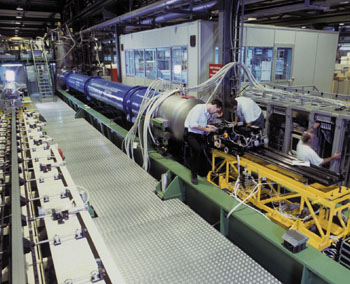
In February, physicists at SLAC, Stanford, successfully finished commissioning the PEP-II B-factory. A few weeks later, engineers and technicians rolled the 1200 ton BaBar detector into position at the interaction point of this dual-ring electronpositron collider. With the insertion of its vertex detector and final checkout scheduled, everything seems ready for the long-anticipated start of the first physics run.
During this final commissioning phase, a team of physicists led by John Seeman gradually nudged the 3.1 GeV positron beam up to very high intensities several times exceeding a current of 1 A. To do so they managed to circulate more than 1500 positron bunches simultaneously, countering the deleterious effects of multibunch instabilities using a sophisticated fast-feedback control system.
At one point the current reached 1.2 A, which is thought to be the highest current ever achieved with an antimatter beam. Its lifetime is fairly short typically less than 1 h but continued “scrubbing” of the ring’s vacuum chambers by circulating the positron beam should eventually resolve this limitation.
Bringing the positron beam into collision with the 9.0 GeV electron beam, the commissioning team achieved a peak luminosity of 5.2 x 1032/sq. cm/s in late February. This is more than 17% of the design value an encouraging feat at this early stage in the life of the new collider.
Design intensities have already been achieved in single-bunch operation. “There are no single-bunch issues remaining on PEP-II, ” remarked Seeman. “It is all about multibunch issues now.” A remaining area of concern is the high background levels encountered during commissioning, which are factors of 5-10 greater than what was anticipated in early simulations. A group of BaBar physicists led by Tom Mattison and Witold Kozanecki has been studying these backgrounds in detail, with an eye to reducing them or coping with them during the experimental runs. Better collimation of the beams well upstream on either side of the detector is one likely solution.
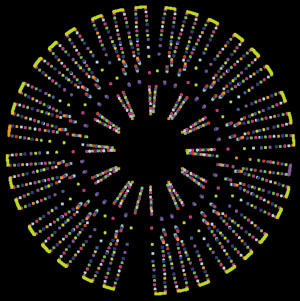
Physicists from the BaBar collaboration commissioned their detector minus its vertex detector and most of its differential Cherenkov detector on cosmic rays in late 1998 and early 1999. The on-line software package has come along smartly in recent months, enabling the reconstruction of cosmic-ray events.
One continuing problem is an unfortunate delay in obtaining enough quartz bars of sufficiently high quality for use in the Cherenkov detector, which begins the first run with only five (out of twelve) bars in place. Thus an idea proposed more than a decade ago by Lawrence Berkeley Lab’s Piermaria Oddone that an asymmetric electron positron collider would prove a superb facility for studying CP violation in the B meson system is about to become reality at SLAC (and across the Pacific at KEKB at the Japanese KEK lab too).
It has been a long, twisting and demanding road, deftly navigated by PEP-II project director Jonathan Dorfan, BaBar spokesman David Hitlin and many others. In the months to come, high-energy physics should begin reaping the benefits of all of the diverse efforts that have gone into this imaginative, challenging project.
As a result of the technological problems to be solved and the global level of participation in the major experiments at CERN’s LHC proton collider, supply and manufacturing has to explore unusual sources.
From the outset, the design of the major CMS experiment at the LHC foresaw calorimetry measuring the energy of the particles emerging from the collisions as of prime importance. Both the electromagnetic and the hadronic calorimeters are inside the solenoid that supplys the detector’s magnetic field, with the electromagnetic calorimeter (ECAL) immediately outside the inner tracker.
The ECAL will use lead tungstate crystals to pick up the emerging photons, which could provide useful signatures of new particles. With its strong photon absorption, lead tungstate makes a compact, and so cheaper, detector. Displaying the international flavour of the CMS collaboration, production of the approximately 80 000 lead tungstate crystals will be shared between the Bogoroditsk Techno-Chemical Plant in Russia and the Shanghai Institute of Ceramics in China.
After four years of active R&D, a preproduction phase has just begun in Russia, where 6000 crystals will be grown in mass-production conditions. This continues until the middle of next year. The goal of this preproduction phase is to tune the production conditions for a maximum yield of good-quality crystals. The first three batches, together amounting to 400 crystals, were delivered to CERN on schedule late last year. The quality of the first crystals received is already greater than the most optimistic expectations. The crystals are very clear, colourless, highly transparent and with an exceptionally fast response time (more than 97% of the light appears within 100 ns). The light yield is in excess of eight photoelectrons per mega electron volt.
All LHC detector components will have to contend with a harsh environment owing to the thousands of secondary particles that are produced by each collision. “Radiation hardness” is therefore of prime importance. Initial measurements of the CMS ECAL crystal’s radiation hardness is well within the specified range.
Growing large crystals is not straightforward, but the growth yield has also been very high already very close to the target of 75%. This was made possible through a concerted R&D effort supported by CERN and the ISTC (International Science and Technology Centre) in which several groups of the CMS ECAL community, particularly those from Minsk and CERN, have actively participated. (The ISTC is the international scheme set up in 1991 to diversify and reorient the effort that was formerly channelled into Soviet military applications.)
During this initial period the basic mechanisms underlying the phenomena responsible for the light production and the radiation damage in this crystal have been studied systematically.
This was a vital step towards improving crystal quality, first at a small scale and progressively at the mass production scale, at a level that meets the very tight specifications imposed by the LHC running conditions.
To provide the best experiences, we use technologies like cookies to store and/or access device information. Consenting to these technologies will allow us to process data such as browsing behavior or unique IDs on this site. Not consenting or withdrawing consent, may adversely affect certain features and functions.
Functional
Always active
The technical storage or access is strictly necessary for the legitimate purpose of enabling the use of a specific service explicitly requested by the subscriber or user, or for the sole purpose of carrying out the transmission of a communication over an electronic communications network.
Preferences
The technical storage or access is necessary for the legitimate purpose of storing preferences that are not requested by the subscriber or user.
Statistics
The technical storage or access that is used exclusively for statistical purposes.The technical storage or access that is used exclusively for anonymous statistical purposes. Without a subpoena, voluntary compliance on the part of your Internet Service Provider, or additional records from a third party, information stored or retrieved for this purpose alone cannot usually be used to identify you.
Marketing
The technical storage or access is required to create user profiles to send advertising, or to track the user on a website or across several websites for similar marketing purposes.