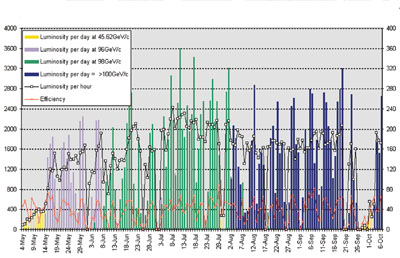
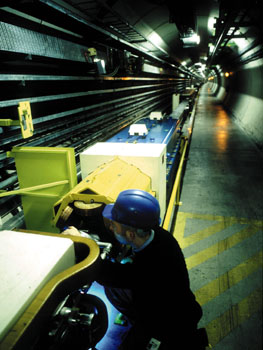
On 24 September 1999 the French authorities gave their formal permission for CERN’s LEP electronpositron collider to run at beam energies of up to 105 GeV. Immediately following the receipt of the letter, two fills were running at 101 GeV. However, the machine then had cryogenics problems.
LEP had been running impressively at 100 GeV per beam (a collision energy of 200 GeV) since early August.
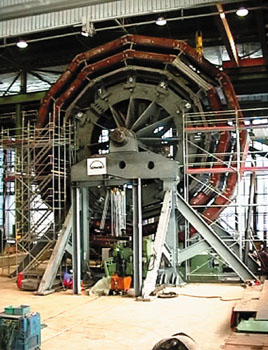
The world’s largest superconducting solenoid magnet for the CMS experiment at CERN’s LHC collider recently took an important step towards completion when the first ring of its barrel yoke was assembled near Munich. The order for the manufacture of the yoke was given to Germany’s Deggendorfer Werft und Eisenbau GmbH (DWE) in the largest individual contract for a high-energy physics experiment ever placed. The contract was worth some 23 million Swiss francs. Following a worldwide call for tender, the order for the CMS barrel iron yoke and vacuum tank was signed on behalf of the CMS collaboration between DWE and the Swiss Federal Technical Institute ETH Zürich in April of last year.
The CMS solenoid coil will measure 6 m in diameter and 12.5 m in length. At 4 T it will have the highest field of any magnet of its kind and it will be able to store some 2.5 GJ of energy. Its return yoke will weigh 11 000 tons and will consist of two endcaps, each of which will have three disks, and a barrel yoke that is made up of five rings.
The magnet system was designed by a CMS team and was financed by a consortium of CMS funding agencies in Switzerland, the US, Germany, Cyprus, Russia and the CMS Common Fund. DWE is coordinating the magnet’s construction with subcontractors in the Czech Republic, France, Germany, Italy, and the Russian Federation.
Eight of the ten feet for the yoke are being provided as an in-kind contribution by Pakistan, where they are being manufactured by the company Scientific Engineering Systems. China will be donating the supports for the endcaps. They are being manufactured in China by the Hudong Heavy Machinery Company. The final assembly of the yoke will commence in July 2000 at CERN. After being tested on the surface, the magnet will be lowered, ring by ring, to the CMS experimental hall some time towards the end of 2003.
The recent discovery of new superheavy transuranic nuclei has reawakened interest in the possibility of an “island of stability” inhabited by quasi-stable nuclei. These exotica are produced by bombarding a suitable nuclear target with a high-energy beam of specially prepared nuclei and studying the resulting decay chains in a suitable detector.
The discovery of these nuclei is a major accomplishment for the accelerators that handle the beams and is a tribute to the expertise of the scientists at the three traditional world centres for this work Dubna near Moscow, the GSI heavy-ion Laboratory in Darmstadt and the US Lawrence Berkeley Laboratory, where transuranic nuclei were first discovered by McMillan and Abelson 60 years ago. The detectors (the SHIP velocity filter at Darmstadt and gas-filled separators at Dubna and Berkeley) also play a vital role.
However, given the minuscule production rates of the new nuclei (roughly one every two weeks), a prerequisite for achieving anything at all is to be able to supply enormous doses (1018) of ions to feed the accelerators in a reasonable time. Moreover, the ions required are highly charged: krypton-19+ at Berkeley, calcium-5+ at Dubna and nickel-9+ at Darmstadt. The supplied beams also have to be well defined so that no precious particles are lost downstream in the acceleration and transport stages. The standard source that meets all of these demanding criteria is the electron cyclotron resonance ion source (ECRIS), which is capable of supplying adequate doses nonstop over several weeks.
ECRIS uses neither cathodes nor arc discharges. The cavity is filled with vapour and subjected to microwave oscillations in a magnetic field. Ionization electrons in the vapour see the source as a miniature cyclotron, whirling round and acquiring energy. These high-energy electrons trigger a plasma breakdown and in turn rip out more electrons, thus ionizing the vapour to high charge states.
Owing to the absence of electrodes, these sources are very reliable and can provide virtually unlimited amounts of ions. Darmstadt is now equipped with its CAPRICE ECR source, Dubna with ECR4M and Berkeley with ECR-U, all of which are operating at 14 GHz.
Incidently, CERN’s new heavy-ion linac, commissioned in 1994, also uses a 14 GHz ECR ion source (supplied by France) and produces lead-27+ ions at 2.5 KeV per nucleon to feed CERN’s programme of research using beams of heavy ions.
To mark the major international Telecom ’99 exhibition in Geneva, CERN staged a demonstration of the world’s fastest computer networking standard, the Gigabyte System Network. This is a new networking standard developed by the High Performance Networking Forum, which is a worldwide collaboration between industry and academia. Telecom ’99 delegates came to CERN to see the new standard in action.
The academic scientific community has been at the forefront of networking for nearly three decades. In the pioneering days of the late 1960s and early 1970s, it was computer scientists working on the US ARPANET, the British National Physical Laboratory network and the French Cyclades that got networking off the ground. Later, the US NSFNET and British JANET brought networking to the academic community as a whole. At CERN, the pioneering CERNET of the 1970s was a network of networks before the Internet was born. Then, when the ARPANET became the Internet and jumped the Atlantic into Europe, high-energy physics was, for a long time, its most important user.
Today, networking has entered the industrial mainstream, but laboratories like CERN still play an important role. CERN’s contribution to the Gigabyte System Network (GSN) has been the development of a bridge to connect the new standard with the increasingly popular Gigabit Ethernet local networking architecture. The CERN set-up, currently the largest GSN network in the world, is a valuable proving ground for the new technology.
GSN is the first networking standard capable of handling the enormous data rates expected from CERN’s forthcoming Large Hadron Collider (LHC) experiments. It has a capacity of 800 Mbyte/s (that’s getting on for a full-length feature film), making it attractive beyond the realms of scientific research. Internet service providers, for example, expect to require these data rates to supply high-quality multimedia across the Internet within a few years. Today, however, most home network users have to be content with 5 kbyte/s, or about a single frame. Even CERN, one of Europe’s largest networking centres, currently has a total external capacity of only 22 Mbyte/s.
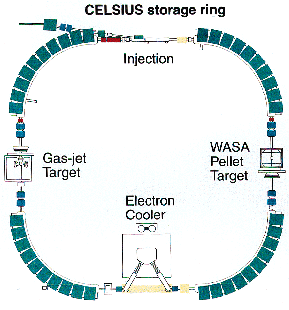
During the recent PANIC99 particle/nuclear physics conference, CELSIUS/WASA, a new detector facility for the CELSIUS cooler storage ring, was inaugurated. The inauguration talk was given by Erwin Gabathuler and the facility was shown to conference participants during tours of the the Svedberg Laboratory a Swedish national facility for accelerator-based research.
The name of the laboratory is associated with Svedberg, the 1926 chemistry Nobel Laureate, who in 1945 took the initiative to build the Gustaf Werner 185 MeV synchro-cyclotron that was, in the early 1950s, the highest-energy accelerator in Western Europe.
This accelerator, rebuilt into a sector-focusing synchrocyclotron, is used for research and also serves as an injector for CELSIUS (Cooling with Electrons and Storing Ions from the Uppsala Synchrocyclotron), which is an accelerator and storage ring intended for internal target experiments.
The magnets for the 82 m circumference CELSIUS ring formerly used in the CERN g-2 experiment (to measure the muon’s magnetism) and ICE (beam cooling) experiment were brought from CERN to Uppsala in 1983. CELSIUS experiments began in 1990. There are two target stations. One is occupied by CELSIUS/WASA and makes use of protons with energies of up to 1.36 GeV.
The CELSIUS/WASA collaboration involves groups from Uppsala, Stockholm, Hamburg, Tübingen, Jülich, Warsaw, Moscow, Dubna, Novosibirsk, Osaka and Tsukuba. Studies will be made of decays and production of light mesons from inelastic protonhydrogen collisions. CELSIUS/WASA consists of a forward part, primarily for measurements of the scattered protons, and a central part for measuring the mesons and their decay fragments. The targets are hydrogen pellets injected at high speed (60 m/s) through a tube that connects to the CELSIUS beam tube. They are produced from a liquid jet broken up into droplets by a piezoelectric crystal at the nozzle. The stream of 0.03 mm diameter pellets can be collimated so that the desired size and frequency are reached at the circulating proton beam.
One key component is the very thin superconducting solenoid coil, which is a further development of airborne magnets for Japanese space experiments. Copper of 3 mm thickness, corresponding to only 0.18 radiation lengths, is placed inside the caesium iodide calorimeter barrel, which has 1012 individual elements. Inside the solenoid are a plastic scintillator barrel with 146 elements and a mini drift chamber with 1738 individual straws. The trigger system has to cope with a total event rate of 10 MHz.
Already, several years of production experiments, with only the forward part of WASA, have provided interesting new information on meson production near the kinematical threshold. These measurements will continue, and studies of rare eta decays are being initiated. Of main interest are suppressed electromagnetic decays and strong decays. These will be used to measure limits of C and CP symmetries and their relations to the corresponding symmetries in the kaon system.
Understanding low-energy phenomena in terms of quarks is one of the great challenges of subatomic physics. The rare decay processes may also unravel surprises that are not easily explainable by the Standard Model.
The new isotope separator and accelerator (ISAC) facility at the Canadian TRIUMF laboratory passed a milestone on 28 July when the proton current on target was raised to 10 µA, making it the highest intensity isotope separator on-line (ISOL) radioactive ion beam facility. Current experiments focus on the very short-lived isotope rubidium-74, for which measurements of the half-life (65 ms) and branching ratios are expected to provide fundamental tests of the weak interaction.
Nuclear shape measurements are also under way using the low-temperature nuclear orientation (LTNO) facility from Oak Ridge. Experiments at lower intensity have been carried out since late November 1998 (CERN Courier March), when ISAC was first commissioned with a 1 µA proton beam. An initial test at 100 µA is planned for December 1999. Meanwhile, progress is on schedule with the radiofrequency quadrupole and drift-tube linac sections for the acceleration of the ions to 1.5 MeV/nucleon for nuclear astrophysics experiments at the end of 2000.
The news broke in the September issue that CERN’s LEP electronpositron collider was running at 100 GeV per beam (giving a total collision energy of 200 GeV) and giving very stable conditions.
Some 10 years ago, equipped with room temperature copper radiofrequency cavities, LEP began operating at 45 GeV per beam. From 1995, superconducting radiofrequency began to be added and the machine’s energy increased initially to 65 GeV per beam, then to 80.5 GeV in 1996 and to 94.5 GeV in 1998.
While this dramatic boost in collision energy via superconducting radiofrequency power looks like a latter-day accomplishment, from the very outset LEP was foreseen as being capable of attaining at least 100 GeV beams. The pioneer 1976 study group (which included Burt Richter, visiting CERN from SLAC in Stanford) addressed a machine that was designed to achieve a beam energy of 100 GeV and a luminosity (which is a measure of the particle collision rate) of 1032/sq. cm/s. Electrons are very light particles, so electron rings have to combat losses owing to synchrotron radiation as the beams are bent. To minimize these losses, the LEP circumference was made as large as possible. Therefore the magnets do not have to be very powerful.
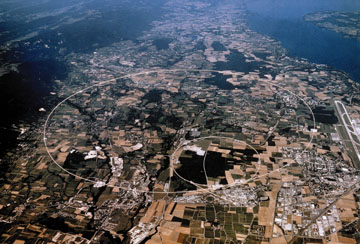
Protons, however, do not lose much energy via synchrotron radiation and proton rings can be compact, with powerful magnets to bend the beams. As a result, CERN has its 27 km LEP ring running with electrons and positrons at 100 GeV. However, the protons in the LHC machine, built in the same tunnel, go beyond 8 TeV.
The 1977 LEP study group looked at 100 GeV per beam or more in a 51 km circumference ring, but, because of technical difficulties and the cost, a study for a machine half the size of LEP-100 was prepared. In 1978 the study group produced a 22 km ring design aimed at 70 GeV, and the emerging 1979 design foresaw a 31 km ring with stored beams capable of being taken from an injection level of 22 GeV up to 130 GeV, with an initial operation of 86 GeV. The ring was subsequently trimmed to 27 km and, as approved by CERN Council in 1981, LEP was optimized for a beam energy of 80100 GeV but with an initial operation phase of up to 55 GeV. The initial LEP study group at CERN was led by Eberhard Keil, Wolfgang Schnell and Kees Zilverschoon. Emilio Picasso became project director in 1981.
LEP’s initial physics goal was to find and make precision measurements of the Z, which is the neutral carrier of the weak interaction. Using the freshly minted electroweak model, other experiments in the late 1970s and early 1980s began to hint that the mass of the Z and its electrically charged W companion were around 100 GeV.
Synthesizing the Z in electronpositron annihilations would need only 50 GeV per beam, but the W, which has to be produced in oppositely charged pairs, would need twice as much beam energy. Thus LEP had to be capable of producing W pairs.
However, by the time the final LEP design report had been formulated in 1984, the W and the Z had been discovered at CERN’s protonantiproton collider with masses of around 80 and 90 GeV respectively. The lattice of magnets, which hold LEP’s electrons and positrons on track, was optimized for the 80-100 GeV beam energy range.
Although the Z had been found, LEP still had the formidable task of making precision measurements of this particle. An electron ring that is optimized for running at around 80 GeV per beam is not unduly taxed when running at 45 GeV per beam to produce Z particles. From 1989 to 1995 the four LEP experiments amassed between them some 20 million Zs.
Meanwhile, work had been under way to ensure that the superconducting radiofrequency power would be available for the higher-energy LEP beams the R&D programme had begun even before LEP had been formally approved. With sufficient superconducting accelerating power on board, the four LEP experiments began logging the production of W pairs in 1996, and this physics too became the subject of precision study.
As these electroweak data began to pile up, another physics horizon beckoned. At the heart of the electroweak model is the mysterious Higgs mechanism, which endows the vacuum with a preferred direction. Higgs particles have to be present to make the electroweak theory tick, but the theory can predict very little about them.
No explicit sign of Higgs particles had turned up by the time the W pair threshold had been reached at 80.5 GeV per beam. However, physicists had another lever to prise open the Higgs door. The interconsistency of the accumulated electroweak data limits where the Higgs particles can be, even if the particles are as yet invisible. In the same way that parallax measurements from two telescopes give a better fix on a distant star than can be achieved by a single sighting, electroweak measurements from different sectors give a sharper picture with less room for the Higgs to maneouvre.
With the electroweak prize at stake, LEP’s beam energy was pushed beyond the W pair threshold from 1998. When the beam energy is increased from 80 to 100 GeV, the electrons and positrons lose 2.44 times as much energy via synchrotron radiation and these losses have to be compensated for by superconducting power.
That this can be achieved is the ultimate success of LEP’s superconducting radiofrequency programme and its attendant cryogenics. The continually increasing collision rate (luminosity) at these higher energies reflects the foresight of the LEP machine designers, who ensured that the ring had all of the necessary beam-handling power right from the beginning. The trick was to allow for flexible phase advance, which focused the beams more tightly as the energy increased, to combat their natural tendency to increase in size.
When CERN came into being in the early 1950s, a sea change was taking place in particle physics research. Until then, cosmic rays had provided most of the basic particle physics discoveries. Accelerators made their first contributions at Berkeley in 1949, with the Chicago and Carnegie synchrocyclotrons not far behind. In 1953, the Cosmotron, so named because it was the first accelerator to attain cosmic-ray energies, began operation at Brookhaven and provided physicists with the first laboratory-made strange particles.
At the Bagnères conference in 1953, leading cosmic-ray physicist Cecil Powell, who had been awarded the 1950 Nobel Prize for his 1947 discovery of the pion, said: “We have been invaded. The accelerators are here.”
Although many of CERN’s first-generation physicists cut their research teeth on cosmic rays, for more than 40 years CERN went about building and exploiting its large accelerators, and cosmic-ray physics took a back seat.
With cosmic rays reporting particles beyond 1020 eV thousands of times as high as the highest laboratory energies now available particle physicists are rediscovering the attractions of natural sources of high-energy particles. While these natural sources provide energies far beyond those that will be opened up by the next generation of particle colliders, the event rates are puny in comparison.
Cosmic-ray revival
There are two primary motivations for this cosmic-ray revival. First, dramatic results from the Super-Kamiokande underground experiment in Japan, studying neutrinos produced by cosmic-ray collisions in the atmosphere, strongly suggest that the different kinds of neutrinos transform into each other – or “oscillate”. To exploit these neutrino possibilities fully requires accurate knowledge of the cosmic-ray muon spectrum. With existing data samples mutually disagreeing by 20-30%, more accurate data are called for.
Second, direct measurements of primary cosmic rays of energies of greater than 1014 eV (100 TeV) are impractical. For example, above 1016 eV there is only one particle per square metre per steradian per year. However, the primary cosmic-energy spectrum extends beyond 1020 eV and there is great interest in the composition, the energy spectrum and the interaction of the primary cosmic rays with nuclei in the upper atmosphere. Knowledge of the cosmic-particle composition above the “knee” (a few times 1015 eV) could shed light on how particles are accelerated to such high energies.
From ground-based observations of different particles (in extensive air showers) and from studies of atmospheric scintillation and Cherenkov light, the cosmic-ray community has learned a lot, but many mysteries and uncertainties remain. Even with good data, it is difficult to determine simultaneously a unique primary composition and interaction model.
Data collected by large detectors at accelerator laboratories would be a valuable contribution. With a relatively modest investment, these detectors can be exploited for cosmic-ray physics in parallel with, and with no loss in efficiency for, the primary mission.
The cosmic-ray muon threshold for L3 is about 15 GeV.
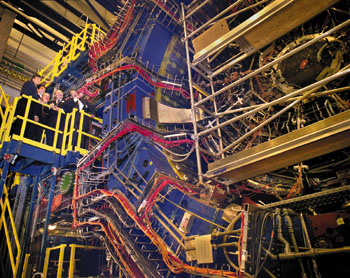
At CERN’s LEP collider, a subgroup of the L3 collaboration has formed the L3+Cosmics group, using new electronics to enable the muon spectrometer drift chambers to be read out independently of LEP data collection. A blanket of about 200 sq. m of scintillator has been installed over the top three octants of the magnet to provide a reference time signal for cosmic-ray data collection. Under 30 m of rock, the cosmic-ray muon threshold for L3 is about 15 GeV.
Elsewhere in the LEP ring, members of the ALEPH collaboration are running a pilot CosmoALEPH experiment to look for coincident muons over long distances. This group has examined, together with the newly established CosmoLEP group, the cosmic-ray data collected during the ALEPH runs.
Data archives have revealed a substantial collection of cosmic-ray muon events. Although the detector is live for only 10% of the time for cosmic-ray particles, this nevertheless adds up over several years to more than a million seconds (about 12 days).
Muon multiplicities, etc, have been analysed using sophisticated cosmic-ray simulation programs developed by the Karlsruhe group. Intriguing events, producing unprecedented numbers of muons, have sparked a proposal to study these phenomena in more detail.
Topical workshop
A topical workshop in Sodankyla, about 100 km north of the Arctic Circle in Finland, on 24-29 April and organized by Karsten Eggert of CERN, highlighted the resurgence of interest in cosmic-ray muons.
The Karlsruhe group with its KASCADE detector array has, perhaps, the most comprehensive data so far on ground-level air showers, which can be interpreted in terms of the primary cosmic-ray spectrum and its composition.
C Taylor (Case Western Reserve) and R Engel (Bartol) looked at the primary cosmic-ray nuclear interaction, noting the uncertainty in the final state particle production at very small forward angles that dominates cosmic-ray muon production.
More than 300 000 cosmic-ray muon events have been analysed
Even though Fermilab’s Tevatron Collider energy corresponds to a cosmic ray, of about 2 x 10¹⁵ eV, interacting with an air nucleon at rest, there are almost no data on forward particle production at energies above the older fixed-target experiments at a few hundred giga electron-volts.
ALEPH and L3 surveyed their respective cosmic-ray muon observations. H Wilkens (Nijmegen) gave an update on the additions to the L3 detector and electronics and the muon programme in progress. S Tonwar (Tata Institute) described the planned addition of a surface air shower array above L3, which will enable the observation of energetic muons together with the related air shower. J Strom (Arcada), A Bruhl (Siegen) and M Schmelling (Max-Planck Institute) presented the current status of the ALEPH cosmic-ray programme. More than 300 000 cosmic-ray muon events have been analysed, and good agreement with the KASCADE Monte Carlo simulations obtained for multimuon events observed in the 16 sq. m time-projection chamber for multiplicities (total number of produced particles) between 2 and 40. However, there are five events with unexpectedly large multiplicities: up to 150 (in some cases with additional muons observed in the hadron calorimeter).
Other ALEPH studies look at the “decoherence” curve the coincidence rate between two muon detectors as a function of their separation, extending beyond 1 km.
Horst Wachsmuth (CERN) proposed looking for muon coincidences between the four LEP detectors, a phenomenon that should not occur for any “ordinary” cosmic-ray interaction in the Earth’s upper atmosphere. Such a coincidence, suggested by some earlier cosmic-ray experiments, would certainly require explanation.
Other major particle physics detector groups are also interested. A De Roeck (DESY) discussed the potential involvement of the big H1 and ZEUS detectors at DESY’s HERA electronproton collider for studies of coincident cosmic-ray muons. With these detectors only 3 m below ground they could study cosmic-ray muons down to energies of 2 or 3 GeV, which is of great interest to the atmospheric muon neutrino groups.
It is also possible, using satellite (GPS) time recording, to look for time correlations between cosmic-ray muons at DESY and CERN.
Future study
M Vallinkoski (Oulu) described a possible new cosmic-ray muon experiment in a mine in Phyhasalmi, Finland. The Centre for Underground Physics in Phyhasalmi (CUPP) would deploy a seven-detector array at several vertically aligned depths to study the multiplicity, lateral distribution and energy spectrum of cosmic-ray muons.
It was noted that major detectors could also be sensitive to point sources of cosmic-ray muons and, using the Moon as a cheap and efficient absorber and the Earth’s magnetic field as a spectrometer, might set a limit on the relative flux of high-energy primary antimatter nuclei.
The Chinese IHEP group is particularly interested in seeking evidence for possible cosmic-ray associated weakly interacting massive particles (WIMPS) in L3.
Workshop organizer Karsten Eggert discussed other areas of future study, including working with larger and upgraded detectors. As noted by Lawrence Jones (Michigan) in his opening discussion, muon studies with LEP detectors contain both elements of an ideal experimental programme: practical and useful results, such as the absolute inclusive muon spectrum, while at the same time there is sensitivity to new and potentially exciting discoveries, such as unexpected muon multiplicities, cosmic-ray point sources, WIMP discoveries and statistically significant coincidences. Paolo Liperi of Rome summarized the attractions of the proposed new programme.
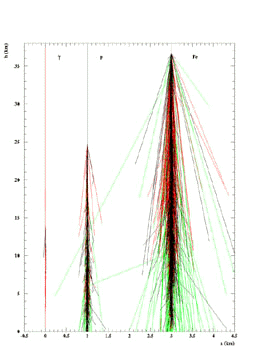
High-energy primary cosmic-ray particles crashing into the atmosphere 20 km above our heads initiate large air showers with hadrons, electrons, muons and neutrinos. By the time they reach ALEPH, 125 m underground, all of these particles are absorbed except for neutrinos and muons above 70 GeV.
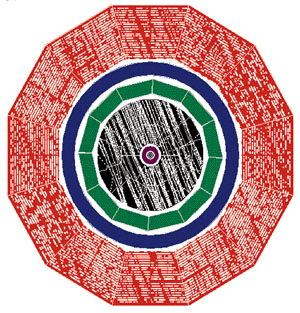
ALEPH provides high resolution tracking in its central Time Projection Chamber (TPC) in a solenoidal magnetic field and the large hadron calorimeter surrounding the TPC provides further information about cosmic muons.
Precision study of these muons, in particular of muon bundles, gives vital information about the primary cosmic rays and the way in which shower particles are produced in the very forward (downward) direction. The primary cosmic particle composition around the “knee” of the energy spectrum (4 x 10¹⁵ eV) is fundamental input for understanding the cosmic acceleration mechanism that pushes particles to these energies.
After analysing cosmic muon events captured by ALEPH in parallel with LEP data-taking and during a special one-week cosmic run, five events were found with the highest muon density ever seen. Some 100 muons hit the sensitive area (16 m2) of the ALEPH TPC. The most crowded event showed about 160 muons in half of the TPC, the other half suffering data overflow.
Extensive simulations using the Corsika program, which was developed by the Karlsruhe group, reproduce the lower muon multiplicities, assuming a primary cosmic particle composition ranging from protons up to nuclei like iron. However, the five spectacular events are an order of magnitude above the simulation prediction. They could come from either unusually large air showers, above 1017 eV, or fluctuations from lower-energy showers, which could hint at new mechanisms for forward particle production.
Charge and momentum determination of the muons in these events, as well as the study of their structure over larger areas, may shed light on their origin. A special cosmic run of ALEPH using the tracking hadron calorimeter extended muon measurements to cover 50 m2. The largest event from this run produced more than 100 muons.
To study these intriguing events the CosmoLEP group proposes placing a 200 m2 array of drift chambers beside the ALEPH experiment. With this large array, the rate of high multiplicity events would be increased by a factor of more than a hundred and the muon patterns would give a window on the energy and composition of the primary cosmic particles. The larger samples could also reveal point sources of cosmic particles in the depths of the universe.
The underground muon showers that have been seen so far extend over, at most, a few hundred metres. The CosmoALEPH effort covers the barrel of ALEPH’s central hadron calorimeter together with several scintillator counter stations installed around the LEP ring near ALEPH, which are up to about 1 km distant. This pilot experiment saw coincident muons in counters that were several hundred metres apart and triggered an idea for a still wider muon search.
The four LEP experiments, equally spaced around the 27 km tunnel, could look for muon correlations over much larger distances. The same approach is being followed at the H1 and ZEUS detectors at the HERA collider at DESY in Hamburg, which are approximately 2 km apart.
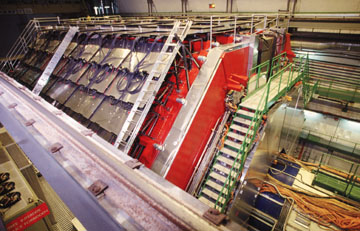
L3+C, an offshoot of the L3 experiment at CERN’s LEP electronpositron collider, has been a “recognized” experiment at CERN since April 1998. It takes advantage of the unique properties of the big L3 muon spectrometer (low energy threshold compared to other underground detectors and unrivalled momentum resolution over a wide momentum range) for accurate measurements of cosmic-ray muons penetrating 30 m underground.
A new muon trigger, readout and data acquisition system have been installed, as well as a 204 sq. m scintillator matrix covering the L3 magnet to time the passage of particles. Data are collected independently, in parallel with L3 running at LEP.
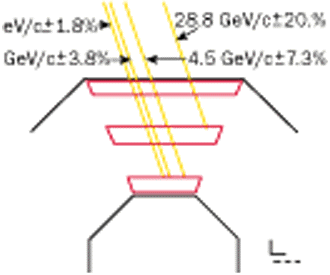
New results for a variety of fundamental topics in cosmic rays, astrophysics and particle physics are expected. The cosmic-ray muon momentum spectrum, zenith angular dependence and charge ratio are being measured to 1% between 10 and 2000 GeV, thanks to L3’s muon drift chambers and large magnetic volume.
The results will provide new information on the primary composition of cosmic rays, shower development in the atmosphere, and pion and kaon levels at high energies. These data will also help us to understand the “atmospheric neutrino puzzle”, where an anomalous muon neutrino signal seen by underground neutrino detectors is heralded as an indication of neutrino oscillations. In particular, the precision measurements will allow a prediction of the absolute number of upward-moving, through-going muons above 10 GeV observed by Super-Kamiokande and MACRO underground.
L3+C started gathering data in 1998. Then in early 1999 it increased its acceptance considerably, achieving an event rate of 550 Hz. In addition to providing more reliable data, this extends both the momentum measurement and the angular range.
The detector could reveal bursts of point source signals, and eventually gamma-ray bursts, and analyse their associated muons. The absence of high energy, upward-moving muons (above a few hundred giga electron-volts) will allow a limit to be set on the neutrino flux from active galactic nuclei. Studies of the primary composition of cosmic rays in the “knee” region (near 1015 eV) will be boosted in a unique way by recording muon “families” and measuring all of their momenta. With exotic events recorded by many different experiments, particle momentum spectra should reveal clues to the processes involved.
The detector will also intercept some upward muons (due to particles that have traversed the Earth). Time variations could reveal meteorological or sidereal effects. Correlations with events seen by other detectors are also among L3+C’s experimental objectives.
Observing the Moon’s muon shadow may give a flux limit of primary antiprotons near 1 TeV the Earth’s magnetic field acting as a convenient momentum analyser and the Moon as an absorber of cosmic particles.
Independent apparatus
The collaboration is preparing to install 50 scintillators below the roof of the L3 access hall (above ground). This air shower array will help to estimate the primary energy of some showers associated with the muons measured underneath. This apparatus is completely independent and runs by itself. Events are correlated via the GPS satellite clock and a signal in the data acquisition system.
The L3+C experiment already has collected some 900 million events and is expected to run up to the end of the LEP operation period next year. The first data were presented at August’s International Cosmic-Ray Conference in Salt Lake City.
To provide the best experiences, we use technologies like cookies to store and/or access device information. Consenting to these technologies will allow us to process data such as browsing behavior or unique IDs on this site. Not consenting or withdrawing consent, may adversely affect certain features and functions.
Functional
Always active
The technical storage or access is strictly necessary for the legitimate purpose of enabling the use of a specific service explicitly requested by the subscriber or user, or for the sole purpose of carrying out the transmission of a communication over an electronic communications network.
Preferences
The technical storage or access is necessary for the legitimate purpose of storing preferences that are not requested by the subscriber or user.
Statistics
The technical storage or access that is used exclusively for statistical purposes.The technical storage or access that is used exclusively for anonymous statistical purposes. Without a subpoena, voluntary compliance on the part of your Internet Service Provider, or additional records from a third party, information stored or retrieved for this purpose alone cannot usually be used to identify you.
Marketing
The technical storage or access is required to create user profiles to send advertising, or to track the user on a website or across several websites for similar marketing purposes.