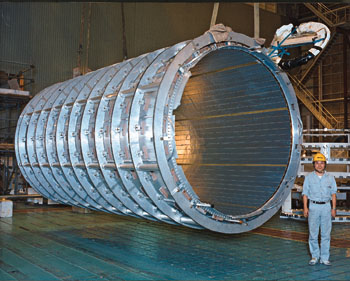
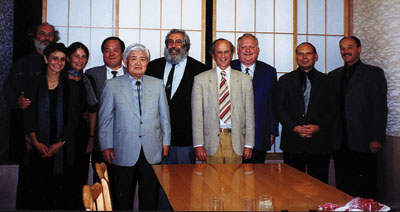
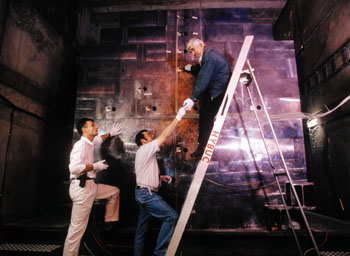
The coil winding for the central solenoid magnet of the forthcoming ATLAS experiment at CERN’s Large Hadron Collider has been completed. It will provide a magnetic field of 2 T at the centre of ATLAS’s tracking volume. This superconducting solenoid was designed and developed by Akira Yamamoto and his team at the Japanese KEK Laboratory, as Japan’s contribution to the ATLAS magnet system. The project is led by Takahiko Kondo.
Weighing in at 5.5 tons, the coil is 2513 mm in diameter, 5300 mm long and 45 mm thick. Conductors made of high-strength aluminium stabilizer, developed by Furukawa Electric and Hitachi Cables, have been used so that the coil is as thin as possible. Some 8.92 km of conductor is coiled into 1151 turns inside an aluminium cylinder, which was made by Oxford Instruments. The coil winding and curing was carried out by Toshiba in Japan and took four months.
Outer reinforcement rings currently support the solenoid. The rings will be removed early next year when the solenoid is incorporated into the inner cylinder of the cryostat, which is being constructed by the US Brookhaven National Laboratory, where the ATLAS liquid argon barrel calorimeter will be housed. The entire solenoid system will then undergo cooling and excitation tests in Japan before being shipped to CERN along with its associated cryogenics in 2001.
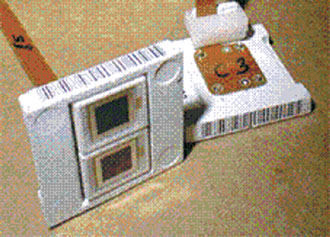
In the search for optimal performance under difficult conditions, experiments for CERN’s LHC are exploiting new technologies. One example is the large-scale use of avalanche photodiodes to read out light signals, which are produced by electromagnetically interacting particles in the CMS detector.
Photodiodes light-sensitive semiconductors have long been used in high-energy physics to read out signals from scintillating fibres and light-emitting crystals in calorimeters, because large magnetic fields or space may prevent the use of vacuum devices. One example is a simple pin photodiode with a layer of intrinsic semiconductor sandwiched between the p and n layers.
An advance on this basic configuration is the avalanche photodiode (APD). The applied bias voltage produces a region with a large field (150 kV/cm or more) in which to generate an avalanche of secondary carriers and thereby amplify the signal. This gain depends on both the applied field and the temperature. This technique has the additional advantage of fully amplifying the signal generated by the scintillation light absorbed at the surface, while signals generated within the diode by traversing ionizing particles are not amplified. A further refinement of the avalanche device is a “reverse” structure, first developed at the beginning of the 1990s, in which a thick avalanche region is located behind a thinner photoconversion layer (in contrast with a standard avalanche device in which the photoconversion layer is thicker).
The scintillating crystals, which are used for recording electromagnetic energy, are one of the big spin-off success stories of particle physics. For big detectors, such as CMS at CERN’s LHC, lead tungstate facilitates a compact calorimeter design and produces short, fast signals. However, because lead tungstate has a low light yield, the APD read-out’s combination of amplification of the light signal and insensitivity to ionizing particles is crucial.
Developing APDs that were able to withstand the high particle intensities of the CMS environment required further research and development with two different specialist suppliers. Using more than 30 different APD prototypes, substantial progress was made and beam tests, using lead tungstate crystals, achieved the design energy resolution of better than 0.5%. The next task was to decide on the relative merits of manufacture, either via epitaxial growth or by diffusion. Last year, CMS chose the epitaxy route, and, after further development work, a contract with Hamamatsu for the supply of 130 000 APDs was signed in Japan by PSI (with ETHZ, Northeastern University and the universities of Minnesota and Split as contributing partners).
Meanwhile a full-scale CMS electromagnetic calorimeter module, with a 400 lead tungstate crystal read-out via 800 APDs, is being constructed at CERN.
In a recent experiment, Thomson-scattered X-rays from Jefferson Lab’s infrared free-electron laser were detected, confirmed and initially characterized. The results suggested a potential new dimension for the laboratory’s free-electron laser development programme. Experimenters used specially configured optical devices to extract intense, ultrafast (hundreds of femtoseconds) X-ray pulses in coincidence with the infrared light pulses of the electron-beam-driven free-electron laser.
The X-ray pulses are generated within the free-electron laser (FEL) via the Thomson scattering of infrared light by electrons. The FEL’s operating characteristics allowed the production of results in a few days. X-ray pulses manipulated in synchronized combination with infrared pulses enable pulse-probe studies one input pulses a target system to yield a subpicosecond of special physical conditions for the other input to probe.
In solid-state physics and materials science, pulse-probe applications could include, the temporal dynamics of condensed-matter phase transitions, the ultrafast time-resolved monitoring of structural changes in materials, and heat propagation at submicrometre dimensions. In biology and chemistry, the capability could be applied to studies of short-range order changes in chemical reactions. In accelerator physics it could be used to develop beam diagnostics for next-generation light sources.
The Jefferson Lab is responding to a call for proposals for the development and application of short-pulse X-ray light sources. The lab’s development of high-average-power FELs is an application of the superconducting radiofrequency accelerating technology, which is at the heart of the 6 GeV continuous-wave accelerator that serves nuclear physics. In July a kilowatt FEL, built mainly with Navy funds, delivered 3.1 µm wavelength light at an average power of 1.72 kW (CERN Courier September 1999). Funding has been allocated for an upgrade that will enable the delivery of 10 kW infrared light and 1 kW ultraviolet light.
Brookhaven and the State University of New York at Stony Brook have established a new centre for data-intensive computing at Brookhaven. James Gliman, Professor of Applied Mathematics and Statistics at the State University of New York, is director.
When Brookhaven’s new Relativistic Heavy Ion Collider begins physics research, the large number of particles that will be produced per collision will generate a huge volume of data. Brookhaven is also one of the US national data centres for the ATLAS experiment at CERN’s LHC proton collider, which is scheduled to begin operation in 2005.
In other areas of science, Brookhaven, site of the US National Synchrotron Light Source, is becoming increasingly involved in determining the structures of proteins.
High-energy physicists are proud that their instrumentation, which was developed for their research, has widespread applications in other fields. A recent symposium Special Applications of Particle Detectors in Medicine, Biology and Astrophysics (SAMBA), proved that this was not just wishful thinking.
The meeting, in Siegen, Germany, on 68 October, was highly cross-disciplinary, to the extent that it was sponsored by the Siegen Research Institute for Social Science and Humanities. The meeting highlighted the contribution of applied physics to our culture and to social prosperity.
After the formal opening by Siegen mayor Ulf Stötzel, Amos Breskin (Weizmann Institute, Israel) surveyed novel, large-area gas avalanche imaging photomultipliers for applications in the assessment of radiation damage to DNA, digital mammography and in the early detection of cancer. These aspects were underlined by Fulvia Arfelli (Trieste) who reported on the demanding diagnostic problems faced to reveal microcalcifications as possible indicators of breast cancer.
The prospects for macromolecular crystallography, particularly for proteins, using synchrotron facilities were presented by Peter Laggner (Graz, Austria). The development of multiwavelength anomalous dispersion techniques has transformed the method from an academic specialist’s playground into a large-scale, high-throughput industry. The importance of time-resolved measurements in X-ray structure analysis was emphasized for small- and wide-angle diffractive scattering experiments on non-crystalline materials.
The jumprelaxation technique opens up time domains down to microseconds, where supramolecular structure processes, induced by a change of parameters such as pressure, temperature or chemical environment, can be analysed. This kind of experiment calls for the development of new, fast, high-resolution and high-rate detectors so that the brilliance of the powerful synchrotron radiation sources, today and in the near future, can be exploited fully. With such experimental facilities designed as multipurpose, multi-user instruments, requirements emerge for new integrated approaches to measurement and detector control, fast data compactification, and artificial intelligence in the evaluation of multiframe results.
The domain of nuclear medicine is a good example of how difficult it is to replace cheap and reliable technology.
Commercial imaging systems for medical applications were reviewed by Detlef Mattern (Siemens/Erlangen). Despite ongoing attempts to switch to directly converting detectors, scintillators are still widely used for medical imaging. In radiography, computer tomography and nuclear medicine, a variety of scintillating devices are the workhorses in today’s clinical practice.
For radiography, flat X-ray detectors with evaporated scintillation layers are not far away. However, X-ray image intensifier tubes are competitive, and have features like speed and dynamic range that are still hard to beat. Although X-ray image intensifier tubes have disadvantages like size and weight, they give more robust image quality and have become cheaper over the decades. Detectors in computer tomography have evolved from scintillators into gaseous direct converters and back to scintillators again. Extreme timing requirements and detector modularity have ruled out designs that would rank as high performance in other fields.
The domain of nuclear medicine is a good example of how difficult it is to replace cheap and reliable technology. For many years, direct converters like cadmium telluride have been proposed as replacements for NaI(Tl) scintillation counters. However, for cost it is difficult to beat this light, high-output scintillator when used in combination with the practically noiseless photomultiplier. New ultracompact multianode photomultiplier designs could even make gamma cameras more compact without using directly converting detectors.
A highlight of the meeting was the talk by Gerhard Kraft (GSI Darmstadt, Germany) on the instrumentation for tumour therapy, which uses heavy-ion beams. Taking advantage of the Bragg peak at the end of the range of charged particles and the nonlinear biological sensitivity to the energy deposit, the small difference in destructive efficiency between healthy cells and cancer cells becomes sufficient to destroy well localized tumours accurately. Short-lived beta emitters, formed by carbon-12 beam fragmentation, are used to monitor the results via PET imaging.
High-granularity pixel counters, such as those being prepared for experiments at CERN’s LHC, are also used as focal detectors for X-ray astronomy. Lothar Strüder (Max Planck Institute for Extraterrestrial Physics, Munich) described the results of the ROSAT and Chandra missions, where radiation damage of semiconductor counters, caused by the Earth’s radiation belts, has to be taken into account. Similar problems concerning radiation hardness also have to be mastered for LHC detectors.
Allan Hallgren (Uppsala) concentrated on particle detectors for astrophysics. He described the virtues of neutrino astronomy using the Antarctic ice as Cherenkov medium. The search for dark matter, using cryogenic detectors, was covered by Klaus Pretzl (Bern). These cryogenic systems are also promising candidates for a new generation of particle trackers to be used in future accelerator experiments.
A public lecture by Claus Grupen (Siegen) entitled “Applications of particle detectors in astrophysics” attracted a good audience.
The meeting was organized jointly by H J Besch, C Grupen, N A Pavel, A Taune and A H Walenta. The proceedings will be published in a special volume of Nuclear Instruments and Methods.
Participants requested a follow-up meeting in this interdisciplinary field of detector applications.
The VEPP-2M electronpositron collider, which has been running at the Budker Institute of Nuclear Physics, Novosibirsk since 1974, amassed more than 4 x 10⁷ phi mesons before the start of the new Italian DAFNE phi factory. With a fairly high luminosity of 3 x 1030 cm-2/s at the phi meson (1.02 GeV), VEPP-2M’s flexible magnetic lattice allowed operation in the pion production threshold to 1.4 GeV collision range.
Two detectors were installed for a series of experiments that started in 1992: CMD-2 (cryogenic magnetic detector) a general purpose detector with a drift chamber inside a 1 ton superconducting solenoid, barrel caesium iodide, and endcap bismuth germanate electromagnetic calorimeters; and SND (spherical neutral detector) a non-magnetic detector with an almost complete angular coverage sodium iodide calorimeter.
These detectors have been successfully complementing each other in their quest for rare decay modes of the rho, omega and phi mesons as well as high-precision measurements of hadronic reaction rates.
Among numerous accurate measurements of various phi decay modes is the first observation of the electric dipole transition to f0(980)/photon (figure 1) and to a0(980)/photon. A high branching ratio of about 10-4 may indicate an exotic four-quark structure of these enigmatic scalar particles.
Another radiative phi decay, to eta/photon, observed by both detectors, is the missing link in a long chain of magnetic dipole transitions among the vector and pseudoscalar mesons, which consist of light quarks. Also of interest to theorists are doubly suppressed decays, to two charged pions, to an omega/neutral pion and to four charged pions.
In addition to the search for rare decay modes of the vector mesons, low-energy measurements of the total electronpositron annihilation cross-section R will allow the precise calculation of the hadronic vacuum polarization, which is currently a limiting factor in other precision analyses. The goal is to measure R to an accuracy greater than 1%.
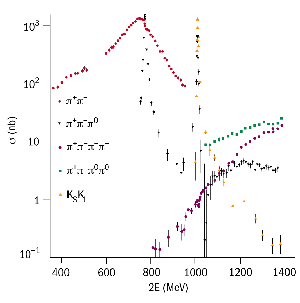
The dominant contribution below 1 GeV comes from the simplest hadronic reaction, which produces charged pion pairs. Of more than 2 million pion pair events detected by CMD-2, about 150 000 have been analysed in the rho meson energy range (610-960 MeV). Thorough analysis of possible systematic effects allowed the final cross-section to be measured with a systematic uncertainty of only 0.6%.
Other achievements include the measurement of three- and four-pion production above the phi meson. The cross-section for annihilation into three pions (two charged) determined by SND agrees with the previous measurement, but it is more precise and shows peculiar behaviour that is consistent with the existence of the omega at 1200 MeV rather than 1420 MeV as recommended by previous interpretations. Analysis of this channel by CMD-2 is still in progress.
Both groups measured two possible final states of the four-pion production with consistent results. The elegant analysis at CMD-2 of intermediate mechanisms leading to the four-pion final state is also important. While for two charged and two neutral pions the omega/neutral pion and a1(1260)/pion channels contribute, it is the latter that saturates the final state with four charged pions.
High luminosity allows the measurement of much smaller cross-sections, at the level of 0.5 nb and below. This is important for the precise determination of R. Figure 2 gives a general impression of the energy dependence of the major contributing processes.
However, VEPP-2M is probably facing its last season. The Budker Institute recently proposed revamping the collider by implementing “round beams” as well as superconducting magnets to increase luminosity and energy. The design foresees flexible operation in the threshold to 2 GeV broad collision energy range, with a maximum luminosity of about 1032, which covers vector meson recurrences and gives a dominant contribution to the uncertainty of important hadronic corrections.
Construction of the new collider as well as the planned upgrade of both detectors should start in 2000, thus justifying the tentative name of the new machine VEPP-2000.
NASA’s Goddard Space Flight Center is coordinating a study, by an international collaboration, of a high-energy cosmic-ray instrument for the International Space Station. The Advanced Cosmic-Ray Composition Experiment for the Space Station will study cosmic-ray nuclei at around 1015 eV in energy to understand better the mechanisms by which particles in the galaxy are accelerated to such high energies.
The Advanced Cosmic-Ray Composition Experiment for the Space Station (ACCESS) will complement terrestrial cosmic-ray air-shower arrays and balloon-borne experiments. It will have the advantage, however, of being able to intercept the incident cosmic rays in space directly rather than observing the showers that they produce when they interact with the atmosphere. This will allow ACCESS to determine the chemical composition of the high-energy cosmic rays directly and should lead to a better understanding of how particles are accelerated in the galaxy. A flight is planned for 2006.
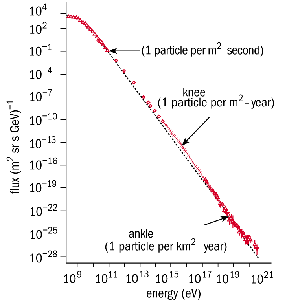
The cosmic-ray energy distribution shows a remarkably uniform slope over many orders of magnitude. There are, however, two kinks in the distribution. One the “knee” occurs near 1015 eV. The second the “ankle” is below 1019 eV. Near both energies, cosmic rays have attracted considerable interest. Above about 5 x 10¹⁹ eV, cosmic rays should not exist. If they originate from a distant source, then their energy should have degraded through interaction with the cosmic-microwave background radiation. If they originate nearby, then it would be surprising if we had not already detected the accelerating source. Thus their origin remains a mystery.
Studying such events is hampered by the extremely low frequency of the cosmic rays; above 1020 eV around 1/km2 per century is detected. However, at the knee, where ACCESS will concentrate its efforts, the rate is about a billion times as high and theories exist for an acceleration mechanism. The most popular theory involves shock waves from supernovae. These will accelerate not only particles blown out in the supernova explosion but also any particles that they encounter as they spread throughout space.
Shock-wave acceleration can account for the cosmic-ray spectrum out to about 1014 eV but has difficulty in going much further. Two possible explanations have been suggested to explain the observation of cosmic rays at higher energies, and ACCESS will be able to distinguish between them. The first assumes that the supernova shock-wave model is essentially correct. This would accelerate protons to 1014 eV and heavier elements up to higher energies. Iron, for example, would reach 3 x 10¹⁵ eV. Another, unknown, mechanism must then be invoked to explain the spectrum at higher energies, with the kink in the distribution being due to overlap between the two mechanisms and the progressive change in chemical composition as the knee is approached. Candidates for the mechanism include rotating compact magnetic objects, such as neutron stars, or black holes.
The second potential explanation postulates a smooth energy distribution up to the highest cosmic-ray energies with some, as yet unknown, loss mechanism beginning to take effect at about 1015 eV and giving rise to the observed kink. By measuring the chemical composition of the cosmic rays at 1015 eV, ACCESS will be able to put the first explanation to the test.
ACCESS is an experiment at the overlap between terrestrial particle physics and astrophysics. The particle detector technologies originate in particle physics experiments but are being pushed to their limits by the volume and weight constraints of a space-borne experiment. The ACCESS team recently tested potential designs for its calorimeter and Transition Radiation Detector in test beams at CERN. The final ACCESS detectors will be calibrated in CERN beams before launching the instrument into space, where it will measure cosmic rays at energies more than 1000 times as great as current accelerators can deliver.
Understanding how the strong force binds nucleons together to form light nuclei and how stars synthesize heavier nuclei is fundamental to our comprehension of the universe. The study of stable and unstable nuclei leads to an improved knowledge of nuclear structure, the limits of nuclear stability and the nature of interactions between protons and neutrons. Accelerator-produced radioactive species will provide a critical source of proton- and neutron-rich nuclei to further these studies.
Lawrence Berkeley National Laboratory’s Berkeley experiments with accelerated radioactive species (BEARS) project has achieved a major goal with the delivery of its first radioactive beam – 1-2 x 10⁸ ions/s of 110 MeV carbon-11 onto a gold target for a period of 4 h for a study of the yields of astatine isotopes. BEARS is led by Joseph Cerny, Professor of Chemistry at the University of California and LBNL Nuclear Science Division, with other researchers from the Nuclear Science Division, the Life Sciences Division of LBNL and from the Brookhaven National Laboratory. The project produces radioactive beams, for use in nuclear studies, at a modest cost by using existing cyclotrons. Efforts are focused on this coupled cyclotron approach, which uses one cyclotron to produce a radioactive isotope and a second one to accelerate it.
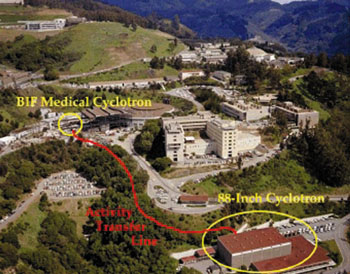
The group began proof-of-principle experiments using carbon-11 with a half-life of 20 min. The carbon-11 is made at Berkeley’s 88 inch cyclotron by bombarding nitrogen-14 with protons. The carbon-11 combines with a small amount of oxygen to form CO2. This was transported by gas jet to a reservoir near the electron cyclotron resonance ion source (ECR) and cryotrapped with liquid nitrogen while the carrier gas was pumped away. The trap was then warmed up and the carbon-11 was fed into the ECR to test the efficiency of the ion extraction. The ions were extracted. However, the efficiency was low.
The next step was to produce batches of carbon-11 at the Biomedical Isotope Facility cyclotron, which is an 11 MeV, 30 µA proton machine. Higher yields were achieved using a high-pressure gas target and the higher beam currents available. The carbon-11 (as CO2) was trapped in a coiled stainless steel tube submerged in liquid nitrogen and brought by truck to the 88 inch cyclotron. The liquid-nitrogen trap was warmed and the carbon-11 was fed into the advanced ECR (AECR) source, ionized and extracted, with 10% efficiency, as a 4+ charge beam of ions. The carbon-11 was injected into the 88 inch cyclotron and the beam was tuned using 8+ neon-22. After the beam optics had been completed with neon, the cyclotron’s radiofrequency was shifted a few kilohertz to bring carbon-11 into resonance. A foil before a key bending magnet completely stripped the ions of electrons. This allowed the separation of contamination from the ECR source. The typical extracted beam speed was 3 x 10⁷ ions/s.
With the success of these experiments, the construction of a 300 m transfer line between the two cyclotrons was begun. Previous tests had shown that the transfer time over this distance was 20 s. A 150 mm rigid outer pipe was installed between the cyclotrons about 1 m off the ground with access boxes every 30 m. Then a 50 mm vacuum hose was pulled through the pipe. Finally, a bundle of capillaries, varying in size from 3 to 10 mm in diameter, was pulled through the 50 mm hose. The pressure in the hose was maintained at 1 Torr. The integrity of the system was monitored for pressure loss, continuity and radiation levels. This system exceeds stringent laboratory safety requirements. The BEARS group also worked closely with the Environmental Health and Safety Division. Close co-operation among all three divisions was instrumental in the project’s success.
On completion of the transfer line, a successful commissioning run used carbon-11 in the form of CO2, which was produced at the Biomedical Cyclotron and released in batches of 3 x 10¹³ molecules down the transfer line at 5 min intervals. At the 88 inch cyclotron the CO2 was caught in a cryotrap and slowly released into the AECR. The entire process was automated and was controlled and monitored by computer. Between 1 and 2 x 10⁸ ions of 11 C/s were available on target.
Future plans will envolve the development of other short-lived radioactive beams, which will include nitrogen-13, oxygen-14, and fluorine-17 and -18 for nuclear physics and nuclear astrophysics experiments.
On 9-10 December a symposium at Cornell University, Ithaca, New York, will mark the 20th anniversary of the Cornell Electron Storage Ring, the CLEO particle detector and the Cornell High-Energy Synchrotron Source. It will also herald the beginning of a new era of B meson physics and a new generation of synchrotron radiation beamlines.
The Cornell Electron Storage Ring (CESR) is now completing a major upgrade with the goal of producing more than 15 million B meson pairs per year. Simultaneously the CLEO detector is installing a new silicon vertex detector, drift chamber and ring-imaging Cherenkov counter. Accelerator commissioning has begun, and data collection is expected to begin in early 2000. The CESR and CLEO upgrades will open the door to studies of CP violation, rare B decays and precision measurements of quark mixing. Cornell is a major player in this new physics push.
In parallel with the CESR/CLEO upgrade, the Cornell High-Energy Synchrotron Source (CHESS) is upgrading its X-ray optics. Construction of a building to house three new, ultrahigh flux X-ray stations is well under way.
In the past 20 years, CESR and CLEO have provided much of the world’s knowledge on heavy quark and lepton physics. Highlights have been the discoveries of the B meson (CLEO, CUSB 1979-1980), the first observation of transitions between the bottom and up quarks (CLEO, 1990) and the first direct sighting of “penguin” decays (CLEO, 1993).
A new facility is set to join the CERN experimental programme from April 2000. The neutron time-of-flight (nTOF) system will support a range of experiments that study neutron-induced reactions. They will cover subjects as diverse as stellar nucleosynthesis and basic nuclear physics, and they will be complementary to experiments already under way at the laboratory’s ISOLDE radioactive beam facility.
Taking its cue from the recent TARC experiment at CERN, which studied the transmutation of elements using neutrons moderated in lead, the facility will also study the neutron-induced transmutation of radioactive isotopes found in nuclear waste.
The nTOF facility’s strong point is its extremely high resolution for neutron capture cross-sections over the 1 eV to 250 MeV energy range. Neutrons, produced by spallation in a lead target that was recycled from TARC, will travel to an experimental area 200 m downstream. It is this distance that gives nTOF its unprecedented neutron energy resolution, which is expected to be of the order 10-4 over the entire energy range.
The facility is currently under construction and, when it starts up next year, it will have been commissioned in record time. One reason for this is the extensive use made of the existing infrastructure. The facility will be installed in an existing tunnel leading from the Proton Synchrotron accelerator, which will provide the protons driving the spallation process in the lead target, to CERN’s west experimental area. Moreover, this tunnel passes 7 m below another that formerly housed the Intersecting Storage Rings collider. The experimental target will be situated below this tunnel, which will be adapted to provide target-handling facilities.
The first experiments at the nTOF will be designed to test its performance. Known neutron capture cross-sections will be evaluated before the nTOF programme moves on to a range of new measurements.
To provide the best experiences, we use technologies like cookies to store and/or access device information. Consenting to these technologies will allow us to process data such as browsing behavior or unique IDs on this site. Not consenting or withdrawing consent, may adversely affect certain features and functions.
Functional
Always active
The technical storage or access is strictly necessary for the legitimate purpose of enabling the use of a specific service explicitly requested by the subscriber or user, or for the sole purpose of carrying out the transmission of a communication over an electronic communications network.
Preferences
The technical storage or access is necessary for the legitimate purpose of storing preferences that are not requested by the subscriber or user.
Statistics
The technical storage or access that is used exclusively for statistical purposes.The technical storage or access that is used exclusively for anonymous statistical purposes. Without a subpoena, voluntary compliance on the part of your Internet Service Provider, or additional records from a third party, information stored or retrieved for this purpose alone cannot usually be used to identify you.
Marketing
The technical storage or access is required to create user profiles to send advertising, or to track the user on a website or across several websites for similar marketing purposes.