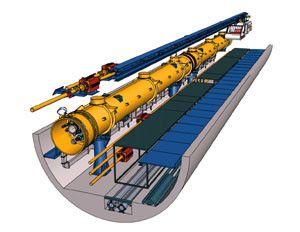
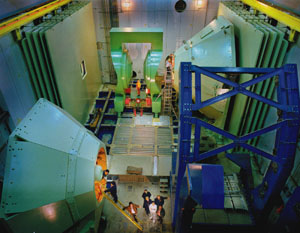
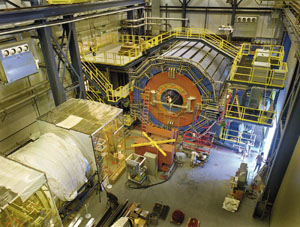
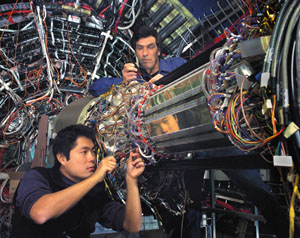
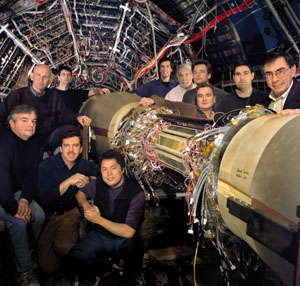
End Station A, the venerable fixed-target facility at the end of the two mile electron linear accelerator beam at SLAC, Stanford, where quarks were discovered in 1967, will soon see a high-energy beam of polarized (spin oriented) photons as three newly approved experiments move onto the floor.
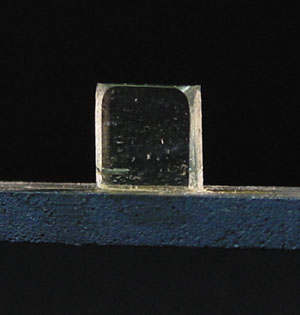
An international collaboration led by Peter Bosted and Stephen Rock (Massachusetts), Donald Crabb (Virginia) and Keith Griffioen (William and Mary) will use paper-thin diamond wafers to generate coherent photon beams with energies of up to 48 GeV.
Louis Osborne and Roy Schwitters pioneered this technique at SLAC in 1970, when the maximum electron energy was 20 GeV. Specific crystal planes of the diamond are precisely aligned with the electron beam to create a diffraction grating for the bremsstrahlung photons produced by electrons interacting in the crystal. This process yields distinct spikes in the photon energy spectrum. Small-angle collimation then enhances the ratio of coherent to incoherent radiation. SLAC’s highly polarized electron beam, with energies now as high as 50 GeV, will be used to generate more than a billion circularly polarized photons per second.
The three new experiments are known as E159, E160 and E161. E161 will study the contribution of gluons to the spin of nucleons. Since the 1980s, Lepton-nucleon scattering experiments at CERN, SLAC and DESY have established that the constituent quarks are responsible for only 25 per cent of the nucleon’s spin. The rest must come from the orbital motion of quarks and gluons and from the intrinsic spin of the gluons.
E161 will study gluon contributions to nucleon spin via a photon-gluon fusion process, in which a circularly polarized photon merges with a polarized gluon to form an unbound charm-anticharm quark pair. The production of charm quarks is established via their decay to muons, which will be identified using a long dipole magnet filled with alumina. Polarized LiD will be used as the target, cooled to 300 mK with a dilution refrigerator inherited from CERN.
E160 will measure the dependence of J/psi production on nuclear composition by firing unpolarized photons at several different unpolarized nuclear targets. This experiment will aid searches for the quark-gluon plasma at CERN’s SPS (Super Proton Synchrotron) and Brookhaven’s RHIC (Relativistic Heavy Ion Collider), in which one expected signature is the suppression of J/psi production. A better understanding of the simpler photoproduction process should help to interpret those results.
E159 will test the Gerasimov-Drell-Hearn sum rule using polarized photons and polarized ammonia and ND3 targets. In this sum rule, the difference between the total cross-sections with the photon spin-polarized parallel versus antiparallel to the nucleon spin is related to the anomalous magnetic moment of the nucleon. If this prediction is not verified, it could suggest possible excitations of the nucleon not previously identified – or even new particles or interactions not encompassed by the Standard Model.
At the heart of all three experiments lie diamonds and charm. Once beautifully set to show their best facets to the electron beam, these diamonds will indeed become a physicist’s best friend.
The rhythm of the International High Energy Accelerator Conference (HEACC), held once every three years, is well matched to the gradual evolution of the accelerator scene. The latest venue, in Tsukuba, Japan, in March, reflected the continued emergence of colliders as the preferred experimental tool, both at high energy and for special physics areas, and the change in emphasis on high-energy fixed target experiments. A small, select meeting, HEACC provides a sharp overview of the current scene, contrasting with the blurred, subjective picture that can emerge from large meetings with many parallel sessions.
In his introductory HEACC talk, Hirotaka Sugawara, director of the host KEK laboratory, stressed that the real physics objectives are for a 100 TeV proton collider and a 10 TeV electron-positron collider, for which current projects are only precursors. His call for more accelerator R&D effort was echoed throughout the meeting.
For high-energy electron-positron colliders, the machines at SLAC, Stanford, and LEP, CERN, have ceased operation since the previous HEACC at Dubna in 1998, and the emphasis has turned instead to lower-energy colliders – PEP-II at SLAC and KEKB, Japan, using unequal electron and positron energies to probe the physics of B particles, containing the fifth (“b”) quark. These colliders have quickly broken all records for luminosity (collision rate), exceeding 1033/cm2/s.
Having made major contributions to B physics for many years, the CESR electron—positron collider at Cornell is now looking to reduce its operating energy to investigate other quark sectors. Another special research focus is the tau-charm sector, where the Budker Institute at Novosibirsk, long-time an electron-positron collider stronghold, continues to develop plans.
In its build-up, LEP was frequently referred to as the last of the big electron-positron rings. However, with talk of a possible Very Large Hadron Collider (VLHC), the ring of which would dwarf CERN’s 27 km LHC project, the ultimate circular electron-positron machine could be built in such a tunnel, attaining collision energies of around 370 GeV.
However, the preferred route to high-energy electron-positron colliders is now via linear machines, and, at many major laboratories, vigorous research and development work is looking at the problems to be solved en route to higher energies.
At the Accelerator Test Facility (ATF) at KEK, Japan, the emittance (size x divergence) of a beam has reached 10 –11 rad m – a promising figure for linear colliders. Less constructive at first glance is the breakdown effects encountered at 60 MV/m in non-superconducting accelerating cavities at ATF, at the counterpart facility at SLAC (for the “Next Linear Collider”) and elsewhere.
However, not all delegates were that pessimistic: Greg Loew of SLAC dismissed this obstacle as “a bump in the road”, while Ron Ruth of SLAC proposed new cavity configurations exploiting standing waves.
On both sides of the Pacific, R&D pushes ahead towards an X-band (11.4 GHz) scheme using high-power klystrons based on periodic permanent magnet focusing, yielding 70 MW and a few microseconds in pulse length.
CERN has its own plan for a linear electron-positron collider – the CLIC scheme – using a drive beam instead of conventional klystrons. The CTF2 CLIC test facility at CERN uses transfer structures yielding 100 MW of 30 GHz power to study how the main linac could withstand accelerating fields of more than 60 MV/m. A major design report is expected in 2005. In his summary talk, Alexander Skrinsky of Novosibirsk thought that a normal conducting S-band (3 GHz) route was the way to go for a “frontier” machine, despite the 60 MV/m threats.
Fresh from the recent launch of the superconducting TESLA idea at DESY, laboratory director Albrecht Wagner described how 500 GeV collision energy was already on the cards with the achieved 23.4 MV/m accelerating fields, but that 800 GeV was attainable if performance could be guaranteed at 35 MV/m, and even beyond with careful electropolishing.
LHC project director Lyn Evans of CERN pointed out the sterling work already achieved by the PS synchrotron at CERN, which will be the LHC pre-injector. This beam-preparation baton now passes to the next link in the LHC injector chain, the SPS. The LHC commissioning schedule foresees a sector test in 2004, the complete ring cooled to 2 K in 2005 and commissioning in 2006.
New ring on the block is Brookhaven’s RHIC heavy-ion collider, which was commissioned last year and has already produced initial physics. Derek Lowenstein pointed out that ion-collision energy will soon be boosted to the 200 GeV per nucleon design figure. Polarized protons will be accelerated using a Siberian Snake magnet structure. Another new RHIC plan is a 52 MeV electron linac for cooling the heavy-ion beam to increase collision (luminosity) performance (52 MeV is the electron mass scale for RHIC’s 100 GeV per nucleon beams).
Fermilab’s Tevatron proton-antiproton collider has just begun its new run, and luminosities should eventually attain 5 x 1032/cm2/s. Electron cooling should soon be introduced for the antiproton collector ring.
For the long-term future, there was talk of LHC II at CERN, with new magnets operating at almost double the current field, while Fermilab is looking at various VLHC options to attain collision energies of some 40 TeV, compared with the LHC’s 16 TeV. VLHC circumferences range from 100 to 500 km, depending on the strength of the bending magnets used.
Although not strictly a hadron collider, DESY’s HERA electron-proton machine has a field of physics all to itself and is seeking to boost collision rates by squeezing the colliding beams more tightly together.
The relatively new idea of using muon rings as intense neutrino sources has already resulted in several proposals, which were summarized by Alessandra Lombardi of CERN. The energies of the envisaged proton driver machines range from 2.2 GeV at CERN to 15 GeV at Fermilab, 24 GeV at Brookhaven and 50 GeV in Japan, using different approaches. The CERN scheme foresees a superconducting proton linac, which could also be used as a new injector for the synchrotron chain. Work in Japan is helped by the recently approved KEK/JAERI proton scheme. However, worldwide enthusiasm for the new neutrino factory idea is being hampered at the moment by inadequate resources.
All hardware should be tested, tested and tested.
Kurt Hübner
R&D for new accelerator methods appears to have reached something of a plateau, where conventional ideas have run out of steam and where there are few new contenders to take their place. Continually increasing laser power is one pointer, however, and Konstantin Lotov of Novosibirsk underlined that the high accelerating fields available over plasma dimensions need to be extended over longer distances.
In his concluding talk, CERN accelerator director Kurt Hübner proudly pointed to the accelerator physicists’ track record of “delivering rather than promising”. He stressed that all hardware should be “tested, tested, tested” to avoid disappointment and to exploit success, and recommended that new projects should request adequate resources from the start, and not feel apologetic about it. With notable accomplishments already having been achieved by international collaborations, it is important to continue this tradition, said Hübner.
The Tsukuba HEACC was organized by Koji Takata of the KEK laboratory. Many HEACC delegates will reassemble in Chicago in June for the US Particle Accelerator Conference. Conscious that the accelerator conference agenda is possibly overloaded, there was discussion of how this could be reduced, and a committee headed by Ferdinand Willeke of DESY (“we cannot do enough work to fill the available speaking time”) will make recommendations. However, HEACC in some form or another will surely continue to appear on the high-energy accelerator agenda.
The prototyping of the main dipole magnets for the LHC reached a conclusion last year with successful tests of the final prototypes, manufactured in a collaboration between CERN and industry. All dipoles delivered to CERN from now on will be installed in the new accelerator. Dipole prototyping began in 1990 when the machine’s design called for 10 m magnets with a 50 mm aperture and a field of 8.6 T. The initial plan was for all of the prototyping to be carried out in industry, and work was soon under way in five companies.
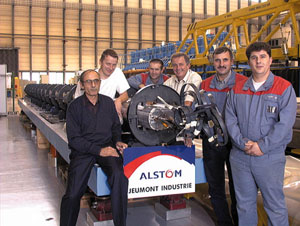
By 1995, however, it had become apparent that a closer working partnership between CERN and industry was needed for the R&D phase. From then on, collared coils were produced in industry, while assembly and cryostating were carried out at CERN. A hydraulic press was installed at the laboratory to precompress and curve the complete assembly during the welding of the magnets. By this time, two of the initial companies had withdrawn, leaving France’s Alstom-Jeumont consortium, Germany’s Noell, and Italy’s Ansaldo still in the running.
Lattice redesign
A redesign of the LHC lattice soon emerged: the dipole length was increased to 15 m to allow a greater operational margin with a field of 8.3 T and an aperture of 56 mm. Two full-scale prototype collared coils were ordered from each company, and these were assembled into magnets at CERN during the course of 1999 and 2000. All worked satisfactorily, achieving the required field with little training. The second magnet from Alstom Jeumont performed particularly well, reaching 9 T with just a single quench. It also displayed good enough field quality to be used in the accelerator.
Lessons learned from these final prototypes were quickly fed back to the three manufacturers, all of which are now producing a preseries batch of 30 magnets each. The first of these, produced in a collaboration between Alstom-Jeumont and CERN, confirmed the excellent behaviour of the prototype. A close relationship between CERN and industry is being maintained for the start of this phase of production, with industry personnel being based at CERN to assemble the collared coils into magnets. The ultimate goal, however, is for the full production process to be transferred to industry. To this end, CERN has installed a press at each of the three companies. These differ from the one at CERN in that the welding procedure will be automated, whereas at CERN a manual procedure was implemented to give maximum flexibility.
Preseries dipole production will be complete by mid-2003. The call for tender to allocate the remaining production of 1158 magnets was launched in May, with contract adjudication expected for September. When full scale production gets under way, a second coil-winding and curing line is scheduled to be installed at each company, bringing the total production capacity to 10 magnets a week. The last dipole is scheduled to arrive at CERN in July 2005.
Dipoles, however, are not the first LHC magnets to receive the production green light. That honour belongs to the 2464 sextupoles that will correct for slight field imperfections at the extremities of the dipoles. These have been developed by CERN in collaboration with India’s CAT laboratory, resulting in an efficient, low-cost design and two patent applications for ingenious construction methods.
One – a so-called diaphragm centring system – could be used for holding wheels on axles, for example. The other is for an automatic coil-winding machine. Production is to be shared between the Kirloskar Electric Company of Bangalore in India and Spain’s ANTEC, with the Indian consignment forming part of India’s in-kind contribution to the LHC project. A first preseries production of 10 magnets each from India and Spain was tested at CERN in 2000, with a second batch expected soon. Most have performed entirely within specification. These preseries sextupoles have paved the way for full-scale production to start in the middle of this year and the green light has already been given to one of the two firms.
Octupole and decapole magnets will also be used to correct for field imperfections. Fewer are needed because only one in two of the LHC’s main dipoles will be equipped with them. Their production is also shared between an Indian and a European firm – Crompton Greeves and Tesla Engineering respectively. Ten pre-series magnets from each company are expected to undergo acceptance tests at CERN before the middle of the year, and the go -ahead for series production should follow a few months later. Like the dipoles, the LHC’s main quadrupoles are also equipped with corrector magnets. Here the aim is to steer and control the beams precisely. These correctors – dipoles, quadrupoles, sextupoles and octupoles – have now all been ordered from industry. By the end of this year, CERN engineers expect to have a full bouquet of corrector magnets under test.
A total of 392 short straight sections will house the LHC’s main focusing quadrupoles, along with other beam correcting magnets. The main quadrupoles have been designed and prototyped by France’s CEA laboratory at Saclay, which will also be responsible for the technical follow-up in industry. Their integration into fully equipped short straight sections has been taken care of by the neighbouring CNRS-IN2P3 laboratory at Orsay. The contribution of both laboratories is part of France’s host-state contribution to the LHC project.
Short and straight
From 1989 to 1994, CEA-Saclay designed, constructed and successfully tested two prototype quadrupoles to an early design. A further three built to the present LHC design were made and tested between March 2000 and January 2001. All showed highly satisfactory behaviour, with at most one quench on their way to a nominal operating current of 11 870 A, corresponding to a field gradient of 223 T/m. After thermal cycling, all “remember” their training. Moreover, their measured field quality meets expectations, indicating that the design fulfils all requirements for LHC operation.
The German firm Accel has won the contract for producing the quadrupoles, and engineers from Saclay are currently transferring their tooling from France to the Accel plant near Cologne. The first series production quadrupole is expected at CERN by the end of the year. Other magnets and components for the short straight sections will come from all over Europe, leading to a complex logistical puzzle for CERN. The company Balcke-Dürr in Germany has been awarded the contract for constructing the cryostats and assembling the short straight sections.
In addition to the LHC’s main lattice magnets, a large number of specialized magnets, known as insertions, will be employed at the LHC. These will perform specific tasks, such as injecting and ejecting beams, and providing the final focus before the collision points. The LHC’s insertions will be the subject of an article in a future issue of CERN Courier.
Whether to bank on techniques with gaseous detectors or to go for alternative modern
semiconductor technology is a continual dilemma in experiment design. To enable delegates to draw their own conclusions, a new approach was adopted for the invited talks at the recent Vienna Conference on Instrumentation.
In the past, the invited talks have concentrated mainly on classes of detectors (e.g. calorimeters), but this time they also included overviews of detector systems dictated by the type of accelerator to be used; e.g. B-factories (D R Marlow, Princeton) and triggering at LHC experiments (W H Smith, Wisconsin).
Gaseous detectors still strong
The first Vienna conference, held in 1978, concentrated exclusively on gaseous detectors. However, as gaseous detectors began to be used as parts of complex subdetectors, such as calorimeters or ring imaging Cherenkovs, or for functions such as rate of energy loss, the remit of the conference was extended to include wire chambers and alternative techniques.
With the advent of silicon detectors, the conference began to focus more and more on general instrumentation. Contributions to the first conference had been almost exclusively on high-energy physics (with a few exceptions on medical applications). Now, however, the scope of the conference has grown to incorporate nuclear physics, synchrotron radiation and neutron experiments, astrophysics, biology, medicine and associated electronics. This change was reflected in the renaming of the conference, to the Vienna Conference on Instrumentation.
However, gaseous detectors are still very actively discussed at the conference, with the majority of new developments presented this year dealing with micropattern detectors. The first session on micropattern gas detectors opened with an invited talk by R Bellazini (Pisa) who gave a comprehensive overview of the various structures. The ingenuity of this community is amazing, with an overall trend towards the de-coupling of amplification and readout, e.g. the gas electron multiplier (GEM) plus the microstrip gas chamber, or the GEM plus the microgroove. The most exciting prospect for future developments could be pixel readout structures for these kind of devices.
Several of the conference talks and posters showed results from multi-stage detectors, with two or more amplification layers being suggested as a possible way to achieve a high gas gain with a low discharge probability (low spark rate). J Va’vra (SLAC) clearly
held the record at this year’s conference, with results on single electron detection with a quadruple GEM detector.
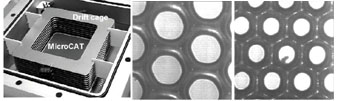
The Micromegas detector was the subject of the invited talk by G Charpak. This attractively simple detector is already used for several applications, for example in the COMPASS experiment at CERN. The Micromegas detector developed for this experiment (A Magnon, Saclay) has an active area of 0.4 x 0.4 m2 and achieved a position resolution of 75 µm in a high-intensity beam with negligible spark rate.
Silicon detectors have their day
A full day was devoted to silicon detectors, beginning with an overview by H Dijkstra (CERN). The talks that followed presented prototype work for strip detectors for LHCb (P Collins, CERN) and for drift detectors for ALICE (E Crescio, Torino). The news from L Casagranda (CERN) that silicon detectors cooled to cryogenic temperatures can withstand fluxes of more than 5 x 10¹⁴ ions/cm2 and still deliver sufficiently high signals was particularly exciting. And Y Gornushkin (Strasbourg) presented a brand new development on monolithic active pixel sensors.
Naturally, the two large multipurpose CERN LHC experiments, ATLAS and CMS, which are beginning production of their very large silicon trackers, were well represented. P Riedler (Zürich) described the application of very thin silicon detectors, just 5-70 µm thick, used in the ATHENA low-energy antiproton experiment as a beam counter.
On 24 February, a satellite workshop concentrated mainly on applications in radiology and monitor systems for teletherapy in radiooncology with protons and heavier nuclei, which is of increasing interest in view of the Med-AUSTRON project.
A truly intercontinental coffee break: the regional spread of attendance at the Vienna conference has greatly increased.Judging by the latest developments as presented at Vienna, the answer to the question of whether gas detectors can compete with silicon is probably that both gas and silicon detectors are required to build an up-to-date high-energy physics experiment. However, it is clear that there are two areas in large experiments where each technology is superior to the other. Firstly, semiconductor detectors perform better very close to the interaction region, where a precision of a few micrometers is required and the radiation is extremely high. But at large radius where large areas have to be covered, e.g. the muon chambers, it is unrealistic to use anything other than gas detectors.
It is in the intermediate region between about 20 cm and 2 m radius where the two technologies meet as rivals. From the presentations given in Vienna it became clear that silicon and micropattern gas detectors fulfil all the necessary requirements concerning precision, rate capability and radiation hardness. And, from the many comments made, it seemed that participants were split into two factions: the cautious, who don’t accept a single spark over the detector’s lifetime – an attitude which drives them towards spending their money on silicon; and the bold, trying to convince the audience that a very small spark rate in a gas detector is fully acceptable for a large system.
For the LHC experiments now under construction, this debate is over, but it will be interesting to see how further developments will influence the detector layout of future experiments.
A brief history of the Vienna series
The Vienna Wire Chamber Conference series was first mooted in 1977 when it was realized that there was a real need for such a conference. (There was only one detector conference in 1977, in Novosibirsk, Russia, but none in Europe.) A total of 170 people took up our first invitation to Vienna, and nobody thought that 23 years later we would be fixing the date for the 10th Vienna Conference for February 2004.
The number of participants rose to a maximum of 300 at subsequent meetings, although in February 2001 this dipped to 250. The main reasons for this were that support from the European Union has become more restrictive, and several participants cancelled when their contributions were not accepted. In addition, there are now several competitive conferences each year, and US researchers have travel budget restrictions. Despite this, the regional spread of attendance was wider this year, in terms of region as well as nation of origin. Russia, for example, had a strong delegation from St Petersburg.
The selection process
It is a strict rule at the Vienna Conference that all contributions (talks and posters) have to be accepted by the International Scientific Advisory Board. All material was sent to the members of this committee three months before this year’s conference; six weeks later, a meeting was held at CERN to make the selection. Members who cannot attend this part of the process can give their judgment by mail, and all efforts are made to discuss by telephone before the final decision is made.
Applications for financial support (e.g. from the Exchange Programme of the Austrian Academy of Sciences, the European Physical Society, or the Austrian Ministry of Education, Science and Culture, with support from the organizers) are totally independent of acceptance for publication.
Transparencies of the talks were scanned and made available immediately at http://wcc.oeaw.ac.at/. The draft papers of all talks and posters will also be put on the Web until the final proceedings – a consecutively numbered volume of Nuclear Instrumentation and Methods, as usual – become available in the late autumn.
The memorable concert by a string quartet in the Great Hall of the Austrian Academy of Sciences was dedicated to the history of music in the hall, and a CD of the concert, mastered overnight, was given as a souvenir to all participants. The organizers (M Jeitler, M Krammer, G Neuhofer, M Regler) are very much looking forward to the 10th Vienna Conference in February 2004.
At a major event held at the DESY laboratory in March, the international TESLA collaboration, together with the members of various study groups, released the TESLA Technical Design Report. This five-volume opus presented the final facts and figures concerning a grand plan for the future: the “TeV-Energy Superconducting Linear Accelerator”, a 33 km electron-positron linear collider with an integrated X-ray laser laboratory.
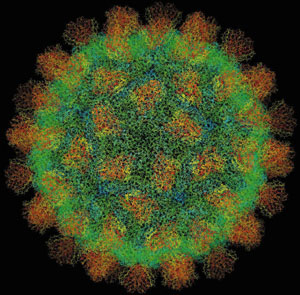
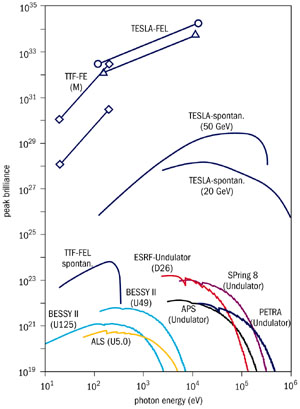
To be built near the DESY laboratory in Hamburg, the facility would not only provide particle collision energies of 500 GeV – which could be increased to 800 GeV – but also include powerful X-ray lasers that would open up new research opportunities in a variety of fields, ranging from condensed matter physics through chemistry and material science to structural biology.
It is widely acknowledged among particle physicists that a linear accelerator colliding electrons and positrons is the ideal machine to complement CERN’s Large Hadron Collider, which is due to start operation in 2006. As well as the TESLA collaboration, plans for similar next-generation linear electron-positron colliders are being worked on by other teams.
SLAC in the US and KEK in Japan are jointly developing two similar designs – known respectively as the Next Linear Collider and the Japan Linear Collider – which could be ready for construction at around the same time as TESLA. CERN is also working on a next-generation collider, CLIC. However, the TESLA proposal is the first to be fully costed and made public. It is also the only project to include an X-ray laser laboratory and thus to address a large interdisciplinary research community.
Resources needed
More than 1100 scientists from 36 countries have contributed to the 1424-page report, which describes the scientific and technical details of TESLA, including cost estimates and time schedule. Based on the experience gained in building the TESLA test facility at DESY and on industrial studies, the cost of the TESLA project in its baseline design of 500 GeV has been estimated at a total of Ý3877 million spread over a period of 10 years: Ý3136 million is earmarked for the 500 GeV electron positron collider, Ý241 million for the accelerator components for the X-ray free electron laser, Ý290 million to equip the X-ray free electron laser laboratory and Ý210 million for one detector for particle physics. The costs are based on prices for the year 2000. The person-years required to build the accelerators amount to 7000, and the total costs for the operation of the accelerators have been estimated at Ý120 million per year, assuming current prices and an annual operation time of 5000 h. Staff costs are not included in this evaluation.
The size and complexity of the TESLA endeavour means that it requires international input. From its onset in 1992, therefore, TESLA was planned and developed by members of a sizeable collaboration that now comprises 44 institutes from 10 countries. The intention is to build and operate TESLA as an international project for a limited duration, initially of 25 years.
As a possible model for the realization of TESLA as an international co-operation, the collaboration has proposed using a “Global Accelerator Network” of many existing accelerator and research centres, which would allow the facility to be maintained and run, to a large extent remotely, from the participating laboratories (see Accelerators to span the globe). This approach would allow participating institutes to share the responsibility for the facility as a whole. It would effectively allow the project to draw on worldwide skills, ideas, manpower and financial resources, with site selection becoming a less critical issue. In this approach the host country would carry roughly half of the investment cost.
Particle physics
In its baseline design, the TESLA electron-positron linear collider will reach a centre-of-mass (collision) energy of 500 GeV, five times as high as that of the first linear collider, SLC at Stanford, and 2.5 times as high as that of LEP at CERN. At the same time the luminosity of TESLA – a measure for the event rate a collider can deliver – is about 1000 times as high as that of LEP at 200 GeV (3.4 x 1034 cm_2 s_1). In a second phase, the energy range of TESLA could be extended to about 800 GeV without increasing the length of the machine.
Together with the “clean” and well defined experimental conditions provided by the collisions of point-like electrons and positrons, the energy range and luminosity of TESLA will make it an ideal machine to measure the properties of new particles unambiguously and with high precision. These precision measurements will be essential to complement the experiments being carried out at the world’s next flagship machine, CERN’s LHC proton collider. A telling example from the past is the Z boson, which was discovered at a proton-antiproton collider, while its properties could be determined with high precision only at electron-positron colliders. These measurements were crucial for establishing the Standard Model. In particular, they allowed an indirect determination of the mass of the top quark prior to its discovery, and are responsible for the present constraints on the Higgs mass.
Higgs exploration
The Higgs boson will play a central role at TESLA. The Higgs mechanism is a compelling way to give the particles a mass: a priori, massless particles acquire “effective masses” by interaction with a background medium, the Higgs field. Recently, events observed at the highest energy of LEP have given a tantalizing hint that the Higgs particle might have a mass of around 115 GeV (Season of Higgs and melodrama). The Higgs particle is likely to be discovered at the Tevatron or the LHC. The precise measurements of its properties, however, which are indispensable for a complete understanding of the mechanism by which masses are generated, require a lepton collider. TESLA is ideally suited to produce the Higgs particle directly and to determine its mass, lifetime, production cross-sections, branching ratios and the way it couples to itself and to the top quark.
A comparison with the predictions of the Standard Model will establish whether or not the Higgs mechanism is responsible for electroweak symmetry breaking and test the self-consistency of the picture. TESLA will achieve a precision of 50 (70) MeV on the mass of a 120 (200) GeV Higgs, and will measure many of the branching ratios to an accuracy of a few percent. The Higgs coupling to the top quark will be measured to 5%. The accuracy of all of these measurements is vital to a full understanding of the origin of mass.
Today, particle physics is in an excellent, yet curious, state: although practically all experimental observations are perfectly accounted for by the Standard Model, it is still based on too many assumptions and leaves too many facts unexplained. Supersymmetry is the favoured candidate for an extension of the model. It provides a framework for the unification of the electromagnetic, weak and strong forces at large energies, and it is deeply related to gravity, the fourth of the fundamental forces. Supersymmetry predicts that each matter and force particle has a supersymmetric partner.
TESLA’s precision measurements are required to determine the parameters of this supersymmetric theory accurately. By sweeping the well defined centre-of-mass energy of TESLA across the thresholds for new particle production, it will be possible to identify the particles one by one and to measure their masses with very high precision. At LHC, part of the supersymmetric particle spectrum can be resolved. Many final states are, however, overlapping, which will complicate the reconstruction of some of the supersymmetric particles. Therefore, only the combination of the results from TESLA and LHC will provide a complete picture.
The highest possible level of precision is needed to extrapolate the supersymmetric parameters measured at the energy attainable with TESLA to even higher energy scales, where the mechanism of supersymmetry breaking and the structure of a grand unified supersymmetric theory may be revealed. This may be the best way to link particle physics with gravity through an experiment.
Around 1000 participants – 40 per cent of them from abroad – attended the TESLA colloquium on 23-24 March 2001 at DESY in Hamburg, where the international TESLA collaboration presented the scientific perspectives and technical realization of its planned 33 km electron-positron linear collider with an integrated X-ray laser laboratory.Netherlands physicist and Nobel prize-winner Martinus Veltman opened the presentations with a profound and entertaining talk on the prospects of TESLA for particle physics. He was followed by the director of the Max Planck Institute for Metals Research, Helmut Dosch, who gave an impressive presentation on the various application possibilities of the TESLA X-ray laser in the fields of physics, chemistry, materials science, molecular biology and medicine. TESLA scientists Reinhard Brinkmann and Jörg Roßbach then dealt with the technical aspects of TESLA.
Finally, Albrecht Wagner, chairman of DESY’s board of directors, discussed how TESLA would operate as an international project within the framework of a Global Accelerator Network, and he concluded by disclosing the long-awaited details of the planned costs and schedule for the project. On Saturday 24 March, seven talks were given that covered the whole spectrum of research possibilities with TESLA, from time-resolved studies of chemical reactions, through investigation of surfaces and opportunities in plasma physics and structural biology, to the Higgs boson and Grand Unification.
Following the commissioning last year of Brookhaven’s Relativistic Heavy Ion Collider (RHIC), the Quark Matter 2001 conference, held on 15-20 January at the State University of New York (SUNY), Stony Brook, and organized jointly by Brookhaven and Stony Brook, provided the first shop window for results under these new physics conditions.
RHIC is the world’s first heavy-ion colliding beam machine. In these colliders, the figure of merit is the collision energy per nucleon pair (E/A, where A is the atomic number of the nucleus), and RHIC reaches higher E/A than had previously been possible. The results presented at QM 2001 came from just one month of RHIC running in late 2000 with gold nuclei (A = 197), at E/A = 130 GeV. The machine luminosity, a measure of the collision rate, was 0.2 x 1026/cm2/s, which is one-tenth of RHIC’s design figure.
Also presented at the meeting were the latest results from heavy-ion experiments at other machines, notably from CERN’s fixed target programme at the SPS synchrotron, where E/A ranges from 9 to 17 GeV with nuclei up to lead (A = 208) were recorded, and from Brookhaven’s Alternating Gradient Synchrotron, where E/A ranged from 2 to 6 GeV with gold nuclei.
Rising to the central plateau
Nucleus-nucleus and proton-proton collisions should be compared at the same value of E/A. To a first approximation, the overall total particle production (multiplicity) in a nucleus-nucleus collision should resemble A times that of a proton-proton collision. Thus an understanding of nucleus-nucleus collisions in the RHIC requires a similar understanding of comparable behaviour in proton-proton collisions.
In the 1970s, proton-proton collision at collision energies of 20-60 GeV were studied at CERN’s Intersecting Storage Rings, which found a marked change at around 20 GeV.
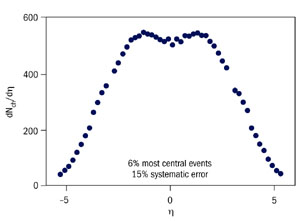
If the produced particle multiplicity is measured as a function of rapidity, y (a measure of production angle), the multiplicity is symmetric about y = 0 (perpendicular to the colliding beam axis). At 17 GeV, there are about two produced hadrons per unit rapidity at y = 0, where the multiplicity is greatest, and an emerging central plateau, out to y = ±1, with the multiplicity falling to zero by about y = ±2.5. For proton-proton collisions, by 130 GeV there are about three produced hadrons per unit y with a central plateau, this time extending to y = ± 2.
Seeking the central plateau
In nucleus-nucleus collisions under CERN SPS conditions, no such central plateau had yet emerged, the total multiplicity being a single peak around y = 0, falling quickly on either side. At y = 0 there are about 500 produced hadrons per unit y, approximately 50% higher than would be expected from simply A times the proton-proton behaviour.
At RHIC, however, the central plateau becomes evident in nucleus-nucleus collisions. The PHOBOS detector finds that this extends over y = ± 2, in a total distribution going out to y = ± 5. There are some 900 (± 10%) hadrons per unit y at y = 0, again about 50% higher than simply A times the proton-proton behaviour. Theoretical estimates of the produced particle multiplicity at RHIC were generally higher than those found experimentally, although some models (e.g. EKRT and HIJING) were close.
Once the central plateau opens up, the y = 0 behaviour changes dramatically. The fraction of net baryons plummets from 14% at SPS conditions to just 3% at RHIC. The ratio of antiprotons to protons jumps from 0.1 at the SPS to 0.65. This latter figure was found by all four RHIC detectors – BRAHMS, PHENIX, PHOBOS and STAR – and is comparable to the behaviour seen in proton-antiproton collisions.
Can the central plateau be used as a laboratory to measure the behaviour of constituent quarks and gluons? The radius of a nucleus of atomic number A is A1/3 that of a proton, so in high-energy nucleus-nucleus collisions one can study proton-proton collisions in a transverse volume up to A2/3 larger. As A increases (very large nuclei), so does the transverse volume, and perhaps central nucleus-nucleus collisions reach equilibrium at a certain temperature.
Simulations of quark-gluon field theory (quantum chromodynamics) using a hypothetical lattice (see Workshop looks through the lattice) show a sudden rise in “pressure” at a critical “temperature” of 175 MeV. The increase above this value is because quark and gluon constituents have many more degrees of freedom than composite particles like pions.
Studying new effects
Are this and other lattice predictions seen in nucleus-nucleus collisions? Even from the thin sliver of RHIC data presented at QM2001, it is clear that there are pronounced differences in the spectrum of produced particles in nucleus-nucleus, compared with proton-proton, collisions.
A change in the spectrum of particle production with transverse momentum is very evident. Above 1.5 GeV, the number of neutral pions found by PHENIX decreases sharply with increasing transverse momentum. STAR and PHENIX find a similar but less dramatic suppression for all charged hadrons. This suppression is always at least 50% of what is expected from A times the proton-proton behaviour.
Explaining this and other gross features is a challenge. At soft momenta, nucleus-nucleus collision behaviour at both RHIC and the SPS differs from the proton-proton case. In this region, particle spectra can be fitted to a thermal distribution with a final temperature related to pion “freezeout” and a relative velocity of the thermal bath. Below about 0.5 GeV transverse momentum, the STAR detector finds that the final temperatures at the SPS and RHIC are about the same – around 100 MeV. The velocity, however, increases sharply.
Elliptic flow, related to asymmetries in peripheral collisions, increases markedly between the SPS and RHIC energies, the corresponding asymmetry parameter increasing from 3.5% to 6%.
Looking for new horizons
Another surprise from January’s Quark Matter conference was that system sizes, as measured by particle interferometry, do not change drastically. Classic Hanbury Brown-Twiss interferometry gives an estimate of the size of the system that last emitted two identical particles, such as neutral pions. Radii increase by no more than 10-20% (to about 6 fm) from SPS to RHIC conditions (PHENIX and STAR). However, the “lifetime” of the system is brief and, while some models had predicted that this would increase, at RHIC, big nuclei appear to blast apart just about as fast as they can.
Another criterion of interest is the fluctuation in behaviour on an event-by-event basis. Some signs of this had been seen at the SPS, but at RHIC this appears to increase dramatically.
At QM 2001, new results also appeared from continuing analysis of the SPS experiments’ data, where the anomalous suppression of J/psi particles seen by the NA50 experiment and the change in shape of the dilepton spectrum below the rho peak, seen by the CERES experiment, are notable (see Heavy implications for the first
second).
For 2001, RHIC is scheduled to run at its full collision energy of 200 GeV per nucleon with gold beams at the machine’s design luminosity. Polarized (spin-oriented) proton-proton collisions should also be on the menu. Given the interesting initial results, it is important also that RHIC should increase its energy coverage stepwise, and in the type of beam used, for only in this way can changes in behaviour, such as those already noted, be tracked and explained.
Major changes are under way at Hamburg’s DESY laboratory. Both the HERA electron-proton collider and its experiments are being upgraded following successful runs in 1999 and 2000 in which each experiment accumulated more than 100 inverse picobarns of data.
HERA has achieved a peak luminosity (collision rate) exceeding 2 x 1031/cm2/sec, well beyond its design specification. Nevertheless, a long shutdown began last September to upgrade the luminosity by a factor of around five and to install spin rotators to provide polarized beams for the collider’s two general-purpose detectors, H1 and ZEUS.
Polarized electron or positron beams will open up the precision exploration of the helicity structure of the electroweak current at unprecedented momentum transfer.
HERA’s increased luminosity will be achieved by introducing new superconducting magnets well inside the H1 and ZEUS detectors, as well as rebuilding 200 m of the accelerator around the interaction points. Both collaborations are refurbishing their current detectors and introducing completely new capabilities to exploit the full potential of the upgraded HERA. They are paying particular attention to the forward direction – the direction of the 920 GeV proton beam – and to vertex and luminosity measurement.
At the largest momentum transfers, both hadrons and the scattered lepton tend to go forward. To deal with the higher track density in this region, ZEUS is adding two modules filled with straw tube chambers; H1 has rebuilt its forward detector to host five additional planar drift chambers; and both are complementing their forward detectors with additional wheels of silicon detectors – eight for H1, four for ZEUS – positioned around new elliptical beryllium-aluminium beam pipes.
The ZEUS silicon detector is the most challenging single upgrade project currently underway at DESY. Its central barrel consists of 30 “ladders”, each of which contains five modules of four single-sided silicon microstrip detectors arranged in pairs with orthogonal strip directions. The elliptical shape of the beam pipe is necessary to avoid the intense synchrotron radiation generated by the new superconducting quadrupoles. This shape implies a complex geometry in which ladders are placed such that most emerging charged particles intersect three detector layers.
H1, which has used silicon detectors for several years, is extending the number of layers in the backward direction and adapting its silicon detector arrangement to the new beam-pipe shape. A challenge when introducing the new silicon detectors from the far end of the H1 detector is that more than 1000 electrical contacts are neither visible nor accessible during installation. A precision docking mechanism – nicknamed “The MIR Solution” because of resemblances to the space programme – is activated remotely to establish the necessary connections. Moreover, H1 will replace its central proportional chamber with a five-layer chamber surrounding the vertex detector and providing sufficient redundancy for triggering.
Further detector modifications are also needed to cope with the higher luminosity. Multiple photons from the Bethe-Heitler process in a single bunch, accompanied by much increased synchrotron radiation, make it necessary for both experiments to rebuild their luminosity monitors. H1 has developed a new tungsten-fibre calorimeter with high-rate sampling of Cerenkov light. The new ZEUS monitor consists of two main elements: a lead scintillator sandwich calorimeter fronted by “active filters” – two carbon absorbers separated by aerogel counters – and a spectrometer that detects electron-positron pairs from photons converting in a thin window in the beam pipe. Other upgrades will improve the trigger selectivity and the data handling.
The HERA shutdown ends in June, with the first dedicated high luminosity run planned before the end of 2001. Polarization tuning will start next year
Back in operation for particle physics for the first time since 1996, Fermilab’s superconducting Tevatron proton antiproton collider is set to write a major new chapter of science history. What is officially called Run II of the collider will continue, with interruptions for maintenance and upgrades, until 2007, by which time CERN’s LHC collider will have made its debut.
For Run II the Tevatron’s beams have been boosted from 900 to 980 GeV (collision energy 1960 GeV), the highest-energy particle accelerator now operating in the world. As well as providing extra energy, the Run II Tevatron is fed by Fermilab’s 150 GeV Main Injector synchrotron, which was commissioned in 1999 and replaced Fermilab’s original Main Ring.
The Tevatron and the Main Ring originally shared the same tunnel, which had a four mile circumference. However, the Main Ring, which has now been removed, became a bottleneck in Fermilab’s particle supply. With the new Main Injector, proton-antiproton collision rates (luminosity) should be boosted twentyfold.
Monitoring these collisions are the Tevatron’s two major collider detectors, CDF and D0. Each have completed five-year upgrades costing USD 100 million to take advantage of the Tevatron’s enhanced capabilities.
Late last year, experiments at CERN’s Large Electron-Positron (LEP) collider detected hints of the long-awaited Higgs particle, the source of mass in the unified theory of weak and electromagnetic interactions. However, LEP was shut down before scientists could either confirm or rule out a Higgs sighting (see Season of Higgs and melodrama). For the next few years, the Tevatron has no competitor in the Higgs race.
Run II also has the potential for revealing much more, including evidence for supersymmetry – a possible doubling of the known number of fundamental particles, new insights into the CP-violation mechanism responsible for asymmetry between matter and antimatter, and a better understanding of the sixth “top” quark, discovered at Fermilab in 1995 during Tevatron Collider Run I.
The Tevatron saw its first proton-antiproton collisions in 1985, and for its first phase of operations (pre-Run I, until 1989) ran with a single detector, CDF. For Run I (1992-1996), CDF was joined by the D0 detector.
On 26 December 2000 the Japanese KEK laboratory accomplished full powering of the superconducting solenoid magnet for the forthcoming giant ATLAS experiment at CERN’s LHC collider. On the initiative of Prof. Takahiko Kondo, this solenoid was designed and constructed under the leadership of Prof. Akira Yamamoto of KEK as Japan’s contribution to the ATLAS magnet system.
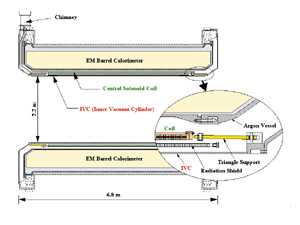
The large solenoid, which is 5.5 tonnes in weight, 2.5 m in diameter and 5.3 m in length, will provide an axial magnetic field of 2 T at the centre of the ATLAS tracking volume. As the solenoid coil precedes the barrel liquid argon (LAr) electromagnetic calorimeter, its thickness must be minimized to achieve maximal calorimeter performance.
Since the early 1980s, starting with the coil for the CDF experiment at Fermilab’s Tevatron, KEK has been steadily accumulating technical know-how on thin superconducting detector coils. Prof. Yamamoto and his team developed and constructed a full-diameter, quarter-length prototype of the superconducting solenoid for the proposed SDC experiment of the ill-fated US Superconducting Supercollider (SSC) project. This prototype was almost complete when the SSC project was cancelled late in 1993.
KEK nevertheless encouraged the team to carry out its test, which took place at the KEK PS experimental hall in early 1994. Precious technical data taken during this test essentially eliminated the necessity for major R&D on the ATLAS thin solenoid.
An idea to make the coil thinner, originally proposed by Prof. Yamamoto, is to use the superconductor not only as a current carrier but also as a main structural body to sustain the magnetic forces. He proposed a high-strength aluminium stabilizer for the superconductor. R&D on high-strength conductors began in the late 1980s at KEK and its usefulness was proven by the SDC prototype solenoid test. As the ATLAS solenoid shares the same conceptual design, it is not surprising that the ATLAS solenoid technical design report devoted a lot of attention to the experimental results of the SDC prototype.
The 12 km superconductor was developed and constructed by Furukawa Electric and Hitachi Cables. The conductor was coiled into 1151 turns inside an aluminium cylinder made by Oxford Instruments. The coil winding and curing, as well as subsequent assembly, were carried out by Toshiba in Yokohama.
Another distinctive design feature of the ATLAS solenoid is that the coil and the barrel LAr calorimeter share a single common cryostat and vacuum. This feature eliminates two vacuum walls. The coil is mounted inside the innermost vacuum cylinder (IVC) of the LAr cryostat using specially developed triangular glass-fibre supports.
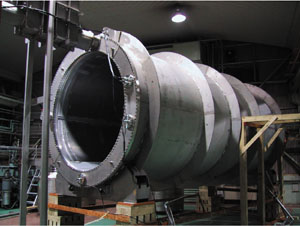
The ATLAS barrel LAr cryostat, an in-kind US contribution designed by Brookhaven, is being constructed at Kawasaki Heavy Industry near Kobe in Japan. Early last year its vacuum vessel was completed and tested. Meanwhile KEK asked Toshiba to construct a “test IVC” for initial solenoid tests in Japan with a design similar to that of Brookhaven’s final IVC.
Thus in spring 2000 two nearly identical IVCs existed in Japan. KEK proposed to exchange these two before coil mounting. This would eliminate coil disassembly for the test IVC and remounting to the final IVC, which is planned to happen at CERN some time in 2003, when the full barrel LAr calorimeter is finally completed.
IVC exchange would not only save time and cost but also enhance quality assurance since all the delicate operations associated with coil mounting could be finished in the best working environment at Toshiba’s factory.
Although the argon vessel was still under fabrication, the Brookhaven team (led by J Sondericker) and Kawasaki agreed to accept KEK’s request for IVC exchange. However, on the administrative side this exchange of property was complicated by legal issues of ownership, as well as liability.
Finally the six interested parties – KEK, Brookhaven, CERN, ATLAS, Kawasaki and Toshiba – reached an agreement in early 2000, and soon the two IVCs were duly transferred between Yokohama and Kobe, a distance of about 500 km.
In the summer and autumn of 2000, Toshiba proceeded with the system assembly of the coil, radiation shields, triangle supports, helium pipes, power lines, control dewar and the test cryostat with the final inner vacuum vessel. Meanwhile the KEK cryogenic team completed the new liquid helium control system.
Early in December the assembly was completed and a KEK/Toshiba team began cooling and power tests at Toshiba’s works on the chilly shore of Yokohama Bay. Three observers from CERN followed the tests.
Initially the coil experienced two unexpected quenches, at 7.0 kA and at 7.6 kA. The voltage and temperature sensors indicated that both were caused by excess epoxy between the coil ends and the end flanges. No unexpected quenches were encountered during some 30 powerings. On 26 December the team achieved the maximum design current of 8.40 kA. This exceeded 7.6 kA, the operating point of 2 T, by 10% in current and by 20% in magnetic forces.
After a short New Year break the team continued further tests for emergencies such as power and cryogenics failures. The coil survived the worst possible case of full energy dump at 7.6 kA, and can be safely de-energized without quench following a sudden interruption of liquid helium supply. In addition tests verified that the coil is adequately and uniformly cooled, leaving at least two degrees of margin for superconducting operation.
At the February ATLAS collaboration meeting at CERN, the success of full performance tests was greeted by warm applause: the KEK solenoid team is now the front-runner in the long, tough race for ATLAS detector construction.
This autumn the solenoid and its associated cryogenics equipment will be shipped to CERN, where the solenoid and the barrel LAr calorimeter will be combined and fully tested.
Recently Brookhaven’s RHIC (Relativistic Heavy Ion Collider) achieved another major milestone with the insertion of the Silicon Vertex Tracker (SVT) into the heart of the Solenoidal Tracker At RHIC (STAR) detector.
Since the RHIC start-up, people have consistently admired the beautifully complex images of high-energy gold ion collisions provided by the STAR Time Projection Chamber. The images from STAR’s first run were remarkable, and the data provided led to a wealth of early scientific results. But for the experts there was still something missing – information on the particle tracks close to the colliding beams.
That blank space in the tracking coverage of STAR is about to be filled with information provided by the Silicon Vertex Tracker, a state-of-the-art instrument which is based on silicon drift technology and was developed at Brookhaven. The completion of the STAR SVT is the culmination of an eight-year research and development effort by a team of more than 50 people, sponsored by the Office of Science of the US Department of Energy. Other institutions collaborating on the project include Wayne State University, Ohio State, the University of Texas and Lawrence Berkeley National Laboratory.
The SVT consists of three concentric layers of silicon drift detectors at 5 cm, 10 cm and 15 cm from the beam. These record the passage of charged particles in time and space, providing important information which can then be used in the STAR global tracking software. This allows for the detection of charged particles that decay quickly or curl up in the magnetic field before reaching the STAR Time Projection Chamber.
According to SVT project leader Rene Bellwied of Wayne State: “The installation of the SVT will provide essential tracking information to allow the detection of particles with short lifetimes, such as the cascade and the omega. It will also afford STAR an important low momentum tracking capability that it hasn’t had until now.”
Silicon drift detection is a new semiconductor technology developed in the mid-1980s by Brookhaven physicist Pavel Rehak in collaboration with Emilio Gatti from Milan. It was employed in the design of the SVT, allowing for a thirty-fold increase in space resolution compared with the TPC. This is necessarily close to the interaction point because of the high density of charged particle tracks produced when the gold ions collide.
The SVT will be commissioned this year when RHIC starts colliding beams of gold ions late in the spring.
To provide the best experiences, we use technologies like cookies to store and/or access device information. Consenting to these technologies will allow us to process data such as browsing behavior or unique IDs on this site. Not consenting or withdrawing consent, may adversely affect certain features and functions.
Functional
Always active
The technical storage or access is strictly necessary for the legitimate purpose of enabling the use of a specific service explicitly requested by the subscriber or user, or for the sole purpose of carrying out the transmission of a communication over an electronic communications network.
Preferences
The technical storage or access is necessary for the legitimate purpose of storing preferences that are not requested by the subscriber or user.
Statistics
The technical storage or access that is used exclusively for statistical purposes.The technical storage or access that is used exclusively for anonymous statistical purposes. Without a subpoena, voluntary compliance on the part of your Internet Service Provider, or additional records from a third party, information stored or retrieved for this purpose alone cannot usually be used to identify you.
Marketing
The technical storage or access is required to create user profiles to send advertising, or to track the user on a website or across several websites for similar marketing purposes.