
Comsol -leaderboard other pages

Topics

Gravitational Waves Vol 1: Theory and Experiments

By Michele Maggiore, Oxford University Press. Hardback ISBN 9780198570745 £45 ($90).

This is a complete book for a field of physics that has just reached maturity. Gravitational wave (GW) physics recently arrived at a special stage of development. On the theory side, most of the generation mechanisms have been understood and some technical controversies have been settled. On the experimental side, several large interferometers are now operating around the world, with sensitivities that could allow the first detection of GWs, even if with a relatively low probability. The GW community is also starting vigorous upgrade programmes to bring the detection probability to certitude in less than a decade from now.

The need for a textbook that treats the production and detection of GWs systematically is clear. Michele Maggiore has succeeded in doing this in a way that is fruitful not only for the young physicist starting to work in the field, but also for the experienced scientist needing a reference book for everyday work.
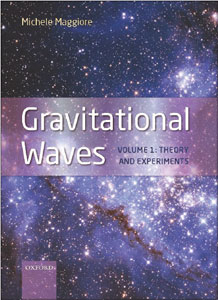
CCboo2_09_08

In the first part, on theory, he uses two complementary approaches: geometrical and field-theoretical. The text fully develops and compares both, which is of great help for a deep understanding of the nature of GWs. The author also derives all equations completely, leaving just the really straightforward algebra for the reader. A basic knowledge of general relativity and field theory is the only prerequisite.

Maggiore explains thoroughly the generation of gravitational radiation by the most important astrophysical sources, including the emitted power and its frequency distribution. One full chapter is dedicated to the Hulse-Taylor binary pulsar, which constituted the first evidence for GW emission. The “tricky” subject of post-Newtonian sources is also clearly introduced and developed. Exercises that are completely worked out conclude most of these theory chapters, enhancing the pedagogical character of the book.

The second part is dedicated to experiments and starts by setting up a background of data-analysis techniques, including noise spectral density, matched filtering, probability and statistics, all of which are applied to pulse and periodic sources and to stochastic backgrounds. Maggiore treats resonant mass detectors first, because they were the first detectors chronologically to have the capability of detecting signals, even if only strong ones originating in the neighbourhood of our galaxy. The study of resonant bar detectors is instructive and deals with issues that are also very relevant to understanding interferometers. The text clearly explains fundamental physics issues, such as approaching the quantum limits and quantum non-demolition measurements.

The last chapter is devoted to a complete and detailed study of the large interferometers – the detectors of the current generation – which should soon make the first detection of GWs. It discusses many details of these complex devices, including their coupling to gravitational waves, and it makes a careful analysis of all of the noise sources.

Lastly, it is important to remark on a little word that appears on the cover: “Volume 1”. As the author explains in the preface, he is already working on the second volume. This will appear in a few years and will be dedicated to astrophysical and cosmological sources of GWs. The level of this first book allows us to expect an interesting description of all “we can learn about nature in astrophysics and cosmology, using these tools”.

The Cosmological Singularity

By Vladimir Belinski and Marc Henneaux
Cambridge University Press

This monograph discusses at length the structure of the general solution of the Einstein equations with a cosmological singularity in Einstein-matter systems in four and higher space–time dimensions, starting from the fundamental work of Belinski (the book’s lead author), Khalatnikov and Lifshitz (BKL) – published in 1969.

The text is organised in two parts. The first, comprising chapters one to four, is dedicated to an exhaustive presentation of the BKL analysis. The authors begin deriving the oscillatory, chaotic behaviour of the general solution for pure Einstein gravity in four space–time dimensions by following the original approach of BKL. In chapters two and three, homogeneous cosmological models and the nature of the chaotic behaviour near the cosmological singularity are discussed. In these three chapters, the properties of the general solution of the Einstein equation are studied in the case of empty space in four space–time dimensions. The fourth chapter instead deals with different systems: perfect fluids in four space–time dimensions; gauge fields of the Yang–Mills and electromagnetic types and scalar fields, also in four space–time dimensions; and pure gravity in higher dimensions.

The second part of the book (chapters five to seven) is devoted to a model in which the chaotic oscillations discovered by BKL can be described in terms of a “cosmological billiard” system. In chapter five, the billiard description is provided for pure Einstein gravity in four dimensions, without any simplifying symmetry assumption, while the following chapter extends this analysis to arbitrary higher space–time dimensions and to general systems containing gravity coupled to matter fields. Finally, chapter seven covers the intriguing connection between the BKL asymptotic regime and Coxeter groups of reflections in hyperbolic space. Four appendices complete the treatment.

Quite technical and advanced, this book is meant for theoretical and mathematical physicists working on general relativity, supergravity and cosmology.

Gravitational Lensing

By Scott Dodelson
Cambridge University Press

Based on university lectures given by the author, this book provides an overview of gravitational lensing, which has emerged as a powerful tool in astronomy with numerous applications, ranging from the quest for extrasolar planets to the study of the cosmic mass distribution.

Gravitational lensing is a consequence of general relativity (GR): the gravitational field of a massive object causes light rays passing close to it to bend and refocus somewhere else. As a consequence, any treatment of this topic has to make reference to GR theory; nevertheless, as the author highlights, not much formalism is required to learn how to apply lensing to specific problems. Thus, using very little GR and not too complex mathematics, this text presents the basics of gravitational lensing, focusing on the equations needed to understand the phenomenon. It then dives into a number of applications, including multiple images, time delays, exoplanets, microlensing, cluster masses, galaxy shape measurements, cosmic shear and lensing of the cosmic microwave background.

Written with a pedagogical approach, this book is meant as a textbook for one-semester undergraduate or graduate courses. But it can also be used for independent study by researchers interested in entering this fascinating and fast-evolving field.

Quantum Fields: From the Hubble to the Planck Scale

By Michael Kachelriess
Oxford University Press

This book treats two fields of physics that are usually taught separately – quantum field theory (QFT) on one side and cosmology and gravitation on the other – in a more unified manner. Kachelriess uses this unusual approach because he is convinced that, besides studying a subject in depth, what is often difficult is to put the pieces into a general picture. Thus, he makes an effort
to introduce QFT together with its most important applications to cosmology and astroparticle physics in a coherent framework.

The path-integral approach is employed from the start and the use of tools such as Green’s functions in quantum mechanics and in scalar field-theory is illustrated. Massless spin-1 and spin-2 fields are introduced on an equal footing, and gravity is presented as a gauge theory in analogy with the Yang–Mills case. The book also deals with various concepts relevant to modern research, such as helicity methods and effective theories, as well as applications to advanced research topics.

This volume can serve as a textbook for courses in QFT, astroparticle physics and cosmology, and students interested in working at the interface between these fields can certainly appreciate the uncommon approach used. It was also the intention of the author to make the book suitable for self study, so all explanations and derivations are given in detail. Nevertheless, a solid knowledge of calculus, classical and quantum mechanics, electrodynamics and special relativity is required.

What goes up… Gravity and Scientific Method

By Peter Kosso
Cambridge University Press

Peter Kosso states that his book is “about the science of gravity and the scientific method”; I would say that it is about how scientific knowledge develops over time, using the historical evolution of our understanding of gravity as a guiding thread. The author has been a professor of philosophy and physics, with expert knowledge on how the scientific method works, and this book was born out of his classes. The topic is presented in a clear way, with certain subjects explored more than once as if to ensure that the student gets the point. The text was probably repeatedly revised to remove any wrinkles in its surface and provide smooth reading, setting out a few basic concepts along the way. The downside of this “textbook style” is that it is unexpectedly dry for a book aimed at a broad audience.

As the author explains, a scientific observation must refer to formal terms with universally-agreed meaning, ideally quantifiable in a precise and systematic way, to facilitate the testing of hypotheses. Thinking in the context of a certain theory will specify the important questions and guide the collection of data, while irrelevant factors are to be ignored (Newton’s famous apple could just as well have been an orange, for example). But theoretical guidance comes with the risk that the answers might too easily conform to the expectation and, indeed, the nontrivial give-and-take between theory and observation is a critical part of scientific practice. In particular, the author insists that it is naïve to think that a theory is abandoned or significantly revised as soon as an experimental observation disagrees with the corresponding prediction.

Considering that the scientific method is the central topic of this book, it is surprising to notice that no reference is made to Karl Popper and many other relevant thinkers; this absence is even more remarkable since, on the contrary, Thomas Kuhn is mentioned a few times. One might expect such a book to reflect a basic enlightenment principle more faithfully: the price of acquiring knowledge is that it will be distorted by the conditions of its acquisition, so that keeping a critical mind is a mandatory part of the learning process. For instance, when the reader is told that the advancement of science benefits from the authority of established science (the structural adhesive of Kuhn’s paradigm), it would have been appropriate to also mention the “genetic fallacy” committed when we infer the validity and credibility of an idea from our knowledge of its source. The author could then have pointed the interested reader to suitable literature, one option (among many) being Kuhn vs. Popper; the struggle for the soul of science by Steve Fuller.

What goes up… is certainly an excellent guide to the science of gravity and its historical evolution, from the standpoint of a 21st-century expert. It is interesting, for instance, to compare the “theories of principle” of Aristotle and Einstein with the “constructive theory” of Newton. While Newton started from a wealth of observations and looked for a universal description, unifying the falling apple with the orbiting Moon, Einstein gave more importance to the beauty of the concepts at the heart of relativity than to its empirical success. I enjoyed reading about the discovery of Neptune from the comparison between the precise observations of the orbit of Uranus and the Newtonian prediction, and about the corresponding (unsuccessful) search for the planet Vulcan, supposedly responsible for Mercury’s anomalous orbit until general relativity provided the correct explanation. And it is fascinating to read about the “direct observation” of dark matter in the context of the searches for Neptune and Vulcan. It is important (but surely not easy) to ensure “that a theory is accurate in the conditions for which it is being used to interpret the evidence”, and that it is “both well-tested and independent of any hypothesis for which the observations are used as evidence”.

The text is well written and accessible. My teenage children learned about non-Euclidean geometry from figures in the book and were intrigued by the thought that gravity is not a force field but rather a metric field, which determines the straightest possible lines (geodesics) between two points in space–time. I think, however, that progress in humankind’s understanding of gravity and related topics could be narrated in a more captivating way. People who prefer more vivid and passionate accounts of the lives and achievements of Copernicus, Brahe, Kepler, Galileo, Newton and many others would more likely enjoy The Sleepwalkers by Arthur Koestler or From the Closed World to the Infinite Universe by Alexandre Koyré. I also vehemently recommend chapter one of Only the Longest Threads by Tasneem Zehra Husain, a delightful account of Newton’s breakthrough from the perspective of someone living in the early 18th century.

Welcome to the Universe

by Neil deGrasse Tyson, Michael A Strauss and J Richard Gott
Princeton University Press

It is commonly believed that popular-science books should abstain as much as possible from using equations, apart from the most iconic ones, such as E = mc2. The three authors of Welcome to the Universe boldly defy this stereotype in a book that is intended to guide readers with no previous scientific education from the very basics (the first chapters explain the scientific notation, how to round-up numbers and some trigonometry) to cutting-edge research in astrophysics and cosmology.

This book reflects the content of a course that the authors gave for a decade to non-science majors at Princeton University. They are a small dream team of teachers and authors: Tyson is a star of astrophysics outreach, Strauss a renowned observational astronomer and Gott a theoretical cosmologist with other successful popular-science books to his name. The authors split the content of the book into three equal parts (stars and planets, galaxies, relativity and cosmology), making no attempt at stylistic uniformity. Apparently this was the intention, as they keep their distinct voices and refer frequently to their own research experiences to engage the reader. Despite this, the logical flow remains coherent, with a smooth progression in complexity.

Welcome to the Universe promises and delivers a lot. Non-scientist readers will get a rare opportunity to be taken from a basic understanding of the subject to highly advanced content, not only giving them the “wow factor” (although the authors do appeal to this a lot) but also approaching the same level of depth as a masters course in physics. A representative example is the lengthy derivation of E = mc2, the popular formula that everyone is familiar with but few know how to explain. And while that particular example is probably demanding to the layperson, most chapters are very pleasant to read, with a good balance of narration and analysis. The authors also make a point of explaining why recognised geniuses such as Einstein and Hawking got their fame in the first place. Scientifically-educated readers will find many insights in this volume too.

While I generally praise this book, it does have a few weak points. Some of the explanations are non-rigorous and confusing at the same time (an example of this is the sentence: “the formula has a constant h that quantises energy”). In addition, an entire chapter boasts of the role of one of the authors in the debate on whether Pluto has the status of a planet or not, which I found a bit out of place. But these issues are more irritating than harmful, and overall this book achieves an excellent balance between clarity and accuracy. The authors introduce several original analogies and provide an excellent non-technical explanation of the counterintuitive behaviour of the outer parts of a dying star, which expand while the inner parts contract.

I also appreciated the general emphasis on how measurements are done in practice, including an interesting digression on how Cavendish measured Newton’s constant more than two centuries ago. However, there are places where one feels the absence of such an explanation, for example, the practical limitations of measuring the temperatures of distant bodies are glossed over with a somewhat patronising “all kinds of technical reasons”.

This text comes with a problem book that is a real treasure trove. The exercises proposed are very diverse, reflecting the variety of audiences that the authors clearly target with their book. Some are meant to practice basic competences about units, orders of magnitude and rounding. Others demand readers to think outside of the box (e.g. by playing with geodesics in flatland, we see how to construct an object that is larger inside than outside, and have to estimate its mass using only trigonometry). For some of the quantitative exercises, the solution is provided twice: once in a lengthy way and then in a clever way. People more versed in literature than mathematics will find an exercise that demands you write a scientifically accurate, short science-fiction story (guidelines for grading are offered to the teachers) and one that simply asks, “If you could travel in time, which epoch would you visit and why?”

The book ends with a long and inspiring digression on the role of humans in the universe, and Gott’s suggestion of using the Copernican principle to predict the longevity of civilisations – and of pretty much everything – is definitely food for thought.

What is Quantum Information?

By O Lombardi, S Fortin, F Holik and C López (eds.)
Cambridge University Press

CCJune18_Book-lombardi

This book debates the topic of quantum information from both a physical and philosophical perspective, addressing the main questions about its nature. At present, different interpretations of the notion of information coexist and quantum mechanics brings in many puzzles; as a consequence, says the author, there is not yet a generally agreed upon answer to the question “what is quantum information?”.

The chapters are organised in three parts. The first is dedicated to presenting various interpretations of the concept of information and addressing the question of the existence of two qualitatively different kinds of information (classical and quantum). The links between this concept and other notions, such as knowledge, representation, interpretation and manipulation, are discussed as well.

The second part is devoted to the relationship between informational and quantum issues, and deals with the entanglement of quantum states and the notion of pragmatic information. Finally, the third part analyses how probability and correlation underlie the concept of information in different problem domains, as well as the issue of the ontological status of quantum information.

Providing an interdisciplinary examination of quantum information science, this book is aimed at philosophers of science, quantum physicists and information-technology experts who are interested in delving into the multiple conceptual and philosophical problems inherent to this recently born field of research.

The Black Book of Quantum Chromodynamics: A Primer for the LHC Era

By J Campbell, J Huston and F Krauss
Oxford University Press

Also available at the CERN bookshop

This book provides a comprehensive overview of the physics of the strong interaction, which is necessary to analyse and understand the results of current experiments at particle accelerators. In particular, the authors aim to show how to apply the framework of perturbative theory in the context of the strong interaction, to the prediction as well as correct interpretation of signals and backgrounds at the Large Hadron Collider (LHC).

The book consists of three parts. In the first, after a brief introduction to the LHC and the present hot topics in particle physics, a general picture of high-energy interactions involving hadrons in the initial state is developed. The relevant terminology and techniques are reviewed and worked out using standard examples.

The second part is dedicated to a more detailed discussion of various aspects of the perturbative treatment of the strong interaction in hadronic reactions. Finally, in the last section, experimental findings are confronted with theoretical predictions.

Primarily addressed at graduate students and young researchers, this book can also be a helpful reference for advanced scientists. In fact, it can provide the right level of knowledge for theorists to understand data more in depth and for experimentalists to be able to recognise the advantages and disadvantages of different theoretical descriptions.

The reader is assumed to be familiar with concepts of particle physics such as the calculation of Feynman diagrams at tree level and the evaluation of cross sections through phase space integration with analytical terms. However, a short review of these topics is given in the appendices.

In Praise of Simple Physics: The Science and Mathematics behind Everyday Questions

By Paul J Nahin
Princeton

81altc6UJ4L

In this book, popular-science writer Paul Nahin presents a collection of everyday situations in which the application of simple physical principles and a bit of mathematics can make us understand how things work. His aim is to take these scientific disciplines closer to the layperson and, at the same time, show them the wonder lying behind many aspects of reality that are often taken for granted.

The problems presented and explained are very diverse, ranging from how to extract more energy from renewable sources, how best to catch a baseball, to how to measure gravity in one’s garage and why the sky is dark at night. These topics are treated in an informal and entertaining way, but without waiving the maths. In fact, as the author himself highlights, he is interested in keeping the discussions simple, but not so simple that they are simply wrong. The whole point of the book is actually to show how physics and some calculus can explain many of the things that we commonly encounter.

Engaging and humorous, this text will appeal to non-experts with some background in maths and physics. It is suited to students at any level beyond the last years of high school, as well as to practicing scientists who might discover alternative, clever ways to solve (and explain) everyday physics problems.

The Cosmic Web

By John Richard Gott
Princeton University Press

The observation of the night sky is as old as humankind itself. Cosmology, however, has only achieved the status of “science” in the past century or so. In this book, Gott accompanies the reader through the birth of this new science and our growing understanding of the universe as a whole, starting from the observation by Hubble and others in the 1920s that distant galaxies are receding away from us. This was one of the most important discoveries in the history of science because it shifted the position of humans farther away from the centre of the cosmos and showed that the universe is not eternal, but had a beginning. The philosophical implications were hard to digest, even for Einstein, who invented the cosmological constant such that his equations of general relativity could have a static solution.

Following the first observations of distant galaxies, astronomers began to draw a comprehensive map of the observable universe. They played the same role as the explorers travelling around our planet, except that they could only sit where they were and receive light from distant objects, like the faded photography of a lost past.

After an introduction to the early days of cosmology, the book becomes more personal, and the reader feels drawn in to the excitement of actually doing research. Gott’s account of cosmology is given through the lens of his own research, making the book slightly biased towards the physics of the large-scale structure of the universe, but also more focused and definitely captivating for the reader.

The overarching theme of the book is the quest to understand the shape of the “cosmic web”, which is the distribution of galaxies and voids in a universe that is homogeneous only on very large scales. Tiny fluctuations in the matter density, ultimately quantum in origin, grow via gravity to weave the web.

In graduate school, under the supervision of Jim Gunn, Gott wrote his most cited paper, proposing a mathematical model of the gravitational collapse of small density fluctuations. Here, the readers are given a flavour of the way real research is carried out. The author describes in detail the physics involved in the topic, as well as how the article was born and completed and how it took on a life of its own to become a classic.

The author’s investigation of the large-scale structure intertwines with his passion for topology. He was fascinated by polyhedrons with an infinite number of faces, which were the subject of an award-winning project that he developed in high school and of his first scientific article published in a mathematics journal.

At the time, when astronomical surveys were covering only a small portion of the sky, it was unclear how the cosmic structures assembled. American cosmologists thought that galaxies gathered in isolated clusters floating in a low-density universe, like meatballs in a soup. On the other hand, Soviet scientists maintained that the universe was made up of a connected structure of walls and filaments, where voids appear like holes in a Swiss cheese.

Does the 3D map of the universe resemble a meatball stew or a Swiss cheese? Neither, Gott says. With his collaborators, he proposed that the cosmic web is topologically like a sponge, where voids and galaxy clusters form two interlocking regions, much like the infinite polyhedrons Gott studied in his youth.

The reader is given clear and mathematically precise descriptions of the methods used to demonstrate the idea, which was later confirmed by deeper and larger astronomical observations (in 3D), and by the analysis of the cosmic microwave background (in 2D). By that time, we had the theory of cosmological inflation to explain a few of the puzzles regarding the origin of the universe. Remarkably, inflation predicts tiny quantum fluctuations in the fabric of space–time, giving rise to a symmetry between higher and lower density perturbations, leading to the observed sponge-like topology.

Therefore, by the end of the 20th century, the pieces of our understanding of the universe were falling into place and, in 1998, the discovery that the universe is accelerating allowed us to start thinking about the ultimate fate of the cosmos. This is the subject of the last chapter, an interesting mix of sound predictions (for the next trillion years) and speculative ideas (in a future so far away that it is hard to think about), ending the book with a question – rather than an exclamation – mark.

This is not only a good popular science book that achieves a balance between mathematical precision and a layperson’s intuition. It is also a text about the day-to-day life of a researcher, describing details of how science is actually done, the excitement of discovery and the disappointment of following a wrong path. It is a book for readers curious about cosmology, for researchers in other fields, and for young scientists, who will be inspired by an elder one to pursue the fascinating exploration of nature.

bright-rec iop pub iop-science physcis connect