Comsol -leaderboard other pages

Topics

Giorgi and Nakada share Fermi Prize

Marcello Giorgi and Tatsuya Nakada

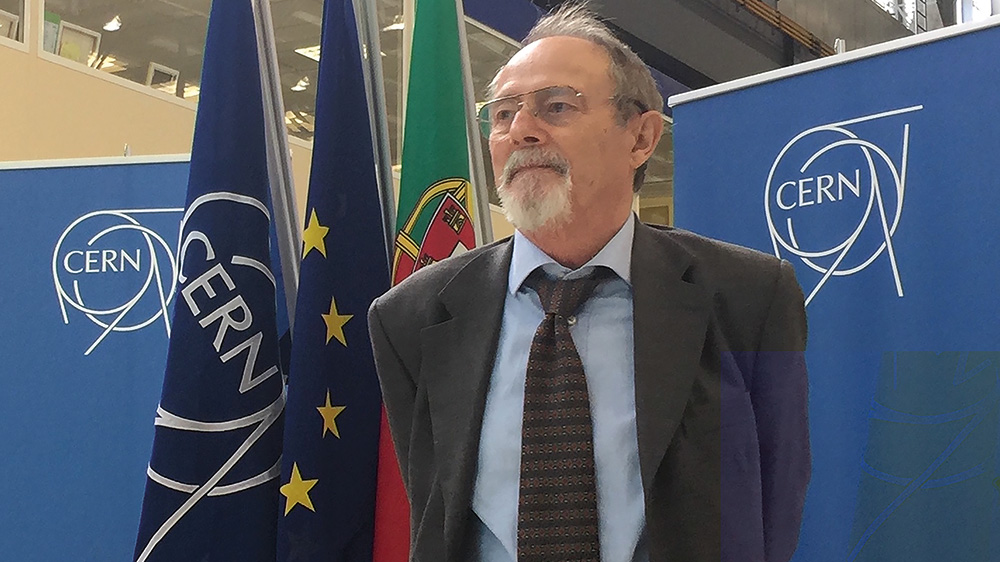
Marcello Giorgi of the University of Pisa and Tatsuya Nakada of the Swiss Federal Institute of Technology in Lausanne (EPFL) have been awarded the Enrico Fermi Prize from the Italian Physical Society for their outstanding contributions to the experimental evidence of CP violation in the heavy-quark sector. Giorgi is cited “for his leading role in experimental high-energy particle physics with particular regard to the BaBar experiment and the discovery of CP symmetry violation in the B meson systems with beauty quarks”, while Nakada is recognised for his conception and crucial leading role in the realisation of the LHCb experiment that led earlier this year to the discovery of CP violation in D mesons with charm quarks. The prize was presented on 23 September during the opening ceremony of the 105th national congress of the Italian Physical Society in L’Aquila, Italy.

Building Gargantua

Oliver James is chief scientist of the world’s biggest visual effects studio, DNEG, which produced the spectacular visual effects for Interstellar. DNEG’s work, carried out in collaboration with theoretical cosmologist Kip Thorne, led to some of the most physically-accurate images of a spinning black hole ever created, earning the firm an Academy Award and a BAFTA. For James, it all began with an undergraduate degree in physics at the University of Oxford in the late 1980s – a period that he describes as one of the most fascinating and intellectually stimulating of his life. “It confronted me with the gap between what you observe and reality. I feel it was the same kind of gap I faced while working for Interstellar. I had to study a lot to understand the physics of black holes and curved space time.”

A great part of visual effects is understanding how light interacts with surfaces and volumes and eventually enters a camera’s lens and as a student, Oliver was interested in atomic physics, quantum mechanics and modern optics. This, in addition to his two other passions – computing and photography – led him to his first job in a small photographic studio in London where he became familiar with the technical and operational aspects of the industry. Missing the intellectual challenge offered by physics, in 1995 he contacted and secured a role in the R&D team of the Computer Film Company – a niche studio specialising in digital film which was part of the emerging London visual effects industry.

Suddenly these rag-dolls came to life and you’d find yourself wincing in sympathy as they were battered about

Oliver James

A defining moment came in 2001, when one of his ex-colleagues invited him to join Warner Bros’ ESC Entertainment at Alameda California to work on The Matrix Reloaded & Revolutions. His main task was to work on rigid-body simulations – not a trivial task given the many fight scenes. “There’s a big fight scene, called the Burly Brawl, where hundreds of digital actors get thrown around like skittles,” he says. “We wanted to add realism by simulating the physics of these colliding bodies. The initial tests looked physical, but lifeless, so we enhanced the simulation by introducing torque at every joint, calculated from examples of real locomotion. Suddenly these rag-dolls came to life and you’d find yourself wincing in sympathy as they were battered about”. The sequences took dozens of artists and technicians months of work to create just a few seconds of the movie.

DNEG chief scientist Oliver James

Following his work in ESC Entertainment, James moved back to London and, after a short period at the Moving Picture Company, he finally joined “Double Negative” in 2004 (renamed DNEG in 2018). He’d been attracted by Christopher Nolan’s film Batman Begins, for which the firm was creating visual effects, and it was the beginning of a long and creative journey that would culminate in the sci-fi epic Interstellar, which tells the story of an astronaut searching for habitable planets in outer space.

Physics brings the invisible to life
“We had to create a new imagery for black holes; a big challenge even for someone with a physics background,” recalls James. Given that he hadn’t studied general relativity as an undergraduate and had only touched upon special relativity, he decided to call Kip Thorne of Caltech for help. “At one point I asked [Kip] a very concrete question: ‘Could you give me an equation that describes the trajectory of light from a distant star, around the black hole and finally into an observer’s eye?’ This must have struck the right note as the next day I received an email—it was more like a scientific paper that included the equations answering my questions.” In total, James and Thorne exchanged some 1000 emails, often including detailed mathematical formalism that DNEG could then use in its code. “I often phrased my questions in a rather clumsy way and Kip insisted: “What precisely do you mean”? says James. “This forced me to rethink what was lying at the heart of my questions.”

The result for the wormhole was like a crystal ball reflecting each point the universe

Oliver James

DNEG was soon able to develop new rendering software to visualise black holes and wormholes. The director had wanted a wormhole with an adjustable shape and size and thus we designed one with three free parameters, namely the length and radius of the wormhole’s interior as well as a third variant describing the smoothness of the transition from its interior to its exteriors, explains James. “The result for the wormhole was like a crystal ball reflecting each point the universe; imagine a spherical hole in space–time.” Simulating a black hole represented a bigger challenge as, by definition, it is an object that doesn’t allow light to escape. With his colleagues, he developed a completely new renderer that simulates the path of light through gravitationally warped space–time – including gravitational lensing effects and other physical phenomena that take place around a black hole.

Quality standards
On the internet, one can find many images of black holes “eating” other stars of stars colliding to form a black hole. But producing an image for a motion picture requires totally different quality standards. The high quality demanded of an IMAX image meant that the team had to eliminate any artefacts that could show up in the final picture, and consequently rendering times were up to 100 hours compared to the typical 5–6 hours needed for other films. Contrary to the primary goal of most astrophysical visualisations to achieve a fast throughput, their major goal was to create images that looked like they might really have been filmed. “This goal led us to employ a different set of visualisation techniques from those of the astrophysics community—techniques based on propagation of ray bundles (light beams) instead of discrete light rays, and on carefully designed spatial filtering to smooth the overlaps of neighbouring beams,” says James.

Gravitationally-lensed accretion disks

DNEG’s team generated a flat, multicoloured ring standing for the accretion disk and positioned it surrounding the spinning black hole. The result was a warped spac–time around the black hole including its accretion disk. Thorne later wrote in his 2014 book The Science of Interstellar: “You cannot imagine how ecstatic I was when Oliver sent me his initial film clips. For the first time ever –and before any other scientist– I saw in ultra-high definition what a fast-spinning black hole looks like. What it does, visually, to its environment.” The following year, James and his DNEG colleagues published two papers with Thorne on the science and visualisation of these objects (Am. J. Phys 83 486 and Class. Quantum Grav. 32 065001).

Another challenge was to capture the fact that the film camera should be traveling at a substantial fraction of the speed of light. Relativistic aberration, Doppler shifts and gravitational redshifts had to be integrated in the rendering code, influencing how the disk layers would look close to the camera as well as the colour grading and brightness changes in the final image. Things get even more complicated closer to the black hole where space–time is more distorted; gravitational lensing gets more extreme and the computation takes more steps. Thorne developed procedures describing how to map a light ray and a ray bundle from the light source to the camera’s local sky, and produced low-quality images in Mathematica to verify his code before giving it to DNEG to create the fast and high-resolution render. This was used to simulate all the images to be lensed: fields of stars, dust clouds and nebulae and the accretion disk around the Gargantua, Interstellar’s gigantic black hole. In total, the movie notched up almost 800 TB of data. To simulate the starry background, DNEG used the Tycho-2 catalogue star catalogue from the European Space Agency containing about 2.5 million stars, and more recently the team has adopted the Gaia catalogue containing 1.7 billion stars.

Creative industry
With the increased use of visual effects, more and more scientists are working in the field including mathematicians and physicists. And visual effects are not vital only for sci-fi movies but are also integrated in drama or historical films. Furthermore, there are a growing number of companies creating tailored simulation packages for specific processes. DNEG alone has increased from 80 people in 2004 to more than 5000 people today. At the same time, this increase in numbers means that software needs to be scalable and adaptable to meet a wide range of skilled artists, James explains. “Developing specialised simulation software that gets used locally by a small group of skilled artists is one thing but making it usable by a wide range of artists across the globe calls for a much bigger effort – to make it robust and much more accessible”.

DNEG CERN Colloquium

Asked if computational resources are a limiting factor for the future of visual effects, James thinks any increase in computational power will quickly be swallowed up by artists adding extra detail or creating more complex simulations. The game-changer, he says, will be real-time simulation and rendering. Today, video games are rendered in real-time by the computer’s video card, whereas visual effects in movies are almost entirely created as batch-processes and afterwards the results are cached or pre-rendered so they can be played back in real-time. “Moving to real-time rendering means that the workflow will not rely on overnight renders and would allow artists many more iterations during production. We have only scratched the surface and there are plenty of opportunities for scientists”. Even machine learning promises to play a role in the industry, and James is currently involved in R&D to use it to enable more natural body movements or facial expressions. Open data and open access is also an area which is growing, and in which DNEG is actively involved.

“Visual effects is a fascinating industry where technology and hard-science are used to solve creative problems,” says James. “Occasionally the roles get reversed and our creativity can have a real impact on science.”

Gaurang Bhaskar Yodh 1928–2019

Gaurang Yodh

Gaurang Yodh, a passionate particle and cosmic-ray physicist and musician, passed away on 3 June at age 90. He was born in Ahmedabad in India. After graduating from the University of Bombay in 1948, he was recruited by the University of Chicago to join the group of Enrico Fermi and Herb Anderson. After Fermi’s death in 1954, he finished his PhD with Anderson in 1955, after which he moved to Stanford where he worked with Wolfgang Panofsky.

He and his wife returned to Bombay (Mumbai) in 1956, where he started accelerator physics programmes at the Tata Institute of Fundamental Research, but he was lured back to the US and took a physics faculty job at the Carnegie Institute of Technology (later Carnegie Mellon University). In 1961 he joined the physics and astronomy department at the University of Maryland and stayed there until 1988, when he moved to the University of California at Irvine, where he finished his career.

Gaurang’s PhD research work at Chicago with Anderson and Fermi studied the interactions of pions with protons and neutrons. With Panofsky he studied electron–nucleon scattering. He continued this work until the late 1960s when his interests shifted from accelerators to cosmic rays. In 1972, with Yash Pal and James Trefil, he showed that the proton–proton cross section increased with energy – a finding later confirmed at CERN.

Prominent work followed with the development of transition radiation detectors for particle identification. His 1975 paper “Practical theory of the multilayered transition radiation detector” is still a standard reference in high-energy and cosmic-ray physics. In the 1980s, Gaurang’s interests shifted again, in this case to study high-energy gamma rays from space. His ideas led to the development of ground-based water Cherenkov telescopes for the study of gamma rays and searches for sources of cosmic rays. In the 1990s and 2000s, Gaurang and collaborators pursued these detection techniques, and their high-altitude offspring, in two major collaborations – MILAGRO and HAWC – and at UC Irvine Gaurang was a contributor to the IceCube collaboration. He was also a strong advocate for the ARIANNA project, which is developing radio techniques to look for astrophysical neutrinos. Throughout his career, Gaurang mentored many PhD students and post-docs who went on to successful careers.

Gaurang was a renowned sitar player who gave concerts at universities and physics conferences, and in 1956 recorded one of the very first albums of Indian music in the US: Music of India (volumes 1 & 2). He was a gentle and caring man with an infectious optimism and a joy for life. His friends enjoyed his good humour, charm and enthusiasm. He is survived by his three children, eight grandchildren and his sister. 

Austria and CERN celebrate 60 years

Manfred Krammer, Jochen Schieck and Fabiola Gianotti

Since joining in 1959, Austria has never stopped contributing to CERN. Associated in bygone days with the UA1 experiment at the SPS, where the W and Z bosons were discovered, and later with LEP’s DELPHI experiment, which helped to put the Standard Model on a solid footing, today hundreds of Austrian scientists contribute to CERN’s experimental programme, and its institutes participate in ALICE, ATLAS, CMS and in experiments at the Antiproton Decelerator. Two of the laboratory’s directors, Willibald Jentschke and Victor Frederick Weisskopf, were born in Austria.

To celebrate the 60th anniversary of Austria’s membership, the public were invited to “Meet the Universe” during a series of exhibitions and public events from 5–12 September, organised by the Institute of High Energy Physics (HEPHY) of the Austrian Academy of Sciences. CERN Director-General Fabiola Gianotti opened proceedings by discussing the role of particle colliders as tools for exploration. The following day, 2017 Nobel Prize winner Barry Barish presented his vision for gravitational-wave detectors and the dawn of multi-messenger astronomy. The programme continued with public lectures by Jon Butterworth of University College London, presenting the various experimental paths that could reveal hints for new physics, and Christoph Schwanda of HEPHY discussing the matter–antimatter asymmetry in the universe.

“We’d like to celebrate this important anniversary and continue to contribute to this long-term endeavour together with the other countries that participate in CERN’s research programme,” said Manfred Krammer, both of HEPHY and head of CERN’s experimental physics department.

The long-standing relationship with CERN has offered broad benefits to the Austrian scientific community, a noticeable example being the Vienna Conference on Instrumentation, and since 1993 the Austrian doctoral programme, which has now trained more than 200 participants, has been fully integrated with CERN’s PhD programme. Today, Austria’s collaboration with CERN extends far beyond particle physics. Business incubation centres were launched in Austria in 2015, and the MedAustron advanced hadron-therapy centre (CERN Courier September/October 2019 p10), which was developed in collaboration with CERN, is among the world’s leading medical research facilities.

“CERN is the place to push the frontiers, and scientists from Austria will contribute to make the next steps towards the unknown,” said HEPHY director Jochen Schieck.

Physics tops finance in economic impact

EPS report

Physics-based industries generate over 16% of total turnover and more than 12% of overall employment in Europe, topping contributions from the financial services and retail sectors, according to a report published by the European Physical Society (EPS). The analysis, carried out by UK consultancy firm Cebr (Centre for Economics and Business Research), reveals that physics makes a net contribution to the European economy of at least €1.45 trillion per year, and suggests that physics-based sectors are more resilient than the wider economy.

“To give some context to these numbers, the turnover per person employed in the physics-based sector substantially outperforms the construction and retail sectors, and physics-based labour productivity (expressed as gross value added per employee) was significantly higher than in many other broad industrial and business sectors, including manufacturing,” stated EPS president Petra Rudolf of the University of Groningen. “Our hope is that the message conveyed by the EPS through the study performed by Cebr will be inspiring for the future, both at the European and national levels, making a convincing case for the support for physics in all of its facets, from education to research, to business and industry.”

The Cebr analysis examined public-domain data in 31 European countries for the six-year period 2011-2016. It defined physics-based industries as those where workers with some training in physics would be expected to be employed and where the activities rely heavily on the theories and results of physics to achieve their commercial goals, following the statistical classification of economic activities in the European community (NACE).

Germany showed the highest percentage of turnover from physics-based industries

Based on several different measures of economic growth and prosperity, the analysis found that physics-based goods and services contributed and average of 44% of all exports from the 28 European Union countries during the relevant period. The three major contributions were from manufacturing (42.5%), information & communication (14.1%), followed by professional, scientific & technical activities in physics-based fields such as architecture, engineering and R&D (14.1%). Distributions in employment data were found to be broadly similar, with professional, scientific & technical activities showing the strongest employment growth. Germany showed by far the highest percentage of turnover from physics-based industries (29%), followed by the UK (14.2%), France (12.9%) and Italy 10.4(%).

Taking into account “multiplier impacts” that capture the knock-on effect of goods and services on the wider economy, the analysis found that for every €1 of physics-based output, a total of €2.49 output is generated throughout the EU economy. The employment multiplier is higher still, meaning that for every job in physics-based industries, an average of 3.34 jobs are supported in the economy as a whole by these industries.

The report also found the European physics-based sector to be highly R&D intensive, with expenditure exceeding €22 billion in every year. “However, what seems to be difficult to comprehend for policy makers and for the general public that elects them is that keeping the physics-based sector in the economy strong and addressing global societal challenges is a process of a very long-term nature,” comments Rudolf. “Indeed, it will not suffice to develop technologies on the basis of the current knowledge: new paths and new knowledge will be needed, which can only be generated by open-ended research.”

While the report does not assess the impact of different sub-fields of physics, it is clear that high-energy physics is a major contributor, says former EPS president Rüdiger Voss of CERN. “The sheer scale and technological complexity of big-science projects, and the thousands of highly-skilled people that they produce, makes particle physics, astronomy and other research based on large-scale facilities significant contributors to the European economy – not to mention the fact that these are the subjects that often draw young people into science in the first place.”

European strategy enters next phase

European Strategy for Particle Physics

Physicists in Europe have published a 250-page “briefing book” to help map out the next major paths in fundamental exploration. Compiled by an expert physics-preparatory group set up by the CERN Council, the document is the result of an intense effort to capture the status and prospects for experiment, theory, accelerators, computing and other vital machinery of high-energy physics.

Last year, the European Strategy Group (ESG) — which includes scientific delegates from CERN’s member and associate-member states, directors and representatives of major European laboratories and organisations and invitees from outside Europe — was tasked with formulating the next update of the European strategy for particle physics. Following a call for input in September 2018, which attracted 160 submissions, an open symposium was held in Granada, Spain, on 13-16 May at which more than 600 delegates discussed the potential merits and challenges of the proposed research programmes. The ESG briefing book distills input from the working groups and the Granada symposium to provide an objective scientific summary.

“This document is the result of months of work by hundreds of people, and every effort has been made to objectively analyse the submitted inputs,” says ESG chair Halina Abramowicz of Tel Aviv University. “It does not take a position on the strategy process itself, or on individual projects, but rather is intended to represent the forward thinking of the community and be the main input to the drafting session in Germany in January.”

Collider considerations
An important element of the European strategy update is to consider which major collider should follow the LHC. The Granada symposium revealed there is clear support for an electron–positron collider to study the Higgs boson in greater detail, but four possible options at different stages of maturity exist: an International Linear Collider (ILC) in Japan, a Compact Linear Collider (CLIC) or Future Circular Collider (FCC-ee) at CERN, and a Circular Electron Positron Collider (CEPC) in China. The briefing book states that, in a global context, CLIC and FCC-ee are competing with the ILC and with CEPC. As Higgs factories, however, the report finds all four to have similar reach, albeit with different time schedules and with differing potentials for the study of physics topics at other energies.

Also considered in depth are design studies in Europe for colliders that push the energy frontier, including a 3 TeV CLIC and a 100 TeV circular hadron collider (FCC-hh). The briefing book details the estimated timescales to develop some of these technologies, observing that the development of 16 T dipole magnets for FCC-hh will take a comparable time (about 20 years) to that projected for novel acceleration technologies such as plasma-wakefield techniques to reach conceptual designs.

“The Granada symposium and the briefing book mention the urgent need for intensifying accelerator R&D, including that for muon colliders,” says Lenny Rivkin of Paul Scherrer Institut, who was co-convener of the chapter on accelerator science and technology. “Another important aspect of the strategy update is to recognize the potential impact of the development of accelerator and associated technology on the progress in other branches of science, such as astroparticle physics, cosmology and nuclear physics.”

The bulk of the briefing book details the current physics landscape and prospects for progress, with chapters devoted to electroweak physics, strong interactions, flavour physics, neutrinos, cosmic messengers, physics beyond the Standard Model, and dark-sector exploration. A preceding chapter about theory emphasises the importance of keeping theoretical research in fundamental physics “free and diverse” and “not only limited to the goals of ongoing experimental projects”. It points to historical success stories such as Peter Higgs’ celebrated 1964 paper, which had the purely theoretical aim to show that Gilbert’s theorem is invalid for gauge theories at a time when applications to electroweak interactions were well beyond the horizon.

“While an amazing amount of progress has been made in the past seven years since the Higgs boson discovery, our knowledge of the couplings of the Higgs-boson to the W and Z and to third-generation charged fermions is quite imprecise, and the couplings of the Higgs boson to the other charged fermions and to itself are unmeasured,” says Beate Heinemann of DESY, who co-convened the report’s electroweak chapter. “The imperative to study this unique particle further derives from its special properties and the special role it might play in resolving some of the current puzzles of the universe, for example dark matter, the matter-antimatter asymmetry or the hierarchy problem.”

Readers are reminded that the discovery of neutrino oscillations constitutes a “laboratory” proof of physics beyond the Standard Model. The briefing book also notes the significant role played by Europe, via CERN, in neutrino-experiment R&D since the last strategy update concluded in 2013. Flavour physics too should remain at the forefront of the European strategy, it argues, noting that the search for flavour and CP violation in the quark and lepton sectors at different energy frontiers “has a great potential to lead to new physics at moderate cost”. An independent determination of the proton structure is needed if present and future hadron colliders are to be turned into precision machines, reports the chapter on strong interactions, and a diverse global programme based on fixed-target experiments as well as dedicated electron-proton colliders is in place.

Europe also has the opportunity to play a leading role in the searches for dark matter “by fully exploiting the opportunities offered by the CERN facilities, such as the SPS, the potential Beam Dump Facility, and the LHC itself, and by supporting the programme of searches for axions to be hosted at other European institutions”. The briefing book notes the strong complementarity between accelerator and astrophysical searches for dark matter, and the demand for deeper technology sharing between particle and astroparticle physics.

Scientific diversity
The diversity of the experimental physics programme is a strong feature of the strategy update. The briefing book lists outstanding puzzles that did not change in the post-Run 2 LHC era – such as the origin of electroweak symmetry breaking, the nature of the Higgs boson, the pattern of quark and lepton masses and the neutrino’s nature – that can also be investigated by smaller scale experiments at lower energies, as explored by CERN’s dedicated Physics Beyond Colliders initiative.

Finally, in addressing the vital roles of detector & accelerator development, computing and instrumentation, the report acknowledges both the growing importance of energy efficiency and the risks posed by “the limited amount of success in attracting, developing and retaining instrumentation and computing experts”, urging that such activities be recognized correctly as fundamental research activities. The strong support in computing and infrastructure is also key to the success of the high-luminosity LHC which, the report states, will see “a very dynamic programme occupying a large fraction of the community” during the next two decades – including a determination of the couplings between the Higgs boson and Standard Model particles “at the percent level”.

Following a drafting session to take place in Bad Honnef, Germany, on 20-24 January, the ESG is due to submit its recommendations for the approval of the CERN Council in May 2020 in Budapest, Hungary.

“Now comes the most challenging part of the strategy update process: how to turn the exciting and well-motivated scientific proposals of the community into a viable and coherent strategy which will ensure progress and a bright future for particle physics in Europe,” says Abramowicz. “Its importance cannot be overestimated, coming at a time when the field faces several crossroads and decisions about how best to maintain progress in fundamental exploration, potentially for generations to come.”

Black-hole snap scoops 2020 Breakthrough Prize in Fundamental Physics

The first direct image of a black hole, obtained by the Event Horizon Telescope (EHT) collaboration earlier this year, has been recognized by the 2020 Breakthrough Prize in Fundamental Physics. The $3 million prize will be shared equally between 347 researchers who were co-authors of the six papers published by the EHT collaboration on 10 April.

The EHT is a network of eight radio dishes in Antarctica, Chile, Mexico, Hawaii, Arizona and Spain that creates an Earth-sized interferometer. Its ultra-high angular resolution images of radio emission from a supermassive black hole at the heart of galaxy M87* opened a new window on black holes and other phenomena. Recently, a team at Brookhaven National Laboratory used the EHT image to disfavour “fuzzy” models of ultra-light boson dark matter.

Also announced were six New Horizons Prizes worth $100,000 each, which recognize early-career achievements in physics and mathematics. In physics, Jo Dunkley (Princeton); Samaya Nissanke (University of Amsterdam) and Kendrick Smith (Perimeter Institute) were awarded for the development of novel techniques to extract fundamental physics from astronomical data. Simon Caron-Huot (McGill University) and Pedro Vieira (Perimeter Institute) were recognized for their “profound contributions to the understanding of quantum field theory”.

The Breakthrough Prize was founded in 2012 by former physicist and entrepreneur Yuri Milner, with sponsors including Google’s Sergey Brin and Facebook’s Mark Zuckerberg. In August, a Special Breakthrough Prize in Fundamental physics was awarded to Sergio Ferrara, Daniel Freedman and Peter van Nieuwenhuizen for the discovery of supergravity.

All prize recipients, along winners in mathematics and biology, will receive their awards at a ceremony in California on 3 November.

Ghent event surveys future of the field

EPS-HEP participants

Almost 750 high-energy physicists met from 10–17 July in Ghent, Belgium, for the 2019 edition of EPS-HEP. The full scope of the field was put under a microscope by more than 500 parallel and plenary talks and a vibrant poster session. The ongoing update of the European Strategy for Particle Physics (ESPP) was a strong focus, and the conference began with a session jointly organised by the European Committee for Future Accelerators to seek further input from the community ahead of the publication of the ESPP briefing book in September.

The accepted view, explained ESPP secretary Halina Abramowicz, is that an electron–positron collider should succeed the Large Hadron Collider (LHC). The question is whether to build a linear collider that is extendable to higher energies, or a circular collider whose infrastructure could later be reused for a hadron collider. DESY’s Christophe Grojean weighed up the merits of a Large Electron Positron collider (LEP)-style Z-pole run at a high-luminosity circular machine – a “tera-Z factory” – against the advantages of the polarised beams proposed at linear facilities, and questioned the value of polarisation to measurements of the Higgs boson at energies above 250 GeV. Furthermore, he said, sensitivities should be evaluated in light of the expected performance of the high-luminosity LHC (HL-LHC).

Blue skies required

Presentations on accelerator and detector challenges emphasised the importance of sharing development between competing projects: while detector technology for an electron–positron machine could begin production within about five years, proposed hadron colliders require a technological leap in both radiation hardness and readout speed. CERN’s Ariella Cattai expressed concern for excessive utilitarianism in detector development, with only 5% of R&D being blue-sky despite the historical success of this approach in developing TPC, RICH and silicon strip detectors, among others. She also pointed out that although 80% of R&D specialists believe their work has potential social outcomes, less than a third feel adequately supported to engage in technology transfer. Delegates agreed on the need for more recognition for those who undertake this crucial work. CERN’s Graeme Stewart highlighted the similar plight of theorists developing event generators, whose work is often not adequately rewarded or supported. The field also needs to keep pace with computing developments outside the field, he said, by designing data models and code that are optimised for graphics-processing units rather than CPUs (central-processing units).

The accepted view is that an electron–positron collider should succeed the LHC

The beginning of the main EPS conference was dominated by impressive new results from ATLAS and CMS, as they begin to probe Higgs couplings to second-generation fermions, and as the experiments continue to search for new phenomena and rare processes. Several speakers noted that the LHC even has the potential to exceed LEP in precision electroweak physics: although the hadronic environment increases systematic uncertainties, deviations arising from beyond-Standard Model (SM) phenomena are expected to scale with the centre-of-mass energy squared. Giulia Zanderighi of the Max Planck Institute and Claude Duhr of CERN also highlighted the need to improve the precision of theoretical calculations if they are to match experimental precision by the end of the HL-LHC’s run, showcasing work to extend next-to-next-to-leading order (NNLO) calculations to two-to-three processes, and the latest moves to N3LO calculations.

The flavour-physics scene was updated with new SM-consistent constraints from Belle on the ratios R(D) and R(D*), somewhat lessening the suggestion of lepton-universality violation in B-meson decays. With the advent of Belle II, and the impending analysis of LHCb’s full Run 2 dataset, the flavour anomalies will surely soon be confirmed or resolved. LHCb also presented new measurements of the gamma angle of the unitarity triangle, which show a mild 2σ tension between the values obtained from B+ and Bs0 decays. Meanwhile, long-baseline neutrino-oscillation experiments provided tantalising information on leptonic CP violation, with T2K data excluding CP conservation at 2σ irrespective of the neutrino mass hierarchy, and NOVA disfavouring an inverted hierarchy of neutrino mass eigenstates at 1.9σ.

Background checks

A refrain common to both collider and non-collider searches for dark-matter candidates was the need to eliminate backgrounds. A succession of talks scaled the 90 orders of magnitude in mass that dark-matter candidates might occupy. CERN’s Kfir Blum explained that: “The problem with gravity is that it doesn’t matter if you’re a neutrino or a rhinoceros – if you sit on a geodesic you’re going to move in the same way,” making it difficult to infer the nature of dark matter with cosmological arguments. Nevertheless, he reported work on the recent black-hole image from the Event Horizon Telescope, which excludes some models of ultra-light dark matter. Above this, helioscopes such as CAST continue to encroach on the parameter space of QCD axions, while more novel haloscopes cut thin swathes down to low couplings in the 20 orders of magnitude of mass explored by searches for axion-like particles. Meanwhile, searches for WIMPs are sensitive to masses just beyond this, from 1 to 1000 GeV/c2. Carlos de los Heros of Uppsala University explained that experiments such as XENON1t are pushing close to the so-called neutrino floor, and advocated for the development of directional detection methods that can distinguish solar neutrinos from WIMPs, and plunge into what is rather a neutrino “swamp”.

An exciting synergy between heavy-ion physics and gravitational waves was in evidence, with the two disparate approaches both now able to probe the equation of state of nuclear matter. Particular emphasis was placed on the need to marry the successful hydrodynamical and statistical description of ion–ion collisions with that used to describe proton–proton collisions, especially in the tricky proton-ion regime. These efforts are already bearing fruit in jet modelling. On the cosmological side, speakers reflected on the enduring success of the ΛCDM model to describe the universe in just six parameters, with François Bouchet of the Institut d’Astrophysique de Paris declaring that “the magic of the cosmic microwave background is not dead”, and explaining that Planck data have ruled out several models of inflation. Interdisciplinarity was also on display in reports on multi-messenger astronomy, with particular excitement reserved for the proposed European-led Einstein Telescope gravitational-wave observatory, which Marek Kowalski of DESY reported will most likely be built in either Italy or the Netherlands, and that will boast 10-times better sensitivity than current instruments.

This year’s EPS prize ceremony rewarded the CDF and D0 collaborations for the discovery of the top quark, and the WMAP and Planck collaborations for their outstanding contributions to astroparticle physics and cosmology. Today’s challenges are arguably even greater, and the spirit of EPS-HEP 2019 was to reject a false equivalence between physics being “new” and being beyond the SM. Participants’ hunger for the technological innovation required to answer the many remaining open questions was matched by an openness to reconsider theoretical thinking on fine tuning and naturalness, and how these principles inform the further exploration of the field.

EPS-HEP 2021 will take place in Hamburg from 21–28 July.

ICTP announces next director

Atish Dabholkar

Atish Dabholkar, a theorist from India, has been appointed the next director of the International Centre for Theoretical Physics (ICTP) in Trieste, Italy. Currently head of ICTP’s high-energy, cosmology and astroparticle physics section, Dabholkar will take up his new position in November. He will succeed Fernando Quevedo, who has led the centre since 2009. Dabholkar’s research has focused on string theory and quantum black holes, and his appointment comes at a time of expansion for ICTP. Over the past 10 years, the centre has hired more researchers and created new research initiatives in quantitative life sciences, high-performance computing, renewable energies and quantum technology. In addition, ICTP has increased its presence with the opening of four partner institutes in Brazil, China, Mexico and Rwanda. “Directing ICTP is a once in a lifetime opportunity due to its unique mission and its big impact in developing countries. I am glad that when I leave in November the institute will be in very good hands,” says Quevedo.

Guido Altarelli Award 2019

Jonathan Gaunt
Josh Bendavid

The fourth edition of the Guido Altarelli Award, which recognises exceptional achievements from young scientists in the field of deep inelastic scattering and related subjects, was awarded during the DIS2019 workshop in Torino, Italy, on 8 April. Jonathan Gaunt of CERN was recognised for his pioneering contributions to the theory and phenomenology of double and multiple parton scattering. Josh Bendavid, also CERN, and a member of the CMS collaboration, received the award for his innovative contributions with original tools to Higgs physics and proton parton density functions at the LHC. The brother of the late Guido Altarelli, Massimo Altarelli, was present at the ceremony and handed the certificates to the two winners.

bright-rec iop pub iop-science physcis connect