Comsol -leaderboard other pages

Topics

Making Physics: a Biography of Brookhaven National Laboratory

1946­1972 by Robert P Crease, University of Chicago Press 0 226 12017 1 (446pp $38/£30.50).

9780226120195

Crease calls this book a biography because he likens Brookhaven National Laboratory to a community, and a community lends itself to biographical treatment. Crease is a philosopher, but he has absorbed and is faithful to the ethos of the scientific community.

I have been at Brookhaven for 44 years but found much in this book that I did not know about the place. Crease had full access to the laboratory’s archives and had interviews with many of the personnel. I found the book fascinating and a good read. He recounts the history of the founding of Brookhaven; the drive by I I Rabi to obtain large physics instruments for the east of the US after the Second World War; the interactions with the Manhattan District of the US Army, which had built the atomic bombs; and the finally successful negotiations with the Federal Government for the establishment of the laboratory at the US Army’s Camp Upton site.

Brookhaven was the first civilian laboratory to have a reactor. Along with the reactor it was decided that accelerators would also be built there. The first two were a Van de Graaff and a 60 inch cyclotron. Both of these machines were built by commercial companies and neither worked properly until significantly altered by laboratory personnel. Rabi was insistent that a large synchrotron should be built at Brookhaven. In a compromise worked out with the funding agency and Berkeley, it was agreed that Brookhaven would build a 2­3 GeV machine and Berkeley a 8 GeV machine with Brookhaven to get the follow-on machine later.

After the Cosmotron was finished, the Brookhaven accelerator builders were informed that a delegation of accelerator builders from a new laboratory, called CERN (modelled to a considerable extent on Brookhaven), would be visiting with plans to build a machine more ambitious than the Cosmotron. Livingston felt that Brookhaven should do more than just show and tell, and organized a study group to brainstorm for improvements on the Cosmotron’s basic design. Crease narrates how this study group came up with the ideas for alternating gradient synchrotrons. When the CERN group arrived they were caught up in the excitement, changed their plans and resolved to build what became the PS. Brookhaven built the AGS, which came on line shortly after the PS.

Crease goes into considerable detail about the work done in particle physics, in nuclear physics (both at the reactors and the accelerators) and in solidstate physics. Brookhaven is a multidisciplinary laboratory, and while Crease’s emphasis is on physics, there is also information about some of the work in other disciplines, such as medicine, chemistry, instrumentation and biology. He cites the development of Tc99 as used in nuclear medicine. It is the predominantly used radionuclide in the several million nuclear-medicine procedures performed today.

Other fruitful developments include the first treatment for Parkinson’s disease and the effect of salt on hypertension. Ray Davis’s work on the detection of solar neutrinos was done in the chemistry department with help from the instrumentation department.

Science is made by human beings. Crease emphasizes the human side of Brookhaven, with miniportraits of many of the prominent personalities associated with the laboratory. He describes in some detail its administration, the interaction of scientists with the administration and how scientific policy is set. He describes interactions among strong-willed personalities and how some of this impacts the research done. He explains the science well and made remarkably few errors.
The seeds of East-West collaboration

cernnews1_5-99

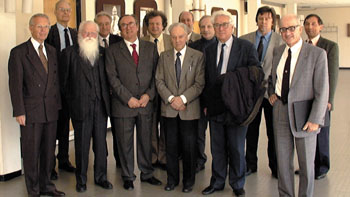
It is no accident that Russia has become a major partner in the CERN programme. In 1967 a historic agreement between CERN and the Institute for High Energy Physics (IHEP) in Protvino, Russia, was signed, under which CERN equipment and expertise was provided for the 70 GeV IHEP machine that was soon to come on line as the world’s highest-energy synchrotron. This agreement led to continual fruitful collaboration between CERN and IHEP in particular, and it opened the door to wider East­West collaboration in general.

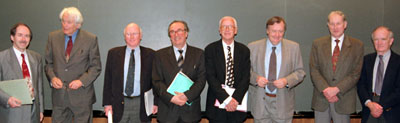
In a short ceremony at CERN on 18 March, IHEP director academician A A Logunov bestowed the title of IHEP professor honoris causa on CERN personalities who played important roles in this initial exchange and in its subsequent consolidation.

A wide span of physics

carlo1_5-99

CERN owes a tremendous debt to Carlo Rubbia. His vision foresaw a gleaming new SPS proton synchrotron transformed into a proton­ antiproton collider, the springboard for discovering the W and Z particles, the carriers of the weak force. With this discovery, CERN moved to the centre of the world physics stage. At a special seminar at CERN on 16 March, director-general Luciano Maiani pointed out that Rubbia’s vision brought the W and Z particles into the reach of physics much earlier than would otherwise have been possible.

The birthday seminar focused on science, but CERN’s debt to Rubbia extends much wider. When he took over from Herwig Schopper as CERN director-general on 1 January 1989, the LEP electron­positron collider had not yet come into operation, research and development work on superconducting magnets for the proposed LHC proton collider was just beginning, and CERN had 14 Member States: Austria, Belgium, Denmark, France, the German Federal Republic, Greece, Italy, the Netherlands, Norway, Portugal, Spain, Sweden, Switzerland and the UK.

The LHC road had already been chosen in 1986 as the main thrust of CERN’s scientific advance by the CERN Long Range Planning Committee, chaired by Rubbia. The route to higher electron­positron collision energies through a purpose-built linear collider (CLIC; CERN Linear Collider) was also acknowledged at that time.

Under Rubbia, the LHC moved from a proposal to a plan, with orchestrated research and development in CERN, other laboratories and industry. In parallel, the LHC’s proposed research programme emerged from a vigorous and carefully managed series of presentations throughout the world.

To safeguard CERN’s future and reflect the growing internationalism of high-energy physics, Rubbia sought to extend CERN’s traditional role as a Western European venture by attracting new member states in Central and Eastern Europe, and by negotiating valuable new working agreements with scientific partners further afield.

Finland, Poland, Hungary, the Czech Republic and Slovakia became CERN member states, while Germany grew to include the former German Democratic Republic, and CERN’s relations with other traditional close collaborating nations, notably Russia and Israel, were put on a new footing.

Rubbia worked tirelessly to ensure that LHC plans moved steadily forward during a global recession, when money was extremely tight and governments were not looking at pure science as an investment for the future.

A life in science

Scientific research has dominated Rubbia’s life, and the seminar emphasized this side of his achievement, which was for a long time concentrated around weak interactions. Rubbia was also a transatlantic physicist, carrying out research at major US research centres as well as at every CERN machine (prior to LEP).

The seminar proceedings were introduced by 1992 Nobel prizewinner Georges Charpak, who pointed to Rubbia’s latest research interests around emerging energy technology as an example of his continual quest for innovation and his flair for new ideas. Innovative instrumentation has been a theme throughout Rubbia’s career.

Val Fitch of Princeton, who shared the 1980 Nobel Prize with Jim Cronin for their discovery of CP violation, described Rubbia’s contributions in this area of physics in the period 1966 to 1973. Fitch displayed a list of 20 physics papers and 4 instrumentation papers with Rubbia as an author, and which had helped to pin down vital parameters in these difficult measurements.

Klaus Winter of CERN looked at the neutrino sector. Rubbia was convinced that neutrino beams were the route to the discovery of the neutral currents ­the key to electroweak unification. In the early 1970s, he and his colleagues convinced the new Fermilab to make a major commitment to this physics. The experiment’s all electronic detectors bore the unmistakable stamp of Rubbia ingenuity.

After a long period away from the neutrino stage, the excitement around neutrino oscillations tempted Rubbia back, this time with the ICARUS neutrino detector at the Italian Gran Sasso underground laboratory. The innovative liquid argon time-projection chamber again bears the trademark of Rubbia innovation.

Continual innovation

Turning away from the experimental side, Gerard ‘t Hooft of Utrecht sketched the development of the theoretical infrastructure that led to electroweak unification and the Standard Model, which Rubbia’s 1983 discovery dramatically confirmed. ‘t Hooft remarked that new theoretical ideas in and around superstrings have predictions that are very difficult to verify by conventional experiments.

Alan Astbury of TRIUMF, Vancouver, a close collaborator of Carlo Rubbia for the UA1 experiment at CERN’s proton­antiproton collider, covered the historic period from the late 1970s that led to the 1983 discovery of the W and the Z particles. This physics was a continual close race between the UA1 and UA2 experiments. Astbury pointed out how UA1 had been galvanized into action in late 1982 by having lost the race to discover the tightly confined “jets” of particles, which signal quark­gluon interactions deep inside the proton­antiproton collisions.

After his mandate as CERN director-general, Rubbia made a dramatic return to the physics stage, this time through his ideas for harnessing accelerators for energy production via nuclear fission with a minimum of nuclear waste and for the destruction of existing waste by transmutation.

Arthur Kerman was billed as covering this phase of Rubbia’s career, but began by pointing out the initial role Rubbia had played in recommending the US Superconducting Supercollider. Kerman described the neutron behaviour that opens up the possibility of controlled fission reactions, whether by orthodox absorbers or via an accelerator in tandem with the reactor. The latter possibility had long been recognized, but only recently has accelerator performance begun to approach the necessary levels.

Carlo Rubbia characteristically used the occasion to look forward rather than back, underlining how little we know about the universe. With much of the world around us composed of invisible but all-pervading “dark matter”, innovative instrumentation is still called for.

Finally director-general Luciano Maiani underlined the breadth of Carlo Rubbia’s contributions, both to CERN and to physics.

Echoes of a report

nuclear1_5-99

The Organization for Economic Cooperation and Development (OECD), through its Megascience Forum, is making its wisdom felt in scientific circles, acting as a valuable catalyst for future developments and as a focus for international collaboration in sectors where this is not yet centrally organized.

Founded in 1960, the OECD is a grouping of nations with advanced economies, its aim being to improve economic and social conditions in its own sector, stimulating relations with developing countries and generally boosting world trade.

Megascience Forum

Its initial concerns were economic and financial, but the roles of science and technology have been identified as being of major importance, hence the creation of the Megascience Forum. Its latest exercise is a report by a special working group that was set up in 1996 under Bernard Frois of Saclay to look into nuclear physics and its worldwide implications.

Nuclear physics is pursued in all OECD member countries (and many others) with a global annual investment of about $1 billion. Nuclear physics has a major impact on technology and society: energy production, biological research, medical imaging, cancer treatment, semiconductor manufacturing, materials science, food processing, environmental monitoring and protection, preservation of art works, archaeology and anthropology.

As scientists probe ever deeper into the structure of nuclear matter, they require larger and increasingly complex facilities and equipment. In most cases these are unique, dedicated facilities, distinct from those of particle physics. The long lead times and considerable resources needed call for strategic decision-making and long-range planning, with a careful consideration of the scientific, technological, economic and social benefits of nuclear research. These requirements are especially critical now, when research budgets are under pressure.

The goals of the Megascience Working Group were to provide an international forum for the exchange of information on priorities, programmes and plans, and to explore opportunities for international collaboration during the next 10 to 20 years.

Particular attention was given to the role of large facilities and programmes that would benefit from international co-operation:

  • to examine the policies and practices that govern access to large facilities,
    and to assess the impact of current and future trends on the users and providers of international facilities;
  • to explore specific opportunities for collaboration in research and development related to nuclear physics facilities,
    detectors and associated technologies.
nuclear2_5-99

Scientific objectives and applications

The fundamental challenges of nuclear physics are not the same as those of particle physics.

What are the constituents of matter, how do they interact and how do they form nuclei?

For nuclear physics, the aim is to understand the properties of nuclear particles from those of quarks and gluons, to solve the nuclear many-body problem and to predict the properties of large nuclei from the known interaction of protons and neutrons. These formidable theoretical problems may become tractable using high -power computers and results from new generations of electron and hadron beam facilities.

What are the limits of nuclear stability?

The early evolution of the universe was determined by the aggregation of quarks and gluons to form hadrons and nuclei, and the synthesis of heavier elements through nuclear reactions. The stability of nuclei arises from a delicate balance between the nuclear, electromagnetic and weak forces in the nuclear medium.

Some very neutron-rich nuclei have recently been found to have extended distributions of dilute, nearly pure neutron matter that are of much theoretical interest and thus a subject of intense investigation. The direct investigation of nuclear structure far from stability will be made possible through the production of intense beams of rare and short-lived isotopes (radioactive beams).

What happens to nuclear matter at extreme pressures and temperatures?

Nuclei can be compared to liquid drops of nuclear matter. In the collision between two nuclei at high energy, the pressure and temperature of nuclear matter are increased. Is there a transition in the nature of nuclear matter? Is there formation of a plasma of elementary constituents in ultrahigh-energy collisions of heavy nuclei? The search for these phase transitions via heavy-ion collision experiments will be a subject of intense experimental and theoretical work during the next decade.

The liquid­gas phase transition is studied at existing energies. The “deconfinement” transition to a quark­gluon plasma will be investigated in new regimes at Brookhaven’s RHIC and CERN’s LHC colliders. The early universe presumably underwent this phase transition within the first few millionths of a second following the Big Bang.

Such phenomena might have a bearing on important aspects of cosmology, such as nucleosynthesis, dark matter and the large-scale structure of the universe. In astrophysics, the dynamics of supernova explosions and the stability of neutron stars depend on the compressibility and thus the equation of state of nuclear matter.

What is the origin of the chemical elements in the cosmos?

Many elements are formed in stellar explosions via very neutron-rich or, under different circumstances, very proton-rich nuclei. The properties of both routes are largely unknown. While element formation inside stars can be sketched by extrapolating model calculations, there is a critical need for experimental data to provide benchmark tests for these predictions or input to numerical simulations.

Nuclear methods are widely used in materials research and manufacturing. Some examples are non-destructive testing via computerized tomography or neutron radiography, the production of densely packed microchips by ion implantation and the sterilization of heat-sensitive materials by ionizing radiation.

Materials analysis using nuclear reactions and Rutherford scattering is a major research tool for surface analysis, catalysis, semiconductor manufacturing, archaeology, etc.

Particle beams from research accelerators are used to analyse the damage to microelectronic circuits that is caused by cosmic radiation or natural radioactivity ­ an issue of increasing importance for the further miniaturization of electronics.

Ultrasensitive accelerator mass spectrometry plays an increasing role in environmental research ­ the study of climatic change, global air and water circulation patterns, stratospheric ozone depletion, and the monitoring of air and water quality. Nuclear technology is indispensable in the monitoring of existing radioactive waste repositories.

For energy production, nuclear fission reactors currently provide about 17% of the world’s electricity. Nuclear techniques have an impact on other forms of energy production, including the exploration and utilization of oil reserves. Neutron techniques are routinely used to monitor the chemical composition of coal, coal preparation plants and the determination of the sulphur, water, ash and energy content of coal. For the long term, thermonuclear fusion still holds the promise of a virtually inexhaustible supply of clean energy and is an area of active research and development.

Nuclear techniques are important in medicine and biology. Radioactive isotopes produced by accelerators and nuclear reactors are widely used for treatment and diagnosis, and also in biomedical research.

In the wide-ranging applications sector, the working group focused on three potentially promising topics: the accelerator-driven transmutation of nuclear wastes, medical imaging and cancer therapy.

Copenhagen interpretation

theatre1_5-99

The play Copenhagen shows that physics, in the hands of talented British playwright and author Michael Frayn, can be entertainment.

However, few theatregoers are pulled to the box office by the promise of an evening about physics: it is Frayn’s name that packs them in. With an International Emmy Award in 1990, several Best Comedy Awards and Play of the Year, audiences know that he delivers the goods.

In the 1998 harvest of theatre awards, Copenhagen was judged Best Play by the London Evening Standard and Best New Play by the Critics’ Circle, and was nominated for a 1999 Olivier Award.

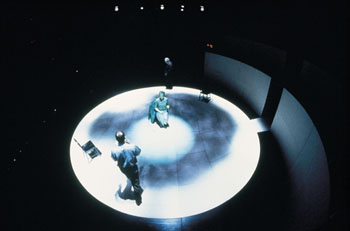
It is stark theatre ­no scenery, three chairs as the only props and a cast of three: Neils Bohr, his wife Margrethe and Werner Heisenberg on stage for the entire performance.

The focus of the “action” is a recreation of what happened in 1941 when Heisenberg went to Copenhagen to meet Bohr. Shortly afterwards, Bohr fled to Sweden and then the UK, eventually turning up in Los Alamos, where he became a father-figure for the Manhattan project.

Heisenberg played an influential role in the much more modest German wartime effort. Did they exchange physics information in Copenhagen? Did they try to influence each other in any other way? Suspecting that Bohr was in contact with the Allies, did Heisenberg try to dupe them by giving Bohr bad information? Did Bohr try to dupe the Germans by fooling Heisenberg? Who knows? Nobody, but Frayn tries to guess.

Rather than a scientific “whodunit?”, the play is more of a “who did what?, with accusations and counter accusations coming from all three sides. As well as the wartime nuclear fission developments, in the second half of the play the “plot” overflows into basic physics for good measure.

Margrethe (admirably depicted by Sara Kestelman) is portrayed as omniscient. Why did Frayn not depict instead Carl von Weizsäcker, who accompanied Heisenberg to Copenhagen and whose pronouncements on physics would have been more authoritative than those of Mrs Bohr? Probably because the idea is to recreate what happened when Heisenberg went to talk with Bohr at his house, not in his physics institute. Whatever else was on his mind in 1941, Heisenberg cared deeply about Bohr.

David Burke’s Bohr is visually evocative. In the Bohr­Heisenberg stage duel, both characters are portrayed as strong and assertive in their dialogue, but in real life their assertiveness and obstinacy lay deeper than their oral skills.

For such a stark presentation, director Michael Blakemore and lighting designer Mark Henderson have pulled out all of the stops.

Frayn says that his interest was whetted by reading Thomas Powers’ book Heisenberg’s War and David Cassidy’s biography of Heisenberg, Uncertainty.

Science communication is still in its infancy, but full marks should be awarded to Frayn for making compelling theatre out of physics. He deserves special recognition for such a heroic undertaking. The result is certainly riveting and accurate, although scientific nit-pickers will occasionally wince. In places the physics is painted too thickly, blinding the audience with science. But that is by the way.

The incomprehensible is always fresh

comm1_5-99

As we worry about how we will mark the passage of the millennium and whether its technology will survive that incremental year, fundamental physics has already embarked on its assault on the 21st century. Caught up in the jostle, it is hard to perceive this acceleration. But look back 100 years and it is clear how the prospect of the 20th century provided incentive right across the cultural spectrum.

The work of poverty-stricken artists who were humiliated by the drudgery of unrecognized creativity now trades for fortunes. Fresh influences that were to fire the popular music of the 20th century blazed only in the confines of the ghetto.

Physics too was poised on a launchpad. The decade spanning the 19th and 20th centuries brought a chain reaction of discovery: X-rays, radioactivity, the electron, quantum theory, special relativity…Before the century was much older, a full theory of relativity and the interpretation of empirical quantum theory in terms of quantum mechanics had revolutionized our understanding of the universe.

Rather than having been assimilated into the collective consciousness, these two monuments of human intellect ­ quantum mechanics and relativity ­ still remain obstacles to the public understanding of science. In his introduction to the first edition of his masterpiece The Principles of Quantum Mechanics, Paul Dirac said: “The methods of progress of theoretical physics have undergone a vast change during the present century [he wrote in 1930!]. The classical tradition has been to consider the world to be an association of observable objects (particles, fluids, etc) moving about according to definite laws of force, so that one could form a mental picture in space and time of the whole scheme…It has become increasingly evident…that nature works on a different plan. Her fundamental laws do not govern the world as it appears in our mental picture in any very direct way, but instead they control a substratum of which we cannot form a mental picture without introducing irrelevancies.”

Dirac was trying to encourage students who were about to embark on a difficult but rewarding book, warning them that they should loosen the straps on their 19th-century imagery of springs and gear-wheels and prepare to accept an unfamiliar “impressionist” physics.

Some 70 years later, many generations of physicists have learned to handle relativity and quantum mechanics in their sleep, but these concepts remain a foreign language for the uninitiated.

“The new theories, ” wrote Dirac, “if one looks apart from their mathematical setting, are built up from physical concepts which cannot be explained in terms of things previously known…which cannot even be explained adequately in words at all. Like the fundamental concepts which everyone must learn on their arrival into the world, the newer concepts of physics can be mastered only by long familiarity with their properties and uses.”

For the 21st century, physicists are venturing into even deeper conceptual water, painting ambitious new pictures that even Dirac would have shunned. Abandoning the “classical” concept of point particles in favour of two dimensional strings in many-dimensional spaces, new developments suggest that some of the mysteries of quarks and gluons could be inferred from quantum theories of gravity cast in many more dimensions than once was ever thought necessary. The microworld could be a hologram of an otherwise invisible structure of a larger universe.

Superstrings

Recent CERN Courier articles on superstrings by Gabriele Veneziano and Yaron Oz have pointed out how we could have been blindfolded by living in a four-dimensional spacetime lesion embedded in a much larger, but ironically indiscernible, scheme. Our limited experience might not be that of most of the rest of the universe, and another Copernican revolution might be round the corner.

These ambitious theories are not yet ready for any textbooks, but something will surely emerge from all of this intellectual industry. Such a reappraisal of our understanding could go on to parallel Planck’s introduction of the quantum concept 100 years ago.

If these new theories do bear fruit, then the problems underlined by Dirac 70 years ago will have been amplified. The preface to the ultimate 21st-century textbook The Principles of Superstrings will have to encourage students even more than Dirac did, and the public, blinkered by living in three dimensions, let alone four, could be even more in the dark and seek easier intellectual comfort.

The 21st-century public could find physics not to its taste unless a major effort goes into making the subject palatable. For physics, a key problem is to accomplish this while retaining the confidence and credibility of the scientists. Paraphrasing what can ultimately only be expressed with mathematical precision can attract heavy dogmatic firepower. Researchers accustomed to peer review frequently get hold of the wrong end of the stick when confronted with a popular market.

A successful play now running in London has shown that physics, given the right treatment, can have popular appeal. However, science communication ultimately has to come from scientists. Where Carl Sagan and Stephen Hawking whetted the public appetite for the incomprehensible, others have followed. With the prospect of fresh conceptual horizons, a new door is open.

Detectors for Particle Radiation by Konrad Kleinknecht

Cambridge University Press 0521 64854 8 (pbk $19.95/$34.95), 0 521 64032 6 (hbk £52.50/$80).

9780521648547

The second edition of this popular text has been updated with the inclusion of recent detector developments and a presentation of modern experimental facilities.

The excellent introduction provides a thorough discussion of the physics principles of detectors, including, for example, such modern treatments as the Photoabsorption Model for the energy loss. This recommendable approach provides the reader with a basis for understanding and evaluating detector behaviour.

The subsequent chapters focus in turn on different types of measurement (position, time, particle identification, momentum, energy). Within each broad topic the full range of the relevant detectors is analysed. The text is complete, yet compact and authoritative. A wealth of equations guides the reader to an analytical understanding of detectors.

One important subject ­ energy measurement ­ would merit a more extensive discussion. A more systematic analysis of the various contributions to the energy resolution would demonstrate that these detectors too can be understood from first principles.

One of the big successes of particle physics detectors is their increasing range of applications in other areas. The description of these applications, although short and less complete than this success merits, should be applauded.

The book is illustrated throughout with instructive diagrams of fine quality. Only the admittedly difficult ­ illustration of large detector facilities will probably leave the novice unsatisfied. A complete list of references covering approximately 30 years of research and development provides ready access to the source literature.

This volume will serve the apprentice experimentalist as an attractive introduction and the seasoned physicist as a fine reference. The publishers should be congratulated for issuing this text in paperback.

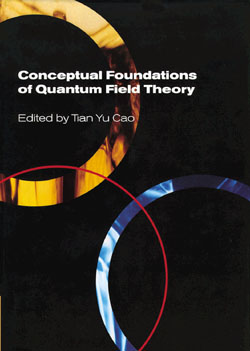
Conceptual Foundations of Quantum Field Theory

edited by Tian Yu Cao, Cambridge University Press 0 521 63152 1 (hbk £60/$100).

books1_5-99

Tian Yu Cao’s book Conceptual Developments of 20th Century Field Theories, published in 1997, was hailed in many quarters as a masterpiece. The same careful thinking is evident in this book, the result of a conference held at Boston University in 1996.

Boston (particularly Harvard) has long been a cradle of field theory, even during the dark years when the subject was not fashionable, and many key figures attended the event. The idea was for leading field theorists, philosophers and historians to present their insights and views. Participants included Sidney Coleman, David Gross, Sheldon Glashow, Steven Weinberg and Arthur Wightman.

All of these figures also participated in a lively concluding round-table discussion that was moderated by Stanley Deser. The following extract from this discussion underlines the scholarship and entertainment that the meeting provided.

Gross: Actually, I wanted to answer [the] question about what question I would ask God…There are two answers…The first is a kind of joke. I’d paraphrase Gertrude Stein and ask “What’s the question?’, because in some sense that’s really the hardest thing in physics: to ask the right question. In explaining to me the question, He would have to explain all the answers I would like to know.

Deser: He’s subtle. We don’t know what He would say.

Gross: The other question is one that from the point of view of particle physics seems to be the most mysterious…that is, “Why is the cosmological constant zero or so small?”

Weinberg: I think we all always keep raising the same question, which is why things are the way they are.

Deser: Sure, but there are some things which are more “the way they are” than others. And it’s not clear to me why the cosmological constant is picked on specifically as being ­

Weinberg: It’s a lot of orders of magnitude.

Deser: No, I understand that.

Coleman: 120 orders of magnitude between the rough order of magnitude and the experimental observation.

Deser: That should tell you that it can’t be the fundamental problem. But anyway, that would take longer to discuss. Shelly, what would you like to ask God, or do you know all the answers?

Glashow: I’m working at that…One question: “Why is the top quark so heavy?”

Deser: That’s a good question. You don’t care about the tau lepton?

Weinberg: Yeah, I would have said, you know, that’s the easy one, because that’s the mass you would expect.

Coleman: Why are the others so light?

Gross: Why is the neutrino so light?

Glashow: Yeah, well, you start off with the easy questions, see.

Weinberg: Why is the electron so light? That’s really hard. I mean, the electron is the mysterious particle, not the top quark.

Deser: Anyway, why is this difference of emphasis important?

Weinberg: Well, it does direct the way you think. I mean, some people think you have to give the top quark new kinds of interactions which are different from the other particles. And other people think you have to invent new symmetries that keep the light quarks light. I’m not sure, obviously, which is right, but there is a difference.

Glashow: Steve, we’re asking the same question: “Why is there this little, curious factor of 105 between the mass of the lightest particle and the mass of the heavier particle?”

Weinberg: Yeah, that’s the right one to ask. And it really is an amazing thing.

Deser: And you have no leptonic questions?

Weinberg: Same question.

Historic hardware

news4_4-99

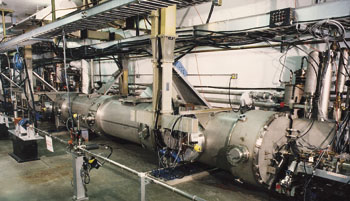
In 1983 the big UA1 and UA2 experiments at CERN revealed the long-awaited W and Z particles, the carriers of the weak force. UA1, UA2 and much of CERN’s antiproton infrastructure are no more, but CERN’s Microcosm exhibition centre is preserving some of this historic hardware and transforming it into the focus of a new Hunting the Bosons exhibition.

Pakistan creates national centre for physics

news1_3-99

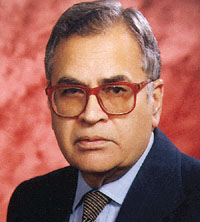
To promote research in physics and strengthen university capability in Pakistan, a National Centre for Physics (NCP) has been established at Quaid-i-Azam University, Islamabad. The director is distinguished theorist Riazuddin and the scientific activities formally began with a one-day symposium on 28 January.

The NCP will try to attract world-class physicists to the Centre throughout the year. Its basic mode of operation will be based on distinguished visiting scholars for periods ranging from a week up to a year.

The NCP will be a permanent focus for workshops, colleges, schools, conferences and seminars covering physics, mathematics and related subjects, and will encourage joint efforts in the relevant departments, institutions, and organizations in Pakistan.

The NCP will also enter into collaborative arrangements with institutions abroad, like CERN and the Abdus Salam International Centre for Theoretical Physics in Trieste.

The strong influence of the late Abdus Salam endowed Pakistan with a distinguished tradition in theoretical physics, and many Pakistani theorists hold important positions in overseas universities and research centres. Recently this tradition has extended to cover also the experimental sector, where Pakistani physicists are involved in the CMS experiment for CERN’s LHC proton collider.

The NCP will also try to use effectively expatriate Pakistani physicists by appointing them as “reverse” associates to enable them to spend some time every year at the Centre.

The Centre is also a natural development of the International Nathiagali Summer College, established in 1976 at the suggestion of Salam and which has been held annually ever since. The twin topics of this year’s school are CERN’s LHC collider and its research programme, and Non-Conventional Energy Resources.

NCP Director Riazuddin took his first research steps under Abdus Salam at Lahore and in the UK, obtaining his PhD in 1959 at Cambridge. After positions in Pakistan and in the US, in 1966 he became founding director of the Institute of Physics at the then new University of Islamabad, which gave Pakistani physics a research base in its own country. The institute is now a department of Quaid-i-Azam University. In 1982 he joined King Fahd University, Dhahran.

bright-rec iop pub iop-science physcis connect