On 11 September, French Minister of Research and Technology Roger-Gerard Schwartzenberg announced the decision to build the SOLEIL third-generation synchrotron radiation source near Paris.
This decision marked the climax of 10 years of effort to convince French scientific and political authorities to replace the DCI and Super-ACO rings at the LURE synchrotron radiation laboratory at Orsay with a modern synchrotron radiation source.
The project study was started and led by LURE between 1990 and 1996, and developed in a 3 year collaboration aimed at producing a 2.5 GeV machine with a circumference of 337 m and very high brightness. The detailed pre project, costing 70 million French francs ($9 million) including salaries, was completed in June 1999.
Three major obstacles have been overcome in reaching the final decision. First, the reference site of Orme des Merisiers met opposition from proponents of political decentralization from 1992 onwards. Then budgetary restrictions on research quickly led to a successful search for alternative financial sources in different French regions. In this area, LURE made a spectacular breakthrough.
Finally, the categorical no to SOLEIL on 2 August 1999 from the previous Minister of Research in favour of a minority participation in the British project DIAMOND began a pitched battle. The massive intervention of the French synchrotron radiation community, with wide support from scientific and political circles, brought the question into the media spotlight.
In March this year, a French parliament scientific and technological evaluation committee mounted a strong counterattack that was taken up by the Académie des Sciences and numerous scientific institutions. The arrival of the new Minister of Research and Technology turned the tide and helped produce the final decision.
In addition, the authorities of the Ile-de-France Region and the Département of the Essonne decided to increase their financial support to 1.2 billion francs ($160 million) out of a total of 2.1 billion francs including salaries, over an 8 year period.
SOLEIL will have 16 straight sections, of which 14 will be for insertions with undulators or wigglers, and must be able to provide room for a maximum of 40 beamlines including those from the dipoles. The photon spectrum must be wide, with performances of particular interest in the 1-11 keV range, but also on either side.
SOLEIL is a project of nationwide importance, but also intends to be European in scope, bringing in researchers from Spain, Belgium and elsewhere, as has always been done at LURE. Several governments, in particular those of Spain and Portugal, are also examining the possibility of participating in SOLEIL. The project incorporates a dozen innovative ideas, including a monomode superconductor which has been designed and built in collaboration with CERN.
First beams should appear in 2005. In this way LURE will continue its long pioneering tradition at the Orsay site.
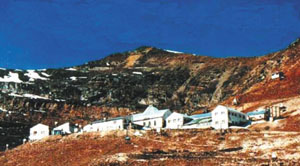
New support for the Chacaltaya Cosmic Ray Research Laboratory, on Mount Chacaltaya near La Paz, Bolivia, underlines its relevance for cosmic ray research. At 5220 m above sea level (a barometric pressure of about 540 mbar; just over 0.5 atm), it is the highest continuously functioning research station on the globe, providing a unique opportunity for siting relatively large cosmic ray detectors.
At energies above 1014 eV, the flux of primary cosmic rays is so low that direct observation by balloon- or satellite-borne instruments (with areas of only a few square metres) is difficult. For example, the integral primary cosmic ray flux of energies above 1016 eV is only one particle per m2 per year. Consequently the most sensitive indirect studies of cosmic rays with energies of 1015 eV (1 PeV) and above suggest the deployment of large-area detector systems at as high a terrestrial elevation as possible, in order to reduce atmospheric shielding.
Although Brazilian and Japanese groups have maintained their research activities at Chacaltaya throughout recent years, the research potential of this site has been underutilized. In consideration of the unique capabilities of this site, and to stimulate further exploitation of this facility, the Centro Latinoamericano de Fisica (CLAF), at its General Assembly in Leon, Mexico in November 1999, unanimously approved a declaration of support for the installation of new experiments at Chacaltaya.
To coordinate the international, and in particular the Latin American, collaborations for new experiments at the laboratory, CLAF asked its director, Luis Masperi, and deputy director, Joao dos Anjos, to form a special committee together with Carlos Aguirre, president of the Academia Nacional de Ciencias of Bolivia, and P Miranda of the Universidad Mayor de San Andres of La Paz and the director of the Chacaltaya Laboratory.
The laboratory was founded in 1942 by I Escobar, initially as a meteorological station. Soon afterwards, a road was constructed, partly to give access to a ski station opened in 1940 by the Club Andino Boliviano.
The project was championed by an Austrian physicist then in Bolivia, F Hendel (now at Michigan) and R Posnaski. C M G Lattes initiated cosmic ray research on Chacaltaya with the exposure of nuclear emulsions, confirming the strange particle decays discovered at Pic du Midi in France.
The Bolivian Air Shower Joint Experiment (BASJE) collaboration was started in about 1960 by B Rossi (MIT) and K Suga (Japan). Lattes, together with Brazilian colleagues and a Japanese group including Y Fujimoto and S Hasegawa from Waseda, established a long-term program at Chacaltaya, working mainly with nuclear emulsion chambers – stacks of alternating layers of nuclear emulsion and lead.
Other research groups from the US, Japan and Europe were also active there from the 1950s until the 1970s. Notable discoveries included the “Centauro” events and other exotic phenomena not apparent in the lower energy collisions studied with particle accelerators, and which are still not understood. The current research activities are primarily the BASJE observations, now involving only a Japanese group and the Saitama Yamanashi-San Andres collaboration.
At 5220 m, the laboratory is only an hour’s drive from La Paz airport (on the Alte Plano, at 4200 m) and about two hours from central La Paz (3600 m). As Chacaltaya is 17° south, access is possible throughout the year.
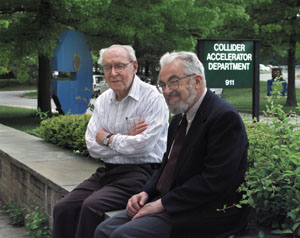
“If you can’t do two things together, you just do one after the other – that’s all there is to it!” Ernest Courant, Brookhaven distinguished scientist emeritus, was describing how he came to think of the strong-focusing principle that he, together with M Stanley Livingston and Hartland Snyder, co-discovered in 1952.
Also known as alternating gradient focusing, this principle was a breakthrough in accelerator design. At Brookhaven it resulted in the construction of the successful Alternating Gradient Synchrotron (AGS), which achieved its design energy on 29 July 1960.
In previous circular accelerators, such as Brookhaven’s Cosmotron, particles had been guided round the ring by a magnetic field made by outward-facing magnets. The magnets bent the particles’ trajectories and at the same time weakly focused them both horizontally and vertically. The particles’ energy could only be increased by enlarging the ring with wider magnets, requiring far more steel – at great cost – to make the larger number of magnets.
However, Courant and his colleagues calculated that energy could be increased dramatically with much smaller magnets if the particles were strongly focused first vertically then horizontally.
They achieved this by arranging the magnets so that their field gradients faced alternately inward and then outward around the ring. (It turned out that this idea had been proposed earlier by Nick Christofilos in Greece, but his innovation had gone unrecognized and was then forgotten. Later he was invited to Brookhaven.)
The practicality of the principle was demonstrated in 1954 by Cornell University’s 1.3 GeV electron accelerator, and in 1959, well before the AGS was finished, by CERN’s 24 GeV Proton Synchrotron.
CERN makes a scoop
On 17 May 1960 a 50 MeV beam completed one turn round the AGS ring. In July that year the 30 GeV design energy was reached and even surpassed. “But,” Courant recalled, “although we were all very excited by how quickly things were going, we were a little disappointed that we’d been scooped by CERN.”
One reason why Brookhaven had fallen behind was because it had built an electron analogue before starting construction of the AGS, Courant says. The analogue was designed to explore what is called the “transition energy” – a potentially serious problem with the synchronization behaviour. The analogue could also give information on nonlinear resonances that might affect the orbit stability of the particles as they circled the AGS ring.
“These resonances were not a big problem, but it was good to know what was happening,” said Courant . “Using the analogue, we found that the transition problem could be overcome. We also found out a lot about higher order resonances that we hadn’t expected, and we confirmed that we could go forward with the design as planned. So the delay was worth it.”
Dedicated staff
In a statement made in July 1960 as the AGS began operation, Leland Haworth, Brookhaven director at the time, congratulated Ken Green, John Blewett and the entire staff of the Accelerator Development Department for their work. He offered special congratulations to Courant, Snyder and Livingston, “whose brilliant concept of strong focusing has once more proved its great utility”.
Taking over as Brookhaven director on 1 July 1961 was Maurice Goldhaber, now distinguished scientist emeritus. From 6 to 12 September the laboratory hosted the 1961 International Conference on High Energy Accelerators. Immediately following the conference, the AGS dedication ceremony was held. Goldhaber had just returned from a celebration in Manchester for the 50th anniversary of the discovery of the nucleus by Ernest Rutherford.
On the return flight, Goldhaber wrote the talk that he was to give at the AGS dedication: “Why high-energy physics?”. Unsurprisingly, Goldhaber’s words on the science lying ahead at the AGS are relevant today in the new age of the AGS’s mighty spin-off partner, the Relativistic Heavy Ion Collider.
In his talk, Goldhaber described experimentalists, eager to work on the new machine “on the border between light and dark, where no complete set of guiding principles is as yet established. Today, the border between light and dark has moved to questions of nuclear structure, of the structure of elementary particles, and of the forces between them,” he also noted. “Research with these machines is a great adventure; it leads us nearer to the heart of the particles of which we all are built. To think of something more exciting is difficult.”
Strong-focusing accelerators
At the end of 1999, CERN celebrated the 40th anniversary of its Proton Synchrotron. This machine and the Brookhaven AGS were the world’s pioneer proton strong focusing accelerators. That both of them are also the hub of complex and ongoing beam networks testifies to the importance of the invention of the strong focusing technique. Other machines that opted for the comfort of the then conventional weak focusing are now history.
In 1952, even before CERN had formally been created, the declared goal of the proposed European laboratory was to build a scaled-up version of Brookhaven’s 3 GeV Cosmotron, then nearing completion. In 1952 a group of European pioneers visited Brookhaven to see Cosmotron preparations. The visit prompted the Brookhaven accelerator experts to organize a brainstorming session. The outcome was alternating gradient (strong) focusing. On his return, Odd Dahl boldly insisted that the new European machine should go for the untried focusing technique. CERN went for it, and the European machine was even commissioned several months before that at Brookhaven. The CERN machine’s 40th anniversary was featured in the December 1999 issue of CERN Courier.
*This article originally appeared in the 4 August issue of the Brookhaven Bulletin.
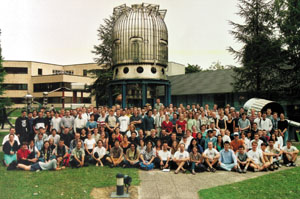
CERN always has plenty of visitors, but never more so than in the summer, when the itinerant population is boosted by several hundred students from CERN member states and further afield. CERN’s Summer Student Programme offers undergraduate students in physics, computing and engineering a unique opportunity to join in the day-to-day work of research teams participating in experiments at CERN.
Beyond the outstanding first-class scientific value of their stay, the students find working in a multidisciplinary and multicultural environment an extremely enriching experience – an opportunity to make valuable and long lasting contacts with other students and scientists from all over Europe.
In addition to the work with the experimental teams, summer students attend a series of lectures specially prepared for them. Scientists from around the world share their knowledge about a range of topics in the fields of theoretical and experimental particle physics and related technologies.
Victor Weisskopf, field theory pioneer and CERN director-general in 1961-1965, had a particular interest in education. During his mandate as director-general, he gave a series of introductory lectures on particle physics (maintaining that “the best way to get a basic understanding of anything is to teach it”). For many years after he left CERN, Weisskopf returned every summer to address an eager audience. These lectures also developed into a book, Concepts of Particle Physics (two volumes), written with Kurt Gottfried.
Many generations of CERN summer student alumni vividly recall a relaxed Weisskopf recounting anecdotes about the early days of quantum mechanics. Among them is Melissa Franklin of Harvard (CERN summer student 1977), who lectured this year on “Classic experiments”. Sadly, Weisskopf seldom returns to CERN, but the tradition lives on.
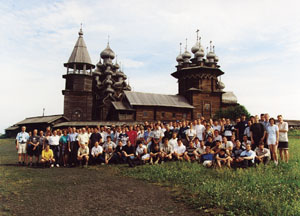
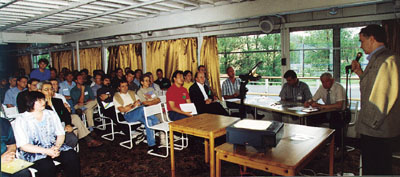
Every two years, Europe, Japan, Russia and the US collaborate to organize a Joint Accelerator School, giving accelerator physicists and engineers from each region an opportunity to meet experts from most of the world’s accelerator laboratories. This year it was Russia’s turn to host the school. It chose an unusual setting – on board a river boat sailing from St Petersburg to Dubna and Moscow along the system of inland waterways that link the mouth of the Neva with the Volga.
The title of the school was JAS2000: High Quality Beams, and an international team of more than 20 lecturers addressed the many effects that limit the intensity, luminosity and brilliance of proton and electron beams in both linear and circular machines. Parallel afternoon sessions on insertion and crossing region design, space charge and beam quality control for linear colliders allowed students to concentrate on a specialist topic of their choice. The school attracted more than 70 students, including 20 from outside Russia.
The boat proved to be an ideal environment for uninterrupted study. Nevertheless, participants still had a chance to visit two great Russian cities on a voyage that also passed through two large lakes – Ladoga and Onega. Historic sites en route included the monastery on Valaam Island, the famous church at Kizhi constructed entirely out of timber and the delightful town of Yaroslavl.
For CERN’s Accelerator School (CAS) this was one of three events in a crowded millennium year calendar. In March, CAS and GSI Darmstadt organized a specialist course on radiofrequency engineering at the Lufthansa Training Center, Seeheim, near Darmstadt, and in October there will be a course entitled Introduction to Accelerator Physics, held in Loutraki, near Athens. This has been organized with the help of the Institute of Accelerating Systems and Applications in Athens and the University of Athens. The Loutraki school is designed to be of particular interest to those participating in the SESAME initiative, which will provide a synchrotron light source for eastern Mediterranean countries. Parallel courses will deal with synchrotron light sources, linacs, and muon and neutrino factories.
In addition, the CAS course, Particle Accelerators for Medicine and Industry, will be held at Pruhonice, near Prague, on 9-17 May 2001.
Personal skills are a valuable form of technology transfer. The expertise acquired in the big international collaborations running today’s major physics experiments is diverse – computing, electronics, project management, etc. In addition are the interpersonal skills gained by being a member of a large international team working on a complex problem. Today’s physics students are much in demand.
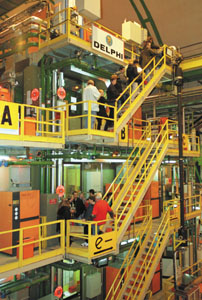
To investigate this, the DELPHI experiment at CERN’s LEP electron-positron collider analysed the careers of 669 students, mainly those involved in DELPHI since it began running for physics in 1989.
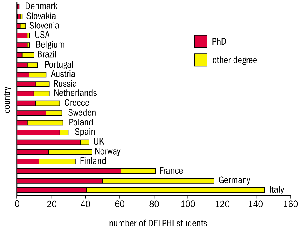
Of these students, 338 obtained a PhD, 89 a masters degree and 242 diplomas. Three nations dominate the sample – Italy (140 students), Germany (120) and France (80). Norway and the UK follow, each with about 40 students (figure 1).
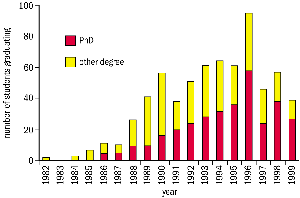
The distribution of the students reflects the resources given to DELPHI by the respective countries (and refers to the university to which the student is attached rather than their nationality). The attraction of DELPHI for students also increased once the experiment began running (figure 2).
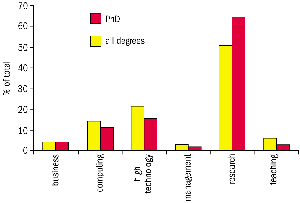
There were seven identifiable career outlets (figure 3):
* research: public-funded jobs in universities and research centres;
* teaching in schools and in universities where there is no research activity;
* computing and simulation, mainly in the private sector;
* management in public administration, the private sector and consultancy;
* business, including entrepreneurs and start-ups, but excluding computing and related activities;
* high technology: electronics and other specialized industries;
* graduate school: further education, but not with the DELPHI experiment.
The 19 different nationalities active in DELPHI in many cases have very different traditions. In certain countries (notably France), choosing to follow a doctoral programme in fundamental research implies a commitment to this as a career. In other countries, for example Germany and Italy, the situation is much more open. Here, the skills acquired in the course of thesis work in high-energy physics can be more important than the topic of the thesis.
Working in high-energy physics at CERN means a certain level of dedication, but it is nevertheless striking how most of the students continue with research, at least for an initial period of a few years. Determining whether ex DELPHIers continued with research later was not so easy, as it is difficult to keep track of students’ progress once they have left their degree-awarding institute.
However, a subsample of 158 ex-students in Austria, Germany, Italy, the Netherlands, Norway, Portugal and the UK revealed a subsequent migration out of research to positions in business, high technology and computing. Assuming that this trend is valid for the whole sample gives the result shown below. This shows that about 50% of students eventually leave research for fast-developing sectors of their national economies.
Comparing data collected in 1996 with those in 2000 shows that physics students have become valuable. With job offers already on the table, they are having to wrap up their thesis work in a hurry.
Career moves after first employment
Career category [All degrees(%), PhD(%)]
high technology 24.4, 19.5
computing 15.7, 13.8
business 7.0, 6.4
management 2.8, 1.9 total private
sector 49.9, 41.6
research 44.3, 55.5
teaching 5.8, 2.9 total public sector 50.1, 58.4
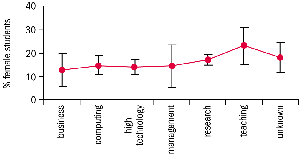
Women make up about 20% of the students involved in the DELPHI experiment today, and, although this has moved down from an all-time high of 30% in 1998, there has been a marked increase over the years. Their initial post-DELPHI job is shown in figure 4. The pattern closely matches that of the overall statistics.
While the study shows that research at an international level is clearly a stimulating environment, most of the students choose not to follow this career path for life. However, whatever they do go on to do, their stay at CERN certainly played a major role.
by Dan Green, Cambridge Monographs on Particle Physics, Nuclear Physics and Cosmology, 361 pp, 0 521 66226 5, £65/$100.
The 12th volume of the Cambridge Monograph Series on Particle Physics, Nuclear Physics and Cosmology again concerns particle detectors. In this case the main emphasis is not on the construction of these devices but rather on the underlying physics.
Dan Green has worked in particle detection and identification in many laboratories – from Stony Brook to the ISR, and from Fermilab to the preparation of LHC experiments.
The book begins with a recollection of the size and energy scales involved in different physical processes. The order of magnitude of atomic and nuclear processes is explained by fundamental physics principles and illustrated using everyday examples. The introductory chapter provides the basic numerical data needed to characterize the interaction probabilities of different particle species.
The main body of the book is subdivided into non-destructive measurements, such as time, velocity, ionization, position and momentum measurements, where the interaction of the incident particle transfers very little energy to the detecting medium; and destructive techniques, such as electron and hadron calorimetry, where the lost energy is a significant fraction of the kinetic energy carried by the particle. Characteristic features of different detectors are partially derived using dimensional arguments. For practical operations, rules of thumb are provided.
All of the methods presented aim to identify the incident particles, a goal that can often only be achieved by combining different techniques. Such a complete set of measurements is presented in the final chapter, using the example of a general-purpose detector.
The author successfully explains the operation of each type of detector from first principles, without rigorously deriving the theoretical background. Readers interested in the theory are referred to the appendices.
The presented applications of particle detectors are illustrated with many numerical examples, which clearly show that Green has “hands-on” experience in constructing and optimizing these devices. Some of the home experiments, however, like deflecting the electron beam of a TV set with a permanent magnet, should be treated with caution. This is fine on a black-and-white screen but can produce irreversible damage on a colour TV.
Various interaction processes are visualized using bubble and cloud chamber events, although these old-fashioned detectors are not described in detail. There is no mention of nuclear emulsions, and very little on neutrino interactions, even though the search for neutrino oscillations and the first direct observation of the tau neutrino have demonstrated that exotic and rare processes can breathe new life into old technologies. There is certainly some demand for the basics of neutrino interactions from the growing number of experiments in astroparticle physics.
Many of the instructive diagrams are taken, with good reason, from the relevant chapters of the excellent Review of Particle Physics by the Particle Data Group.
This book presents an attractive and comprehensive introduction to the physics of particle detection. The reader is guided by practical examples from everyday experience. It will be of interest to physics students and will also be a valuable reference for the experienced detector builder. The design of actual particle detectors may be subject to change over the coming years, but the underlying physics principles will stay the same. The book will thus remain useful for some time. The publishers should also be encouraged to issue an affordable paperback edition.
Wolfgang Pauli – long the “conscience of physics” – was professor at ETH-Zürich for 30 years, from 1928 to 1958, except during the Second World War, when he was at Princeton at the Institute for Advanced Study. To honour his centenary, the ETH Library organized a special exhibition, which was first presented at ETH Zürich in April and May.
The exhibition, which beautifully illustrates Pauli’s life, has now moved to CERN where it is on display in the Main Building from 17 August until 26 September. A ceremony in the Council Chamber on Monday 11 September at 4.30 p.m. will include short presentations from Maurice Jacob (chairman of the Pauli Committee), Konrad Osterwalder (Rektor of the ETHZürich), Luciano Maiani (director-general of CERN) and Charles Enz (University of Geneva) on Pauli’s life and legacy.
It is natural that CERN honours in this way one of the greatest physicists of the past century. Pauli acted as custodian of intellectual integrity while the field underwent tremendous development. He discovered the Exclusion Principle, which he formulated in 1924 and for which he was awarded the Nobel prize in 1945. He predicted the existence of the neutrino in 1930. However, he first became known through the publication of his famous 1921 review on relativity, when he was a student of Arnold Sommerfeld’s. Many physicists, including Einstein, much admired this article, later reprinted as a book.
After the centenary exhibition, the next Pauli milestone will be the publication of the authoritative biography by Charles Enz. This should be complete in 2002, “in phase” with the completion of the Herculean task of publishing Pauli’s scientific correspondence.
Wolfgang Pauli left an imposing scientific correspondence. At a time when private correspondence, rather than preprints and e-mail, was instrumental in discussing and maturing ideas, his advice was often solicited and given on many key issues. Pauli maintained a prolific correspondence with the greatest physics minds of his time – Einstein, Bohr, Heisenberg and many others – amounting to several thousand letters.
This correspondence is a mine of information on the development of theoretical physics and is of great value both to physicists interested in history and to historians interested in modern physics. Most of the letters deal with topical physics questions, but they also reflect Pauli’s great interest in philosophy and psychology.
After her husband’s death, Mrs Franca Pauli, helped by Charles Enz, Pauli’s last scientific assistant, began to sort out and administer this scientific legacy and invited friends and colleagues of Pauli to send copies of scientific correspondence. Mrs Pauli relied on the advice and help of Victor Weisskopf, who had been one of Pauli’s first assistants at ETH Zürich and was soon to become director-general of CERN.
In August 1960 Mrs Pauli made a first deed of gift to CERN on behalf of her late husband’s estate. After Mrs Pauli’s death in July 1987, all author rights as well as inherent legal financial claims from the scientific work of Pauli were transferred to CERN. A second formal deed of gift was made in November 1971.
Thus, while CERN has the privilege of being the home of the Pauli Archive – scientific books, reprints, correspondence, manuscripts and photographs, as well as his Nobel Prize and other awards – it also has copyright on all hitherto unpublished works of Pauli and had to assume responsibility for publishing the scientific correspondence. CERN signed a contract with Springer-Verlag for the publication of this correspondence.
The Pauli Committee
After Weisskopf’s mandate as CERN director-general (1961-1965), the responsibility for the Pauli Archive was assigned to a committee chaired by the new director-general, Bernard Gregory. Responsibility for looking after the collection passed to CERN’s Scientific Information Service (including the CERN library).
Weisskopf remained a member of the Pauli Committee, chaired by successive director-generals, until Leon Van Hove was mandated by Herwig Schopper to retain chairmanship of the committee after Van Hove left his director-general position in 1981. I succeeded Van Hove as chairman when he retired from CERN in 1989. My successor is Gabriele Veneziano.
The Pauli Committee was reorganized in 1985. Charles Enz from the University of Geneva joined, shortly followed by H Primas of ETH-Zürich and me, as CERN representative. CERN archivist Roswitha Rahmy was nominated to represent the Scientific Information Service and to look after the collection. This task has been inherited by Anita Hollier.
In 1997 Enz and Primas retired from their university posts and left the committee. They were replaced by W Amrein of Geneva and K Osterwalder of ETH-Zürich. K von Meÿenn had then already joined the committee and R Mumenthaler joined more recently to strengthen the links with the ETH library.
The committee has only one formal meeting per year. Until 1997 this took place when Weisskopf returned to the Geneva area for a traditional vacation.
As well as the archive, CERN has its Pauli Room, where many memorabilia and books are kept. Scholars are welcome to use the archive but there are some restrictions on publishing under their name material that includes extensive quotes from unpublished material.
Another important Pauli collection is in the “Pauliana” archive of the ETH-Zürich Library. This too includes much Pauli correspondence, in particular with Markus Fierz, Carl Jung and Marie-Louise von Franz.
Nevertheless, much Pauli correspondence is still scattered and is being patiently located and retrieved by editors. Recently, many letters have been found in the Oppenheimer files at Princeton and in the Jauch files in Geneva.
The Pauli Committee first concentrated on publishing scientific correspondence. This will eventually consist of four volumes: Wolfgang Pauli, Wissenschaftlicher Briefwechsel mit Bohr, Einstein, Heisenberg u.a. (Scientific Correspondence with Bohr, Einstein, Heisenberg, a.o.), published by Springer-Verlag.
The letters are printed in their original version, dominantly in German to start with but later with increasing use of English. Volume 1, published in 1979 and edited by A Hermann, K von Meÿenn and V Weisskopf, covers 1919 1929 and brings together 242 letters. Volume 2, published in 1985 with K von Meÿenn as editor, includes 364 letters from 1930-1939 together with 15 letters from the preceding period, which were subsequently retrieved. Volume 3, also edited by K von Meÿenn, covers 1940-1949. It includes 486 letters together with 67 from the preceding period. Volumes 1, 2 and 3 include more than 1000 letters.
Volume 4, also edited by K von Meÿenn, covers 1950-1958 and will include more than 2000 letters. It was therefore deemed appropriate to publish it as four separate books. The first, covering 1950-1952, appeared in 1996. It puts together close to 450 letters and bears witness to a new trend – about 100 letters refer to questions of psychology. The second book (1100 pages) came out in 1998. Covering 1953-1954, it includes about 450 letters, 50 of them concerning psychological matters. The third (1955-1956) will appear at the end of this year. The impressive editorial work of K von Meÿenn is recognized this year by the award of the Marc-Auguste Pictet medal.
Pauli and psychology
The inclusion of letters dealing mainly with psychology within the scientific correspondence was much debated by the committee. The scientific publications of Pauli are presented in strictly scientific terms and make no reference to any influence of the psyche in theoretical physics. Nevertheless, Pauli was convinced that science was unable to provide all of the answers.
He was deeply interested in psychology and in particular in the significance of dreams. Dreams were precious guides to him. It was therefore considered proper that the publication of his scientific correspondence should reveal the thinker as a whole and not only the physicist, providing clues about how Pauli reached his ideas, as well as articulating and presenting them in purely logical and analytical arguments.
Despite the interest and value of all of this material, sales are limited and a reasonable price for the books does not cover all costs. It was fortunate that the long-time editor, K von Meÿenn, could be supported for many years by the Deutsche Forschungsgemeinschaft, with extra support provided by the Max Planck Gesellschaft. After a stopgap solution provided by CERN, this support has continued, thanks to the Swiss National Fund and then the ETH. Support to cover part of the publication costs was provided by the Swiss National Fund and later by the Deutsche Forschungsgemeinschaft. This help, which we hope will continue until the end of publication of volume 4, is greatly appreciated. It is one of the tasks of the committee to assure it.
The psychological correspondence of Pauli culminated in his long exchange of letters with C G Jung from 1932 to 1958. This reveals an hitherto poorly known facet of Pauli’s mind. It is fascinating to follow how these two intellectual giants argue from different sides to find mutual enlightment.
This correspondence has been published as Wolfgang Pauli and C G Jung – Ein Briefwechsel 1932-1958. This collection of letters was brought together by C A Meier, with the help of C Enz and M Fierz, and it was first published by Springer-Verlag in 1992. This caters for a rather wider audience and there was no need to engineer additional finance. Sales have even warranted a second print run.
This correspondence is published in the original German, but translations into English (Routledge, London and Princeton University Press), French (Albin Michel, Paris) and Spanish (Alienza Editorial, Madrid) are now available.
This interest prompted a special symposium, held at Monte Verita, Ascona, in June 1993. Its proceedings include the first publication of a remarkable essay by Pauli in which dreams and physics are intertwined. This is The Piano Lesson (Die Klavierstunde), a long letter to Mrs von Franz. The proceedings of the meeting – Der Pauli Jung-Dialog und seine Bedeutung für die moderne Wissenschaft – have been published by Springer-Verlag (1995). The editors are H Altmanspacher, H Primas and E Wertenschlag-Birkhäuser.
Pauli’s deep and brillant grasp of epistemology and the philosophy of science is clearly displayed in the collection of essays Aufsätze und Vorträge über Physik und Erkenntnistheorie, published by Vieweg, Braunschweig in 1961, and in the article “Der Einfluss archetypischer Vorstellungen auf die Bildung naturwissenschaftlicher Theorien bei Kepler”, written with C G Jung, which appeared in Naturerklärung und Psyche, first published by Rascher Verlag, Zürich, in 1952. The latter shows Pauli’s great interest in the archetypes (in the Jungian sense) of Kepler.
Under the auspices of the Pauli Committee, these two publications have been put together in an English translation as W Pauli, Writings on Physics and Philosophy, published by Springer-Verlag in 1992, with editorial work by C Enz and K von Meÿenn and a short Pauli biography by C Enz. They benefited from the careful but unused English translation by R Schlapp, which was made during Pauli’s lifetime. Translations into French, Spanish and Japanese are in progress. In all cases the Pauli Committee insisted that these translations should follow the German originals and not rely on the more readily available English translation.
A separate publication of correspondence between Pauli and Arnold Sommerfeld is now under way as a Deutsche-Forschungsgemeinschaft project.
The expenses of the archive, referencing and preparation for publication are met by the modest income from translation rights. The committee was also glad to support in this way the publication of a volume bringing together the “Schulrat” papers and minutes related to Pauli’s professorship at ETH, once they became publicly available. This ETH Schulratsakten/Pauli, published by ETH-Hochschulverlag, is edited by C Enz, B Glaus and G Oberkofler from the University of Innsbruck Archives. The committee could also help with the publication of a booklet associated with the Pauli centenary exhibition.
The Pauli Committee hopes that all of these endeavours will make for a better understanding and knowledge of the many aspects of a great mind that played such a leading role in the development of modern physics.
To provide the best experiences, we use technologies like cookies to store and/or access device information. Consenting to these technologies will allow us to process data such as browsing behavior or unique IDs on this site. Not consenting or withdrawing consent, may adversely affect certain features and functions.
Functional
Always active
The technical storage or access is strictly necessary for the legitimate purpose of enabling the use of a specific service explicitly requested by the subscriber or user, or for the sole purpose of carrying out the transmission of a communication over an electronic communications network.
Preferences
The technical storage or access is necessary for the legitimate purpose of storing preferences that are not requested by the subscriber or user.
Statistics
The technical storage or access that is used exclusively for statistical purposes.The technical storage or access that is used exclusively for anonymous statistical purposes. Without a subpoena, voluntary compliance on the part of your Internet Service Provider, or additional records from a third party, information stored or retrieved for this purpose alone cannot usually be used to identify you.
Marketing
The technical storage or access is required to create user profiles to send advertising, or to track the user on a website or across several websites for similar marketing purposes.