Bluefors – leaderboard other pages

Topics

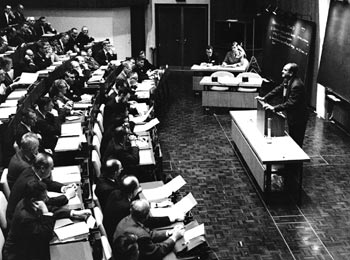
Amsterdam hosts ICHEP conference

“Brilliant work by many people has resulted in an extraordinarily profound, precise description of the physical world,” concluded Frank Wilczek of MIT, in summarizing the 31st International Conference on High-Energy Physics in Amsterdam. “Because of this we can ask, and formulate plans to answer, some truly awesome questions.” Examples of new high-precision results presented at the conference included the measurements of the mass and width of the W boson at LEP and the Tevatron; the strong coupling constant at HERA and LEP; and CP violation in B mesons from the BaBar and Belle experiments, which Yossi Nir from the Weizmann Institute described in terms of the first successful precision test of the Kobayashi-Maskawa mechanism of CP violation. A full report of the conference will appear in next month’s issue of CERN Courier.

New particle data

The 2002 edition of the Review of Particle Physics appears in the 1 July edition of Physical Review D (K Hagiwara et al. 2002 Phys. Rev. D 66 010001). Full details and ordering information for the review and the accompanying particle physics booklet are available at http://pdg.lbl.gov/ and its mirror sites around the world.

ESO reaches 40

The European Southern Observatory (ESO) celebrates its 40th anniversary on 5 October. Next month, Astrowatch will report on the proceedings and focus on the important contributions of ESO astronomy.

CANDLE set to light up Armenian science

cernnews4_10-02

Originally in the running to host SESAME, Armenia launched its own synchrotron project when Jordan was chosen as the location for the Middle Eastern regional facility. Championed by the Armenian-American property magnate, Jirair Hovnanian, the Centre for the Advancement of Natural Discoveries using Light Emission (CANDLE) project aims to build a 3 GeV third-generation light source from scratch in the Armenian capital Yerevan. If successful, it will be the only facility of its kind within a 2000 km radius, serving users from countries of the former Soviet Union, parts of Europe, the Middle East and Asia. The Armenian government has provided an office building and 20 ha of land.

CANDLE received an important boost earlier this year when the US State Department allocated $500 000 (€510 000) for the preparation of a technical design report. This report was presented for review by the US National Science Foundation in Washington in August, along with details of scheduling, international participation and scientific programme. Riding on the outcome of the review could be a $15 million injection of US foreign aid towards CANDLE’s projected $48 million price tag. If funding is secured, CANDLE’s director, Alexander Abashian, is hopeful that construction could begin in 2004, allowing the first beamlines to be operational by 2007.

High-Energy Particle Diffraction

by Vincenzo Barone and Enrico Predazzi, Springer Verlag 2002, ISBN 3540421076, €74.95 plus local VAT.

4B56696D677C7C32323634393836347C7C434F504C

Diffraction has played a fundamental role in physics for centuries, beginning with the realization of the wave nature of light. Given the wave-particle duality of quantum mechanics (QM), diffraction continued to be an important concept in non-relativistic QM scattering, and later in the study of elementary particle scattering using relativistic S-matrix theory.

For some decades after 1950, a vast experimental and theoretical effort went into the study of high-energy elastic and diffractive scattering of elementary particles, culminating in the largely unexpected discovery that cross-sections grow with energy. Being essentially non-perturbative processes, theory could not provide a really detailed description of elastic and diffractive scattering, but it did introduce a new idea that is truly fundamental. This new idea was the concept of complex angular momentum in non-relativistic QM (now a vital component in any serious book on QM) and its connection with the behaviour of relativistic scattering amplitudes at high energy. This led to the theory of Regge poles, which enjoyed enormous success in correlating the data on many reactions, though it also experienced some failures. Terms like Regge pole, pomeron and reggeon became household words. (A non-physicist spouse, upon being introduced to Tulio Regge at a party in the 1960s, is reported to have said: “Ah, Mr Pole, I have heard so much about you.”)

The discovery of the partonic structure of hadrons and the advent of quantum chromodynamics (QCD) led to a dramatic change in the thrust of experimental high-energy physics, away from the study of elastic and diffractive scattering. Because of its property of asymptotic freedom, QCD was able to predict interesting correlations between experimental data in certain kinematical regions characterized by a hard scale. Consequently, a huge effort has gone into the study of such deep inelastic reactions.

But history, according to the Italian philosopher Vico, is supposed to be cyclical. So we should not be surprised to learn that there is a connection between certain aspects of deep inelastic reactions and Regge concepts, and that the relatively new field of hard diffraction opens up the possibility of a bridge between Regge theory and QCD (leading, one hopes, to an understanding of Regge theory in the language of QCD).

Unfortunately, the concepts and language of Regge theory have largely fallen into disuse, so that several generations of young physicists, whose education had a lacuna in this field, now find themselves working on experiments in which such concepts are of importance. It is for these lost generations, and, of course, for the present generation of elementary particle physicists that this volume will be of great value. It manages to succinctly introduce all the important ideas in the Regge theory of diffraction (now referred to as soft diffraction) and attempts to connect these to the recent developments in hard diffraction and its interpretation in the framework of QCD.

There are three main sections to this book. The first offers a rapid but clear survey of scattering theory in both classical wave optics and non-relativistic QM. It also includes a discussion of the eikonal approximation, which plays a major role in later chapters, when attempting to understand the high-energy behaviour of very complex QCD Feynman diagrams. A chapter on relativistic kinematics introduces the concepts of rapidity and rapidity gaps, the latter being the current focus of intense experimental study in lepton-hadron deep inelastic scattering (DIS).

The second part of the book surveys concisely the old soft diffraction from the “golden age” of Regge theory. Here the emphasis is on those aspects of theory and experiment that are directly relevant to the present-day resurgence of interest in diffraction – i.e. to the diffractive aspects of hard interactions. The essential ideas of dispersion relations, Muller’s generalization of the optical theorem to inclusive reactions and the key, rigorous theorems on permissible growth with energy of cross-sections are presented. Also discussed is the Pomeranchuk theorem relating particle-particle to particle-antiparticle asymptotic cross-section growth, but, surprisingly, no attention is drawn to the optics-diffraction motivation for the key assumption in the proof of this “theorem”.

The reasons for introducing complex angular momentum, crucial in the development of Regge theory, are simply and convincingly explained, and there follows an intelligible treatment of diffractive dissociation, the triple Regge limit (relevant to contemporary experiments), and how Regge theory can emerge from a field theoretic point of view. The latter is one of the most challenging issues in the study of perturbative QCD.

This section ends with a chapter devoted to the phenomenology of soft diffraction, summarizing cross-section growth, diffraction peaks and diffractive dissociation. The successful description of the energy behaviour of cross-sections in terms of Regge poles and the soft pomeron (that has an intercept of approximately 1.08) is emphasized. Included is a brief mention of the odderon, the intriguing object that seems to emerge from QCD and would be responsible for the breaking of the Pomeranchuk theorem, giving rise to a difference asymptotically between particle-particle and particle-antiparticle reactions.

The third section, about half of the book, is addressed to the relatively new subject of hard diffraction, which is currently under intense experimental study at DESY’s HERA collider and Fermilab’s Tevatron, and will be pursued at Brookhaven’s RHIC and the LHC at CERN. This is a difficult subject. The theoretical approaches involve very complex and subtle calculations requiring the summation of an infinite series of Feynman graphs. The phenomenology is difficult to describe. The kinematic specification and experimental isolation of the class of events one wants to study is highly non-trivial and technically complex.

This final section begins with the theory of the BKFL equation, a perturbative treatment of generalized two-gluon exchange – summed to all orders in leading logarithmic approximation (LLA) – in parton-parton scattering. This leads to the conclusion that the gluon itself “reggeises”, i.e. it behaves as a Regge pole and, perhaps more dramatically, that a pomeron-like object – the hard pomeron – emerges to control the high-energy behaviour of parton-parton scattering with an intercept of about 1.5. Perturbation theory breaks down in the range of small momentum transfer where the soft pomeron is operative, so it is not clear whether there is any incompatibility with the hard QCD pomeron. Unfortunately, studies going beyond the LLA appear to change the intercept appreciably and the full story remains untold.

After this challenging chapter we are offered a gentle introduction to lepton-hadron DIS and then led to the intriguing question of the behaviour of the structure functions at very small Bjorken-x. Here the soft pomeron, the QCD hard pomeron and the small-x behaviour of the DGLAP evolution equations confront each other. The theoretical aspects seem, unavoidably, to be complicated.

The last two chapters are devoted to the new field of hard diffraction, first the phenomenological aspects, mainly in DIS, where the topology of rapidity gaps, the concept of diffractive structure functions and parton densities, and the partonic structure of the pomeron are explained. There is also a brief description of single and double diffraction in hadron-hadron collisions. In the final chapter the BFKL version of the hard pomeron and the colour dipole picture of a highly virtual photon are used to derive theoretical predictions for various hard diffractive reactions. Many processes of current interest are covered: jets in diffractive DIS, diffractive production of open charm and vector mesons, nuclear shadowing, colour transparency and the cross-section for g* g * scattering.

High-Energy Particle Diffraction offers a comprehensive survey of the theoretical and experimental sides of one of the major areas of study in current elementary particle physics. It provides essential background information for younger physicists who were not taught about soft physics and Regge theory, and for those who were it is a helpful bridge to the newer area of hard diffraction. This book is not easy going. Some of the theoretical approaches are inherently very complex and, despite the efforts of the authors, remain an intellectual challenge. This is somewhat exacerbated by a large number of typographical errors, which will hopefully be rectified in the second edition.

Modern Cosmology

edited by S Bonometto, V Gorino and U Moschella, IOP Publishing Ltd 2002, ISBN 0750308109, £75 (`€118).

9780429140020

Cosmology has become a phenomenological science where large amounts of data from a host of precise experiments are being contrasted every day with concrete theoretical ideas about the early universe, based on general relativity and high-energy particle physics. Until recently, this happy situation was only envisioned as a dream in the minds of a few.

This book is a heterogeneous compilation of articles based on lectures, mostly from theorists, describing both the foundations and the present status of cosmology. The lectures were given in the spring of 2000, at a doctoral school in Como, Italy. Unfortunately, as with any science in rapid progress, the book has become quickly outdated. Some of the authors, like Piero Rosati, still write the standard formulae of luminosity and angular diameter distances as a function of redshift assuming zero cosmological constant, two years after the discovery of the acceleration of the universe by the Supernova teams. Others, like Rita Bernabei (for dark-matter searches with the DAMA experiment) or GianLuigi Fogli (for neutrino masses and mixings) describe experimental results that are obsolete or outdated, given the great advances that these fields have made in the past two years (thanks to Edelweiss and the Sudbury Neutrino Observatory, respectively). The same applies to the chapter on galaxy clusters and large-scale structure (LSS), or the one on the anisotropies of the cosmic microwave background (CMB), where the Sloan Digital Sky Survey and the Two Degree Field Galaxy Redshift Survey for LSS, and BOOMERANG, MAXIMA, CBI and VSA for CMB, have revolutionized their respective fields since the spring of 2000.

However, the reviews by John Peacock on the physics of cosmology, Arthur Kosowsky on the microwave background, Antonio Masiero on dark matter and particle physics, Philippe Jetzer on gravitational lensing and Andrei Linde on inflation, are very up to date and enlightening. They are a pleasure to read and may be extremely useful to PhD students and even researchers in other fields. The reviews of George Ellis on cosmological models, and Renata Kallosh on supergravity are somewhat technical and are probably beyond the level of doctorate students. On the other hand, I miss some discussion on gravitational waves, the Sunyaev-Zeldovich effect and perhaps even ultra-high-energy cosmic rays.

In summary, I think the book is a nice compilation of the status of cosmology in the year 2000. It gives the right perspective of what is to come in the next few years, or even decades, with inflationary cosmology as the early universe paradigm at the heart of a standard cosmological model, connecting astrophysics with high-energy particle physics.

Space Radio Science

by Oleg I Yakovlev, Taylor & Francis 2002, ISBN 0415273501, £60 (€94).

cernbooks1_10-02

The twinkling of radio sources due to propagation effects is a nuisance most of the time, and radio astronomers try hard to remove these effects and sharpen up their radio maps. However, the scintillation can also be used in a positive way to probe conditions in the Earth’s atmosphere and ionosphere, the interplanetary medium, the solar wind and the interstellar medium. For example, regular monitoring of the scintillations of extragalactic radio sources is now used to map out the interplanetary weather and the solar wind on a daily basis.

Artificial Earth satellites and deep-space probes have opened up even more elegant possibilities for remote sensing of planetary atmospheres and ionospheres and the solar wind. Satellites have many advantages compared with natural radio sources, as they are truly point-like and can transmit coherent monochromatic signals at several frequencies. Professor Yakovlev has devoted most of his scientific life to devising and interpreting such experiments. This extended monograph gathers together many of the insights he has gained, and provides a graduate-level introduction to this fascinating field of radio science. The book includes an extensive bibliography covering the period 1960-1999.

Chapter 1 starts with the basic physics of radio propagation through the Earth’s atmosphere and ionosphere between ground stations and spacecraft, and ends with the topical subject of ionospheric tomography, in which satellite systems (such as GLONASS and GPS) transmitting coherently at several frequencies are observed simultaneously from different locations on the ground. This is a powerful tool for studying the ionosphere.

Professor Yakovlev’s speciality, radio occultation studies, comes next. Reading between the lines I could glimpse the excitement of some of the early experiments. For example, the atmosphere of Venus is so thick that radio waves passing within 40 km of the surface are refracted by 6°, while waves that try to pass within 34 km of the surface of the planet suffer critical refraction and are captured. The radio occultation studies of the giant planets Jupiter, Saturn, Uranus and Neptune by the Pioneer and Voyager probes are outstanding achievements of space science in the 20th century. The same techniques have also been used to study the very rarefied plasmas around smaller bodies, including Halley’s Comet. Nearer to home, experiments between Mir and a geostationary satellite have demonstrated exciting possibilities for global monitoring of the Earth’s atmosphere using satellite-to-satellite paths at several frequencies.

The core of the book covers radio sounding of the solar wind and the interplanetary plasma. By ingenious application of the techniques already expounded, Yakovlev explains how to measure the scale sizes and velocities of irregularities in the solar wind, the magnetic field, how to study magnetosonic and Alfven waves, and much more. The book then changes direction slightly to deal with radar observations of planets, asteroids and comets, including detailed treatments of scattering from a rough surface, back scattering, effects of planetary rotation, bistatic radar experiments and sideways-looking synthetic-aperture radar. Finally there is a short, and to me disappointing, chapter covering basic principles for interstellar radio communications. This is fairly standard material, presented without the unique insights that make the rest of the book so much more interesting. Russian space probes have been monitored at Jodrell Bank since the early 1960s. Many of us wondered exactly what was going on up in Lab 5, and what became of the large number of data tapes forwarded to Russia. With the arrival of this book on my desk things have become clearer to me. I have enjoyed learning from an expert guide the joys of watching the signals twinkle and fade as spacecraft pass behind a planet.

Committee affirms LHC as global priority

cernnews1_9-02

Following the funding shortfall for CERN’s Large Hadron Collider (LHC) that emerged last September, the laboratory established five task-forces to examine ways of redeploying resources to the new accelerator. In parallel, the laboratory’s governing body, Council, established an External Review Committee (ERC) under the chairmanship of Robert Aymar, director of the International Thermonuclear Experimental Reactor. The task-force recommendations were presented to Council in March, and form the basis of a medium-term plan that was submitted to Council for approval in June. Elements of the plan include a cutback in the ongoing research programme (with the Proton Synchrotron and Super Proton Synchrotron accelerators shutting down for all of 2005), redeployment of personnel to the LHC, new accounting and reporting measures and a reduction in accelerator R&D.

The ERC presented its final report to the June meeting of Council. Covering immediate measures to resolve the current problems as well as structural changes for the longer term, the report’s recommendations were accepted by Council as a well balanced set of measures for the future of CERN. Council noted the coherence between the ERC’s recommendations and the management’s medium-term plan, issuing a statement saying that it “believes that the ERC report and the management proposals are an important step towards solving the problems identified and re-establishing an atmosphere of trust”.

In its report, the ERC found CERN to be a laboratory “justifiably proud of its past success and of its worldwide reputation” – success that “speaks loudly for its permanent asset: a competent and dedicated staff”. The committee also found that “the technical basis of the LHC accelerator is sound”, and affirmed that the LHC is “the worldwide priority in high-energy physics: the support to CERN for this objective will not fade out”. However, the ERC did find that the crisis that became apparent last year arose from “serious weaknesses… in cost awareness and control, as well as in contract management and financial reporting”.

The report makes various recommendations to improve financial procedures at CERN, including a transition to “earned value” reporting and to integrated personnel and materials accounting, which are currently treated separately. The ERC also looked at non-LHC related scientific activities at CERN and recommended a significant transfer of staff to the LHC.

CERN’s management is now preparing an action plan and timetable for the detailed implementation of the ERC’s recommendations for presentation to Council this month. The management will also prepare, for Council in December, a proposal for the revision of the 1996 financial framework for the LHC, with the completion of the LHC as the all-out priority in the years to come. This revision will include the cost-to-completion for the LHC project, the resources for the non-LHC programme and a new long-term financial framework and staff plan for the organization.

With a clear convergence between the ERC and CERN management, the June meetings of the laboratory’s Council ended in an atmosphere of renewed confidence in the laboratory’s ability to deliver the LHC, and in its long-term future. This was underlined by Council’s approval of an expenditure figure of SwFr 1217 million (€ 840 million) for 2003 and the release of SwFr 33 million from the 2002 CERN budget that had been frozen pending clarification of LHC funding issues.

Canada steps onto the international stage

cernnews2_9-02

Canadian particle physics received a boost earlier this year when the Canadian Foundation for Innovation announced support for nine infrastructure projects for international research. These include two projects in particle physics – a new International Facility for Underground Science and the KOPIO experiment. The nine projects, which are aimed at promoting Canada’s position in scientific research, were selected by a national competition with input from international experts.

The International Facility for Underground Science will be based at the site of the Sudbury Neutrino Observatory (SNO) at the Creighton mine in Ontario. Here the intention is to expand the site to become a facility for further experiments, in particular with international participation. Its administrative centre will be at Carleton University.

The aim of the KOPIO project, in which Canadian physicists are playing a leading role, is to use the Alternating Gradient Synchrotron at the Brookhaven National Laboratory to create an intense beam of kaons for the study of very rare decays, which can provide a window into the small differences between matter and antimatter.

German Science Council endorses TESLA

cernnews3_9-02

On 15 July 2002 the German Science Council published its evaluation of large-scale facilities for basic research in natural science. The council gave the TESLA superconducting linear electron-positron collider, planned by Hamburg’s DESY laboratory and a host of international partners, a strong nod of approval, deeming the project to be worthy of support subject to a number of conditions. The council requested a detailed proposal for TESLA to include the vital aspect of international participation, and requested a revised technical proposal for the TESLA X-ray laser based on a separate linear accelerator. In its statement the council stressed that TESLA is a world-leading development test-bed for superconducting linear accelerators, RF components and linac-driven free electron lasers, and that the technical aspects of the project have reached a high degree of maturity.

Development work for the TESLA project is currently being carried out within a large international collaboration under the overall leadership of DESY. Some 45 institutes from 11 countries are involved in developing and testing the TESLA accelerator and free electron laser technology. According to the TESLA Technical Design Report, published in March 2001, TESLA would be constructed as a linear collider with integrated X-ray lasers – two 15 km linear accelerators would face each other in a 33 km tunnel. Particle physics experiments would be located in the middle of the facility, while the electron accelerator would also serve as a driver for X-ray free electron lasers (X-FEL).

In October 2001 an option was added to the proposal according to which a separate linear accelerator would be built for the X-FEL to avoid direct coupling with the linear collider, thus bringing increased planning and operation flexibility. The separate linear accelerator for the X-FEL would be set up in an additional 5 km tunnel parallel to the main accelerator.

The German Science Council’s endorsement of the TESLA project brings with it a strong vote of confidence for particle physics and for a future linear collider. Along with the Japan Linear Collider and the US-based Next Linear Collider, TESLA is one of three projects preparing for such a machine. Particle physicists around the world are broadly united in the belief that a linear collider is the next logical step for particle physics to follow CERN’s Large Hadron Collider. For DESY in particular the endorsement is an important landmark, because it gives the laboratory the encouragement to try to build international support around its TESLA proposal.

bright-rec iop pub iop-science physcis connect