edited by S Bonometto, V Gorino and U Moschella, IOP Publishing Ltd 2002, ISBN 0750308109, £75 (`€118).
Cosmology has become a phenomenological science where large amounts of data from a host of precise experiments are being contrasted every day with concrete theoretical ideas about the early universe, based on general relativity and high-energy particle physics. Until recently, this happy situation was only envisioned as a dream in the minds of a few.
This book is a heterogeneous compilation of articles based on lectures, mostly from theorists, describing both the foundations and the present status of cosmology. The lectures were given in the spring of 2000, at a doctoral school in Como, Italy. Unfortunately, as with any science in rapid progress, the book has become quickly outdated. Some of the authors, like Piero Rosati, still write the standard formulae of luminosity and angular diameter distances as a function of redshift assuming zero cosmological constant, two years after the discovery of the acceleration of the universe by the Supernova teams. Others, like Rita Bernabei (for dark-matter searches with the DAMA experiment) or GianLuigi Fogli (for neutrino masses and mixings) describe experimental results that are obsolete or outdated, given the great advances that these fields have made in the past two years (thanks to Edelweiss and the Sudbury Neutrino Observatory, respectively). The same applies to the chapter on galaxy clusters and large-scale structure (LSS), or the one on the anisotropies of the cosmic microwave background (CMB), where the Sloan Digital Sky Survey and the Two Degree Field Galaxy Redshift Survey for LSS, and BOOMERANG, MAXIMA, CBI and VSA for CMB, have revolutionized their respective fields since the spring of 2000.
However, the reviews by John Peacock on the physics of cosmology, Arthur Kosowsky on the microwave background, Antonio Masiero on dark matter and particle physics, Philippe Jetzer on gravitational lensing and Andrei Linde on inflation, are very up to date and enlightening. They are a pleasure to read and may be extremely useful to PhD students and even researchers in other fields. The reviews of George Ellis on cosmological models, and Renata Kallosh on supergravity are somewhat technical and are probably beyond the level of doctorate students. On the other hand, I miss some discussion on gravitational waves, the Sunyaev-Zeldovich effect and perhaps even ultra-high-energy cosmic rays.
In summary, I think the book is a nice compilation of the status of cosmology in the year 2000. It gives the right perspective of what is to come in the next few years, or even decades, with inflationary cosmology as the early universe paradigm at the heart of a standard cosmological model, connecting astrophysics with high-energy particle physics.
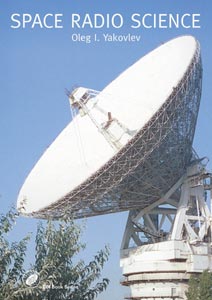
The twinkling of radio sources due to propagation effects is a nuisance most of the time, and radio astronomers try hard to remove these effects and sharpen up their radio maps. However, the scintillation can also be used in a positive way to probe conditions in the Earth’s atmosphere and ionosphere, the interplanetary medium, the solar wind and the interstellar medium. For example, regular monitoring of the scintillations of extragalactic radio sources is now used to map out the interplanetary weather and the solar wind on a daily basis.
Artificial Earth satellites and deep-space probes have opened up even more elegant possibilities for remote sensing of planetary atmospheres and ionospheres and the solar wind. Satellites have many advantages compared with natural radio sources, as they are truly point-like and can transmit coherent monochromatic signals at several frequencies. Professor Yakovlev has devoted most of his scientific life to devising and interpreting such experiments. This extended monograph gathers together many of the insights he has gained, and provides a graduate-level introduction to this fascinating field of radio science. The book includes an extensive bibliography covering the period 1960-1999.
Chapter 1 starts with the basic physics of radio propagation through the Earth’s atmosphere and ionosphere between ground stations and spacecraft, and ends with the topical subject of ionospheric tomography, in which satellite systems (such as GLONASS and GPS) transmitting coherently at several frequencies are observed simultaneously from different locations on the ground. This is a powerful tool for studying the ionosphere.
Professor Yakovlev’s speciality, radio occultation studies, comes next. Reading between the lines I could glimpse the excitement of some of the early experiments. For example, the atmosphere of Venus is so thick that radio waves passing within 40 km of the surface are refracted by 6°, while waves that try to pass within 34 km of the surface of the planet suffer critical refraction and are captured. The radio occultation studies of the giant planets Jupiter, Saturn, Uranus and Neptune by the Pioneer and Voyager probes are outstanding achievements of space science in the 20th century. The same techniques have also been used to study the very rarefied plasmas around smaller bodies, including Halley’s Comet. Nearer to home, experiments between Mir and a geostationary satellite have demonstrated exciting possibilities for global monitoring of the Earth’s atmosphere using satellite-to-satellite paths at several frequencies.
The core of the book covers radio sounding of the solar wind and the interplanetary plasma. By ingenious application of the techniques already expounded, Yakovlev explains how to measure the scale sizes and velocities of irregularities in the solar wind, the magnetic field, how to study magnetosonic and Alfven waves, and much more. The book then changes direction slightly to deal with radar observations of planets, asteroids and comets, including detailed treatments of scattering from a rough surface, back scattering, effects of planetary rotation, bistatic radar experiments and sideways-looking synthetic-aperture radar. Finally there is a short, and to me disappointing, chapter covering basic principles for interstellar radio communications. This is fairly standard material, presented without the unique insights that make the rest of the book so much more interesting. Russian space probes have been monitored at Jodrell Bank since the early 1960s. Many of us wondered exactly what was going on up in Lab 5, and what became of the large number of data tapes forwarded to Russia. With the arrival of this book on my desk things have become clearer to me. I have enjoyed learning from an expert guide the joys of watching the signals twinkle and fade as spacecraft pass behind a planet.
Following the funding shortfall for CERN’s Large Hadron Collider (LHC) that emerged last September, the laboratory established five task-forces to examine ways of redeploying resources to the new accelerator. In parallel, the laboratory’s governing body, Council, established an External Review Committee (ERC) under the chairmanship of Robert Aymar, director of the International Thermonuclear Experimental Reactor. The task-force recommendations were presented to Council in March, and form the basis of a medium-term plan that was submitted to Council for approval in June. Elements of the plan include a cutback in the ongoing research programme (with the Proton Synchrotron and Super Proton Synchrotron accelerators shutting down for all of 2005), redeployment of personnel to the LHC, new accounting and reporting measures and a reduction in accelerator R&D.
The ERC presented its final report to the June meeting of Council. Covering immediate measures to resolve the current problems as well as structural changes for the longer term, the report’s recommendations were accepted by Council as a well balanced set of measures for the future of CERN. Council noted the coherence between the ERC’s recommendations and the management’s medium-term plan, issuing a statement saying that it “believes that the ERC report and the management proposals are an important step towards solving the problems identified and re-establishing an atmosphere of trust”.
In its report, the ERC found CERN to be a laboratory “justifiably proud of its past success and of its worldwide reputation” – success that “speaks loudly for its permanent asset: a competent and dedicated staff”. The committee also found that “the technical basis of the LHC accelerator is sound”, and affirmed that the LHC is “the worldwide priority in high-energy physics: the support to CERN for this objective will not fade out”. However, the ERC did find that the crisis that became apparent last year arose from “serious weaknesses… in cost awareness and control, as well as in contract management and financial reporting”.
The report makes various recommendations to improve financial procedures at CERN, including a transition to “earned value” reporting and to integrated personnel and materials accounting, which are currently treated separately. The ERC also looked at non-LHC related scientific activities at CERN and recommended a significant transfer of staff to the LHC.
CERN’s management is now preparing an action plan and timetable for the detailed implementation of the ERC’s recommendations for presentation to Council this month. The management will also prepare, for Council in December, a proposal for the revision of the 1996 financial framework for the LHC, with the completion of the LHC as the all-out priority in the years to come. This revision will include the cost-to-completion for the LHC project, the resources for the non-LHC programme and a new long-term financial framework and staff plan for the organization.
With a clear convergence between the ERC and CERN management, the June meetings of the laboratory’s Council ended in an atmosphere of renewed confidence in the laboratory’s ability to deliver the LHC, and in its long-term future. This was underlined by Council’s approval of an expenditure figure of SwFr 1217 million (€ 840 million) for 2003 and the release of SwFr 33 million from the 2002 CERN budget that had been frozen pending clarification of LHC funding issues.
Canadian particle physics received a boost earlier this year when the Canadian Foundation for Innovation announced support for nine infrastructure projects for international research. These include two projects in particle physics – a new International Facility for Underground Science and the KOPIO experiment. The nine projects, which are aimed at promoting Canada’s position in scientific research, were selected by a national competition with input from international experts.
The International Facility for Underground Science will be based at the site of the Sudbury Neutrino Observatory (SNO) at the Creighton mine in Ontario. Here the intention is to expand the site to become a facility for further experiments, in particular with international participation. Its administrative centre will be at Carleton University.
The aim of the KOPIO project, in which Canadian physicists are playing a leading role, is to use the Alternating Gradient Synchrotron at the Brookhaven National Laboratory to create an intense beam of kaons for the study of very rare decays, which can provide a window into the small differences between matter and antimatter.
On 15 July 2002 the German Science Council published its evaluation of large-scale facilities for basic research in natural science. The council gave the TESLA superconducting linear electron-positron collider, planned by Hamburg’s DESY laboratory and a host of international partners, a strong nod of approval, deeming the project to be worthy of support subject to a number of conditions. The council requested a detailed proposal for TESLA to include the vital aspect of international participation, and requested a revised technical proposal for the TESLA X-ray laser based on a separate linear accelerator. In its statement the council stressed that TESLA is a world-leading development test-bed for superconducting linear accelerators, RF components and linac-driven free electron lasers, and that the technical aspects of the project have reached a high degree of maturity.
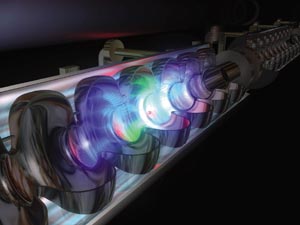
Development work for the TESLA project is currently being carried out within a large international collaboration under the overall leadership of DESY. Some 45 institutes from 11 countries are involved in developing and testing the TESLA accelerator and free electron laser technology. According to the TESLA Technical Design Report, published in March 2001, TESLA would be constructed as a linear collider with integrated X-ray lasers – two 15 km linear accelerators would face each other in a 33 km tunnel. Particle physics experiments would be located in the middle of the facility, while the electron accelerator would also serve as a driver for X-ray free electron lasers (X-FEL).
In October 2001 an option was added to the proposal according to which a separate linear accelerator would be built for the X-FEL to avoid direct coupling with the linear collider, thus bringing increased planning and operation flexibility. The separate linear accelerator for the X-FEL would be set up in an additional 5 km tunnel parallel to the main accelerator.
The German Science Council’s endorsement of the TESLA project brings with it a strong vote of confidence for particle physics and for a future linear collider. Along with the Japan Linear Collider and the US-based Next Linear Collider, TESLA is one of three projects preparing for such a machine. Particle physicists around the world are broadly united in the belief that a linear collider is the next logical step for particle physics to follow CERN’s Large Hadron Collider. For DESY in particular the endorsement is an important landmark, because it gives the laboratory the encouragement to try to build international support around its TESLA proposal.
Within the framework of the CERN-Asia Fellows and Associates programme, CERN offers three grants every year to East, Southeast and South Asia postgraduates under the age of 33, enabling them to participate in its scientific programme in the areas of experimental and theoretical physics and accelerator technologies. The appointment will be for one year, which might, exceptionally, be extended to two years.
Applications will be considered by the CERN Fellowship Selection Committee at its meeting on 28 January 2003. An application must consist of a completed application form, on which “CERN-Asia Programme” should be written; three separate reference letters; and a curriculum vitae that includes a list of scientific publications and any other information regarding the quality of the candidate. Applications, references and any other information must be provided in English only.
Application forms can be obtained from: Recruitment Service, CERN, Human Resources Division, 1211 Geneva 23, Switzerland. Email Recruitment.Service@cern.ch, or fax +41 22 767 2750. The closing date for applications is 20 November 2002.
The CERN-Asia Fellows and Associates Programme also offers a few short-term Associateship positions to scientists under 40 years of age who are on a leave of absence from their institute. These are open either to scientists who are nationals of the East, Southeast and South Asian countries who wish to spend a fraction of the year at CERN, or to researchers at CERN who are nationals of a CERN member state and wish to spend a fraction of the year at a Japanese laboratory.
* Candidates are accepted from Afghanistan, Bangladesh, Bhutan, Brunei, Cambodia, China, India, Indonesia, Japan, Korea, the Laos Republic, Malaysia, the Maldives, Mongolia, Myanmar, Nepal, Pakistan, the Philippines, Singapore, Sri Lanka, Taiwan, Thailand and Vietnam.
On 1 July, the UK officially became a member of the European Southern Observatory (ESO). ESO runs the four 8.2 m and smaller telescopes making up the Very Large Telescope array in the Atacama desert, and also the La Silla observatory, Chile. Future projects include the Atacama Large Millimetre Array (ALMA) and the Overwhelmingly Large Telescope (OWL). The UK is the 10th member of ESO. The others are Belgium, Denmark, France, Germany, Italy, the Netherlands, Portugal, Sweden and Switzerland.
The Journal of High Energy Physics (JHEP) archive, 1997-2001, plus current 2002 material has been made available free of charge by Institute of Physics Publishing (publishers of CERN Courier) until the end of the year. Institute of Physics Publishing took responsibility for the electronic-only publication of the journal in January, while submission and peer review remain the responsibility of the International School for Advanced Studies (SISSA) in Trieste, Italy.
Up to now JHEP has been financed by SISSA with contributions from Italy’s Istituto Nazionale di Fisica Nucleare, CERN and, more recently, other laboratories and universities. With the journal’s growing size and importance, however, this is no longer viable and from January 2003 JHEP will be available to institutions for an annual subscription of £600/$900. The 1997-2002 archive will remain free. See http://www.iop.org/journals/jhep.
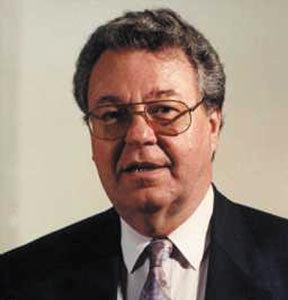
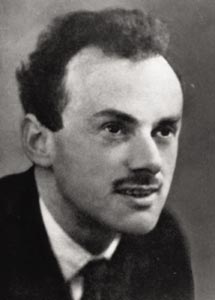
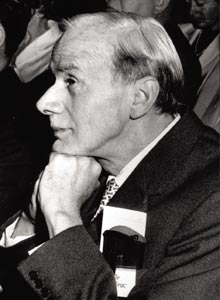
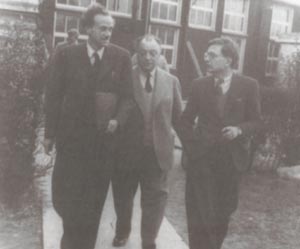
The year 2002 is the centennial year for Paul Dirac, who was born in Bristol on 8 August 1902. His Swiss father, Charles, was born in Monthey near Geneva in 1866 and migrated to Bristol, England, to become the French teacher at the Merchant Venturers Technical College. His mother was Florence Holten, a Cornish woman who was born in Liskeard in 1878 and became a librarian in Bristol. They married in Bristol in 1899 and had three children: two sons (of which Paul was the younger) and then a daughter. After his primary and secondary education at the technical college, Paul Dirac joined the electrical engineering department of Bristol University in 1918 to train as an electrical engineer. This choice was due to prompting from his father who was concerned about his son’s job prospects.
Dirac did well at university, but he did not find a suitable job due to post-war conditions. His desire was to go to Cambridge University to study mathematics and physics. He was accepted by St John’s College, Cambridge, in 1921, but was offered only a minor scholarship, insufficient to support him there. Fortunately, he was able to study Applied Mathematics at Bristol University for two years, paying no fees and living at home. After this, in 1923, he was awarded a major scholarship at St John’s College and a Department of Scientific and Industrial Research training grant, but even these did not cover the amount he needed to study at Cambridge. In the end he was able to go to St John’s College because extraordinary action was taken by the college. He did all his life’s work there, from postgraduate studies in 1923 to retirement from his Lucasian professorship in 1969 (excluding sabbatical leaves). Thus, it turned out that the college made a profitable investment when they gave him a modest increase to the major scholarship they had awarded him.
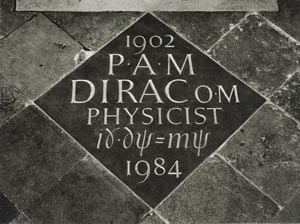
Paul Dirac died, aged 82, on 20 October 1984 as a Nobel Prize winner (1933) and a member of the British Order of Merit (1973). He was the outstanding theoretical physicist in Britain in the 20th century. In 1995 there was a great celebration of Dirac and his work in London. A plaque was placed in Westminster Abbey as a memorial to him and his achievements, joining similar plaques to Newton, Maxwell, Thomson, Green and other outstanding theoretical physicists. It included Dirac’s equation in a compact relativistic form (as Dirac’s full equation would not have fitted on the plaque). This was not a form that Dirac would ever have used, although later students of Dirac often used it. As part of the celebration, addresses were given on four topics related to Dirac’s work (see P Goddard 1998 in Further reading).
Monumental discoveries
Dirac established the most general theory of quantum mechanics and discovered the relativistic equation for the electron, which now bears his name. The remarkable notion of an antiparticle to each particle – i.e. the positron as antiparticle to the electron – stems from his equation. He was the first to develop quantum field theory, which underlies all theoretical work on sub-atomic or “elementary” particles today, work that is fundamental to our understanding of the forces of nature. He proposed and investigated the concept of a magnetic monopole, an object not yet known empirically, as a means of bringing even greater symmetry to Maxwell’s equations of electromagnetism. He quantized the gravitational field, and developed a general theory of quantum field theories with dynamical constraints, which forms the basis of the gauge theories and superstring theories of today. The influence and importance of his work has increased with the decades, and physicists daily use the concepts and equations that he developed.
Dirac’s first step into a new quantum theory was taken late in September 1925. R H Fowler, his research supervisor, had received a proof copy of an exploratory paper by Werner Heisenberg in the framework of the old quantum theory of Bohr and Sommerfeld, which leaned heavily on Bohr’s correspondence principle but changed the equations so that they involved directly observable quantities. Fowler sent Heisenberg’s paper on to Dirac, who was on vacation in Bristol, asking him to look into this paper carefully. Dirac’s attention was drawn to a mysterious mathematical relationship, at first sight unintelligible, that Heisenberg had reached. Several weeks later, back in Cambridge, Dirac suddenly recognized that this mathematical form had the same structure as the Poisson Brackets that occur in the classical dynamics of particle motion. From this thought he quickly developed a quantum theory that was based on non-commuting dynamical variables. This led him to a more profound and significant general formulation of quantum mechanics than was achieved by any other worker in this field (see P Dirac 1925 in Further reading).
This was a major achievement that marked him out from others in the field. As a young, 25-year-old physicist he was quickly accepted by outstanding physicists. He was invited to speak at their most exclusive conferences, such as the Solvay Congress of 1927 (see Further reading), and joined in their deliberations as an equal.
However, this general formulation allowed him to go much further. With it, he was able to develop his transformation theory, which showed explicitly (see P Dirac 1927 in Further reading) how it was possible to relate a range of different formulations of quantum mechanics, all of them equivalent in their physical consequences, such as Schrödinger’s wave equation and Heisenberg’s matrix mechanics. This was an astonishing achievement, which led to a deeper understanding of quantum mechanics and its use. This transformation theory was the pinnacle of Dirac’s development of quantum mechanics since it unified all proposed versions of quantum mechanics, as well as giving rise to a continuum of other possible versions. In later life Dirac considered this transformation theory to be his own as no other quantum mechanician had found any hint of it. Altogether, Dirac’s quantum mechanics takes a simple and beautiful form, with a structure showing elegance and economy of concept, and linked directly with the classical theory. It showed us a new aspect of our universe, both profound and perplexing in its new concepts, and certainly unexpected.
Even as an undergraduate Dirac had been deeply conscious of the importance of special relativity in physics, the theory that Einstein had put forward in 1905 and that Dirac had learned about from lectures by C D Broad, the philosophy professor at Bristol University. Most of his early papers as a postgraduate student were devoted to modifying calculations already in the literature to make them compatible with special relativity. In 1927 Dirac sought to develop a theory of the electron that satisfied this requirement and he published his relativistically invariant equation for the electron early in 1928 (see P Dirac 1928 in Further reading).
Although this goal had been in the minds of many other physicists, none had been able to find a satisfactory equation. He gave an argument, simple and of the utmost elegance, that was based on the requirement that his transformation theory should also hold for relativistic quantum mechanics – an argument that specified the general form this relativistic equation should have, an argument that all physicists have found compelling. His transformation theory requires the equation to be no more than linear in time-derivative, while relativity arguments indicate that the equation can be only linear in the space derivatives also. Dirac’s equation is certainly one of the most beautiful physics equations. Professor Sir Nevill Mott, former director of the Cavendish Laboratory, wrote recently: “This [equation] seemed, and still seems to me, the most beautiful and exciting piece of pure theoretical physics that I have seen in my lifetime – comparable with Maxwell’s deduction that the displacement current, and therefore electromagnetism, must exist.” (See B Kursunoglu and E P Wigner 1988 in Further reading.) Also, the Dirac equation for the electron implied that it should have spin 1/2, and a magnetic moment of eh/(4pm), where h is the Planck constant and m is the electron mass, correct to the accuracy of 0.1%.
Dirac’s equation and his theory of the electron have remained firm up to the present day. Its predictions have been thoroughly verified for all atomic and molecular systems. It has been demonstrated to hold for all other particles that have the same spin as the electron, such as the protons, the hyperons and all other baryons, when their induced magnetic moments are taken into account; and all known leptons, to say nothing of the fundamental building blocks of all hadrons, the quarks themselves. It is universally applicable and well known by all physicists and chemists, something nobody could deny. Indeed, in 1929 Dirac felt able to state: “The general theory of quantum mechanics is now complete… The underlying physical laws necessary for the mathematical theory of a large part of physics and the whole of chemistry are thus completely known.” (See P Dirac 1929 in Further reading.)
Dirac soon showed that his equation had other, unexpected, implications for these particles. The equation predicted the existence of antiparticles, such as the positron and the negatively charged antiproton, objects now well known in high-energy physics laboratories. Indeed, all particles have corresponding antiparticles and almost all of them are now known empirically. The positron and antiproton are particularly well known, both being stable in a vacuum, and are now widely used in collider accelerators, with which physicists study physical phenomena at very high energies.
It is important to emphasize here the outstanding beauty of Dirac’s equation. It may be difficult to convey this quality to non-scientists, but we can be confident that no physicist would disagree with this statement. The Dirac equation is one of the most outstanding discoveries. Through this work, Dirac uncovered for us all a fundamental and satisfying principle governing our universe, which demonstrates to an unsurpassed degree the elegance of its structure. For this discovery, Dirac’s name will be known forever. It is an outstanding monument to his ability and ingenuity, leading us to comprehend at least one aspect of the fundamental forces in this remarkable universe in which we live.
Dirac’s name would be high in physics records even if quantum mechanics and transformation theory were his only contributions to knowledge. His discovery of the Dirac equation puts him far above all others – an outstanding genius in the history of physics.
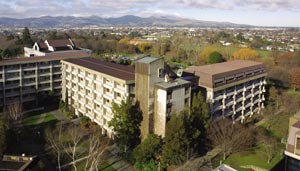
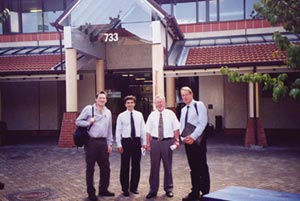
In June, two New Zealand universities formally applied to join the CMS experiment at CERN’s Large Hadron Collider (LHC). This marked the launch of an initiative to establish a New Zealand high-energy particle physics and instrumentation programme called NZ_CMS. The basis of this programme is the formation of an experimental particle physics and instrumentation research group within New Zealand that not only contributes directly to the CMS experimental programme, but does so in a way that also optimizes the benefits for New Zealand, its industry and its young researchers. The application was made on behalf of six staff from the universities of Auckland and Canterbury, and also includes several graduate students. In addition, NZ_CMS is receiving support from staff and university groups within the two universities in the fields of electrical engineering, computer science, medical imaging, nanotechnology and optics.
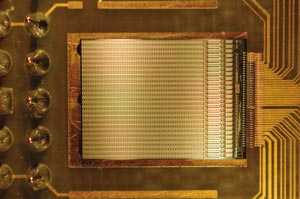
The CMS pixel system was identified as the area where NZ_CMS should contribute, as it provides the best match in terms of personnel, resources, and the focus on instrumentation development sought by Auckland, Canterbury, and the New Zealand government. Over the last year members of NZ_CMS have been working within the CMS pixel community, ensuring a smooth integration into CMS as well as establishing the connections and the technology transfer necessary for the continued development of the programme.
Pixel systems
NZ_CMS has benefited greatly from input from New Zealand, the CMS management and the CMS pixel group at the Paul Scherrer Institut (PSI) in Villigen, Switzerland. Realistic goals have been outlined for long-term benefits and contributions to CMS, whist enabling NZ_CMS to establish itself within the New Zealand academic climate, as well as allowing the shorter-term goals attractive to funding agencies to be achieved. Roland Horisberger, the CMS pixel detector project leader, and the PSI group have strongly supported NZ_CMS, facilitating pixel technology transfer to New Zealand and helping to define the scope of the NZ_CMS deliverables. At present, members of NZ_CMS are working within the PSI pixel group on the pixel control systems and services. As the NZ_CMS collaboration develops, it is expected that the New Zealand-PSI connection will be strengthened, and a training-exchange programme for students, engineers and researchers will be established.
As a sign of the enthusiasm and support for NZ_CMS, the development from initial idea to application for CMS membership has taken only a year and a half, and it has already secured preliminary funding for pixel instrumentation research. The initiative was first presented at the New Zealand Institute of Physics conference in July last year, which was followed by a visit from a CMS-CERN delegation to New Zealand in January.
The week-long itinerary of the delegation, led by John Ellis (representing CERN) and Diether Blechschmidt (representing CMS), included formal meetings with the minister of research, science and technology, the Royal Society of New Zealand and the Universities of Auckland and Canterbury. The delegates also visited Industrial research Ltd (a Crown Research Institute of some 400 staff) and participated in the 18th International Workshop on Weak Interactions and Neutrinos (WIN 2002) held at Canterbury. There was also time for a public lecture by Ellis entitled “From Rutherford to Higgs” in which he described particle interactions using vocabulary from the sport of rugby.
Following the delegation’s visit, Steve Thompson, chief executive officer of the Royal Society of New Zealand, made an official information visit to CERN. Soon afterwards initial funding was obtained from the New Zealand government and it was decided to proceed with the NZ_CMS application to join CMS. It is now hoped that concurrent with the NZ_CMS application New Zealand and CERN can negotiate and sign an agreement on co-operation. This would facilitate the development of the country’s participation in the LHC.
Current programmes
In an effort to build on its strengths and resources, NZ_CMS is endeavouring to work in conjunction with the country’s existing particle physics programmes. Current areas of research in New Zealand include heavy-ion physics at Auckland, ultra-high-energy neutrino physics at Canterbury and theoretical physics at Massey University.
In addition to the University of Auckland’s taking a leading role in the NZ_CMS pixel programme with the establishment of a pixel laboratory at its Tamaki campus, Auckland’s David Krofcheck is augmenting NZ_CMS’s contribution to CMS through reaction-plane studies for the CMS Heavy Ions programme. This follows on from work done with gold-gold collisions at the E895 experiment at Brookhaven in the US. E895 used the Alternating Gradient Synchrotron (AGS) to deliver gold beams of 2, 4, 6 and 8 GeV per nucleon to measure the excitation functions of collective nuclear matter “flow”. The NZ_CMS Heavy Ions group currently consists of three researchers and is based entirely at the University of Auckland.
As far as Canterbury is concerned, its particle physics group is participating in the Radio Ice Cherenkov Experiment (RICE) in Antarctica. RICE is a neutrino telescope at the south pole using radio antennas to detect the coherent emission of radio-wavelength Cherenkov radiation from the electromagnetic shower of particles produced when an ultra-high-energy electron neutrino interacts in the ice. The Canterbury group is involved in the Monte-Carlo simulation of the shower and the subsequent detection of the Cherenkov pulse, and the investigation into other possible physics sources such as the transition radiation from air showers. The absence of any neutrino events in the data analysed to date implies upper limits for the neutrino flux comparable to the air shower experiments AGASA and Fly’s Eye over the neutrino energy range of around 107-1012 GeV.
With research into medical imaging instrumentation, digital-signal processing and nanotechnology, Canterbury is also looking to establish instrumentation applications associated with pixel systems and pixel data visualization. These would tie in with its new HITLab NZ, the annex of the Human Interface Technology Laboratory (HITLab) at the University of Washington in Seattle. The HITLab consortium is a world leader in virtual-reality technology such as remote surgery and virtual retinal display, which scans images directly into the retina of the eye.
An additional aspect to be developed is online and offline computing, with a contribution from New Zealand now being possible thanks to the installation of the high-bandwidth transpacific Southern Cross Cable, which started operation in late 2000. The cable removes the bandwidth bottleneck between Australasia and the United States, and delivers 120 Gbit/s of fully protected capacity (the equivalent of eight full-length motion pictures every second). An upgrade in early 2003 will double capacity to 240 Gbit/s. At present, the currently available bandwidth to the US from within the universities is around 100 Mbit/s. This removal of bandwidth constraints, coupled with a developing interest in GRID research within New Zealand’s IT community, has prompted discussion of possible contributions to online and offline computing within the context of NZ_CMS.
The third component of New Zealand’s existing particle physics programme is the theoretical physics group at Massey University, which focuses on nucleon-structure functions and deep inelastic scattering calculations. Their interest in NZ_CMS is ongoing, as experiments at the LHC are an excellent opportunity for studying quark and gluon distribution functions. Detailed knowledge of these distribution functions is needed for much of the physics that will be performed at the LHC, and the NZ_CMS programme will enable the Massey group to participate directly in a facility that should contribute significantly to this area of research.
Finally, the NZ_CMS initiative should be seen as part of the resurgence in New Zealand particle physics that looks to work in close collaboration with both the country’s established research groups and our international collaborators (PSI and CMS/CERN). This is a significant step towards New Zealand’s participation in the truly global “big science” projects associated with modern high-energy particle physics laboratories, and is based on access to research at the frontier of particle physics.
The NZ_CMS initiative is also a way to combat New Zealand’s perceived geographical isolation and the continued “brain drain” of young researchers who venture overseas for graduate and career opportunities – often never to return.
This brain drain is, of course, not a new phenomenon. One of the best documented cases is a young Kiwi (New Zealander) called Ernest Rutherford, who left the country in 1895 to work with J J Thompson at Cambridge University’s Cavendish Laboratory. NZ_CMS intends to reunite quarks and Kiwis in New Zealand!
To provide the best experiences, we use technologies like cookies to store and/or access device information. Consenting to these technologies will allow us to process data such as browsing behavior or unique IDs on this site. Not consenting or withdrawing consent, may adversely affect certain features and functions.
Functional
Always active
The technical storage or access is strictly necessary for the legitimate purpose of enabling the use of a specific service explicitly requested by the subscriber or user, or for the sole purpose of carrying out the transmission of a communication over an electronic communications network.
Preferences
The technical storage or access is necessary for the legitimate purpose of storing preferences that are not requested by the subscriber or user.
Statistics
The technical storage or access that is used exclusively for statistical purposes.The technical storage or access that is used exclusively for anonymous statistical purposes. Without a subpoena, voluntary compliance on the part of your Internet Service Provider, or additional records from a third party, information stored or retrieved for this purpose alone cannot usually be used to identify you.
Marketing
The technical storage or access is required to create user profiles to send advertising, or to track the user on a website or across several websites for similar marketing purposes.