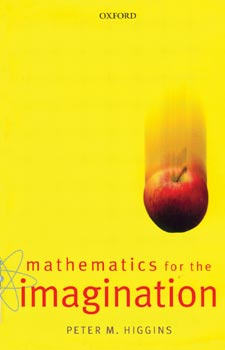
As a citizen of Antwerp, the place where the Renaissance produced some of its finest atlases, I was of course very pleased to read a book that for once properly explains the work of Gerardus Mercator.
Fortunately (or perhaps unfortunately), I am not familiar with Peter Higgins’ other books that popularize mathematics, so this is an impression of one work only. The author states that he wants to give something interesting to everyone. That is a very large audience, and I’m convinced that reality is somewhat more selective.
The book starts densely; each sentence has its weight, and speed-reading will not work. While I personally like that, it may lose some of the target audience now and then. I found the beginning of the trip rather bumpy; the first figure is a strange map of the world, and the second one has a confusing caption. The explanation of the date line is simply inadequate. A book on mathematics that still uses imperial units in a metric world is also annoying. Some concepts are introduced without any previous explanation. A few errors are merely funny; the inhabitants of the US state of Nevada will be pleased to learn that they share a border with Colorado, so maybe we do need five colours to paint the map!
However, after the rough road of the first 40 pages or so, the going gets good, and I found the reading most pleasing. A book of this type will inevitably talk about how certain parts of mathematics came to be discovered, and that means lots of history and people. Higgins’ book has a number of interesting details that were new to me, including the fact that Abraham Lincoln took Euclid’s elements with him on trips, as a source of mental relaxation.
There is a lot on classical plane geometry, mostly involving triangles. It is very pleasing to be able to refresh your school maths with these excellent chapters. There are some very good summaries of the properties of conical sections, though the accompanying drawings should have been made using proper tools; conical sections are too beautiful to be illustrated with the crude approximations the publishers have allowed. This made me cringe more than once!
The chapter on symmetries seems a bit out of place, especially considering that there is no treatment of groups, fractals, or the theorems of Gödel and Turing. A number of quite recent, but still “classical” developments that are familiar to everyone got no mention: Rubik’s cube for example, and more on Penrose tilings. Today’s computer graphics and printing are almost entirely based on Pierre Bézier’s curve, and some entertaining exposition of its remarkable properties would have been a welcome addition to the geometry parts of the book.
However, the mere fact that I have a thirst for more means I have spent several hours of exciting reading.
Canada’s Perimeter Institute for Theoretical Physics was awarded C$25 million (€16 million) by the Canadian Federal government at a groundbreaking ceremony in June. Soon after, the province of Ontario, which will host the institute, announced that it would be providing a further C$15 million for the institute, bringing total Canadian public funding for the new institute to slightly more than C$54 million.
The Perimeter Institute was founded in 1999 when Mike Lazaridis, founder and chief executive of the company Research in Motion (RIM), set up a board of directors to determine how best to go about establishing a world-class institute devoted to fundamental physics in the Canadian town of Waterloo. After visiting many institutes for advanced research in physics around the world, the board concluded that the new institute should be independent, focusing on foundational, non-directed research, be resident-based with a flat hierarchy, and should have a strong public outreach programme.
The institute was officially launched on 23 October 2000 with a C$100 million donation from Mike Lazaridis and an additional C$20 million from RIM executives Doug Fregin and Jim Balsillie. The City of Waterloo donated a site for the institute’s new building, along with temporary accommodation in a former post office and national revenue building. An international eight-member scientific advisory committee was selected in late 2000, and had its first meeting in Waterloo in spring 2001. Research began in autumn 2001 with a core scientific staff of five and four postdoctoral fellows in quantum gravity, string theory, quantum information theory and quantum computing.
CERN played host to a meeting of First Tuesday Suisse romande, a network for innovation and technology in French-speaking Switzerland, in September. Some 250 people came to the laboratory to learn about the latest developments in Grid computing technology. Topics covered Grid development at CERN and in industry, including an insight into the emerging field of Grid economics and an example of how Grid technologies are having an impact in the medical arena. The event also marked the company Hewlett-Packard joining the CERN openlab for DataGrid applications, other sponsors of this industrial collaboration being Intel and Enterasys Networks.
Now in its fourth year of operation, First Tuesday Suisse romande was founded to provide a forum for entrepreneurs, investors and all those interested in new technology. Its Geneva meetings are held on the first Tuesday of each month, and take the form of a few short presentations followed by an informal networking session. CERN’s director for technology transfer and scientific computing, Hans Hoffmann, plans to host more First Tuesday events at CERN. “The Large Hadron Collider project,” he explains, “is a goldmine of technological innovation, ideally suited for the kind of networking events First Tuesday holds.” This first event was broadcast on the Web to ensure a wider international audience could benefit.
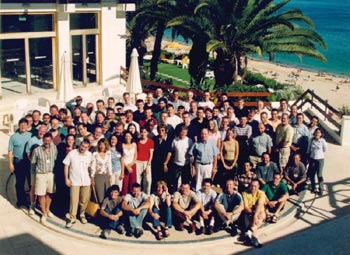
Young accelerator physicists converged on the Portuguese coastal town of Sesimbra in September for the 2002 CERN Accelerator School (CAS) introductory course on particle accelerators. Organized by CAS together with the Laboratório de Instrumentação e Física Experimental de Partículas of Lisbon (LIP), the course covered the basics of accelerator and particle physics, concluding with a series of lectures entitled “Putting it all together”. Thirteen European specialists, chosen for their teaching experience, made up the lecture team, while CERN and LIP shared the organizational responsibilities.
Students came from a range of countries – 13 from Germany, and 12 each from Italy and the UK. France, Canada and Russia each sent three students, and two came from South Korea. There were also students from Belgium, Brazil, Iran, Israel, the Netherlands and Poland, as well as 25 from CERN who were too international to declare a specific nationality, but who no doubt came from Europe. More than 60% of the students were under 35, and about the same percentage had a Masters degree, while fewer than 10% had PhDs. Two-thirds came from accelerator and public sector laboratories, with the remainder made up largely of people from universities.
CAS organizes one such introductory course every two years, interspersed with more advanced courses on specialist technology. It has organized more than 40 courses on accelerator physics and technology since its formation in 1983. Its aim is to train physicists and engineers who design, construct and operate accelerators in laboratories, universities, hospitals and in industry worldwide. Venues are in the European countries that contribute to CERN, and are usually at hotels with conference facilities, where bargain rates are to be had outside the tourist season. Typical attendance is between 50 and 80 students. Each new school produces one or two volumes of proceedings, and these have become the principal body of reference material for the field.
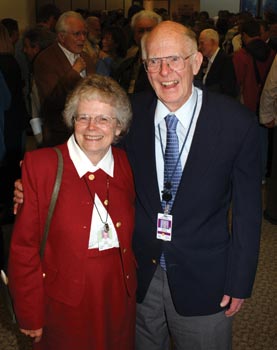
I started working on neutrino detection early in my career. I had rather broad interests in other fields of the physical sciences and worked on a number of other projects. Usually, an experimentalist develops a number of skills and applies them to solving new problems that appear interesting. I was fortunate to live at a time when there were many interesting new developments, and fundamental science was well supported.
In 1942, I received my PhD from Yale in physical chemistry, and went directly into the army as a reserve officer. After the war, I decided to look for a research position with a view to applying chemistry to studies in nuclear physics. After two years with the Monsanto Chemical Company in applied radiochemistry of interest to the Atomic Energy Commission, I was very fortunate in being able to join the newly created Brookhaven National Laboratory, which was dedicated to finding peaceful uses for the atom in all fields of basic science: chemistry, physics, biology, medicine and engineering.
I became a member of the chemistry department in 1948 and remained there until my retirement in 1984. In 1948, a scientist at Brookhaven was able to choose an independent research programme consistent with the laboratory’s effort. After reading a stimulating review paper by H R Crane (Crane 1948), I decided to begin by selecting an experiment in neutrino physics, a field of physics that was wide open to exploration, and a suitable one for applying my background in physical chemistry. So, how lucky I was to land at Brookhaven, where I was encouraged to do exactly what I wanted, and get paid for it!
First experiments
My first experiment was a study of the recoil energy of a lithium-7 nucleus resulting from the electron capture decay of beryllium-7. In a beryllium-7 decay, a single monoenergetic neutrino is emitted with an energy of 0.862 MeV, and the resulting lithium-7 nucleus should recoil with a characteristic energy of 57 eV. A measurement of this process provides evidence for the existence of the neutrino, postulated by Wolfgang Pauli in 1931. An experiment of this nature had been carried out much earlier, but the result was inconclusive. In my experiment, the energy spectrum of a recoiling lithium-7 ion from a surface deposit of beryllium-7 was measured. The energy spectrum of the recoiling lithium-7 was found to agree with that expected from the emission of a single 0.862 MeV neutrino (Davis 1952).
Later, I began working on a radiochemical experiment for detecting neutrinos using a method that was suggested by Bruno Pontecorvo in 1946 (Pontecorvo 1946). Louis Alvarez proposed carrying out the experiment at a reactor, but lost interest in the project (Alvarez 1949). Since no-one else appeared interested in attempting the chlorine-argon neutrino detection method, it seemed a natural and timely experiment for me to work on.
The Pontecorvo method makes use of the neutrino capture reaction, n + 37Cl →37Ar + e–. The reaction produces the isotope argon-37 that decays back to chlorine-37 by the inverse of the capture process, with a half-life of 35 days. In my experiment, carbon tetrachloride served as the target material. After exposing a tank of this liquid to a neutrino source for a month or two, the radioactive argon-37 atoms produced by neutrino capture were removed and counted in a small Geiger counter. The neutrino capture cross-section is extremely small. Therefore, one must use a very large volume of carbon tetrachloride. To observe the argon-37 decays, it was necessary to develop a miniature counter with a very low background counting rate. There are background effects that must be studied as well, particularly those from cosmic rays.
The technology for carrying out the experiment on a relatively large scale, using 1000 gallons of carbon tetrachloride, was developed with the Brookhaven Graphite Research Reactor as the neutrino source. That reactor did not have a high enough neutrino flux to detect with this target size, so neutrinos were not observed. Furthermore, a reactor emits antineutrinos, and the Pontecorvo reaction requires neutrinos. It was not clear in 1952, however, whether neutrinos and antineutrinos were different particles, nor was it clear how they could differ. After all, there are other instances in nature where the particle is its own antiparticle, for example the photon and the neutral kaon.
So, in 1954, I built an experiment using 1000 gallons of carbon tetrachloride in the basement of one of the Savannah River reactors, the most intense antineutrino source in the world. One can calculate the total capture rate from all fission-product antineutrinos by chlorine-37, presuming neutrinos and antineutrinos are equivalent particles. The sensitivity for detecting neutrinos and the flux at this location was sufficiently high to provide a critical test for the neutrino-antineutrino identity. However, the experiment failed to observe a clear signal from reactor neutrinos. The Savannah experiment demonstrated that the argon-37 production rate was a factor of five below the rate expected if neutrinos and the antineutrinos were identical particles (Davis 1957).
While I was at Savannah River doing these experiments, Fred Reines, Clyde Cowan and their associates were performing a beautiful experiment, the first detection of a free antineutrino (Reines and Cowan 1956). Their experiment was a clear demonstration that the neutrino postulated by Pauli was indeed a real particle. They observed antineutrinos being captured by a hydrogen nucleus (proton) producing a positron and a neutron. The measured cross-section was consistent with that expected from Fermi’s theory of b-decay.
In 1957, T D Lee and C N Yang suggested that the neutrino was a two-component particle whose interactions violated the principle of parity conservation. This concept was confirmed in a beta-decay experiment by Chien-Shiung Wu of Columbia and her associates at the National Bureau of Standards. The two-component theory postulates that all neutrinos have spins rotating in a left-handed helicity with respect to their direction of motion. Right-handed antineutrinos will not interact with the chlorine-37 nucleus and produce argon-37 because they have the wrong helicity. The Reines and Cowan experiment should and did observe reactor antineutrinos. All was explained. But this was not the end of the matter.
Pauli and many others did not believe all was as it seemed, and urged that another and more sensitive chlorine-37/argon-37 experiment be performed. To complicate matters, many physicists measured the spins of electrons from many beta-decay sources. They found that the electrons were not necessarily polarized as expected. After a couple of years of improved experiments, these polarization studies ultimately found that the two-component theory was correct.
Don Harmer from Georgia Tech and I set about building a three-times larger chlorine-37/argon-37 experiment. After several years, we obtained a greatly improved result. We found that the argon-37 production rate was a factor of 20 below the expected rate for neutrinos and antineutrinos being identical particles. In this experiment, our sensitivity was limited by the production of argon-37 in our liquid by cosmic rays.
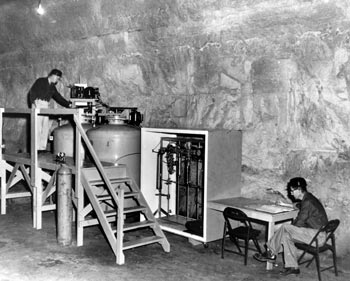
Textbreak=After the Savannah River experiments were terminated, I started thinking about an experiment to measure neutrinos from the Sun. The first step in the plan was to set up one of our detectors as a pilot experiment in a deep mine to measure the background effects and determine the ultimate sensitivity for observing solar neutrinos. The measurements of argon-37 activity could be made more sensitive and specific by using proportional counters. The Sun emits only neutrinos, so the chlorine-argon method was the simplest means of studying solar neutrinos. In 1959, we located a mine near Akron, Ohio, to begin these studies.
Observing the neutrinos from the Sun had the potential of testing the theory that the hydrogen-helium thermal fusion reactions are the source of solar energy. However, the proton-proton chain of reactions in the 1950s was regarded as the principal source of the Sun’s energy, and this chain emitted only low-energy neutrinos from the primary proton-proton reaction. These neutrinos were below the energy threshold of the chlorine-argon reaction. We were saved from this impossible situation, however, by a new development.
In 1958, two nuclear physicists, H D Holmgren and R I Johnston at the Naval Research Laboratory measured the 3He + 4He →7Be + g reaction, and found it had a higher than expected cross-section. It was immediately recognized that this reaction could be important in the terminal stages of the proton-proton cycle. Furthermore, the beryllium-7 could react with a proton and become boron-8. These two radioactive products, beryllium-7 and boron-8, would be the source of energetic neutrinos, ones that could be measured by the chlorine-argon radiochemical method. W A Fowler and A G W Cameron immediately relayed to me these developments. They pointed out that the neutrino flux from these neutrino sources could perhaps be easily observed by the chlorine-argon detector! I might add that Fred Reines was also stimulated by the new findings and immediately embarked on a programme of solar neutrino research (Reines 1967). There was also a very active programme in the Soviet Union in solar neutrino research under M A Markov and G T Zatsepin.
These events ultimately led Brookhaven, with support from the chemistry office of the Atomic Energy Commission, to build a 100 000 gallon chlorine-argon neutrino detector in the Homestake Gold Mine at Lead, South Dakota. The scale of the experiment was determined by a theoretical estimate of the expected neutrino flux and the neutrino capture cross-sections for each solar neutrino source in the Sun. It was necessary to measure the production cross-sections of the neutrino-producing reactions, and derive their rates in the interior of the Sun. The aim was to forecast as accurately as possible the rate of solar neutrino capture in the Homestake detector.
This great effort was largely carried out at the California Institute of Technology under the leadership of Fowler. During this period, John Bahcall calculated the neutrino capture cross-section to produce argon-37 in excited states (Bahcall 1964). Of particular interest was the analog state in argon-37 and a means of calculating other excited states by studying the decay of calcium-37. The effect of these states was to greatly increase the expected neutrino capture rate of the energetic boron-8 neutrinos with energies extending to 15 MeV. Bahcall and I wrote an account of these activities in a volume of papers dedicated to Fowler. As outlined in the article, very many nuclear physicists and astronomers contributed to the basic physics that supported this early effort in solar neutrino astronomy. Our task at Brookhaven was far simpler, and we (Don Harmer, Kenneth Hoffman and myself) had the fun of building a large detector and making it work.
We were very fortunate that the Homestake Mining Company accepted our project. They assisted us in many ways with the building and operation of the experiment. The great depth of the experiment (4850 feet or 1560 m) turned out to be a crucial element.
The observed neutrino capture rate was much lower than was anticipated from the solar model calculations (Davis et al. 1968). In fact, we did not observe a solar neutrino signal at all, and our results were expressed only as upper limits. The low neutrino capture rate was a result that many theorists found difficult to accept. They believed that there must be some chemical inefficiency in the recovery of a few atoms of argon-37 in the massive Homestake detector. We made numerous tests to check the chemical efficiency, and found that the chemical procedures were reliable.
The main difficulty was experimental: the argon-37 counting needed to be improved to search in a more sensitive way for a solar neutrino signal. Brookhaven electronic engineers Veljko Radeka and Lee Rogers solved this problem by devising a pulse rise-time system to discriminate argon-37 decay events from background events. We began using this new system in 1970. After about a year of observations, a clear solar neutrino signal was observed. The signal was smaller than the earlier limit, but we were convinced that the Homestake experiment would in time make a valid measurement of the solar neutrino capture rate in chlorine-37 to compare quantitatively with the solar model calculations.
The pulse rise-time system development gave the Homestake experiment a new life. The solar neutrino production rate was indeed lower than the solar model predictions by a factor of about three. The most likely explanation, in my view at the time, was that the solar model was in error.
Fred Reines organized an in-depth conference on all aspects of solar neutrino research at the University of California’s Irvine campus in 1972. There was an excellent discussion of the theoretical and experimental matters, and new experiments (Trimble and Reines 1973). This conference was of great importance in defining many basic problems and new directions in this new field. Another conference of a similar nature was held at Brookhaven five years later, in 1978. Trevor Pinch made an interesting sociological and historical study of the reaction of the scientific community to the Homestake experiment in his book Confronting Nature (Pinch 1982). We had to wait 18 years for another experiment, the Kamiokande experiment in Japan, to confirm that the solar boron-8 neutrino flux was low.
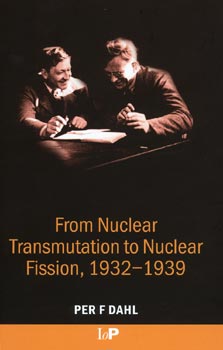
by Per F Dahl, IOP Publishing, ISBN 0750308656, £55 ($75/€75).
Per Dahl continues to be a careful and conscientious compiler of physics history. After Flash of the Cathode Rays: A History of J J Thomson’s Electron (1997) and Heavy Water and the Wartime Race for Nuclear Energy (1999), his latest volume completes a trilogy published under the Institute of Physics imprint. The Heavy Water saga was compelling reading, but Nuclear Transmutation reverts to the solid scientific style of Flash of the Cathode Rays.
Nuclear Transmutation focuses on the competition between experimental teams in Europe and the US to furnish and exploit high-energy beams of subatomic particles in the quest to understand more about the atomic nucleus. Dahl, as in his other books, takes pains to place this central theme in a much broader context.
The period covered by the book links the twilight of the career of one physics giant named Ernest – Rutherford – with the emergence of another – Lawrence. The two main contenders in the competition were the Rutherford-inspired team of Cockcroft and Walton at Cambridge, and the group led by Lawrence at Berkeley. Their achievements and the subsequent award of the Nobel prize assured them a place in science history. Also prominent were the teams with Merle Tuve and Gregory Breit at the Carnegie Institution of Washington DC; Charles Lauritsen at Caltech; and Robert Van de Graaff at Princeton.
In the 1920s, the interior of the atomic nucleus was a complete mystery, but there was a widespread feeling that systematic studies using high-energy projectiles could reveal more about the nucleus. Each group developed its own technique to produce the necessary high voltages to accelerate projectile particles.
Many of Rutherford’s physics achievements came before he arrived at Cambridge in 1919. The road ahead was to be more difficult, demanding inspired teamwork, Rutherford’s dogged perseverance in his belief in the neutron, and the development and mastery of new techniques. However, Rutherford knew more than most about two complementary aspects of nuclear transformations: radioactive decay and reactions induced by radioactively emitted particles.
Rutherford’s era in Cambridge also coincided with the development of modern quantum mechanics. While the majority of quantum mechanics applications focused on atomic physics, a deeper implication was seen by George Gamow. Radioactive particles tunnel, rather than leap, out of the nucleus. Gamow soon realized that if this were the case, energetic particles could also tunnel their way in.
Gamow’s new ideas immediately raised the research temperature
Gordon Fraser
At Cambridge, Gamow’s new ideas immediately raised the research temperature. The payoff came in 1932 when Cockcroft and Walton “split the atom”. This, along with Chadwick’s discovery of the neutron the same year, was the high-water mark for Cambridge research, and soon the tide there began to ebb.
Dahl recounts how another tide rose in the US. In the mid-1920s, the young Lawrence had been dabbling in nondescript research. He and Tuve were both born in 1901 in the same small South Dakota town. Tuve, working under the astute Gregory Breit, wisely urged Lawrence to concentrate instead on digging deep in a potentially rich new physics vein – beams of subnuclear particles. Lawrence took the idea and ran with it, going on to invent the cyclotron. Dahl explains how Lawrence, obsessed with cyclotron performance, initially missed out on several major physics discoveries in the early 1930s. However, Lawrence’s powerful and versatile machines quickly overhauled the rest of the field, and he received the Nobel accolade in 1939, while recognition for Cockcroft and Walton’s pioneering achievement did not come until 1951. The lesson from Lawrence was that the development of big physics machines is not an end in itself, and must be complemented from the outset by physics insight and the provision of adequate detectors.
The history of accelerating subatomic particles has a curious Norwegian tradition. Both Lawrence and Tuve had Norwegian roots, as did Tuve’s collaborators Lawrence Hafstad and Odd Dahl (who in the early 1950s initially led the team that developed CERN’s first large accelerator). In Europe, accelerator pioneer Rolf Wideröe (whose work greatly influenced Lawrence) was also Norwegian. As Odd Dahl’s son, Per Dahl is well qualified to document this story.
Towards the end of the 1930s, the physics spotlight turned away from artificially induced reactions to nuclear fission, again a transatlantic affair and with many of the earlier figures continuing to play key roles. Fission, a different kind of physics, is a closing parenthesis in the book.
Dahl contends that the early history of experimental nuclear physics was a race. It was surely more complicated than that. The history of science and technology is full of examples of different approaches to a common goal, where success and failure is not a simple binary outcome. In the quest to study the deep structure of matter using precisely controlled conditions, the Cambridge researchers got off to a flying start because of their unrivalled expertise in studying radioactive decays and nuclear transmutations. However, it was Lawrence who went on to set the industrial standard.
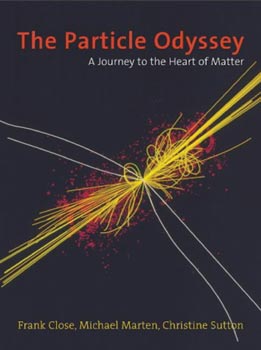
by Frank Close, Michael Marten and Christine Sutton, Oxford University Press (2002), ISBN 0198504861, £29.95 (€48).
Fifteen years ago saw the publication of the most visually stunning, most accessible popular picture book on high-energy physics, The Particle Explosion. It resulted from a collaboration between theoretical physicist Frank Close, physicist and journalist Christine Sutton, and founder of the Science Photo Library Michael Marten. Theirs has proved a perfect partnership, bringing together clear explanation and story-telling; scientific rigour and journalistic flair; and visual impact.
The Particle Odyssey is not simply the same book under a new name. Some 250 of the pictures are entirely new, as are great swathes of text. Clearly, a lot has happened in the past 15 years, not least the complete operational lifetime of LEP, the discovery of the top quark at Fermilab, and the first signs of neutrino oscillations. It is also interesting to note how book design has changed. After leafing through Odyssey, Explosion seems strangely dated. The new edition has whiter, glossier paper and crisper illustrations, some of them bled off the pages. Every page is eye-catching, and I suspect that considerably more text has been squeezed into the same 240 pages, mostly by greater column width.
It is not easy to find a news peg in an incremental advance
Martin Redfern
The change of title is perhaps revealing too. Back in the 1980s, just after the discovery of the W and Z bosons, it seemed that there had been an explosion of particles, almost more than theory could accommodate. Since then, I suspect, to those patiently wading through the terabytes of data, it has been more like an odyssey to try and catch the last remaining particles within experimental range. It has been interesting to watch high-energy physics as a journalist for the past 15 years. It is not easy to find a news peg in an incremental advance. A few thousand more data points do not make a story; a surprise or a race between laboratories does. As a result, I think I reported the discovery of the top quark three or possibly four times before its final confirmation! On the other hand, it is frustrating when a laboratory won’t issue a public announcement even when you know the data are accumulating. This book recounts most of the trials and tribulations from the physicists’ point of view, and, by telling many of the stories in their historical sequence, it gives us some very readable tales.
I recommend this book to everyone, whether they have read The Particle Explosion already or not; and whether they are complete novices or professional physicists. If you don’t know the stories, it’s a new adventure. If you do, it’s a model of story-telling. And whoever said picture books were only for children? My only hope is that there will be enough new physics for another version in 15 years’ time.
The Royal Swedish Academy of Sciences has awarded this year’s Nobel Prize for Physics to three astrophysics pioneers. Raymond Davis Jr and Masatoshi Koshiba share one half of the award “for pioneering contributions to astrophysics, in particular for the detection of cosmic neutrinos”. The second half goes to Riccardo Giacconi “for pioneering contributions to astrophysics, which have led to the discovery of cosmic X-ray sources”.
Cosmic neutrinos
Neutrinos were postulated by Wolfgang Pauli in 1930 and first detected by Frederick Reines and Clyde Cowan in the mid-1950s using a detector placed close to a nuclear reactor. Soon after, Ray Davis proposed building an underground detector to look for neutrinos coming from the Sun. The majority of reactions in the Sun generate neutrinos with energies too low to be detected with the technology of the 1950s, but one relatively rare reaction – the decay of boron-8 – produces neutrinos of up to 15 MeV. This is high enough to be detected by the technique elaborated by Bruno Pontecorvo and Luis Alvarez, who had suggested in the 1940s that such neutrinos could interact with chlorine atoms to produce a radioactive isotope of argon with a half-life of around 35 days. By 1967, Davis had installed a tank filled with 615 tonnes of the common cleaning fluid tetrachloroethylene in the Homestake gold mine in South Dakota, US. His background in chemistry had allowed him to devise the techniques for extracting the argon atoms every few weeks and counting their number – a feat equivalent to finding a particular grain of sand in the Sahara desert.
What Davis discovered came as a surprise – he detected only about half the number of neutrinos expected from the standard solar model. This meant the experiment was wrong, the standard solar model was wrong, or something was happening to the neutrinos on their way from the Sun.
Davis’s experiment ran continuously from 1967 to 1994, and was joined in 1987 by the huge Kamiokande water Cerenkov detector, built in Japan by a team led by Koshiba. This provided a confirmation that Davis’s experiment was right, and focused attention on the hypothesis proposed by Pontecorvo and Vladimir Gribov in 1968 – one year after Davis’s first results – that neutrinos oscillate, or change flavour on their way from the Sun. Both the Homestake and Kamiokande experiments are sensitive only to electron-type neutrinos. Kamiokande was also able to trace the direction of incoming neutrinos, confirming that they came from the Sun.
Koshiba went on to build the larger Superkamiokande experiment, which saw evidence for neutrino oscillation in neutrinos produced in the atmosphere by cosmic rays. Solar neutrino oscillation has since been confirmed by the Sudbury Neutrino Observatory in Canada.
X-ray sources
It was not until 1949 that X-ray astronomy got off the ground. X-rays from cosmic sources are almost entirely absorbed by the Earth’s atmosphere, and it was only in the 1940s that rocket technology had advanced sufficiently to allow Herbert Friedman and colleagues to launch detectors to a sufficiently high altitude to make significant measurements. These experiments showed that X-ray radiation comes from areas on the surface of the Sun with sunspots and eruptions, and from the surrounding corona. Their observations were, however, confined to the solar system.
When in June 1962, Giacconi’s group launched an instrument consisting of three Geiger counters equipped with windows of varying thickness aboard a rocket, they became the first to record a source of X-rays beyond the solar system. Designed to see whether the Moon could emit X-rays under the influence of the Sun, the experiment instead located a source at a far greater distance, and observed an evenly distributed X-ray background. These discoveries gave an impetus to the development of X-ray astronomy.
Giacconi’s pioneering efforts in X-ray astronomy have changed our view of the universe.
The first source to be identified with a visible object was Scorpio X-1; other important sources were the stars Cygnus X-1, X-2 and X-3. Most proved to be binary systems in which a visible star orbits around a dense compact object such as a neutron star or a black hole. Detailed studies using short flights on rockets were, however, difficult, so Giacconi initiated construction of the UHURU satellite, which was launched in 1970. This was 10 times more sensitive than the rocket experiments, and was itself succeeded by the Einstein X-ray observatory – the first X-ray telescope capable of generating sharp images at X-ray wavelengths. Giacconi’s most recent accomplishment is the Chandra observatory, named for astrophysicist Subrahmanyan Chandrasekhar. Initiated by Giacconi in 1976, Chandra was launched in 1999 and has provided remarkable images of the X-ray universe.
Giacconi’s pioneering efforts in X-ray astronomy have changed our view of the universe. Some 50 years ago, the universe appeared largely to be a system in equilibrium. Today, we know that it is also the scene of extremely rapid developments in which enormous amounts of energy are released in processes lasting less than a second, in connection with objects not much larger than the Earth. Studies of these processes, and of the central parts of active galaxy cores, are largely based on data from X-ray astronomy.
The SESAME (Synchrotron Radiation Light for Experimental Science and Applications in the Middle East) project to build a synchrotron light source in the Middle East took a step closer to reality in May, when it received unanimous approval from the UNESCO executive board. The board endorsed SESAME as “a model that should be made known to other regions”, and described it as a quintessential UNESCO project.
The idea for SESAME dates back to 1997 when, at a seminar on Middle East Scientific Co-operation (initiated by CERN’s Sergio Fubini), Herman Winick of SLAC and Gustav-Adolf Voss from DESY suggested using components of Berlin’s BESSY 1 machine, scheduled to be closed down in 1999, as the core facility for a new laboratory in the Middle East. Soon after, an interim council was established along identical lines to CERN under the auspices of UNESCO. Like CERN before it, SESAME is a project designed not only to advance science and technology, but equally importantly to help bring peace and stability to a troubled region through scientific collaboration. Former CERN director-general, Herwig Schopper, chairs its interim council.
In 2000, Jordan was chosen to host the new facility; 13 interim council member states undertook to provide $50,000 (€50,000) per year each for three years from 1 January 2001 for preparatory work, and the US State Department and Department of Energy contributed $200,000.
The endorsement of the SESAME project by UNESCO’s executive board is an important step towards establishing SESAME as an independent international scientific organization. As soon as six potential member states have deposited their agreement of the new laboratory’s statutes with UNESCO, SESAME will gain its independence and the interim council will give way to a governing council, again based on the CERN model.
So far Bahrain, Iran, Jordan, the Palestinian Authority and Turkey have formally decided to join SESAME. Other member states of the interim council are Egypt, Greece, Israel, Morocco, Oman, Pakistan and the United Arab Emirates. Armenia and Cyprus, originally members of the interim council, have changed their status to observer. For Armenia, the change of status came when the country took the decision to build its own light source. Other observers are France, Germany, Italy, Japan, Kuwait, the Russian Federation, Sudan, Sweden, the UK and the US. Kuwait has indicated that it intends to become a full member of SESAME.
Originally conceived as a 1 GeV machine, the interim council has already approved plans presented by technical director Dieter Einfeld to upgrade SESAME from the 0.8 GeV BESSY 1 machine to 2 GeV, resulting in a third-generation light source with 13 positions for insertion devices. Advisory committees have been appointed, and tangible progress was made in June, when the BESSY 1 machine set sail from Germany bound for the Jordanian port of Al-Aqabe. A request has been made to the European Union (EU) for €8 million for the installation and upgrade of the machine. An evaluation panel has submitted a report to the EU, but its contents have not yet been made public.
A seminar organized and financed by the Japanese Society for the Promotion of Science to discuss the scientific programme, including the first beamlines, was held in the Jordanian capital Amman in October. Several laboratories have offered beamline equipment, and financial support for beamlines is being sought from the International Atomic Energy Authority in Vienna and from US agencies. Meanwhile, the Jordanian government has agreed to finance the building that will house the centre at a campus of the Al-Balqa’ Applied University in Allan, 30 km from Amman. A ground-breaking ceremony in the presence of the Jordanian king, HM Abdullah II, and the director-general of UNESCO, Koïchiro Matsuura, is planned for 6 January 2003.
Fermilab and SLAC announced the launch of an email news wire for high-energy physics and related fields in September. Available at http://www.interactions.org/, the news wire is the first element of a service that aims to group information from the world’s particle physics laboratories on a single website.
To provide the best experiences, we use technologies like cookies to store and/or access device information. Consenting to these technologies will allow us to process data such as browsing behavior or unique IDs on this site. Not consenting or withdrawing consent, may adversely affect certain features and functions.
Functional
Always active
The technical storage or access is strictly necessary for the legitimate purpose of enabling the use of a specific service explicitly requested by the subscriber or user, or for the sole purpose of carrying out the transmission of a communication over an electronic communications network.
Preferences
The technical storage or access is necessary for the legitimate purpose of storing preferences that are not requested by the subscriber or user.
Statistics
The technical storage or access that is used exclusively for statistical purposes.The technical storage or access that is used exclusively for anonymous statistical purposes. Without a subpoena, voluntary compliance on the part of your Internet Service Provider, or additional records from a third party, information stored or retrieved for this purpose alone cannot usually be used to identify you.
Marketing
The technical storage or access is required to create user profiles to send advertising, or to track the user on a website or across several websites for similar marketing purposes.