The CERN Council has nominated Robert Aymar, director of the International Thermonuclear Experimental Reactor (ITER), to succeed Luciano Maiani as the laboratory’s director-general, to take office on 1 January 2004. Aymar, who will serve a 5 year term, will oversee the start-up of CERN’s current major project, the Large Hadron Collider (LHC) in 2007. He was previously with the French Atomic Energy Commission (CEA), and directed the Tore Supra – one of the world’s largest tokamaks, based on superconducting toroidal magnets – from its design in 1977 through to its operation in 1988. He is familiar with the challenges presented by the LHC project, as he chaired the External Review Committee that was set up in December 2001 in response to the increased cost to completion of the LHC. Commenting on his appointment, Aymar said: “I am very honoured by this decision, and I thank the Council members for the confidence put in me. CERN is a prestigious institution; I will follow the good examples set by my predecessors, and with the help of the CERN staff, collaborators and supporters, I hope to be able to provide the institution with a future as brilliant and successful as it deserves.”
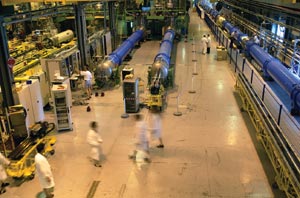
The LHC is now the main focus of activity at CERN, as components for the accelerator arrive at the laboratory from around the world. Council secured the future of the LHC project by unanimously endorsing the new Baseline Plan for 2003-2010, based on a revision of the 1996 financial framework for the LHC, which confirms the target of commissioning the LHC in April 2007. Most of CERN’s resources will be committed to the project, leaving only a very limited non-LHC programme. In the plan, overall cost-to-completion budgets (including materials and personnel costs, as well as a contingency) are set for the construction of the LHC and for CERN’s share of detector construction.
With the activities surrounding the LHC, CERN’s community of scientific users has grown to comprise about half of the world’s experimental particle physicists, with nearly a third coming from outside the CERN member states. India has been an active partner for many years, and in the December meeting, Council granted the country observer status. In the past, India has contributed equipment and technical teams to LEP, the PS injector complex and fixed-target experiments. This effort was formalized in a co-operation agreement in 1991, extended in 2001 for a further decade. Then, in the framework of the 1996 protocol signed with the Indian Department of Atomic Energy, India became one of the first non-member states to make significant contributions to the LHC. Indian scientists are also valued members of the ALICE and CMS collaborations, and Indian IT expertise is being put to good use in GRID computing projects.
Recognizing the increasingly global nature of particle physics, and CERN in particular, Council also agreed to create an associate status for non-European states that wish to make more substantial contributions to CERN’s activities. The new status would provide a closer partnership, including participation by right in CERN’s activities, eligibility of nationals for appointments at CERN, and entitlement of firms in the associate state to bid for CERN contracts. An associate state would contribute to funding at CERN through an annual contribution, but at a lower level than a member state.
Germany’s DESY laboratory in Hamburg and SLAC in Stanford, US, have formally agreed to pool resources for the development and promotion of X-ray free-electron lasers. At a ceremony at the Department of Energy in Washington, DC on 1 November 2002, the directors of the two laboratories signed a memorandum of understanding describing the exchange of personnel, equipment, research results and data, as well as know-how. The aim is to accelerate and contribute to the scientific programmes of SLAC’s Linac Coherent Light Source (LCLS) project and DESY’s TESLA X-Ray Free-Electron Laser (TESLA-XFEL), which, according to current planning, will start operation in 2008 and 2011 respectively. The first step will be the sharing of results from small pilot facilities already under construction in Stanford and Hamburg.
Commenting on the agreement, SLAC director Jonathan Dorfan said: “International collaboration is the most efficient, responsible and cost-effective way of building world-class science facilities. There is already dynamic collaboration between SLAC, DESY and the KEK laboratory in Japan on research and development for a future high-energy physics linear collider. Today’s agreement establishes stronger bonds between international centres of excellence.”
Albrecht Wagner, chairman of the DESY board of directors, said he is “delighted by this collaboration. Both projects will be enriched and accelerated by the first-class personnel and accumulated expertise at both laboratories.”
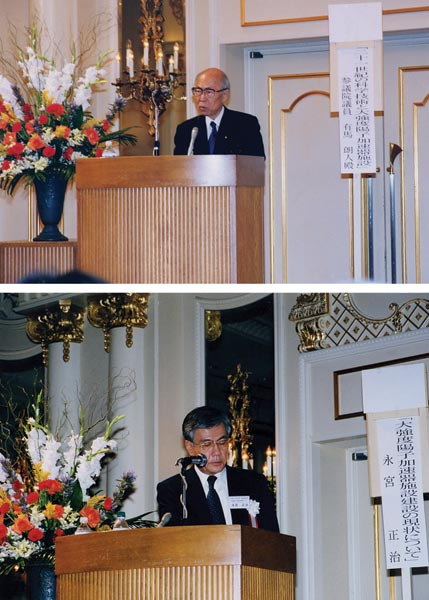
While Japan’s KEK laboratory was celebrating the achievements of its B-factory, just 70 km away in Tokai, the official inauguration of the Japan Proton Accelerator Research Complex (J-PARC; formerly called the Japan Hadron Facility) was taking place. This is a joint project between KEK and the Japan Atomic Energy Research Institute.
An inaugural lecture on the scope of science in the 21st century was given by former University of Tokyo president Akito Arima, who was also Japanese Minister of Education, Science, Sports and Culture. J-PARC project director Shoji Nagamiya described the status of the project. Funding for J-PARC was secured in 2001, and construction began in June 2002.
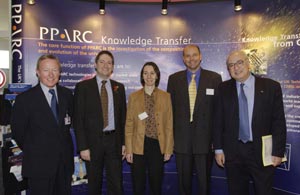
During the past year, the UK’s Particle Physics and Astronomy Research Council (PPARC) has begun an innovative approach to strengthening technology transfer with CERN. In September 2001, the UK Office of Science and Technology awarded PPARC £200,000 (€300,000) to appoint a UK Technology Transfer Coordinator for CERN. This role has been contracted to a Cambridge and Oxford-based firm, Qi3, whose task is to foster closer links between CERN and industry. The goal is to bring greater exploitation of science by encouraging wider and more rapid transfer of new ideas, products and processes to UK business.
CERN and PPARC share an interest in technology transfer. Particle physics research naturally pushes existing technologies beyond customary limits and can lead to novel technologies, so CERN’s member states have encouraged the laboratory to introduce an active technology transfer policy to demonstrate clear benefits from the research. Technology transfer is now an integral part of CERN’s mission, and is implemented via the Technology Transfer Service set up in 2000.
One of the main objectives of PPARC’s technology transfer work is to increase the return on its investment in CERN, which currently stands at about £90 million per year. Money to support the new initiative has been awarded from the UK’s Public Sector Research Establishment (PSRE) fund. This has been possible because PPARC argued that as the UK has no national particle physics accelerator facility, CERN is effectively the UK’s PSRE in the area of high-energy physics.
The Qi3 team of Nathan Hill, John Attard and David Rafe are now working to help UK businesses benefit from the diverse range of technologies developed by scientists at CERN and the associated laboratories in UK universities. Business partnerships, technology licences and spin-out companies will all form routes to commercialization for technologies developed at CERN. The team has already started looking at several opportunities, including novel semiconductor packaging materials, high-speed imaging cameras, accelerator components and cost improvements in the printed circuit board manufacturing process.
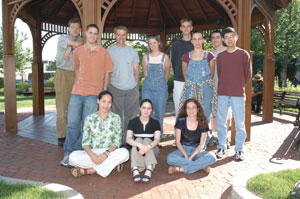
Boston’s Northeastern University launched its Research Experience for Undergraduates (REU) programme at CERN in 1998. Joining summer students from the laboratory’s member states, the participants use their experience to help them to establish what direction their careers will take. Christine Nattrass, a double major in biochemistry and physics at Colorado State University, says that her experience in the programme has influenced her future. “Now I’m more certain I want to study physics rather than biophysics or biochemistry,” she says, “and I think I’d like some kind of particle physics. The research experience confirmed my suspicions that physicists are more fun to work with than biochemists.”
Christine admits, however, that only time will tell just how deeply the whole programme has influenced her. Other students say that the experience at CERN helped determine what course their future studies will take; some have decided that they are more interested in theory than in experiment, while others say that the work they did over the summer has reaffirmed their love of the field.
Assessing the impact
Just as the students have to determine how their experiences in the programme have affected them, so the long-term impact of the programme itself must be assessed. Just how important are educational and research programmes of this sort, and what should their future be? It is often difficult to make these decisions when the programmes are still new, but now that the REU programme has reached maturity, we can begin to get a clearer sense of its value.
CERN has had a summer programme for undergraduate students for more than 40 years, but US students have only been able to participate since the REU programme was formed. Historically, only CERN member states have had the opportunity to send their students to experience what it’s actually like to work in a physics research group at the laboratory. In 1997, however, Stephen Reucroft, an experimental physicist at Northeastern University, sent a proposal to the US National Science Foundation (NSF) for funding to send US students to the summer student programme at CERN. Independently, Homer Neal of the University of Michigan made a similar proposal, and the NSF suggested that the two join forces. The result was the programme that exists today. CERN agreed to take 10 US undergraduates from the REU programme, starting in 1998.
After three years of running a joint programme, Reucroft and Neal split the programme in two and started sending 10 students each. The CERN summer student programme places half, and Northeastern University and the University of Michigan place the remainder. Additional funding has been provided by the Ford Motor Company, which now supports five students.
Participants in the REU programme are chosen from colleges all over the US, from small institutions as well as the larger, better-known universities. A committee of physicists chooses students with a strong academic record, an interest in physics, demonstrable creativity and a desire to take advantage of CERN’s culturally diverse environment. The social and cultural life of the programme is as important as the research and educational elements.
REU organizers brief successful candidates about what they can expect, and encourage them to network before they leave for Switzerland. There is a four-day orientation meeting for students in the US, and a programme administrator accompanies them to CERN and gives them a tour of the laboratory’s facilities. After they have settled in, the REU administration keeps in touch with the students throughout the summer. One of the programme’s coordinators, Artemis Egloff, says: “We try to keep a good balance between helping them and smothering them with too much attention. They like to be independent and we encourage them.”
While at CERN, the US summer students work with an assigned research group, supervised by a physicist who works with them and assigns them various tasks, allowing them to see what work as a particle physicist is like. Students perform research, take measurements, write computer programs, papers and reports, learn to use specialized software, build and test equipment, and inevitably do manual work. In short, they are expected to cover the entire range of activities that makes up experimental particle physics.
Students are expected to learn new skills on the fly – things that they don’t learn in the classroom. Their work is often disorganized and their days frequently unstructured, but as Reucroft points out, this is what research is often like. Students are often surprised at how much mundane manual labour is involved in science, such as connecting cables, and moving and stacking lead bricks.
Although hands-on work forms a large part of the activities at CERN, the students also attend lectures in experimental and theoretical physics, and in accelerator and detector techniques. Andrew Essin, a student at Reed College, Oregon, explains: “There were lectures on experimental high-energy physics, which allowed me to get a view of more than just mathematical formalism and phenomenology, to see the nitty-gritty of creating and detecting particles, accumulating and processing vast quantities of data and all that good stuff that I might miss if I simply concentrated on theoretical studies.” The CERN lectures focus on the detailed techniques of particle physics in both experiment and theory. Since the students are a mixture of potential experimentalists and theorists, the lecture material benefits all of them. In ordinary classroom lectures, most of what is taught about physics is historical information, neatly packaged.
The lectures often cover material that is too new to be taught to US physics undergraduates. As a consequence, some of the students find the lectures difficult. One, however, said that even the material he did not understand will be valuable to him eventually – either he will process it once it has had time to settle, or else the fact that he has already been exposed to it will make him feel more comfortable next time he comes across it.
International culture
The international atmosphere at CERN makes it an ideal place for US students to learn how scientists from different countries bring different approaches to physics. Students and advisors not only work together, but also get to know each other socially. Many returning students have remarked on the spirit of tolerance that reigns in CERN’s multicultural setting, with people choosing to pass over potentially awkward social situations rather than giving them too much weight or taking offence at unintended slights. Inevitably, this attitude is carried over into the work environment. The students learn how people in other countries are educated, and discover the strengths and weaknesses in the US system, as well as in others. It is one of the aims of the REU programme that as the students develop, they will keep in mind what they have learned, and perhaps bring good ideas back to the US system.
The vast majority of undergraduates participating in the REU programme have gone on to pursue PhDs in the sciences, including various aspects of physics, biophysics and aeronautical engineering. One became a Rhodes Scholar, and another went into business, although she changed her mind after a year and went back to physics because her experience at CERN was so good. One spent time developing computer simulations at a financial institution and is pursuing a Masters degree in architecture at MIT. He hopes to enter into a physics PhD programme after he has completed his Masters.
One of the main challenges of the REU programme is placing students with advisors. Even the best-intentioned researchers can find themselves unexpectedly busy by the time the summer arrives, and it is not uncommon for students to find themselves working largely independently. However, Reucroft says that experience has shown that if an advisor can motivate a student and give them a start, they frequently end up working happily and productively on their own.
Like the CERN summer student programme, the REU programme has a great potential impact. It helps students decide whether or not to pursue an advanced degree in physics. By ensuring that they are well informed about the nature of research before they embark on their career, it helps students find out whether experimental or theoretical physics – or even no physics at all – is right for them. It also attracts young people to science, exposing them to the demands and rewards of working at the leading edge of experimental physics, showing them how experiment and theory work together, and how particle physics impacts other branches of science. Perhaps most importantly, students also learn skills that are helpful in whatever career they choose to pursue, such as programming, problem solving and working with people from different backgrounds. All of the students who have participated in this programme say that they would recommend it to their friends. And it is safe to say that the majority will go on to be good ambassadors for science and for international collaboration, wherever their future careers take them.
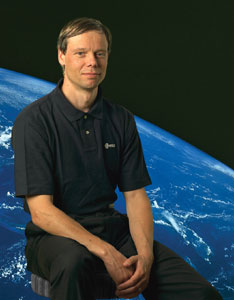
In June 1990, while I was a Fellow at CERN in experimental particle physics, a friend told me that the European Space Agency (ESA) was recruiting new astronauts. Although I loved (and still love!) the physics research work I was doing, and being at CERN in particular, I had always dreamed of going into space one day. It did not take me long to decide that at the very least I should inquire further, though I was concerned that my background was quite unlike the kind of research that is typically performed during manned space flights. I discussed this with the Swedish Space Board before asking them to send me the application papers (a densely written 16 page form), but they confirmed that I was the kind of person that could be of interest to ESA.
The selection process for just six new ESA astronauts took almost two years. Initially, each ESA member state selected up to five candidates, and then ESA chose from the 60 pilots, engineers, medical doctors, physicists and other scientists whose names were put forward. The selection process involved extensive medical screening, as well as several interviews. My CERN background was invaluable – though it is not space science per se, particle physics is closely related to astrophysics and cosmology, and also to radiation, which is a problem for humans and technology in space. My hands-on experience with experimental hardware was useful, but even more important, I believe, was my experience of working in a highly international environment, and the language skills I had gained there.
During one interview, a member of the selection panel remarked that although I had a fairly long publication list, he had noticed that the publications had up to 100 names on them. How could he be sure of my contribution? I had to explain how particle physics experiments are generally performed by large collaborations from many countries. This is increasingly true today, with as many as a thousand collaborators being involved in a single experiment. Fortunately, I was able to point out one or two papers that I had produced myself.
It should be noted that astronauts rarely perform their own experiments in space, and therefore a broad background is important. The exception is when so-called “payload specialists” fly on dedicated science missions, having been selected because of their expertise in a particular scientific field. A mission crew has to deal with technically advanced equipment on a daily basis, and must be able to operate various experiments as well as spacecraft systems. Having worked with particle physics experiments that demand high technology in many fields, I had already been exposed to several areas that one encounters in space activities.
Astronauts are among the prime communicators for the space programme – one could say they are “space ambassadors”. My scientific background has been extremely useful to me during many talks and presentations – in particular during the question-and-answer sessions that often ensue.
The International Space Station (ISS) is certainly “big science”, very much as CERN is. I recognize many similarities, although the ISS is more politicized. There are often complaints that ISS science is too expensive, and that the money could be better spent elsewhere. This is a misunderstanding of the real goals of the ISS, which are to learn how to build and live in space, and to prepare for future space developments. In some ways, it is like the basic science carried out at CERN – we do it out of curiosity, and we do not know what the eventual outcome will be. However, we are convinced that one day we will achieve results that will be of great benefit for all humankind. In the meantime, we take this great opportunity to carry out experiments in a unique environment, and to learn as much as possible about it, in particular how humans react to long periods in space.
I have always tried to combine my interest in particle physics with being an astronaut. I was dreaming of having my own experiment to work on in space, when I heard about the light flashes in the eyes that most astronauts experience in space. It was clear that these are from particles that penetrate the eyes, but until then no-one had put an active detector in space, in front of the eyes, in an effort to correlate particles and light flashes. This eventually led to the Italian-Russian-Swedish SilEye project, based on silicon strip detectors. The collaboration flew two detectors to the Russian space station Mir, and now also has one on the ISS. I hope to get a chance to use it in the summer of 2003, when I am finally scheduled to fly on the space shuttle and spend a week on the ISS.
by Peter T Johnstone, Oxford University Press. Volume 1 ISBN 0198534256 £100.00 (€158); volume 2 ISBN 0198515987 £100.00 (€158); both volumes ISBN 01982496X £175.00 (€277).
This comprehensive two volume set on the theory of topos – the abstract construction of algebraic geometry – owes its title to the Indian tale of four blind men asked to describe an elephant. Each of them inspects a different part of the animal by touch, and each comes up with a very different description. The same, says Johnstone, is true of topos – how you describe them depends on how you approach them.
(Cambridge Lecture Notes in Physics) by Jan Smit, Cambridge University Press, ISBN 0521890519, £21.00 (€33).
This book is based on a series of lectures given by the author at an advanced undergraduate/beginning graduate level.
For readers of Russian, the Joint Institute for Nuclear Research (JINR) in Dubna has just produced the second issue of its Information and Biographical Guide. Including 680 short biographical summaries of the scientists who created JINR and who have worked or are working there, the book profiles specialists in physics, mathematics, chemistry, radiobiology and engineering from more than 20 countries. It is a thorough compilation of JINR history, scientific discoveries, prizes and literature about the Institute and its scientists. Enquiries should be addressed to the editor, M G Shafranova, at shafran@sunse.jinr.ru; fax +7 09621 65767.
by I J R Aitchison and A J G Hey, Institute of Physics Publishing, ISBN 0750308648, £29.99 (€48).
For the third edition of this classic graduate textbook, first published in 1982, the authors have substantially enlarged the text to reflect developments both in university curricula and the field of particle physics. New introductory chapters have been added to give a historical account of the properties of quarks and leptons. Volume 2, covering the non-Abelian gauge theories of QCD and electroweak interactions, is scheduled for publication in 2003.
To provide the best experiences, we use technologies like cookies to store and/or access device information. Consenting to these technologies will allow us to process data such as browsing behavior or unique IDs on this site. Not consenting or withdrawing consent, may adversely affect certain features and functions.
Functional
Always active
The technical storage or access is strictly necessary for the legitimate purpose of enabling the use of a specific service explicitly requested by the subscriber or user, or for the sole purpose of carrying out the transmission of a communication over an electronic communications network.
Preferences
The technical storage or access is necessary for the legitimate purpose of storing preferences that are not requested by the subscriber or user.
Statistics
The technical storage or access that is used exclusively for statistical purposes.The technical storage or access that is used exclusively for anonymous statistical purposes. Without a subpoena, voluntary compliance on the part of your Internet Service Provider, or additional records from a third party, information stored or retrieved for this purpose alone cannot usually be used to identify you.
Marketing
The technical storage or access is required to create user profiles to send advertising, or to track the user on a website or across several websites for similar marketing purposes.