by João Magueijo, Arrow Books. Paperback ISBN 0099428083, £8.99.
Cosmologist João Magueijo certainly believes in rocking the boat. This is his first book, but he is happy to propose theories that challenge the fundamentals of physics. He also challenges the institution of science itself – so much so, that a long-time collaborator had to point out that a reference letter for a PhD student was not an appropriate forum for insulting the establishment.
So what is Magueijo’s theory? Simply, that the speed of light, one of the fundamental constants in our model of the universe, may not be as constant as we have assumed. Working through explanations of relativity and modern cosmology – often featuring a cow called Cornelia – he introduces the science of his Variable Speed of Light (VSL) theories, but it is the personal element that makes the book unusual. Here, Magueijo really brings us two books: one is popular science, and the other is about the day-to-day process of science, a human drama full of dreams, allegiances and betrayals. This section is likely to surprise members of the public as much as it makes scientists chuckle (or grimace) in sympathy with the story Magueijo has to tell.
In an unusual display of emotion, Magueijo attacks everything from the management of his university (which he suggests blowing up for the good of science) to journal reviewers (whose reports, he claims, often contain only 1% science). He avoids sounding bitter only because he compliments the same groups he criticises, remarking that his university has “perhaps the best scientific environment in the world”, despite his views on how it is run.
The book ends on an uncertain note, its VSL theories widely discussed but as yet unproven. Magueijo is not precious about his creation, or worried about humiliation if he is proved wrong. He believes that trying out new ideas is crucial to science. This aside, it is Magueijo’s unsanitized portrayal of science that will surprise and entertain his readers.
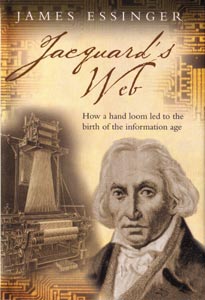
When invited to review Jacquard’s Web, I admit that I had to google (v.t., Macmillan English Dictionary) James Essinger. I discovered, with some misgivings, that he has published more than 25 management books with titles such as The Investment Manager’s Handbook and Virtual Financial Services. However, I also found a claim that he is good at making technical issues accessible, and indeed he is. Better still, Essinger turns out to be an accomplished storyteller.
Jacquard’s Web is an intricate tale of inventors and inventions, starting almost three centuries ago among the silk-weavers of Lyons, France, and ending today, or rather tomorrow, among computer users worldwide. Well researched, the narrative traces a chain of links between Jacquard’s silk-weaving loom and modern computers. Most of the techniques involved are adequately explained, even if occasionally with fuzzy accuracy (a pixel, whether on a screen or in woven cloth, has more than two possible states), but Essinger presents this particular technological evolution from a socio-economical standpoint, and here his familiarity with the business world and its denizens clearly adds value.
The story tells of the achievements and frustrations of a motley collection of characters, who between them took the punched card about as far as it could go. We find out about Joseph-Marie Jacquard, son of a Lyons master weaver, who cunningly avoided execution as a counter-revolutionary and went on to benefit from Napoleon’s imperial boost to science and technology; Charles Babbage, a Victorian gentleman of private means, who outlived the largesse of a government that funded his developments of some of the most complicated unbuilt machines ever imagined; Ada, Countess of Lovelace, daughter of Lord Byron and steadfast believer in Babbage, a scientifically minded lady born long before her time; Herman Hollerith, a mechanical engineer more at ease with cogs than commerce, who nonetheless became successful and wealthy thanks to his exploitation of Jacquard’s concepts; and finally Thomas Watson, businessman par excellence, patron saint of salesmen and father of IBM.
The automated loom technology patented by Jacquard in 1804 was born of a need to increase production of the exquisite silk fabrics so coveted by France’s aristocracy, and to create whatever pattern the customer desired – roses today, lilies tomorrow. The breakthrough came with the use of punched cards to store instructions for controlling the “pick” – the number and position of warp threads to be lifted for each row woven. The result was an astonishing 24-fold increase over the inch of cloth per day that a weaver and draw-boy could produce.
Thereafter, the humble punched card was pivotal to most of the inventions described, controlling the cogwheels of Babbage’s would-be Analytical Engine, storing data for Hollerith’s automatic information processing of US and Russian census returns, and governing the operation of tabulators, comptometers and early computers. Indeed, IBM’s very last punched card was produced as late as 1984.
Instead of Jacquard’s Web, this book could aptly have been titled Pieces of Cardboard that Changed the World. As well as looms and computers, the author recalls the notorious “hanging chads” of Florida, those parts of the stiff cards that didn’t always fall away from holes punched by voters in the 2000 presidential election.
With the advent of electronics, magnetic tapes and disks, Essinger has increasing difficulty arguing for one-to-one associations between looms and modern computers; Tim Berners-Lee might take umbrage, were that his nature, at the suggestion that “it is not stretching credibility too far to describe the internet itself [sic] as Jacquard’s Web”.
The final chapter, speculating on the future, is rather untidy, unnecessary and much weaker than the others. But never mind – the others are all good, packed with facts and anecdotes, agreeably illustrated, highly informative and subtly amusing.
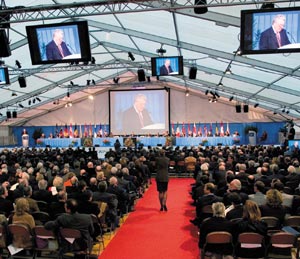
Heads of state, representatives from many countries, and scientists and engineers from CERN’s past, present and future research in particle physics attended the laboratory’s official 50th anniversary ceremony on 19 October. The speakers praised the organization for its advancement of science and for fostering international collaboration, both among scientists and between countries, across Europe and beyond.
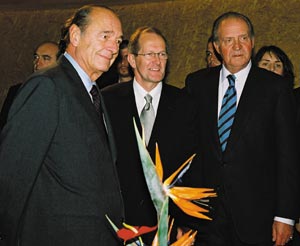
Juan Carlos, the King of Spain, Jacques Chirac, President of the Republic of France, and Joseph Deiss, President of the Swiss Confederation, were joined by delegations from member and observer states. Before the ceremony, Jacques Chirac visited the construction site for the CMS experiment in Cessy, France, and later he joined Joseph Deiss and Juan Carlos on a tour of the ATLAS cavern. Juan Carlos also took the time to meet many of CERN’s Spanish scientists.
Immediately before the ceremony, the heads of state and the delegations gathered in the recently erected Globe of Science and Innovation. This large, spherical building made entirely of wood was donated by the Swiss Confederation in honour of the 50th anniversary. In the Globe, which is as big as the dome of St Peter’s Cathedral at the Vatican, a multimedia presentation tailored to each country played while the representatives entered and signed the gilded visitor’s book.
Robert Aymar, director-general of CERN, began the series of speeches at the event. François de Rose, the sole surviving founder of the organization, gave a first-hand account of how CERN arose from the ashes of the Second World War. Also speaking were Federico Mayor, former director of UNESCO; Maria van der Hoeven, minister of education, culture and science of the Kingdom of the Netherlands (speaking on behalf of the president of the European Council, who was recovering from a severe illness); Robert Cramer, president of the Geneva State Council; and the heads of state, Joseph Deiss, Jacques Chirac and Juan Carlos. Enzo Iarocci, president of the CERN Council, closed the ceremony.
A common theme in the speeches was how CERN should continue to serve as a model of scientific rigour and international co-operation. Speakers pointed to how scientists at CERN have deepened our knowledge of nature, while also creating technologies of practical importance, such as new types of medical imaging equipment and the World Wide Web.
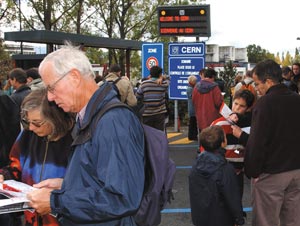
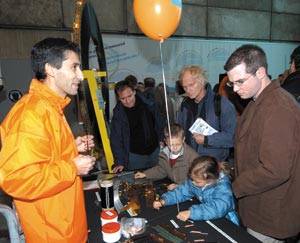
When CERN opened its doors to the public for its open day on 16 October, the laboratory took on the air of a county fair. Children took rides around the site in a big lorry, visitors ate ice cream that had been handmade in a flash using liquid nitrogen, and crowds strolled the lanes as they visited more than 50 events across various sites in Switzerland and France.
An estimated 32,000 visitors, from across Europe and beyond, flocked to the laboratory for a day of tours, displays and presentations. The majority of events were in experiment halls and workshops that are normally closed to the public. The last open day was in 1998, and this one attracted so many people that visitors had to wait in long lines at the main events.
Some of the biggest attractions were the huge detectors under construction for the Large Hadron Collider. Such tours helped the visitors gain a sense of the scale of CERN’s work – and even those who already had some notion of CERN were awed by the gigantic detectors, caverns, and tunnels.
Some of the attractions gave visitors a more direct feel for the science and technology behind research at CERN. In one hall, volunteers revealed the strange properties of matter at low temperatures with a miniature train levitated by a superconducting magnet, and demonstrated superfluidity in liquid helium. At the GridCafé, visitors could surf the Web and learn about the networks of computer centres that CERN is helping to organize. At another site, visitors gained hands-on experience assembling their own working cosmic-ray detectors.
In a letter to the European Cultural Conference in Lausanne, Switzerland, in December 1949, Louis de Broglie advocated “the creation of a laboratory or institution where it would be possible to do scientific work, but somehow beyond the framework of the different participating states”. Endowed with more resources than national facilities, such a laboratory could “undertake tasks, which, by virtue of their size and cost, were beyond the scope of individual countries”.
CERN, the European Organization for Nuclear Research, came into being five years later in 1954. Today, 50 years after its foundation, it is reassuring to see that CERN is building the largest and most powerful particle accelerator ever: the Large Hadron Collider (LHC). This 14 TeV proton-proton collider is at the cutting edge of technology, and is a heartening sign of both the public’s support for basic science in Europe and beyond, and of the determination of European countries to stay at the forefront of particle physics.
I have been asked to imagine what the next 50 years might hold for CERN and for particle physics. I shall take this opportunity to look into a very cloudy crystal ball, with the deep conviction that particle physics will continue to enrich culture and produce knowledge and technology as it has done for a large part of the last century.
In the medium term, CERN’s activities will be dominated by the LHC. By modifying the magnetic fields of the collider around the proton-interaction points, we can envisage a luminosity upgrade that would prolong the working life of the accelerator and extend the mass range for discovery. At a much higher cost we can even imagine doubling the collision energy by replacing the present LHC dipoles with higher-field magnets. Indeed, fully exploiting the LHC could easily take us to 2020 or 2025. As a result, there is little chance of CERN being involved in the construction of a 0.5-1 TeV linear electron-positron collider.
But what can we say about the more distant future of CERN, say from 2020 onwards, once the results from the LHC and, possibly, the linear collider are known? A linear collider with a length of several tens of kilometres could conceivably be built underground alongside the Jura mountains next to CERN. On the other hand, a big circular tunnel, such as that required by a Very Large Hadron Collider, would have to go below Lake Geneva or below the Jura (or both). Either option would be simply too expensive to consider. This is why a 3-5 TeV Compact Linear Collider (CLIC) would be the project of choice for the CERN site. A CLIC project could be launched in about 2015, when the LHC will be operating smoothly at its design luminosity, and data-taking could begin as soon as the early 2020s.
CLIC or a VLHC are enormous projects that will have to be undertaken through worldwide collaboration. But does this mean we should make a further step along the lines advocated 50 years ago by de Broglie and promote a world laboratory? This issue has been widely discussed, but in my view concentrating high-energy particle physics in a single laboratory with worldwide support is not a good idea. It would be too vulnerable to fluctuations in policy and mistakes in management. Moreover, it would not stimulate competition. My preference would be a coordinated global network that includes universities, national laboratories and regional laboratories like CERN and Fermilab.
The International Committee for Future Accelerators has considered the concept of a global accelerator network, although there is no consensus on what such a network might actually be or what it could do for us. As I see it, a global network would essentially be a new way of organizing existing particle-physics centres across the world, and focusing them on projects with a global dimension. For example, it would perform “diffuse” R&D on accelerators and detectors, co-operating on a single project at any one time and providing components for the machines and detectors.
Multinational companies are supposed to do what national companies cannot. Similarly, a global accelerator network only makes sense if it can achieve something that individual regions cannot do by themselves and, moreover, something that is essential to make real progress in particle physics. CLIC at CERN and the VLHC at Fermilab could be among the long-term goals of the global accelerator network, which would keep the world’s particle physicists busy until 2050. The transition to such a new organization would probably be similar to the shift in Europe from national laboratories to CERN – it would be difficult but worth trying.
Whatever the next 50 years hold for CERN and particle physics in general, it will almost certainly require countries to pool their resources and work together closely. Some 54 years since de Broglie’s letter inspired European scientists to build a single laboratory, his vision of basic science is still as relevant: “The universal and very often disinterested nature of scientific research seems to have predestined it for reciprocal and fruitful collaboration.”
by Hagen Kleinert, World Scientific. Hardback ISBN 9812381066, £84 ($138). Paperback ISBN 9812381074, £29 ($48).
This third edition is a significantly expanded version of the original textbook published in 1990. It includes, for the first time, explicit solutions of nontrivial quantum-mechanical systems, in particular the hydrogen atom.
by G W Gibbons, E P S Shellard and S J Rankin (eds), Cambridge University Press. Hardback ISBN 0521820812, £40 ($60).
Stephen Hawking’s 60th birthday was celebrated in Cambridge, UK, with a meeting attended by many well-known theoretical physicists. This volume is based on lectures given at the meeting. It begins with talks by Martin Rees, James Hartle, Roger Penrose, Kip Thorne and Hawking himself given at a public symposium that formed part of the conference. Subsequent chapters cover advanced presentations on space-time singularities, black holes, Hawking radiation, quantum gravity, M-theory, cosmology and quantum cosmology.
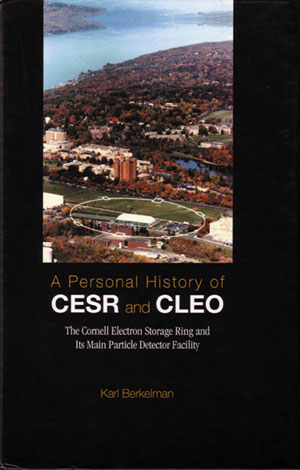
This slim volume relates in chronological order the main events in the story of the particle-physics laboratory at Cornell, from its foundation in the days when any major university would have the ambition and generally the means to found and run its own particle accelerator, to the present day, in which Cornell has the only front-rank accelerator not based in a national or international laboratory. The story of how Cornell survived and prospered as similar laboratories foundered is a fascinating one.
The Laboratory of Nuclear Studies was founded as faculty members of Cornell University, New York, returned from duties on the Manhattan Project in 1946. Shortly thereafter, the first director, Robert Bacher, left for the Atomic Energy Commission and Bob Wilson was hired from Harvard to replace him. The Cornell ethos that underpins the remarkable success of the laboratory emanates in large part from Wilson’s “can do” mentality and determination to cut out all frills and many corners in order to get the biggest “bang for the buck” spent on an accelerator. The faculty pitched in enthusiastically and became experts in a wide variety of techniques in both accelerator physics and analysis. After Wilson left to found Fermilab, “Mac” McDaniel continued his tradition of inspiring leadership, although with a very different style.
Berkelman himself took over in 1985, bringing his own style of modest, calm but inspirational leadership to the still-juvenile CESR machine and detectors. The book is the story not only of some remarkable accelerators, but also of a remarkable experiment, CLEO, as well as its sister experiment for many years, CUSB. Perpetually renewing itself as it passed from CLEO-I through various integers and half-integers to CLEO-III, the collaboration grew but always retained the very democratic outlook that Berkelman considers the secret of its success. This success is impressive indeed; in 2001, over half the entries in the PDG tables for B mesons and charmed mesons and baryons were established by results from CESR.
The success of a lab depends greatly on the personality of charismatic leaders, and in many ways this book is the story of three of them: Wilson, McDaniel and Maury Tigner. Tigner rides to the rescue at several moments of crisis in his predecessors’ reigns with a typically inspired technical solution or idea, and it is in his capable hands that the future of the laboratory now lies. Naturally, the book downplays the influence of Berkelman himself, which was large, but it makes clear the other important factor in Cornell’s success – the strength in depth in the faculty and the dedication of all the staff. Perhaps another visible thread throughout the narrative is the long-standing rivalry between SLAC and Cornell, always simmering below the surface and occasionally erupting in open contests such as the competition with the PEP machine and the discussions on the site for a US B-factory. Berkelman is illuminating on some of the factors he believes played a part in these decisions and the role of the National Science Foundation in steadfastly supporting the laboratory while perforce leaving it substantially free to run its own affairs.
Berkelman has a straightforward and clear style, and there are several interesting and enlightening illustrations. However, despite the claim in the preface that he tried “to broaden its accessibility to a wider audience” than particle physicists, it is difficult to believe that any such readers will be able to make much progress through the host of technicalities in both machine physics and particle physics that are inevitable in a book of this kind, and which indeed give it much of its value. On the other hand, physicists who either know and/or love the Cornell that is the real hero of this book, or who wish to discover the reasons behind its remarkable and in many ways unique success, will find much food for thought in this interesting and valuable exposition.
by C Bertulani and P Danielewicz, Institute of Physics Publishing. Paperback ISBN 0750309326, £40 ($60).
This graduate textbook is based on lectures given at Michigan State University. It leads the reader from basic laws to the final formulae used to calculate measurable quantities, and examines in detail different models of the nucleus and discusses their inter-relations. It combines a thorough theoretical approach with applications to recent experimental results.
CERN and the Joint Institute for Nuclear Research (JINR) in Dubna are celebrating their 50th anniversaries within a year and a half of each other. During the past 50 years both centres have become famous for their first-class achievements at the forefront of natural science – the origin and structure of the universe. Their fundamental results have been achieved through the joint efforts of scientists from many countries, who were united by one common goal – to gain new knowledge about nature and to enhance their understanding of it. At the same time these efforts have also helped bring together nations of widely differing cultures.
It was in 1949 at the European Cultural Conference in Lausanne, Switzerland, that the distinguished French scientist Louis de Broglie first proposed the idea for a European research laboratory: “…Our attention has turned to the question of developing this new international unit, a laboratory or institution where it would be possible to carry out scientific work above and beyond the framework of the various nations taking part…This body could be endowed with greater resources than those available to the national laboratories and could then embark upon tasks whose magnitude and nature preclude them from being done by the latter on their own.” The following year Isidor Rabi took up this theme at the Fifth General Conference of UNESCO (the United Nations Educational, Scientific and Cultural Organization), and a series of meetings held under the auspices of UNESCO led ultimately to the establishment of CERN in 1954 (CERN Courier October 2004 p11).
CERN has since evolved to become the world’s largest particle-physics laboratory, exploring some of nature’s most fundamental questions. Today CERN’s membership comprises 20 European countries, and more than half the world’s particle physicists use CERN’s facilities. This international collaborative effort has enabled CERN to become greater than the sum of its parts and a centre of excellence in research. Over the years the accelerator complex has allowed many discoveries by researchers at CERN, including in the 1970s the discovery of weak neutral currents and in the 1980s the W and Z bosons that carry the weak interaction. In the 1990s the Large Electron Positron collider (LEP), in a tunnel 27km in circumference and 100 m underground, contributed significantly to establishing the current Standard Model of particles and their interactions. Now LEP has been dismantled and the Large Hadron Collider (LHC) is being installed in its place.
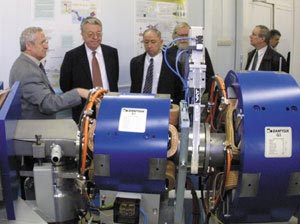
The LHC project, including its four major detectors, is being implemented by the efforts of more than 400 research laboratories from dozens of countries around the world. These include Russia, which as an observer state of CERN is actively participating in the LHC construction and experiment collaborations. Around 20 scientific institutions belonging to various agencies and more than 30 industrial enterprises from Russia are involved in the work on this large-scale project.
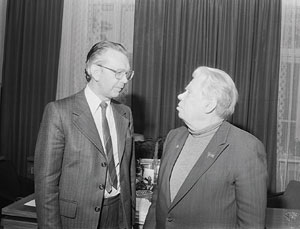
Russia also has its own succeess story in fundamental research and international collaboration. JINR, located in the picturesque town of Dubna on the bank of the Volga river, has been closely collaborating with CERN for nearly half a century. The first contacts began in the mid-1950s, immediately after the foundation of JINR in 1956, with conferences and the first visits of scientists. In 1958 the distinguished Russian physicist Nikolai Nikolaevic Bogoliubov, director of the JINR Laboratory of Theoretical Physics, suggested that there should be systematic exchanges of scientists between JINR and CERN. This idea was given impetus at an informal meeting on international co-operation in the field of high-energy accelerators held at CERN in 1959, which was attended by senior scientists from the US, Russia and Western Europe. In the 1960s and 1970s co-operation with CERN was developed further with the organization of joint seminars, summer schools for young scientists and a wider exchange of scientists.
During the 48 years of its existence JINR, like CERN, has played the role of a bridge between East and West, contributing to the development of international scientific co-operation among dozens of countries. Now JINR has scientific relations with nearly 700 research centres and universities in 60 countries.
In the early 1990s, after the disintegration of the USSR, JINR entered a new stage of its development. Eighteen countries became its member states, and bilateral agreements at governmental levels were concluded with Germany, Hungary and Italy. In 1992 JINR established an international scientific council, whose membership included leading scientists from the world’s largest research laboratories. Independent and international programme advisory committees were also established. For the first time representatives of the JINR member states have been able to indicate which specific fields of research were for them the most interesting and important.
JINR today offers a unique choice of experimental facilities: the Nuclotron, which is the only superconducting accelerator for nuclei and heavy ions operating in Russia; the U400 and U400M cyclotrons with record beam parameters, which are used for experiments on the synthesis of heavy and exotic nuclei; the unique pulsed neutron reactor IBR-2, and the Phasotron, a proton accelerator used for hadron therapy. JINR also has powerful and high-performance computing facilities integrated into the global computing network.
As a recognition of the achievements of JINR’s research staff, in 1997 the International Committee of Pure and Applied Chemistry awarded the name “Dubnium” to element 105 of the periodic table. The international scientific community was impressed by the experiments carried out during 1999-2003 at the U400 cyclotron of the JINR Flerov Laboratory of Nuclear Reactions on the synthesis of new elements with atomic numbers 114, 116, 118, 115 and 113. Today JINR is a world-recognized leader in this area of research.
In the past few years the positive experiences accumulated by CERN and JINR in overcoming political barriers through mutually beneficial scientific co-operation has been succeessfully used in the development in Jordan, again under the auspices of UNESCO, of a new international centre for research and advanced technology “in the image and likeliness of CERN and JINR”. The Synchrotron light for Experimental Science and Applications in the Middle East (SESAME) project will produce synchrotron radiation over a broad range of wavelengths from the infrared to X-rays, with various fields of application (CERN Courier November 2002 p6). Its participants include Israel, the Palestinian National Authority, Iran, Jordan, Turkey, Egypt and other countries. The president of the council of the SESAME centre is German physicist Herwig Schopper, who is playing the key role in the realization of this project. In the past Schopper served as CERN director-general (1981-1988), and was president of the European Physical Society (1994-1996) and a member of the JINR Scientific Council (1993-2002). He was awarded the Russian Order of Friendship in 1997.
The establishment of the new international SESAME centre will not only make a significant contribution to the scientific, technical and economic development of the Middle East countries but will also undoubtedly promote the coming together of the people of this region, the mutual understanding of people with different traditions, religious and political views, and, hopefully, the peaceful settlement of existing conflicts.
SESAME is thus set to continue the tradition of co-operation begun by CERN and JINR, who are justly called a “permanently operating peace congress”, as they have never stopped their extensive collaboration, even during the gloomiest years of the Cold War. Today, the world at large recognizes that the major merits of JINR and CERN are not only their remarkable achievements in the field of basic science but also their extremely important contributions to the rapprochement and understanding among nations. By their practical activities over the decades these two international laboratories have proved that the fundamental principles that were declared at their foundation, namely the openness and peaceful nature of joint scientific research, the equality of all member states, and wide applications of scientific results for the benefit of mankind, have turned out to be most profound, humane and promising for the future.
To provide the best experiences, we use technologies like cookies to store and/or access device information. Consenting to these technologies will allow us to process data such as browsing behavior or unique IDs on this site. Not consenting or withdrawing consent, may adversely affect certain features and functions.
Functional
Always active
The technical storage or access is strictly necessary for the legitimate purpose of enabling the use of a specific service explicitly requested by the subscriber or user, or for the sole purpose of carrying out the transmission of a communication over an electronic communications network.
Preferences
The technical storage or access is necessary for the legitimate purpose of storing preferences that are not requested by the subscriber or user.
Statistics
The technical storage or access that is used exclusively for statistical purposes.The technical storage or access that is used exclusively for anonymous statistical purposes. Without a subpoena, voluntary compliance on the part of your Internet Service Provider, or additional records from a third party, information stored or retrieved for this purpose alone cannot usually be used to identify you.
Marketing
The technical storage or access is required to create user profiles to send advertising, or to track the user on a website or across several websites for similar marketing purposes.