Comsol -leaderboard other pages

Topics

Wisdom generation in the Alps: a student’s tale

“Seventy per cent of today’s successful particle physicists have attended this school – which means you have a high chance to be one of them in the future,” says a joyful Egil Lillestøl as he welcomes us to the 2005 European School for High Energy Physics. Instantly more than 100 glasses rise, accompanied by a cheerful applause. We all feel lucky to be here.
CCEsum1_11-05

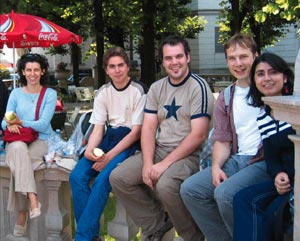
We are in Kitzbühel, a peaceful town with green and beautiful surroundings in south-west Austria, to witness a curious learning experience and to contribute to its spirit as much as we can. The first evening’s dinner sweeps away any clouds of anxiety we might have, and observations of the first encounters have provided more than 5σ evidence of a great event.

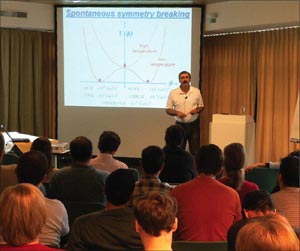
On the first morning, just as rain is refreshing the beauty of the mountains outside, the overhead projector starts to light up the first fields and interactions on the screen. Wilfried Buchmüller from DESY provides us with the most fundamental piece of knowledge we will ever need – the Standard Model itself. The school’s academic programme is like a perfect PhD Student’s Guide to High-Energy Physics, as if to advise “don’t panic” in the wide and diverse realm of this exciting subject, “we will show you the route”.

CCEsum3_11-05

Our appetite for learning grows as cosmology slowly makes peace with precision in the lectures by Rocky Kolb from Fermilab. He calmly strides through the whole universe, from its brilliant but furious past to its settled and gloomy present, from its simply overwhelming dark side to its modest but comforting light side.
CCEsum4_11-05

Then enters Larry McLerran from Brookhaven, who introduces us to the colour glass condensate and the quark-gluon plasma, which happen to be two rather unusual forms of strongly interacting matter. He tells us the ancient tales of the good old days when quarks and gluons used to enjoy their freedom, and how the Relativistic Heavy Ion Collider came along at Brookhaven with the aim of capturing a few memories of such eras. On the other hand, Gerhard Ecker from Vienna draws a somewhat more familiar portrait of strong interactions as he systematically goes through quantum chromodynamics, explaining the usual quarks and gluons, and showing the remarkable detail hidden behind even the simplest approaches in this theory.

The evenings call for our creativity in the discussion sessions (which might also be considered as gentle warnings for us to stay awake during the lectures). Having received our daily lecture notes we are divided into six discussion groups, where we are supposed to make an account of the day’s learning and remove any obscurities in the lectures. Encouraged by the friendly attitudes of our discussion leaders, who are all young and willing theorists, and of the visiting lecturers, any shyness disappears and the first hints of inspiration begin to appear as ideas, questions and comments bravely make their way into the discussions.

It is now Thursday night and the poster session begins, transforming modest students into proud physicists who share the outcomes of their current research with great skill and enthusiasm. As well as discovering new ideas, we also see some different approaches to familiar subjects. For example, as someone who wrote an MSc thesis on the analysis of miniature black holes in the CMS experiment at CERN, I am delighted to come across a poster on a similar study for ATLAS. I discover that our friends from Oxford suffered the same problems we did, and so over discussions we decide to support each other in any future studies of these ruthless objects. Best of all though, is to have the vision that through all of these diverse contributions the goals of physics today can indeed be fulfilled.

The sound of music

But it’s not all work. We also have enough time to answer the irresistible call of the great Alps or to relax in the pleasant atmosphere of the historic town of Kitzbühel. On Saturday we visit Salzburg, the town enchanted by the graceful hand of Mozart.

The second week brings new lectures and new lecturers. After convincing us that Buchmüller’s Standard Model is fine but definitely insufficient, John Ellis from CERN goes on to reveal the vast worlds beyond, which are ruled by brilliant scientific imagination, with of course some rightful emphasis placed on the unavoidable elegance of supersymmetry. His presence is an invaluable gift, especially for me, as my current research happens to be on supersymmetric dark matter. Inspired by his lectures, as devoted experimentalists, we even go on a dangerous quest for dark matter on the nearby Schwarzsee at night.

Later, Robert Fleischer, also from CERN, explains how a nasty complex phase destroyed the beautiful CP symmetry and introduced some excitement into our universe, which would otherwise be less interesting; and how it also caused a few headaches among the physicists trying to explore the rich phenomenology of the Cabibbo-Kobayashi-Maskawa matrix and its unitarity triangles. We then discover some “CP violating terms” in the local organizing committee as two of its members from Vienna, Manfred Jeitler and Laurenz Widhalm, in addition to their efforts to offer us an outstanding experience, present lectures on experimental aspects of B- and K-physics, respectively. Then Manfred Lindner from Munich describes the ghostly neutrinos and the many consequences of their mischievous behaviour, and gives a long list of the global endeavours to discover their nature experimentally.

There are even some lectures not on particle physics. Wolfram Müller from Graz gives instructions on the physics of ski jumping, which seems quite appropriate in Kitzbühel, and Herbert Pietschmann from Vienna shows us our fate on the way to knowledge in his delightful lecture on physics and philosophy.

Meanwhile, the interactions increase, just as predicted by the famous “Summer Student Group Theory”. Although we have grown up under the strict hands of scientific work, the children within us still seek fun and adventure. We make the most of a colourful international community formed without prejudices and borders. The coffee breaks, which seemed a little long in the beginning, now fly swiftly by with cheerful conversations. I feel a significant improvement in my debating skills, especially after all the “SUSY and beyond” discussions with several expert theorist friends.

Grand finale

However, the inescapable end is close. In order to avoid becoming too melancholy and to create a glorious finale, we amalgamate all our creativity in preparing an unforgettable farewell night. This time we are on stage, giving so-called lectures on “serious subjects” (that cannot be mentioned here!), singing, acting and doing all sorts of things to entertain our audience. But finally we have to say difficult goodbyes to all of our friends (yes, we are friends now), and leave the cosy Hotel Kitzhof, where our hosts, through their patience and goodness, have somehow managed to survive our two-week occupation.

I know that all of us share the same feeling of gratitude towards everyone who made this school possible. I am especially indebted, as a student coming from an observer state who had the privilege of being supported through the generosity of CERN. We are greatly thankful for the endless support and kindness we received from Egil Lillestøl (CERN schools director), Danielle Métral (CERN schools secretary), Tatyana Donskova (JINR schools secretary), all the local organizers plus all the other representatives of CERN and JINR who were with us during the school. We have been thoroughly enriched as a result of their sincere efforts. This worthy tradition must continue, as long as physics has new puzzles to offer us and as long as we can respond through willing fresh minds.

CERN and Poland sign agreement

On 29 July, the rector of the AGH University of Science and Technology in Cracow, Ryszard Tadeusiewicz, and CERN’s director-general, Robert Aymar, signed a collaboration agreement relating to the commissioning of the instrumentation and monitoring equipment for the cryogenic system of the Large Hadron Collider (LHC). A team consisting of 12 physicists, engineers and technicians from the AGH University will assist teams at CERN in commissioning the cryogenic system in the tunnel.

CCEnew2_10-05

This is the first in a series of agreements that will relate to the commissioning of the LHC’s various systems. From the end of this year until the summer of 2007, CERN will enlist the aid of physicists, engineers and technicians from many different institutes in order to complete the tasks associated with the start-up of the accelerator.

Masterclass spreads the word for physics

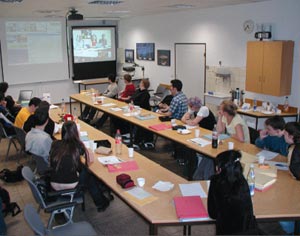
The videoconference between centres

Particle-physics masterclasses began in the UK in 1997, the centenary of J J Thomson’s discovery of the electron. It was then that Ken Long of Imperial College and Roger Barlow of Manchester devised a series of one-day events for 16- to 19-year-old pupils and their teachers. Run by particle physicists at various institutes all over the UK and coordinated by the High Energy Particle Physics Group of the Institute of Physics, each year the programme offers a very popular combination of exciting talks and hands-on experience of the interactive graphical display programs that particle physicists use at CERN. More recently, the concept of the particle-physics masterclasses has been successfully adopted by several institutes in Belgium, Germany and Poland on a regular basis.

The World Year of Physics 2005, commemorating Einstein’s annus mirabilis, was the inspiration for the particle-physics masterclasses to spread even further. It was just enough to mention the idea of a Europe-wide version of this programme for all the members of the European Particle Physics Outreach Group (EPOG) to come on board and try to get institutes in their countries involved. EPOG promotes the outreach activities of particle-physics institutes and laboratories in CERN’s member states and acts as a forum for the exchange of ideas and experiences related to particle-physics outreach. Fifty-eight institutes in 18 countries across Europe, from Athens to Bergen and from Lisbon to Helsinki, participated in the masterclass event, which was centrally coordinated at Bonn University.

The basic idea of the pan-European event was to let the students work as much as possible like real scientists

As with the original masterclasses, the basic idea of the pan-European event was to let the students work as much as possible like real scientists in an authentic environment at a particle-physics institute, not only to feel the excitement of dealing with real data, but also to experience the difficulties of validating the scientific results. After lectures from practising scientists they performed measurements on real data from particle-physics experiments, and at the end of each day, like in an international collaboration, they joined in a videoconference for discussion and combination of the results.

The measurement of the branching ratios of Z boson decays at CERN’s Large Electron-Positron Collider (LEP) was chosen as the main common task at all sites. For this the students had to identify the final states of quark-jets, electron pairs, muon pairs and the notoriously difficult tau pairs from the tracks and signals in various components of LEP detectors. Interactive computer material for this task was available using data from OPAL in the Identifying Particles package from Terry Wyatt at Manchester, or alternatively using DELPHI data in A Keyhole to the Birth of Time by James Gillies and Richard Jacobsson at CERN or in the well known Hands-on-CERN package developed by Erik Johansson of Stockholm.

To simplify students’ access to the unfamiliar world of particle physics, EPOG and the national institutes undertook the immense effort of translating the material into various languages. By the beginning of March, each package was available in at least one of 16 languages, with Hands-on-CERN now covering 14 languages, from Catalan to Slovak. This material, including real data for performing the measurements and several extra teaching and learning packages, lays the basis for regularly performing masterclasses at a European level, and is also of valuable use outside the masterclasses. It is available on the Internet and on a CD that was given to each masterclass participant.

Graph of Students Feedback

The skills required to become a “particle detective” were taught in the morning lectures at each institute. Since in most countries particle physics is not normally taught at school, the talks had to go all the way from basic explanations to the world of quarks and leptons. “Easy-to-follow explanations of scientific research” was the immediate reaction of one of the students at Berlin. After some brief training by young researchers from the institute, the students made the fascinating discovery that they were indeed able to identify the elementary particles on the event displays themselves, at least in most cases; it was even more fascinating for them to learn that professional scientists cannot be completely sure either on an event-by-event basis that their identification is right. The exercise was in fact usually performed quite quickly: “What next?” was a frequent demand once the Z-decays were measured.

Another innovative idea of the EPOG European Masterclasses was to hold an international videoconference at the end of each day using the same Virtual Room Videoconferencing System (VRVS) technology as practising scientists. CERN’s IT Department and the Slovak group of the Caltech VRVS team provided valuable technical help for the many institutes that had never used this tool before. The link-up was centrally moderated by two inspiring young researchers at CERN: Silvia Schuh from ATLAS, and Dave Barney from CMS (who recently received the 2005 Outreach Prize of the High Energy and Particle Physics Division of the European Physical Society). Using English as a common language, the students discussed why, for instance, classes in Helsinki and Vienna found significantly more taus than those in Innsbruck, Heidelberg, Bonn or Bergen. They then assigned systematic errors derived from the differences and ended up with combined measurements, confirming (happily!) the results from LEP. In addition invited scientists at CERN were ready to answer further questions on topics ranging from antimatter and Big Bang cosmology to the daily life of a CERN researcher.

The videoconferences made the students aware that the masterclasses were taking place in other countries, and created the feeling of an international collaboration of researchers. It was “interesting to learn how scientific information is exchanged around the globe”, according to one of the comments on the feedback questionnaires, which are currently being evaluated by the Leibniz Institute for Science Education (IPN) at the University of Kiel.

How was it for you?

The first results from the evaluation show that, independent of country and gender, some 70% of about 400 female and 900 male students felt strongly or very strongly that they had learned at the masterclasses how scientific research is organized and carried out. More than 81% liked the masterclasses “much” or “very much”, again independent of gender. Moreover, there was significantly higher enthusiasm in Finland, Portugal and the Czech Republic with 96% choosing “much” or “very much”, which can mostly be attributed to particularly interesting lectures and a bigger increase in knowledge of particle physics.

Graph of students feelings

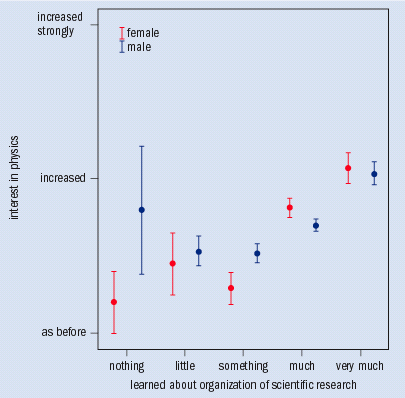
The impact on the student’s interest showed greater spread between the countries. On average 58% of both male and female students felt that they were generally more interested in physics after the masterclasses, and only 6% were less interested. Again, the masterclasses had a significantly stronger impact in Portugal and Finland, with 86% and 95% of students respectively reporting increased interest. In two countries the female participants benefited especially. While the male participants showed no significant deviation from the average, 78% of the Italian girls and all seven female students in Sweden reported an increased interest in physics. The Swedish girls unanimously marked the highest possible increase in their knowledge of particle physics, and felt more strongly than average that they had learned about the organization of scientific research. For all students both factors correlated very strongly with positive answers to the question on increased general interest in physics (see figure 1). Apart from this, the reactions of the female and male students to the masterclass programme were nearly identical, although in all countries the girls said they thought they knew significantly less about physics than the boys and were significantly less familiar with computers.

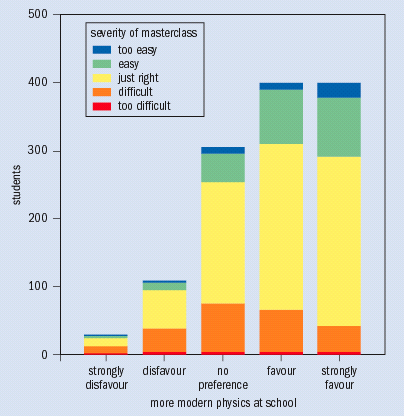
Finally, regardless of whether they like their current physics lessons at school, 65% of the students thought that modern physics, like particle physics, should play a bigger part in their science lessons (see figure 2). This question showed the largest variation between the countries. The majority was significantly higher, for example, in Germany, with 75% of the students responding positively, and Portugal with 91%. In Switzerland and Norway, by contrast, not even 30% of the students clearly supported this statement. In the latter two countries more than half of the students found the level of the masterclasses rather difficult, while on average only 19% shared this opinion.

“I got the feeling that I did something which physicists do every day in their experiments, and I felt involved.” This statement from a 17-year-old girl shows that the authentic surroundings and the measurements with real data were indeed able to bring modern physics close to the hearts of young people.

• For more details about the event and materials see http://wyp.teilchenphysik.org. The European Masterclasses were sponsored by the High Energy Physics Board of the European Physical Society and the Bundesministerium für Bildung und Forschung (BMBF), and received organizational help from the German Science-on-Stage Executive Office. The EU has acknowledged the success of the first European Masterclasses by nominating the project leader, Michael Kobel, for a Descartes Prize for Excellence in Science Communication for 2005. The project is now competing with 22 other nominees for up to five Descartes Communication Prizes, to be awarded in December in London.

HELEN network unites Europe and Latin America

After I became director-general of CERN in 1999, I had the chance to meet Juan Antonio Rubio, a well known experimental physicist and former collaborator of Carlo Rubbia and Samuel Ting, who is now the director-general of CIEMAT, Spain. In addition to his other good qualities, Rubio has a deep knowledge of Latin America – her people, schools and traditions. We understood that the Large Hadron Collider (LHC) being built at CERN offered a great opportunity to renew old ties with Latin America and to attract to Europe and CERN a new generation of experimental physicists.

CCEhel1_10-05

In the past, ties between European and Latin American particle physics had been very strong, involving well known physicists such as Cesar Lattes, José Leite Lopez, Roberto Salmeron and many others. Lately, however, Latin American experimental physicists had turned to the US, and Fermilab in particular, as their main point of contact in particle physics. The US had opened up to them and to their students under the enlightened action of Nobel prize-winners such as Richard Feynman, whose stay in Brazil had an enormous influence on the development of fundamental physics there, and Leon Lederman. On the other hand, theoretical physicists in Latin America had always considered CERN as one of their main poles of interest (together with the International Centre for Theoretical Physics, Trieste) with physicists of the calibre of John Ellis, Alvaro de Rújula and Luis Alvarez Gaumé being particularly friendly to Latin Americans.

CCEhel2_10-05

The first step towards rebuilding the relationship with Latin America was launching a biannual CERN-Latin American school of physics. I discussed the matter with Egil Lillestol at the 1999 European School of High-Energy Physics in Bratislava, and we concluded that the conditions were right to go ahead. The first Latin American school, modelled on CERN’s long-standing European School of High Energy Physics, was held two years later in Itacuruça, Brazil. It was a clear success, demonstrating the interest of the younger Latin American generation in European physics, CERN and the LHC.

CCEhel3_10-05

At the same school, I also saw first-hand a strong interest going in the other direction, with European physicists curious about the Pierre Auger Observatory, the ultra-high-energy cosmic-ray detector being built in Argentina. Indeed, as I learned at Itacuruça, the sum of contributions to the project from CERN member states was already larger than the contribution made by the US via the Department of Energy, a nation historically considered the main partner of Latin American countries.

The first Latin American School of High Energy Physics marked the beginning of a new collaboration, but during the following years the problem was how to keep the collaboration going, in view of the difficulties that were arising from financing the LHC. In late summer 2003, Philippe Busquin, the EU commissioner for research whom I had asked for support, pointed out that a programme from the EU Commission, América Latina – Formación Académica (ALFA), was the natural framework for stabilizing relations between CERN and Latin America, by taking advantage of the potential for training young physicists that the LHC offered.

CCEhel4_10-05

Rubio and I quickly got the message and started to prepare an application to ALFA. Fortunately, another lucky circumstance made the enterprise possible. Verónica Riquer, a former student of Marcos Moshinsky (a well known nuclear theorist from Universidad Nacional Autónoma de México, UNAM), was a postdoctoral fellow in CERN’s theory division. A good friend of Rubio, Riquer somehow knows everybody doing physics anywhere in Latin America, and even has a clear idea of what they are actually doing.

Riquer enthusiastically adopted the project that was going to have a big impact on her for the next few years (“HELEN nos va matar” she warned me in the difficult periods – “HELEN is going to kill us!”). Indeed, she proved the crucial person to connect with high-energy physics groups in Latin America, to get them involved in the hard work of preparing a valid application to the (notoriously difficult) EU Commission and, finally, to convince so many people on a different continent to persuade 22 rectors to sign an agreement with the EU at very short notice. Eventually, the full application was finished during the night of 29 April 2004, and taken by hand to Brussels the following morning, complying exactly with the deadline of 30 April 2004. Riquer left CERN to see her family in Mexico, and Rubio and I could relax. The High Energy Physics Latin-American-European Network (HELEN) now existed.

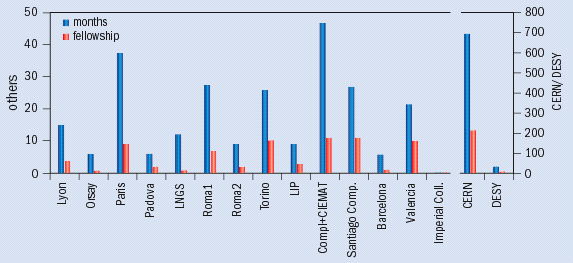
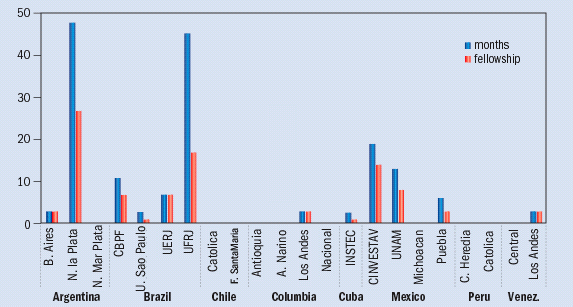
HELEN is a big project. Over three years, it will involve stays in Europe totalling 1002 months (70% at CERN) for students and young researchers from 22 institutions across eight countries in Latin America, and stays in Latin America totalling 164 months for physicists from seven European countries (about 50% at the Pierre Auger Observatory). In addition, some 15% of the budget is dedicated to visits from professors in the network, to give seminars, oversee students and start new collaborations. Each institution has one reference person (the “interlocutor”), among them Arnulfo Zepeda in Mexico, Alberto Santoro in Brazil and Teresa Dova in Argentina. All in all, we expect a whole new generation of Latin American physicists to be trained in particle physics at the most advanced facilities in the world, and to establish new ties with their European peers.

On a happy day last February, we received the news that HELEN had been approved and that we could start discussing the practical implementation of the contract. In fact, at the time I was in Mexico, spending two months at the Centro de Investigación y Estudios Avanzados del Instituto Politécnico Nacional (CINVESTAV). There, I could see first-hand the enthusiasm that HELEN was raising in Latin America. In the few months since HELEN’s approval, we have had to refine the project and make it suitable for a contract between the EU and the Università di Roma “La Sapienza”, the coordinating institution of HELEN. However, at last, the contract was signed on 28 July and the project officially started on 1 August.

When physics needs the public

Decision-making in high-energy elementary particle-physics research is usually highly technical, sometimes political, and often very passionate. And now, in the 21st century, scientists have come to realize that the public not only has the right to know what science we do, but should also be involved in many decisions of that scientific work. This is precisely what the particle-physics community has set out to accomplish with the design process and creation of the world’s next big particle accelerator.

CCEvie1_10-05

Outside of space exploration, it is sometimes assumed that large populations are not interested in science, but the International Linear Collider (ILC) is an accelerator that will collide particles of matter and antimatter to help solve some of the true mysteries of the quantum universe. So how can the public be involved in the design of such a complex facility?

In August, I was among the nearly 700 participants in the 2005 International Linear Collider Physics and Detector Workshop held in Snowmass, Colorado. A number of my colleagues around the world engaged in the global design effort have been studying the technical issues and understanding the limitations of the proposed facility for some years. Now, in addition to the physics, a communications group is focusing on how this facility will affect the public when completed, and how physicists should communicate our work to decision-makers and the public.

In many scientific disciplines, the research community often communicates to the public on laboratory experiments by reporting the benefits after the designs are completed, during the building of the apparatus (if any), and after the research results are assembled. For the ILC project, communication was a high priority from the very beginning. At the ILC workshop, Judy Jackson of the Fermilab Office of Public Affairs and a member of the ILC Communication Group invited Douglas Sarno, head of The Perspectives Group, Inc. of Alexandria, Virginia, to lead a seminar on the public-participation process.

At the seminar, Sarno instructed us on elements of the process: identify members of the public and the “stakeholders”; examine and include the public values; and seek input from all sides when issues arise. He helped us recognize the benefits of this effort in general, and showed how real participation in the process leads to decisions.

There can be a range of participation in this process, from minimal participation where the public is informed only of the general scientific goals and information, to the other end of the spectrum where the final decision on the project implementation is in the hands of the public. The former can be accomplished by reading materials, websites, public lectures and personal contacts, while the latter might additionally require ballots, elections, citizen referendums or chief-executive initiatives. For the ILC, the specifics of the ideal public-participation process lie somewhere in between, and of course input from the public is required to find the right level. When we think about access to materials, land use, ecology and economic impacts due to the resources that are required, large scientific projects are never isolated from the public.

I am now convinced that the ILC project will benefit from a high level of public participation. Because of the very long tradition of international participation in particle-physics research, and the international character of this project, the public-participation process should include all the countries and regions contributing to the project, taking into account the role of local communities. I believe our discussion helped those participating in this seminar gain a broader view of how the decisions concerning the ILC might include a public perspective, independent of region.

However, the ILC is a complex facility and the science that motivates the need for this facility is equally complex, which of course means that decisions are multifaceted and interwoven primarily with physics issues. Nevertheless, a host of other considerations and opportunities will include resource and design issues, communication, organization, a construction timeframe, the world-community effort and – usually before any actions – a decision. The level at which the public is included in this decision process could also be viewed as a complex question.

My experience in public communication leads me to conclude that involving the public early in the design and description of our scientific research, and continuing that involvement, is crucial to an effective partnership between the public and the scientific proponents of our research. Although it is a noble goal to teach particle physics to the public and government leaders, this may not always be necessary. It is important to convey the excitement and the impact of the ILC project on society, and to earnestly listen to the response of policy-makers and members of the public about all of our science. It is vital to gain and sustain the trust of the public, so that the inevitable changes in this research project will be embraced and perhaps even understood as a regular component of fundamental research.

Pulsed Power

by Gennady A Mesyats, Springer. Hardback ISBN 0306486539, 7227 (£157, $249).

978-0-306-48654-8

Meysat provides an in-depth coverage of the generation of pulsed electric power, electron and ion beams, and various types of pulsed electromagnetic radiation, with a wide range of methods for producing up to 1014 W of power for pulse durations from 10-10 to 10-7 s. The physics of pulsed electrical discharges, properties of coaxial lines, spark gap switches, various plasma and semiconductor switches and their use in pulse generators are covered, as well as the production of high-power pulsed electron and ion beams, X-rays, laser beams and microwaves.

Foundations of Modern Cosmology (Second Edition)

by John F Hawley and Katherine A Holcomb, Oxford University Press. Hardback ISBN 9780198530961, £33.99.

51tnWAdloRL._SX375_BO1,204,203,200_

The new edition of this thorough, descriptive introduction to the physical basis for modern cosmological theory includes the latest observational results and provides the background material necessary to understand their implications, with a special focus on the concordance model. Emphasis is given to the scientific framework for cosmology, beginning with the historical background and leading to an in-depth discussion of the Big Bang theory and the physics of the early universe.

Quaternions, algèbre de Clifford et physique relativiste

par Patrick R Girard, Presses Polytechniques et universitaires romandes. Broché ISBN 288074606X, 68CHF (€45.50).

978-2-88074-606-3

Ce livre propose une introduction pédagogique à ce nouveau calcul, à partir du groupe des quaternions, avec des applications principalement dans les domaines de le relativité restreinte, de l’eacutelectromagn&eacutetisme classique et de la relativité geacuteneacuterale. C’est le premier ouvrage sur le sujet reacutedigé en langue française depuis près de 30 ans. Il s’adresse aux eacutetudiants, professeurs et chercheurs en physique et en sciences de l’ingeacutenieur.

Meacutethodes quantiques: Champs, N-corps, diffusion

par Constantin Piron, Presses Polytechniques et universitaires romandes. Broché ISBN 2880746116, 42CHF (7euro28).

71RdxWUJz2L

Cet ouvrage constitue une introduction à la theacuteorie des champs quantiques très diffeacuterente des exposeacutes habituels le plus souvent formels. Reacutedigé par l’un des speacutecialistes francophones en la matière, il est particulièrement clair et didactique, illustré de nombreux exemples et exercices corrigeacutes.

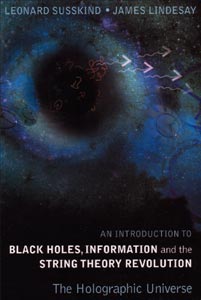
An Introduction to Black Holes, Information and the String Theory Revolution: The Holographic Universe

by Leonard Susskind and James Lindesay, World Scientific. Hardback ISBN 9812560831, £17 ($28). Paperback ISBN 9812561315, £9 ($14).

Black holes have attracted the imagination of the public and of professional astronomers for quite some time. The astrophysical phenomena associated with them are truly spectacular. They seem to be ubiquitous in the centre of galaxies, and they are believed to be the power engines behind quasars. There is little doubt of their existence as astronomical objects, but this very existence poses deep and unresolved paradoxes in the context of quantum mechanics when one tries to understand the quantum properties of the gravitational field.

CCEboo1_10-05

For many readers, the title of this book may sound odd because the contents have little to do with the astrophysical or observational properties of black holes. If you look for nice pictures of galaxy centres and gamma-ray bursts, you will find none. If, however, you are looking for the deep paradoxes in our understanding of quantum-field theory in nontrivial gravitational environments, and the riddles encountered when trying to harness the gravitational force within the quantum framework, then you will find plenty.

At the end of the 19th century, Max Planck was confronted with serious paradoxes and apparent contradictions between statistical thermodynamics and Maxwell’s electromagnetic theory. The resolution of the puzzle brought the quantum revolution. When Albert Einstein asked himself what someone would observe when travelling at the same speed as a light beam, the answer revealed a fundamental contradiction between Newtonian mechanics and electromagnetic theory.

The resolution of these problems led to the relativity revolution, first with special and then general relativity. Sometimes experiment itself is not the only way towards progress in our understanding of nature. Conceptual paradoxes often provide the way to a deeper view of the world.
In the 1960s, largely due to Roger Penrose and Steven Hawking, it became understood that under very general conditions, very massive objects would undergo gravitational collapse. The end state would be a singularity of infinite curvature in space-time shrouded by an event horizon – the last light surface that did not manage to leave the region. The horizon is a profoundly non-local property of a black hole that cannot be detected by local measurements of an unaware, infalling observer.

Classically, black holes were supposed to be black. However, in the early 1970s Jacob Bekenstein and Hawking showed that black holes must necessarily have very unsettling properties. As Bekenstein argued, if the second law of thermodynamics is supposed to hold, then an intrinsic entropy must be assigned to a black hole. Since entropy measures the logarithm of the number of available states for a given equilibrium state, it is logical to ask what these states are and where they came from.The entropy in this case is proportional to the area of the black-hole horizon measured in Planck units (a Planck unit of length is 10-33 cm). This is vastly different from the behaviour of ordinary quantum-field theoretic systems.

Meanwhile, Hawking showed that if one considers the presence of a black hole in the context of quantum-field theory, it radiates thermally with a temperature inversely proportional to its mass, so the hole is not black after all. If the radiation is truly thermal, this raises a fundamental paradox, as Hawking realized. Imagine that we generate a gravitational collapse from an initial state that is a pure state quantum-mechanically. Since thermal radiation cannot encode quantum correlations, once the black hole fully evaporates it carries with it all the subtle correlations contained in a pure quantum state. Hence the very process of evaporation leads to the loss of quantum coherence and unitary time evolution, two basic features of quantum-mechanical laws.

These puzzles were formulated nearly 30 years ago and they still haunt the theory community. It was, nevertheless, realized that resolving these puzzles requires deep changes in our understanding of both quantum mechanics and general relativity, and also a profound modification of the sacrosanct principle of locality in quantum-field theory.

This book is precisely dedicated to explaining what we have learned about these puzzles and their proposed solutions. Assuming that some of the basic features of quantum mechanics (such as unitary evolution) and general relativity (such as the consistency of different observers’ observations, no matter how different they may be) do indeed hold, the authors analyse the conceptual changes that are required to accommodate strange phenomena such as black-hole evaporation.

In the process, they masterfully present a whole host of subjects including quantum-field theory in curved spaces; the Unruh effect and states; the Rindler vacua; the black-hole complementarity principle; holography; the Maldacena conjecture and the role of string theory in the whole affair; the notion of information in quantum systems; the no-cloning theorem for quantum states; and the general concept of entropy bounds.

A remarkable feature of this book is that relatively little specialized knowledge is required from the reader; a cursory acquaintance with quantum mechanics and relativity is sufficient. This is impressive, given that the authors cover some of the hottest topics in current research.

The technical demands are low, but conceptually the book is truly challenging. It makes us think about many ideas we take for granted and shakes the foundations of our understanding of basic physics. It provides a rollercoaster ride into the treacherous and largely uncharted land of quantum gravity. This book is highly recommended for those interested in these fascinating topics.

The authors end with the sentence: “At the time of the writing of this book there are no good ideas about the quantum world behind the horizon. Nor for that matter is there any good idea of how to connect the new paradigm of quantum gravity to cosmology. Hopefully our next book will have more to say about this.” We hope so too.

bright-rec iop pub iop-science physcis connect