Physicists in Germany will soon be able to strengthen their role in the international quest to understand the fundamental laws of nature. On 15 May, the Senate of the Helmholtz Association of German Research Centres announced that it will grant €25 m in funding over the next five years to support the Helmholtz Alliance, Physics at the Terascale, in a proposal led by the DESY research centre. In this alliance, DESY – together with Forschungszentrum Karlsruhe, 17 universities and the Max Planck Institute for Physics in Munich – will bring together existing competencies in Germany in the study of elementary particles and forces.
At the same time, the Helmholtz Alliance will provide the basis to drive technological advancement in a much more focused way. This new initiative comes at a time when German particle physicists are making large contributions to international collaborations at particle accelerators, such as the LHC at CERN, and a future International Linear Collider.
Alliance funds will finance more than 50 new positions for scientists, engineers and technicians during the initial five-year period. Junior scientists, in particular, will be given the opportunity to lead research groups with options for tenure positions. This is intended to open up attractive new perspectives for a future career in particle physics. Joint junior positions at all partner institutes, coordinated recruitment and teaching substitutes for researchers who are abroad will together provide a framework where it is possible for scientists to work away from their home institutes at large-scale international research centres without interfering with teaching provision.
The new network will enhance collaboration between universities and research institutes in data-analysis fields and the development of new technologies. Particular support will be given to the design of new IT structures, as well as detector and accelerator technologies that are of central importance for the sustainable development of particle physics in the future.
As a member of the alliance, DESY will offer its facilities for testing and development of detector and accelerator technology, and 10 Helmholtz Alliance positions will be opened at the laboratory. An analysis centre for LHC data will also be established at DESY.
In another major development, Council approved a programme of additional activities together with the associated budget resources. This decision follows the definition of the European Strategy for Particle Physics adopted by Council last year. It makes it possible to start implementing the strategy as presented by CERN management last autumn. The approved resources amount to an extra SwFr240 million for 2008–2011. The host states, France and Switzerland, have committed to providing half of these additional funds.
The extra resources are essential to ensure full exploitation of the discovery potential of the LHC and to prepare CERN’s future. The programme consists of four priority themes: an increase in the resources dedicated to the experiments and to reliable operation of the LHC at its nominal luminosity; renovation of the injector complex; a minimum R&D programme on detector components and focusing magnets in preparation for an increase in the LHC luminosity and for enhancement of the qualifying programme for the Compact Linear Collider study; and activities of scientific importance for which contributions from other European organizations will be essential.
This book presents a collection of writings in honour of the late Wolfgang Gentner, which was prepared for a colloquium to celebrate the centenary of his birth (23 July 1906). It offers a unique opportunity for colleagues, pupils and friends who knew Gentner – and even more so for those who never met him – to read about his life as a scientist, naturalist, teacher, manager and politician. Readers can also learn more about the generation of scientists, including Gentner, who built a new Europe of scientific collaboration after the disaster of the Second World War. They can appreciate the great merit, vision and efforts of this co-founder of CERN and DESY, who was also the founding director of the Max Planck Institute (MPI) for Nuclear Physics at Heidelberg.
In the early 1950s, Gentner played a key role in Germany together with Otto Hahn and Werner Heisenberg. Through contributions by contemporaries, the book allows the reader to grasp how Gentner realized his vision of international collaboration on scientific research, through the foundation of CERN. It also makes clear how much we owe him for the restart in the early 1950s of fruitful scientific relations between Israel and Germany, and how enthusiastically he promoted scientific collaboration between CERN and the Soviet Union.
The book was conceived by Ulrich Schmidt-Rohr and Dieter Hoffmann, professors of physics and science history at the MPIs in Heidelberg and Berlin, respectively. Despite the untimely death in April 2006 of Schmidt-Rohr, who had been a close collaborator of Gentner at Heidelberg and was author of several books on the history of nuclear-physics laboratories and research in Germany, Hoffmann completed this remarkable overview of Gentner’s life, scientific work, and achievements, which spans more than five decades.
The four-part book is published in German, which is somewhat of a pity. Part I, Studien zu Leben und Werk von Wolfgang Gentner [Studies of the life and works of Wolfgang Gentner], includes, however, an original contribution in English by Sir John Adams, which is accessible to all interested readers at CERN (CERN/DOC 82-3 January 1982 p9). Adam’s appraisal of the man who was not only co-founder of CERN, but who was also at one time or another a CERN director, chair of the Scientific Policy Committee and president of the CERN Council, is worthwhile reading as an authentic record of the early years of CERN. Other chapters of Part I cover topics such as Gentner and big science, Gentner and the public, Gentner and the promotion of German–Israeli scientific relations, and Gentner’s “hobby”, Kosmochemie und Archäometrie [cosmochemistry and archaeometry].
Part II, Erinnerungen an Wolfgang Gentner [Memories of Wolfgang Gentner], contains a collection of personal recollections from collaborators, pupils, friends and family members. Here there are stories about his family life and about the typical working atmosphere in physics institutes of the time, including memories of Valentine Telegdi and Victor Weisskopf serenading Gentner on the occasion of his 60th birthday symposium. In short, the reader is taken back to the good old times and the reading is just fun!
Part III contains a collection of Gentner’s articles and speeches, for example, Aus der frühen Geschichte der gamma-strahlung [About the early history of gamma radiation] and Forschungs einst und jetzt [Research then and now]. This includes two talks related to his hobby, the application of scientific methods to solve questions of archaeology. Gentner was indeed in his later years much attracted by topics related to Kosmochemie and Archäometrie, fields at the intersection of natural and cultural science. Finally, Part IV provides the bibliographic collection of all of Gentner’s publications.
All in all, the book does a marvellous job of tracing the life and scientific achievements of one of the most remarkable and influential scientists and science politicians of post-war Germany and Europe.
Some years ago, it was customary to divide work in the exact sciences of physics, chemistry and biology into three categories: experimental, theoretical and computational. Those of us breathing the rarified air of pure theory often considered numerical calculations and computer simulations as second-class science, in sharp contrast to our highbrow elaborate analytical work.
Nowadays, such an attitude is obsolete. Practically all theoreticians use computers as an essential everyday tool and find it hard to imagine life in science without the glow of a monitor in front of their eyes. Today an opposite sort of prejudice seems to hold sway. A referee might reject an article demonstrating the nearly forgotten fine art of rigorous theoretical thought and reasoning if the text is not also full of plots showing numerous results of computer calculations.
Sometimes it seems that the only role that remains for theoreticians – at least in nuclear physics, which I know best – is to write down a computer code, plug in numerical values, wait for the results and finally insert them into a prewritten text. However, any perception of theorists as mere data-entry drones misses the mark.
First, to write reasonable code one needs to have sound ideas about the underlying nature of physical processes. This requires clear formulation of a problem and deep thinking about possible solutions.
Second, building a model of physical phenomena means making hard choices about including only the most relevant building blocks and parameters and neglecting the rest.
Third, the computer results themselves need to be correctly interpreted, a point made by the now-famous quip of theoretical physicist Eugene Wigner. “It is nice to know that the computer understands the problem,” said Wigner when confronted with the computer-generated results of a quantum-mechanics calculation. “But I would like to understand it, too.”
We live in an era of fast microprocessors and high-speed internet connections. This means that building robust high-performance computing centres is now within reach of far more universities and laboratories. However, physics remains full of problems of sufficient complexity to tax even the most powerful computer systems. These problems, many of which are also among the most interesting in physics, require appropriate symbiosis of human and computer brains.
Consider the nuclear-shell model, which has evolved to be a powerful tool for achieving the most specific description of properties of complex nuclei. The model describes the nucleus as a self-sustaining collection of protons and neutrons moving in a mean field created by the particles’ co_operative action. On top of the mean field there is a residual interaction between the particles.
Applying the model means being immediately faced by a fundamental question: What is the best way to reasonably restrict the number of particle orbits plugged into the computer? The answer is important since information about the orbits is represented in matrices that must subsequently be diagonalized. For relatively heavy nuclei these matrices are so huge – with at least many billions of dependent variables – that they are intractable even for the best computers. This is why, at least until a few years ago, the shell model was relegated for use describing relatively light nuclei.
The breakthrough came by combining the blunt power of contemporary computing with the nuanced theoretical intellect of physicists. It was theorists who determined that a full solution of the shell-model problem is unnecessary and that it is sufficient to calculate detailed information for a limited number of low-lying states; theorists who came up with a statistical means to average the higher-level states by applying principles of many-body quantum chaos; and theorists who figured out how to use such averages to determine the impact on low-lying states.
Today physicists have refined techniques for truncating shell-model matrices to a tractable size, getting approximate results, and then adding the influence of the higher-energy orbits with the help of the theory of quantum chaos. The ability to apply the shell model to heavier nuclei may eventually advance efforts to understand nucleosynthesis in the cosmos, determine rates of stellar nuclear reactions, solve condensed-matter problems in the study of mesoscopic systems, and perform lattice QCD calculations in the theory of elementary particles. Eventually, that is, because many answers to basic physics questions remain beyond the ken of even the most innovative human–computer methods of inquiry.
So yes, one can grieve over the fading pre-eminence of theory. However, few among us would want to revert to the old days, despite our occasional annoyance with the rise of computer-centric physics and the omnipresent glow of the monitor on our desks. As for my opinion, I happen to agree with the chess grandmaster who, when recently complaining about regular defeats of even the best human players by modern chess computers, said: “Glasses spoil your eyes, crutches spoil your legs and computers your brain. But we can’t do without them.”
Physics has always had a relatively low proportion of female students and researchers. In the EU there are on average 33% female PhD graduates in the physical sciences, while the percentage of female professors amounts to 9% (ECDGR 2006). At CERN the proportion is even less, with only 6.6% of the research staff in experimental and theoretical physics being women (Schinzel 2006). The fact that there is no proportional relationship between the number of PhD graduates and professors also suggests that women are less likely to succeed in an academic career than men.
Before examining the findings of various studies, it is worth asking if this low representation of women in physics is a problem – do we actually need more female physicists? In my opinion this question has to be answered from three perspectives: the perspective of society, the perspective of science and the perspective of women.
Starting from the viewpoint of society, there are several issues to consider. First, physics is a field of innovation. Many technological advancements that have a huge impact on society and everyday life come directly or indirectly from physics. Being a physicist therefore means having access to people and knowledge that set the technological agenda.
Second, in many countries research and academic positions are regarded as high-status jobs. Academic staff are often appointed to committees that fund research projects or advise governments on issues that are closely related to their field of expertise. As such, scientists influence the focus of research and the general development of society.
Finally, it is a democratic principle that power and influence should be distributed equally and proportionally among different groups in society. An EU average of 9% female physics professors does not even come close to equal representation in this field. The fact that women fund research through tax payments adds to the demand for more female scientists.
From a scientific point of view, the lack of women represents a huge waste of talent. For physics to develop further as a science, it needs more people with excellent analytical, communicational and social skills. There are also reports that departments without women suffer in many ways (Main 2005).
From the perspective of women, they will of course benefit from increased influence in society, but contributing to physics is not only about struggling for influence and power. Fundamental questions have been asked throughout history by men and women alike. Contributing to physics is to participate in a human project, driven by curiosity and wonder that seeks to understand the world around us.
What the studies find
So why do women fail to advance to the top levels in academia? Some reports state that it is because women are less likely to give priority to their career (Pinker and Spelke 2005), while others cite inferiority in the ability to do science compared with men or the lack of some of the abilities necessary to be successful in science. For example, one report suggests that men are on average more aggressive than women, and that this characteristic (among others) is necessary to succeed in academic work (Lawrence 2006). What these reports have in common is that they all conclude that there will never be as many women as men in academia because of innate differences between the genders, and also that these differences are the main reason for the under-representation of women.
Other reports state that women do not succeed in physics because of prejudice, discrimination and unfriendly attitudes towards them. Studies have shown that women need to be twice as productive as men to be considered equally competent (Wennerås and Wold 1997). In fact both men and women rate men’s work higher than that of women (Goldberg 1968). There is also the psychological mechanism called “stereotype threat”, which causes individuals who are made aware of the negative stereotypes connected to the social group to which they belong – such as age, gender, ethnicity and religion – to underperform in a manner consistent with the stereotype. White male engineering students will for instance perform significantly worse on tests when they are told that Asian students usually outperform them on the same tests (Steele 2004). It is important to remember that these prejudices are present in most human beings and do not necessarily arise from bad will or conscious hostility.
A survey designed to identify issues that are important to female physicists also reported on their negative experiences as a minority group owing to the male domination in the field (Ivie and Guo 2005). In this survey 80% state that attitudes towards women in physics need to be improved, while 65% believed discrimination is a problem that needs to be dealt with. This survey also reported on positive experiences among female physicists, in particular their love for their field and the support that they have received from others.
To produce an exhaustive list of reasons for why so few women are able to reach the highest positions in academia would be a tedious endeavour with many conflicting opinions. However, if we agree that we need more women in physics, it is clear that we need to take action. In this regard it is important to recognize that some of these actions will also be beneficial to men, improving their ability to succeed in a scientific career.
In academia several things can be changed to eliminate discrimination and hostile attitudes towards women (and men):
• Transparency in selection processes for scholarships, funding and positions, i.e. making all evaluation done by the selection committees public so that any discriminating mechanism can be unveiled. This will also benefit men, since they are also subjects of discrimination (Wennerås and Wold 1997).
• Investigate hostile attitudes in institutes and laboratories. Those who discriminate tend not to see how their behaviour affects their environment, and those discriminated against are usually reluctant to admit it. The Institute of Physics in London visits institutes, on invitation only, to investigate their attitudes towards women (Main 2005).
• Make the career path more predictable. Both genders suffer from the unpredictability and requirement of mobility in an academic physics career, and this can also conflict with the desire to start a family (Ivie and Guo 2005).
• Awareness of discrimination. Nobody wants to discriminate against others; the use of stereotypes and prejudice is a part of the human mind. It is therefore important to be aware of how these properties affect the way that we evaluate and treat others. Awareness of discriminating procedures have caused changes. Both the US National Institutes of Health (Carnes 2006) and the Swedish Medical Research Council (Wennerås and Wold 1997) changed their routines after being made aware that their evaluation and recruitment schemes were prejudiced against women.
There is no doubt that the under-representation of women in physics is a sensitive issue. Women and men who have never experienced discrimination or bias towards their gender often feel repelled when the issue is discussed. However, I believe the numbers speak for themselves: women do not have the same possibility to succeed in academia as men. As individuals we would like to think that we can all approach any branch of society without being met with hostility or bias, no matter what ethnic group, social class, religion or gender we might belong to. In the end most women would just like to be able to make the same mistakes, produce the same number of papers and be respected, accepted or rejected on the same conditions as their male colleagues, not more, not less.
• With thanks to the ATLAS Women Group, David Milstead, Robindra Prabhu, Helene Rickhard, Josi Schinzel, Jonas Strandberg and Sara Strandberg.
In 1948 Giampietro Puppi, Gianni to his friends, published a paper in Il Nuovo Cimento where he distinguished the neutral counterpart of the muon – now known as the muon neutrino, νμ – from the neutral counterpart of the electron, now called the electron neutrino, νe (Puppi 1948). Fourteen years later, what Puppi had proposed in his famous paper was demonstrated experimentally by a team led by Leon Lederman, Mel Schwartz and Jack Steinberger (Danby et al. 1962). Puppi had calculated three weak processes – pion decay, muon capture and muon decay – and was able to prove that these three different processes were described by “approximately” the same fundamental weak coupling. The coupling of the three vertices of the “Puppi triangle” described all weak processes known at the time with the same strength, represented by the sides of his equilateral triangle.
This work was the first step towards the universality of the weak forces and indeed attracted the attention of Enrico Fermi, since it was the first proof that all weak processes could be described by the same coupling. It came just a year after the discovery by Marcello Conversi, Ettore Pancini and Oreste Piccioni that the negative cosmic-ray “mesons” (now known to be the leptons called muons) were disintegrating as if they were not strongly coupled to the nuclear forces (Conversi et al. 1947).
Fermi, together with Edward Teller and Victor Weisskopf, pointed out that the lifetime of this meson was 12 powers of 10 longer than the time needed for the long-sought Yukawa meson to be captured by a nucleus via the nuclear forces (Fermi et al. 1947). The solution of the puzzle was soon found by Cesare Lattes, Giuseppe Occhialini and Cecil Powell, who discovered that the cosmic-ray muon was the decay product of a particle, now known as the π meson or pion, which the authors considered to be the “primary meson” (the origin of the symbol π, for primary; Lattes et al. 1947).
To prove that rates for pion decay, muon decay and muon capture were “approximately” equal as expected by the universality of the Fermi coupling was indeed remarkable. These were great times for the understanding of the weak forces, and at the time the topic of the universality of the weak interaction was a central focus of the physics community (Klein 1948, Lee et al. 1949 and Tiomno and Wheeler 1948). The Puppi triangle played a crucial role in revealing the basic property of the new fundamental force of nature, the strength of which appeared to be so much weaker than that of the electromagnetic and of the nuclear forces.
At this time, cosmic rays provided the only source of high-energy particles, and Puppi made another valuable contribution to the field with his paper on the energy balance of cosmic rays (Puppi 1953). However, the direction of research was soon to change with the advent of particle accelerators and the newly invented bubble_chamber technology. In 1953 Puppi established the first group of the Bologna section of INFN, which led to the existence of a large collaboration in the field of bubble-chamber physics, leading to the observation of parity non-conservation in hyperon decays in 1957.
I have a personal reason for being grateful to Puppi around this time. When he was research director at CERN (1962–63) and later chair of the Experimental Committee (1964–65), he played a crucial role by being a strong supporter of my Non-Bubble Chamber (NBC) project. Physics was at the time dominated by bubble-chamber technology, and Puppi himself had been fully engaged in promoting the National Hydrogen Bubble Chamber in Italy, and in establishing large international collaborations for the analysis of bubble-chamber pictures. It was the need for powerful computing for this analysis that led him to establish the first computing facility in Bologna, the development of which through the subsequent decades produced what is now the largest computing centre in Italy.
Bubble-chamber technology had revealed an enormous number of baryons and mesons and Puppi was interested in what this could mean. The question arose of whether to encourage other technologies, and in particular to do what? In a meeting in his office as research director at CERN, the subject came up of studying the rare-decay modes of mesons – especially the electromagnetic decay modes. This needed NBC technology. As a typical exponent of the classical culture of Venice, Puppi was open to new horizons and made the point that new technologies had to be encouraged; and this is how the NBC project began. He was no longer at CERN when, in 1968, thanks to the NBC set-up, a new decay mode of the X0 meson (now η’) into two photons was discovered, thus establishing that this heavy meson could not be the missing member of the tensor octet. This was the first step in determining directly the correct value of the pseudoscalar meson mixing.
During a meeting on Meson Resonances and Related Electromagnetic Phenomena at the European Physical Society conference in Bologna in 1971, Dick Dalitz pointed out that it was thanks to physics leaders of the calibre and vision of Puppi that new horizons in the physics of mesons has been opened. The problem of the vector and pseudoscalar meson mixings needed NBC technology in order to be investigated experimentally. These were times when no data on vector mesons existed from electron–positron colliders and direct measurements of the pseudoscalar and vector-meson mixings did not exist. As we now know, to understand the mesonic mixings, it was necessary first to discover the theory of quantum chromodynamics and then to discover instantons. No-one could have imagined these developments, rooted in the physics of mesons, when, in the 1960s, CERN’s research director had encouraged the young fellows to propose new ways to go beyond bubble-chamber technology, and the knowledge of the meson-mixings was based only on their masses, which Puppi correctly considered a tautology.
No one should underestimate the fact that CERN has the remarkable property of being unique in the world.
Gianni Puppi
Puppi’s scientific interests extended beyond particle physics to space physics, which is why he became president of the European Space Research Organization (ESRO) and co-founder of the European Space Agency (ESA). Also, in the field of ecology and the protection of the treasures of civilization, he founded the Istituto delle Grandi Masse to study, on a rigorous scientific basis, the sea-water dynamics so vital for the future of his beloved Venice.
The last time I had the pleasure and the privilege to meet my teacher was a few weeks before he departed this life in December 2006. He never stopped pursuing a multitude of interests, including the future of CERN, having been not only a research director but also a member of the CERN Council. He was very concerned when he learned that the Council now does not always express its full support for the laboratory’s activities.
“During my time, the CERN Council was a strong supporter of the decisions taken, always, for the strengthening of the scientific excellence of the results, to be obtained in the most civilized competition mankind can put forward: physics. No one should underestimate the fact that CERN has the remarkable property of being unique in the world.” These were his last words.
When acclaimed playwright, novelist and translator Michael Frayn visited CERN in March there was a distinct air of humility about him. This Tony award winner, who is best known for such plays as Copenhagen and Noises Off, is genuinely honest and enthusiastic about science – a subject he openly claims he knows little about.
Frayn studied philosophy at Cambridge and went on to study in Russia during the Cold War, eventually becoming one of the leading translators of Russian literature. So, how did he find himself exploring science in his works? It all started in a rather serendipitous way: “When I was six years old there was a gang at school led by a fierce, Amazon-like girl, and because I wore spectacles I was appointed ‘gang scientist’. My job was to make explosives for the gang, using chalky soil, sawdust and elderberries.” Although he failed in his mission, this sparked his interest in science.
During his twenties Frayn served in the army and made friends with a fellow soldier who was fascinated by science and went on to become a zoologist. It was this friendship that introduced him to quantum theory and the uncertainty principle. As a student of philosophy, he also encountered extraordinary applications for these ideas, but it was not until the 1990s when he wrote Copenhagen that he began exploring science on a deeper level. “My only access to science is through the wonderful books that some scientists and science writers produce for the benefit of the lay people. Science becomes a very specialized subject and any non-scientist who ventures into it is a fool. But at the same time, I think you have to be an even bigger fool not to try to understand something, because it’s so important.”
Frayn indicates that modern, experimental science is possibly the greatest human achievement, affecting everything about the world and our general philosophical understanding of it. However, as Richard Feynman pointed out, to truly understand science, especially physics, one needs to understand mathematics. Despite this struggle to understand, Frayn says that it is important to let a little science into one’s life.
After bursting onto the scientific scene with his play Copenhagen, to much critical acclaim, Frayn was greatly struck by the generosity with which scientists treated it. He points out that there were a great many mistakes in the play, despite all of his efforts, and was surprised by the graciousness of the letters suggesting that he take another look at certain aspects. Whereas, “People in the arts, I think, take a great malicious pleasure in correcting each other,” he says.
Frayn first heard of Niels Bohr and Werner Heisenberg while on the services’ Russian course at Cambridge with his friend. Yet, he was only introduced to the story of Heisenberg’s visit to Bohr in Copenhagen in 1941 when he read a book by Thomas Powers called Heisenberg’s War. It was an unusual situation with old friends meeting under tremendously difficult circumstances as the Nazi regime had occupied the city. Many questions remain about the discussions that took place during this tense visit and the idea of such uncertainty sparked Frayn’s imagination.
“What fascinated me about the story are the questions it raises: Why did Heisenberg go to Copenhagen? What were his motives? And you can never really know the answer.” There is an uncertainty with human motivation and an uncertainty with the behaviour of a particle, and though the reasons are completely different, Frayn indicates that both have a theoretical barrier beyond which the human mind cannot reach, although he does encourage debate on this issue.
As for the scientists that he admires, he says: “All of them! I think Ernest Rutherford was a very interesting figure, and Niels Bohr because he was just a wonderful person. Science writer Richard Dawkins writes so well and tries to reach out to the lay readers, he truly appreciates the beauty of science.” He is also sympathetic to Werner Heisenberg, who he feels was put in a difficult position.
Touching the universe
Covering a wide range of disciplines, including linguistics, literature, neuroscience, philosophy and quantum physics, Frayn’s latest book, The Human Touch, asks whether the world has meaning or order other than what we give to it. The book also explores the similarities between science and fiction, both of which deal with narrative. He suggests that even the most abstract science is trying to tell a story and keep the interest of its audience. The Human Touch questions our place in the universe, a recurring theme in Frayn’s works. “The plays I’ve written are about how we organize the world around us, how we try to make sense out of it and try to make sense out of each other. I have been writing The Human Touch on and off for the past 30 years and I’ve tried to confront some of these questions.”
During his visit to CERN, Frayn gave a colloquium on his new book to CERN staff. Although a bit intimidated by the level of knowledge at CERN, he seemed to enjoy the opportunity to listen and debate with physicists about some of these philosophical questions.
After touring the ATLAS and CMS experiments, Frayn was stunned by CERN’s huge efforts to understand the universe more precisely. “I had no real concept of the sheer scale, the amount of effort and political skill needed, and the extraordinary technological complexity of it all, quite apart from the theories it will be testing. It really is quite amazing.” The desire to know our world better is something this philosophical writer appreciates, especially considering that these experiments are being constructed and performed in the sole interest of science, and not for monetary gain or military power.
For four years, the Genoa Festival of Science, which took place in 2006 on 26 October – 7 November, has been one of the best-attended events in European scientific communication. The aim is to create a crossroads where people and ideas can meet.
One of the many influential speakers at the 2006 festival was Fritjof Capra, founding director of the Center for Ecoliteracy in Berkeley, CA, which promotes ecology and systems thinking in primary and secondary education. Capra is a physicist and systems theorist, who received his PhD from the University of Vienna in 1965 before spending 20 years in particle-physics research. He is the author of several international bestsellers, including The Tao of Physics, The Turning Point, The Web of Life and The Hidden Connections, and at the festival he gave a talk entitled “Leonardo da Vinci: the unity of science and art”.
You started your career as a researcher in particle physics and became well known for writing a very popular book in 1975, The Tao of Physics, which linked 20th-century physics with mystical traditions. Did you expect such a success when you wrote the book?
During the late 1960s I noticed some striking parallels between the concepts of modern physics and the fundamental ideas in Eastern mystical traditions. At that time, I felt very strongly that these parallels would some day be common knowledge and that I should write a book about it. The subsequent success of the book surpassed all my expectations.
Recently, I was especially gratified to learn that my work as a writer was acknowledged by CERN. When CERN was given a statue of Shiva Nataraja, the Lord of Dance, by the Indian government to celebrate the organization’s long association with India, a special plaque was installed to explain the connection between the metaphor of Shiva’s cosmic dance and the “dance” of subatomic matter with several quotations from The Tao of Physics.
Particle physics can be seen as a reductionist approach, but you moved towards advocating viewing systems as a whole. When did you begin to move into systems theory and what guided your thoughts?
In the epilogue to The Tao of Physics, I argued that “the world view implied by modern physics is inconsistent with our present society, which does not reflect the harmonious interrelatedness we observe in nature”. To connect the conceptual changes in science with the broader change of world view and values in society, I had to go beyond physics and look for a broader conceptual framework. In doing so, I realized that our major social issues – health, education, human rights, social justice, political power, protection of the environment, the management of business enterprises, the economy, and so on – all have to do with living systems: with individual human beings, social systems and ecosystems. With this realization, my research interests shifted and in the mid-1980s I stopped doing research in particle physics.
This now seems to be becoming a popular approach with increasing interest in the ideas of complexity. Are you pleased to see how complexity is developing?
Yes, I am. I think the development of nonlinear dynamics, popularly known as complexity theory, in the 1970s and 1980s marks a watershed in our understanding of living systems. The key concepts of this new language – chaos, attractors, fractals, bifurcations, and so on – did not exist 25 years ago.
Now we know what kinds of questions to ask when we deal with nonlinear systems. This has led to some significant breakthroughs in our understanding of life. In my own work, I developed a conceptual framework that integrates three dimensions of life: the biological, the cognitive and the social dimension. I presented this framework in my book The Hidden Connections.
How did you become involved in the Center for Ecoliteracy at Berkeley?
For the past 30 years I have worked as a scientist and science writer, and also as an environmental educator and activist. In 1995, some colleagues and I founded the Center for Ecoliteracy to promote ecology and systems thinking in public schools. Over the past 10 years, we developed a special pedagogy, which we call “education for sustainable living”. To create sustainable human communities means, first of all, to understand the inherent ability of nature to sustain life, and then to redesign our physical structures, technologies and social institutions accordingly. This is what we mean by being “ecologically literate”.
How successful would you say your projects are, and how do you measure their success?
I am happy to say that our work has had a tremendous response from educators. There is an intense debate about educational standards and reforms, but it is based on the belief that the goal of education is to prepare our youth only to compete successfully in the global economy. The fact that this economy is not life-preserving but life-destroying is usually ignored, and so are the real educational challenges of our time – to understand the ecological context of our lives, to appreciate scales and limits, to recognize the long-term effects of human actions and, above all, to “connect the dots”.
Our pedagogy, “education for sustainable living”, is experiential, systemic and multidisciplinary. It transforms schools into learning communities, makes young people ecologically literate and gives them an ethical view of the world and the skills to live as whole persons.
From what you know of education on both sides of the Atlantic, do you think there are major differences between the education systems in Europe and the US, and do you think they can learn from each other?
The educators attending our seminars include people from many parts of the world. These dialogues have made us realize that, although our pedagogy has inspired people in many countries – in Europe as well as in Latin America, Africa and Asia – it cannot be used as a model in those countries in a straightforward way.
The principles of ecology are the same everywhere, but the ecosystems in which we practice experiential learning are different, as are the cultural and political contexts of education in different countries. This means that education for sustainability needs to be re-created each time.
Can physics contribute to the vision of sustainable living?
Absolutely. Ecology is inherently multidisciplinary because ecosystems connect the living and non-living world. Ecology, therefore, is grounded not only in biology, but also in many other sciences, including thermodynamics and other branches of physics.
The flow of energy, in particular, is an important principle of ecology, and the challenge of moving from fossil fuels to renewable energy sources is one in which physicists can make significant contributions. It is no accident that one of the world’s foremost experts on energy, Amory Lovins, director of the Rocky Mountain Institute, is a physicist.
You are currently working on a new book about the science of Leonardo da Vinci. In your seminar at the Genoa Festival of Science you explained that what we need today is exactly the kind of science that Da Vinci anticipated. How do you think physics should – or could – evolve in the future? Is there, in your opinion, a future for physics?
Well, you are asking several questions here, all of them very substantial. I’m not sure whether I can do them justice in this short space. We can indeed learn a lot from Leonardo’s science. As our sciences and technologies become increasingly narrow in their focus, unable to understand the problems of our time from an interdisciplinary perspective, and dominated by corporations with little interest in the well-being of humanity, we urgently need a science that honours and respects the unity of all life, recognizes the fundamental interdependence of all natural phenomena, and reconnects us with the living Earth. This is exactly the kind of science that Leonardo da Vinci anticipated and outlined 500 years ago.
Physicists have a lot to contribute to the development of such a new scientific paradigm. In modern science, the fundamental interdependence of all natural phenomena was first recognized in quantum theory, and various branches of physics are essential for a full understanding of ecology.
However, to contribute significantly to the great challenge of creating a sustainable future, physicists will need to acknowledge that their science can never provide a “theory of everything”, but is only one of many scientific disciplines needed to understand the biological, ecological, cognitive and social dimensions of life.
As in many other countries and regions, the Canadian subatomic-physics community has recently completed an in-depth study of its strengths in particle and nuclear physics, and has developed a focused Long Range Plan (LRP) for the coming decade. While primarily focusing on the community’s scientific goals, the planning process compiled a list of the economic and training benefits that have resulted from research in subatomic physics and took stock of the extraordinary financial resources that have been available over the past decade. Operating with a budget surplus for much of that time, the Canadian government has invested heavily in all areas of fundamental research, including subatomic physics. Recent studies by the Organisation for Economic Co-operation and Development (OECD) show that these investments have moved Canada to the top of the G8 in public funding per capita for scientific research (OECD 2003). Some of this funding has targeted the hiring of top researchers at Canadian universities, but much of it has rejuvenated research infrastructure in Canada – including the construction of the Sudbury Neutrino Observatory (SNO) and the funding of Canada’s Tier-1 LHC computing centre.
While there are many similarities between the Canadian LRP and others recently released, there is one important difference. Particle and nuclear physics receive joint funding in Canada not only for university-based researchers – who are funded by the Natural Sciences and Engineering Research Council (NSERC), the sponsor of the LRP process – but also for TRIUMF, the national laboratory for particle and nuclear physics. The LRP balances Canadian priorities for particle and nuclear physics in the coming decade. The five priorities that the plan identifies are seen as crucial if the Canadian subatomic-physics community is to build on its recent successes (see box 1). These five priorities encompass the main research activities of more than three-quarters of the experimental subatomic-physics community in Canada.
Canadian particle physicists were founding members of the ATLAS experiment at CERN’s LHC in the 1990s. In addition to contributing major pieces of the hadronic endcap and forward calorimeters, Canada, through TRIUMF, has made important in-kind contributions to refurbishing the CERN proton-injector complex. Canadians are now leading commissioning efforts for the ATLAS calorimeter and are preparing for in situ calibrations using the initial data expected later this year. A growing contingent of recently hired faculty, bringing their experience from Fermilab’s Tevatron, are contributing to the ATLAS high-level trigger system – crucial to the extraction of LHC physics. At home, researchers are taking full advantage of the state-of-the-art Canadian computer network infrastructure, integrating the operations of our Tier-1 centre at TRIUMF with those of our Tier-2 centres in Toronto/Montreal and Vancouver/Victoria. The high profile of ATLAS attracts the best graduate students and also serves as a focal point, bringing together Canadian theorists and experimentalists as they prepare to unravel the LHC phenomenology. The LRP prioritizes the support of these researchers to capitalize on Canada’s investment in the LHC programme. In addition to preparations for initial ATLAS physics the LRP anticipates a continued involvement and proposes that significant funding be made available for upgrades to the LHC and ATLAS in the second half of the plan.
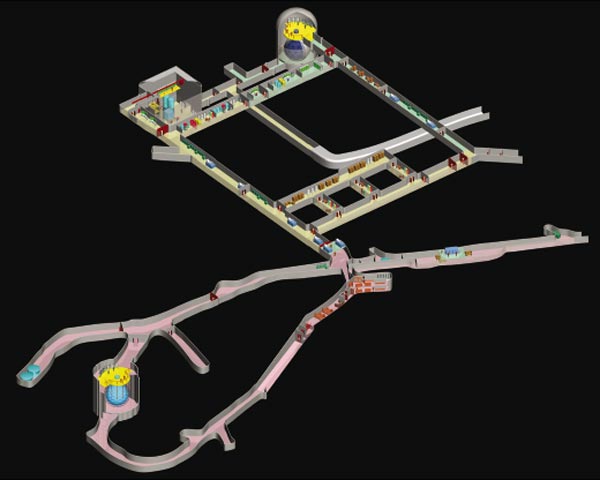
One of the great Canadian successes of the past decade has been SNO, which has provided unequivocal evidence that electron-neutrinos produced in solar fusion oscillate into muon- and τ-neutrinos at a sufficient rate to explain the long-standing solar-neutrino deficit (see SNO: solving the mystery of the missing neutrinos). As a result of this great success the Canadian government has funded the expansion of the SNO experimental facilities. The new SNOLAB infrastructure is almost complete, nearly tripling the floor space for experiments and generating significant interest from researchers in underground physics from around the world. Out of twenty expressions of interest for SNOLAB experiments, nine are still being vetted for first-round space in the new laboratory.
The main scientific goals include searches for dark matter, neutrino-less double beta decay and the study of lower energy solar and geo-neutrinos. With such a world-class facility in Canada, the LRP prioritizes support for Canadian researchers to lead the construction of one or more major experiments. The SNO+ experiment has an advanced engineering design to replace the heavy water in SNO with liquid scintillator to allow the study of neutrinos from the solar “pep” chain. It may also be possible to dope the scintillator with enriched neodinium, making SNO+ a competitive neutrino-less double beta-decay detector. The DEAP/CLEAN experiment is at prototype stage, exploiting the novel signal properties of dark matter in liquid argon and neon. First-round experiments are expected to begin before the end of the decade.
Canadian subatomic physicists are also at the forefront of the study of nuclear astrophysics and the quest to understand the basic hadronic building block of nature – the nucleus – using radio-active beams at TRIUMF’s Isotope Separator and Accelerator Complex (ISAC). The ISAC facility delivers some of the world’s most intense rare beams using the world’s highest power on target (up to 50 kW). One highlight was an experiment with 21Na that provided incisive measurements, refining our understanding of stellar evolution and modelling nuclear synthesis. The new ISAC-II facility extends the accelerator to 12 MeV for each nucleon using superconducting RF cavities. The first experiment, using 11Li (t1/2 = 8 ms), was carried out in December 2006: a European, US and Canadian collaboration investigated the unexpected behaviour of this halo nucleus.
The unique capabilities of ISAC and ISAC-II, including state-of-the-art instrumentation, make this the prime location for a worldwide user network; however, it is configured as a single-user facility. There is contention for beam time between the first-rate science programme and the development of new targets and ion sources. To alleviate this, the LRP prioritizes the full exploitation of ISAC and ISAC-II and the development of a second isotope production line.
TRIUMF is also the nexus for Canada’s contribution to the Tokai-to-Kamioka (T2K) project in Japan. With its expertise in remote target handling, developed at ISAC, TRIUMF is consulting on the T2K neutrino-beam target station. Canadian researchers are leading the construction of the T2K near detector, building modules of the time projection chamber tracker, as well as the fine-grained calorimeter.
The LRP identified a further future priority, foreseeing a fully fledged Canadian participation in an International Linear Collider. TRIUMF accelerator physicists are already engaged in the ILC Global Design Effort. Members of the Canadian subatomic-physics community are working to identify industrial partners and are encouraging them to become full participants in the North American ILC industrial forum. Canadian university-based researchers have a long history of important contributions to electron–positron collider experiments, including the OPAL experiment at CERN’s LEP and more recently the BaBar experiment at SLAC. These researchers have been actively engaged in Canadian detector R&D efforts for ILC detectors.
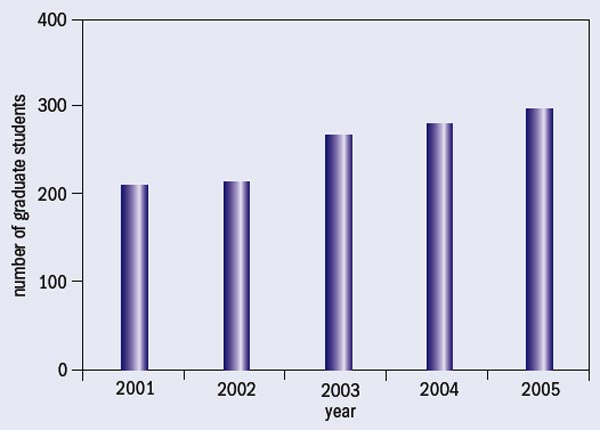
The Canadian subatomic-physics community has seen significant growth this century. As a result of targeted hiring and replacing retiring faculty, 35% of the subatomic-physics faculty in Canada has been hired in the past six years. A 45% surge in the number of graduate students has accompanied this faculty renewal. Further growth is anticipated as the new faculty members establish their research programmes and recruit their full complement of students and postdoctoral researchers. This growth in subatomic-physics graduate student numbers appears to be counter to the experience in other OECD nations, and bodes well for subatomic physics in Canada.
The LRP Committee has therefore found that subatomic physics in Canada is strong and healthy, but the news is not all good. Despite the significant infusion of capital from the government’s novel funding mechanisms, support for traditional sources of sub-atomic physics in Canada have not kept pace with inflation over the past 10 years. The growth and renewal in the community has put ever increasing pressure on the ongoing operational support. One main goal of the LRP exercise was to identify and quantify these pressures, so as to provide a firmer basis for requests for increased operational support for fundamental research in general and subatomic physics in particular.
Particle physics often describes itself, and correctly so, as having brought countries and people together that previously had been unable to co-operate with each other. In Europe, CERN was born out of a desire for co-operation. This was evident later, for example, when Russian and Chinese scientists worked well together within the US throughout the Cold War. This spirit of connection across national boundaries led to success for our science – and for us all as scientists. The strong innate desire to understand our universe transcends our differences. Our field was in many ways, or so we like to say, the first and most successful model in modern international relations. CERN embodies this co-operation.
Nowadays, however, we cannot rest on our laurels. This co-operation is happening in almost every other field of research; international facilities and multinational teams of researchers are no longer unique to particle physics. So what is the next level of co-operation for us? To some it might be obvious. We should continue to strive for a seamless global vision of science projects, and we should distribute those projects around the world so as to maximize the benefits of science in all countries, large or small, rich or poor. The ITER and LHC projects perhaps exemplify global projects: the world unites to select, design, build and operate a project. Particle physicists, as everyone knows, are considering another one, an International Linear Collider (ILC).
The Global Design Effort (GDE) for an ILC is not “flat” globally, but is a merging of regions. The world has been divided into three geographical areas: Asia, the Americas and Europe. In this mixture, Canada is an interesting case study. TRIUMF, Canada’s National Laboratory for Particle and Nuclear Physics is located in Vancouver, on the Asia–Pacific rim, yet only a few miles north of the US border. TRIUMF, though a small laboratory, hosts more than 550 scientists, engineers, technicians, postdoctoral fellows and students, and more than 1000 active users from Canada, the US and around the world. Historically, TRIUMF and the Canadian particle-physics community have made significant intellectual contributions to the major projects – both on the accelerator side and detector-physics side – in Europe at DESY with HERA and ZEUS, LHC and ATLAS at CERN, and most recently in Japan with T2K at JPARC. Canadian particle physicists have also been active in experiments in the US, such as SLD and BaBar at SLAC, CDF and D0 at Fermilab and rare-kaon experiments at Brookhaven National Laboratory.
TRIUMF also has a world-leading internal radioactive-beam programme using the ISOL technique, familiar at CERN’s ISOLDE. TRIUMF’s nuclear physicists are collaborating with China and India and have strong ties to France (Ganil), Germany (GSI), the UK and Japan. TRIUMF is truly global, reflecting that Canada is close to Europe in culture, close to the US geographically and culturally, and is on the Asia–Pacific rim. Canada also continues to merge the culture of nuclear and particle physics, just as CERN is doing at the LHC with ALICE, ATLAS and CMS. A good example is the Sudbury Neutrino Observatory (SNO), where particle and nuclear physicists came together and did great science. SNOLAB will also merge nuclear and particle physics to pursue neutrino and dark-matter searches (see Canada looks to future of subatomic physics). TRIUMF’s infrastructure and technical resources allowed Canadian physicists to help build SNO and will be important in the future for experiments at SNOLAB.
TRIUMF is not yet fully engaged in the ILC effort. Given its history, it is obvious that it will want to participate significantly. Canadian particle physicists are big proponents of an ILC and believe that it is a great opportunity and that it has tremendous discovery potential. However, the area of TRIUMF’s involvement and with which regions it will partner is under discussion.
One fact remains: involvement in any international science project must also feed back to help the internal national programmes. Advances in accelerator technology and detector development for the LHC help the entire national science programme, including nuclear physics, life sciences and condensed matter physics. ILC and superconducting radio-frequency (SRF) development will also be important for Canada and TRIUMF’s internal programmes. The latest ILC technology will bootstrap other vanguard technical developments in each country just as we hope that the globally distributed computing for the LHC, such as TRIUMF’s Tier_1 centre, will have a similar impact.
A strong national science programme supports educational advances and is necessary for innovation and economic prosperity. We should keep this in mind as the world considers the ILC and other large projects, such as next-generation neutrino observatories or underground laboratories. TRIUMF’s and Canada’s strategy is to develop niches of national expertise while participating in exciting international science projects such as the LHC and ILC. The development of such niches is essential to the future prosperity of our field.
All of this will require strategic regional and global planning in particle and nuclear physics. Surely, we are up for this challenge!
After investing in ATLAS and LHC for many years, Canada and TRIUMF are looking forward to a decade or more of great discoveries.
To provide the best experiences, we use technologies like cookies to store and/or access device information. Consenting to these technologies will allow us to process data such as browsing behavior or unique IDs on this site. Not consenting or withdrawing consent, may adversely affect certain features and functions.
Functional
Always active
The technical storage or access is strictly necessary for the legitimate purpose of enabling the use of a specific service explicitly requested by the subscriber or user, or for the sole purpose of carrying out the transmission of a communication over an electronic communications network.
Preferences
The technical storage or access is necessary for the legitimate purpose of storing preferences that are not requested by the subscriber or user.
Statistics
The technical storage or access that is used exclusively for statistical purposes.The technical storage or access that is used exclusively for anonymous statistical purposes. Without a subpoena, voluntary compliance on the part of your Internet Service Provider, or additional records from a third party, information stored or retrieved for this purpose alone cannot usually be used to identify you.
Marketing
The technical storage or access is required to create user profiles to send advertising, or to track the user on a website or across several websites for similar marketing purposes.