By Sergio Ferrara and Rudolf M Mössbauer, World Scientific Series in 20th Century Physics, Volume 39. Hardback ISBN 9789812700186 £69 ($128).
The “superworld” is a subject of formidable interest for the immediate future of subnuclear physics to which Antonino Zichichi has contributed with a series of important papers of phenomenological and theoretical nature. These papers represent a must-have collection, not only for their originality, but also for their complete analysis of expected scenarios on the basis of today’s knowledge of physics. The contributions are divided into two parts. The first deals with the problem of the convergence of the three fundamental forces of nature measured by the gauge couplings, with the onset of the energy threshold for the production of the lightest supersymmetric particles and with the existence of a gap between the string scale and the GUT scale. The second deals with the study of a theoretical model capable of including supersymmetry with the minimum number of parameters (possibly one), and agreeing with all the conditions established by string theories – this turns out to be a “one-parameter no-scale supergravity” model whose experimental consequences are investigated for present and future facilities aimed at the discovery of the first example of the superparticle.
By Guido Caldarelli, Oxford University Press. Hardback ISBN 9780199211517, £49.95 ($115).
This book presents the experimental evidence for scale-free networks and provides students and researchers with theoretical results and algorithms to analyse and understand these features. A variety of different social, natural and technological systems – from the Internet to food webs and boards of company directors – can be described by the same mathematical framework. In all these situations a graph of the elements of the system and their interconnections displays a universal feature: there are few elements with many connections, and many elements with few connections. The content and exposition make this a useful textbook for beginners, as well as a reference book for experts in a variety of disciplines.
by Giuliano Benenti, Giulio Casati and Giuliano Strini, World Scientific. Hardback ISBN 9789812563453 £33 ($58). Paperback ISBN 9789812565280 £22 ($38).
Quantum computation and information is a new, rapidly developing interdisciplinary field. Building on the basic concepts introduced in Volume I, this second volume deals with various important aspects, both theoretical and experimental, of quantum computation and information in depth. The areas include quantum data compression, accessible information, entanglement concentration, limits to quantum computation due to decoherence, quantum error-correction, and the first experimental implementations of quantum information protocols. This volume also includes a selection of special topics, including quantum trajectories, quantum computation and quantum chaos, and the Zeno effect.
Edited by M Shifman, World Scientific. Hardback ISBN 978-981-270-532-7, £41 ($75). Paperback ISBN 9789812705334, £21 ($39).
Felix Berezin was an outstanding Soviet mathematician who was the driving force behind the emergence in the 1960s and 1970s of the branch of mathematics, now known as supermathematics. The integral over the anti-commuting Grassmann variables that he introduced in the 1960s laid the foundation for the path integral formulation of quantum field theory with fermions, the heart of modern supersymmetric field theories and superstrings. This book features a masterfully written memoir by Berezin’s widow, Elena Karpel, who narrates a remarkable account of his life and struggle for survival under the totalitarian Soviet regime. Supplemented with recollections by close friends and colleagues, Berezin’s accomplishments in mathematics, his novel ideas and breakthrough works, are reviewed in two articles written by Andrei Losev and Robert Minlos.
CERN would like to express its gratitude to the following for having generously sponsored the various events in the “LHC 2008” programme, and in particular the offical inauguration of the LHC on 21 October 2008.
Gold Sponsor
INEO GDF Suez, Regione Sicilia.
Main Sponsors
Air Liquide, ALSTOM Power, ASG Superconductors SpA, ATI Wah Chang, Babcock Noell GMBH, HAMAMATSU Photonics, Intel, La Fondation Meyrinoise pour la Promotion Culturelle, Sportive et Sociale, Linde Kryotechnik AG, Luvata, Oracle, Ville et Etat de Genève and UBS.
Sponsors
CECOM Snc, Efacec, Farnell, Force10 Networks, La Mobilière Suisse, Peugeot Gerbier, Sun Microsystems SA, TRANSTEC Computer AG and Western Digital.
Associate Sponsors
Accel, Arcelor Mittal, Bruun & Sorensen, CAEN SpA, Carlson Wagonlit, CEGELEC, DELL SA, E4 computer engineering SpA, EAS European Advanced, EOS, Ernesto Malvestiti SpA, IBM, IEEE, Infotrend Europe Ltd, Iniziative Industriali Srl, ISQ, Italkrane Srl, Kaneka, La Tour Réseau de Soins, Migros, National Instruments, ProCurve Networking by HP, SERCO, Société Générale, Sunrise Communications AG, Super Micro Computer, Tosti srl and Xerox.
The LHC has attracted significant contributions from several major nations outside the CERN member-state community, making it truly a world machine.
In addition to these important contributions from Canada, India, Japan, Russia and the US, CERN host-states France and Switzerland also contribute significant additional resources to the LHC above and beyond their natural involvement as part of the 20-nation European CERN community.
Canada
The contribution to the LHC from Canada is valued at C$40 m, much of which is used for hardware to help to upgrade the injector chain, particularly the Booster and the PS synchrotron. This involvement goes back to 1995 and is coordinated by the Canadian TRIUMF laboratory.
Equipment includes ferrite rings, and the tuning and high-voltage power supplies for four new radiofrequency cavities for the Booster, which was upgraded from 1 to 1.4 GeV specifically for its new role in the LHC injector chain.
Canadian contributions also include most of the magnets and power supplies for the transfer line between the Booster and the PS, major equipment for the Booster main magnet power supply, and a reactive power compensator to reduce Booster-induced transients on CERN’s electrical supply system.
A second wave of Canadian contribution is mainly for the LHC ring, including 52 twin-aperture quadrupole magnets for “beam cleaning” insertions, together with power supplies for kicker magnets, pulse-forming networks and switches. Canada will also develop beam-position-monitor electronics and carry out some beam optics studies.
India
The initial CERN–India cooperation agreement was signed in 1991 and is renewed every five years. The value of equipment covered is $25 m, of which half is transferred by CERN into a special fund to underwrite further joint ventures.
The main Indian hardware contribution is superconducting sextupole and decapole spool pieces amounting to half of the total LHC requirement for such corrector magnet equipment. In addition, India will supply LHC magnet support jacks and quench heater power supplies.
Circuit breakers are being supplied by Russia, but India remains responsible for the necessary electronics. In addition, India is carrying out several programming and documentation projects.
Japan’s early entry into the LHC arena in 1995 provided a memorable boost for the project. Japanese contributions currently total approximately ¥13 850 m (some SFr160 m). Of this sum, some SFr25 m was earmarked for construction of the solenoid magnet for the ATLAS experiment.
The KEK national laboratory acts as a major coordinator for all of this work. Japan is the source of much of the basic material (steel and superconducting cable) for the LHC.
A further significant Japanese contribution to the LHC is the 16 quadrupoles used to squeeze the colliding beams and boost the interaction rate. Also on the list of equipment are compressors for cooling superfluid helium.
The contribution of the Russian Federation to the LHC machine is valued at SFr100 m. One-third is channelled into a special fund for CERN–Russian collaboration.
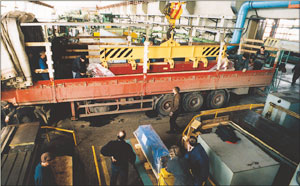
The largest and most visible part of this contribution is the thousands of tonnes of magnets and equipment for the beamlines to link the SPS synchrotron to the LHC. The supply of this equipment from Novosibirsk will soon be complete. Novosibirsk is also supplying insertion magnets for the LHC ring.
The Protvino laboratory is responsible for 18 extraction magnets and the circuit breakers that will receive the electronics from India. The Joint Institute for Nuclear Research, Dubna, is contributing a damping system, and a number of other Russian research centres will furnish a range of items and equipment, including design work, radiation studies, survey targets, ceramic components, busbars and shielding.
USA
Work in the US for the LHC centres on interaction regions 1, 2, 5 and 8, together with some radiofrequency equipment for Point 4. The work is shared between the Brookhaven, Fermilab and Lawrence Berkeley National laboratories.
The impressive list of contributed hardware includes superconducting quadrupoles and their cryostats for beam intersections (Fermilab), superconducting dipoles for beam separation (Brookhaven) and cryogenic feed boxes (Berkeley).
The beam insertion hardware overlaps with that from Japan, and there has been excellent co-operation on LHC contributions between these two industrial giant nations.
France and Switzerland, as CERN host nations, make special contributions to the LHC. For France, this includes 218 person-years of work, spread over four major technical agreements, covering the cold mass for LHC short straight sections (handled by the CEA Atomic Energy Commission), the short straight section cryostats and assembly (by the CNRS national research agency), calibration of 8000 thermometers for the LHC (by the Orsay laboratory), and design and series fabrication work for the superfluid helium refrigeration system (CEA).
In addition to this national involvement, the local Rhone-Alpes regional government and the départements of Ain and Haute-Savoie also contribute.
Under the regional government plan, about 90 person-years of assistance will be supplied by young graduates of technical and engineering universities. Haute-Savoie contributes design work on the integration of microelectronics for the LHC cryogenic system.
In addition, the LAPP laboratory at Annecy is developing ultrasonic equipment to monitor superconducting dipole interconnections, and it is doing design work for the vacuum chambers of the major LHC experiments. Ain has contributed the land to build a major new construction and assembly hall next to the CERN site.
The Swiss contribution comes from the federal government and the canton of Geneva, and it covers the cost of a 2.5 km tunnel through which protons will be fed from the SPS to the LHC in the anticlockwise direction.
The first testing of series production LHC magnets began in 2001, with two test benches and a limited cryogenic infrastructure. The first sets of dipoles had to be thoroughly tested, with full magnetic and other measurements. This extensive testing, together with the limited operational experience and support tools, meant that some 20–30 days were required to test a magnet during 2001–2002, and only 21 magnets were tested in this period.
To increase throughput, the test facility began to operate round the clock early in 2003. With a final set-up of 12 test benches and a minimum of 4 people per shift, this required a minimum team of 24. The initial plan had been to outsource, but by early 2002 it was clear that this was no longer an option. It was at this time that the Department of Atomic Energy (DAE), India, offered technical human resources for SM18. A collaboration agreement between India and CERN had been in place since the 1990s, including a 10 man-year arrangement for tests and measurements during the magnet prototyping phase. This eventually allowed more than 90 qualified personnel from four different Indian establishments to participate in the magnet tests on a one-year rotational basis (a condition requested by India) starting around 2002.
As CERN’s major project for the future, the LHC sets a new scale in world-wide scientific collaboration. As well as researchers and engineers from CERN’s European Member States, preparations for the LHC now include scientists from several continents. Some 50% of the researchers involved in one way or another with preparations for the LHC experimental programme now come from countries that are not CERN Member States.
Underlining this enlarged international involvement is the recent decision by the Japanese Ministry of Education, Science and Culture to accord CERN a generous contribution of ¥5 bn (about Sfr65 m) to help finance the construction of the LHC. This money will be held in a special fund earmarked for construction of specific LHC components and related activities.
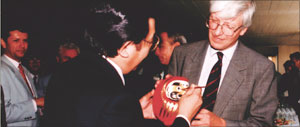
At the June Council session, Japan was unanimously elected as a CERN Observer State, giving them the right to attend Council meetings. Speaking at the Council meeting in his new capacity as Observer State spokesman, Kaoru Yosano, Japan’s Minister of Education, Science and Culture, pointed to his country’s wish to contribute to the LHC project at an early stage. He said that large scientific projects like the LHC “captivated the imagination of citizens”.
The signing of a new protocol between CERN and Russia marks a considerable increase in joint collaboration and a further consolidation of ties dating back 30 years. As well as directly assisting construction of CERN’s new LHC proton collider, the protocol, within the framework of the 1993 CERN–Russia Cooperation Agreement, and with Russia as a CERN Observer State, will provide valuable further stimulus for Russian high technology.
Covering Russian participation in LHC construction and the preparations for its research programme over a 10 year period, the protocol includes two separate in-kind contributions, each with net value to CERN of Sfr67 m, for LHC construction and for the LHC detectors. In addition, a generous contribution from the Joint Institute for Nuclear Research at Dubna, near Moscow, will be invested in LHC preparations.
This latest two-way development in CERN/Russian collaboration will be to the mutual advantage of both parties. It will boost the LHC effort en route to completion of the machine at its full design collision energy of 14 TeV. In addition, the increased scope and scale of this challenging work, together with its inherent complexity and sophistication, will provide impetus to Russian science and industry, and provide vital transfer of front-line technology and skills.
As well as the new protocol, additional contributions to LHC experiments could come through the International Science Technology Centre programme funded by the European Union, Japan, Russia and the US to promote the integration of former Soviet Union weapons scientists into fresh projects, and where six particle physics projects have already been approved.
In the wake of the demise of the US Superconducting Supercollider (SSC) project, which impoverished both US and world science, some rapid scene shifting is going on. The SSC may be dead, but the underlying physics quest lives on.
To nurture the natural enthusiasm to continue this physics, contacts have been developing at several levels. In December 1993, informal exploratory talks were held at CERN between spokesmen of the LHC experiments and their counterparts from the major SDC and GEM projects which were being readied for the SSC, and with CERN management. The object was the common interest in multi-TeV physics at the LHC, and, once this is in place, to exploit valuable R&D already accomplished and the high level of expertise achieved in the SSC framework. A substantial number of US physicists involved in SDC and GEM could be interested in joining LHC experiments, together with Japanese researchers involved in SDC. Many of the SDC Canadian contingent could also turn their sights towards Geneva.
It was a workshop on a scale to match the ultimate goal. When some 500 physicists met in Aachen, Germany, in October to put the research case for the proposed Large Hadron Collider (LHC) at CERN, the turnout was among the biggest attendances of the year.
Organized by ECFA, the European Committee for Future Accelerators, the meeting, by its attendance and by the depth of its scientific content, clearly displayed the enthusiasm for LHC in the research community, and provided valuable additional impetus for the already-compelling idea of a proton collider using superconducting magnets in the 27 km tunnel built for LEP.
Introducing the plenary sessions at Aachen, CERN director-general Carlo Rubbia underlined the complementarity of a dual LEP–LHC complex with its electron and proton beams, providing a balanced two-pronged attack on the physics-research frontier while at the same time making the most of CERN’s versatile beam-handling systems, both existing and potential. With CERN already serving a varied menu of particles, LHC physics would be well-endowed with beam options. As well as providing proton–proton collisions at about 8 TeV per beam, LHC could follow the tradition of CERN’s other proton machines and handle heavy ions as well.
With basic (dimensional) arguments saying that reaction rates have to decrease with collision energy, then high luminosity (related to the collision rate) is a basic collider requirement which is expected to become even more important at higher energies. Thus a main aim of the LHC design is to attain the highest-possible luminosities.
The Aachen meeting mirrored on one hand the physics potential opened up by such a high-luminosity approach, and on the other the challenges for the detector systems which will have to handle bunches of 1011 protons crossing every 15 ns or so, resulting in billions of secondary particles each second. In addition to coping with this flood of data, the potentially delicate detector components will have to withstand long exposure to this harsh radiation environment.
The presentations at Aachen summarized the work of the hundreds of physicists in LHC working groups set up by ECFA earlier this year. Three groups looked at the physics potential of the three collision options (proton–proton, electron–proton, and ion–ion), while others studied detector aspects.
For proton–proton collision physics, Daniel Denegri of Saclay looked at the implications of the current Standard Model, while Felicitas Pauss of CERN attempted to look at the uncharted territory beyond. Putting the physics case for LHC proton–proton studies, Guido Altarelli of CERN was confident that new physics would turn up at the mass scales covered by this machine and provide a natural explanation for some of the apparently arbitrary numbers of today’s Standard Model (the unification of the weak nuclear force and electromagnetism loosely tied to the quark–gluon field theory of strong nuclear forces). While no cracks have yet appeared in this structure, Altarelli thought that with LHC the betting would be against the Standard Model, and its continued survival would be a turnup for the book.
Major goals include the clarification of the electroweak symmetry breaking mechanism (Higgs Particle), where Altarelli remarked there was room for contributions from LEP a well as from the proton–proton sector. However with its proposed high luminosity of 1034/cm2 per s, LHC has the discovery potential to attack the main outstanding questions of particle physics. Subsequent talks outlined the additional potential opened up by LHC’s electron–proton and ion–ion collision options.
Summarizing the work on the interaction regions where LHC experiments would be housed, Lars Leistam of CERN pointed out that if construction work on big new underground caverns is to begin in 1993, then the plans for the experimental areas should be ready by the end of next year. Although ideas for individual experiments have not yet been tabled, the sessions on muon identification at least gave some idea of what an LHC detector might look like. Contenders included toroids, solenoids, and their variants, and an idea to convert the L3 setup currently used at LEP.
• December 1990 pp3–5 (abridged).
“The LHC project now exists”
Sir William Mitchell
1991: The right machine
At the December meeting of CERN’s Council, the Organization’s Governing Body, the delegates from the 16 member states unanimously agreed that the LHC proton–proton collider proposed for the 27 km LEP tunnel is the ‘right machine for the advance of the subject and of the future of CERN’. Detailed information on costs, technical feasibility and prospective delivery schedules, and involvement of CERN Member States and other countries, together with an outline of the LHC experimental programme, its goals and its implications, including funding, will be provided before the end of 1993 so that Council can move towards an LHC decision. Following the vote, Council President Sir William Mitchell said “this is a historic occasion”. “The LHC project now exists,” he added.
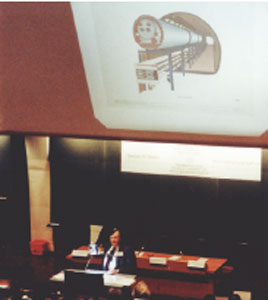
The vote followed a special extended Council session on the LHC project on 19 December before extended delegations from CERN Member States and invited guests from other nations. They heard presentations from Scientific Policy Committee chairman Chris Llewellyn Smith on the physics potential for LHC, from ECFA Chairman J-E Augustin on the LHC user aspects, and from CERN director-general Carlo Rubbia on the LHC project and the future of CERN. This special meeting helped prepare the ground for Council’s vote the following day.
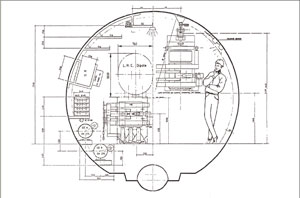
The installation of a hadron collider in the LEP tunnel, using superconducting magnets, has always been foreseen by ECFA and CERN as the natural long term extension of the CERN facilities beyond LEP. Indeed such considerations were kept in mind when the radius and size of the LEP tunnel were decided. The recent successes of the CERN proton–antiproton collider now give confidence that a hadron collider would be an ideal machine to explore physics in the few TeV range at the particle constituent (quarks and gluons) level. The present enthusiasm for the Superconducting Super Collider (SSC) in the US reflects the impressive potential of such machines.
Although the installation of such a hadron collider in the LEP tunnel might appear still a long way off (LEP is scheduled for initial operation in 1988), it was still an opportune moment for ECFA, in collaboration with CERN, to organize a ‘Workshop on the Feasibility of a Hadron Collider in the LEP Tunnel’ from 21–27 March. The first four days of detailed work were held in Lausanne, at the kind invitation of the University, and were followed by two days of summary talks and discussion at CERN.
The workshop was initiated particularly by the then ECFA Chairman, John Mulvey, in keeping with ECFA’s role in stimulating and coordinating plans for future particle-physics facilities in Europe. The workshop was timed to enable CERN to communicate present ideas on long-term prospects to an ICFA (International Committee for Future Accelerators) seminar held in Tokyo on 15–19 May and entitled ‘Perspectives in High-Energy Physics’.
To be competitive, the LHC has to push for the highest-possible energies given its fixed tunnel circumference
In his opening address at the workshop summary session, CERN director-general Herwig Schopper emphasized that CERN’s top priorities remain the completion of LEP Phase I (to achieve electron–positron collisions up to 50 GeV per beam), followed by Phase II (taking the beam energies to around 100 GeV). Thus the Large Hadron Collider (LHC) means looking as far ahead as the middle of the next decade.
Nevertheless, LHC would have to use the infrastructure permitted by LEP. Present ECFA Chairman Jean Sacton emphasized what LEP and CERN would offer. Besides the LEP tunnel itself, the PS and SPS provide excellent proton (and antiproton) injectors. In particular, with the experience of the Intersecting Storage Rings (ISR) and the proton–antiproton Collider under its belt, CERN can claim unique experience and expertise with bunched-beam hadron colliders. The European particle-physics community is also well aware of the competition from the SSC in the US breathing down its neck.
Giorgio Brianti summed up the outcome of the LHC machine studies so far. After confirming that the LEP tunnel would indeed be suitable for such a machine, the next conclusion was that construction moreover need not interfere significantly with LEP operation, given the foreseen LEP operating schedule. Four excavated colliding beam regions are still vacant, although this may not still be the case by the time of LEP Phase II.
To be competitive, the LHC has to push for the highest-possible energies given its fixed tunnel circumference. Thus the competitivity lives or dies with the development of high field superconducting magnets. The long gestation period of LHC fits in with the research and development required for 10 T magnets (probably niobium-tin), which would permit 10 TeV colliding beams. The keen interest in having such magnets extends into the thermonuclear fusion field, and development collaborations in the US, Japan and Europe look feasible.
There are two main options – either to build a single ring and have proton–antiproton colliding beams, as in the CERN SPS Super Proton Synchrotron and scheduled for Fermilab’s Tevatron, or to build two rings and have colliding proton beams. Two considerations turned the thinking firmly towards the second option. The first is the advantage of the higher luminosity (up to 1033/cm2 per s) of proton–proton collisions. The second is the complications in separating the multi-bunch proton and antiproton beams outside the collision regions, which would require cumbersome separators. These considerations outweigh the intrinsic economy of having protons and antiprotons circulating in the same ring. At the workshop, designs were presented of two-in-one magnets in single cryostats with the two proton-beam channels less than 20 cm apart.
At such high energies, there are aspects of machine operation which need special attention. For example – the enormous stored energy in the beams means that the beam-abort system would have to cope with 60 MJ, the vacuum chamber design has to take account of synchrotron radiation heating, the refrigeration system has to distribute liquid helium over tens of kilometres and be able to cope with several superconducting magnet quenches at a time. The growing experience at the Fermilab Tevatron, where the world’s first superconducting synchrotron has come so impressively into operation, would provide important input into design decisions.
Preceding the workshop, studies of machine design, magnets and cryogenics had been (and continue to be) underway at CERN, with periodic meetings to review progress. This work was summarized at Lausanne, including a panel discussion on superconducting magnet design and technology.
The key point is to have at least 10 TeV collision energy in order to have typically at least one TeV at the hadron constituent level
On the experimental side, eight working groups had been set up: Jets (convener P Jenni), Electron and photon detection (P Bloch), Muon detection (W Bartel), Tracking chambers (A Wagner), Vertex detection (G Bellini), Triggering (J Garvey), Data acquisition (D Linglin) and Forward physics (G Matthiae). There was also a great deal of input from theorists, and the Lausanne theory talks were also attended by many experimentalists.
The reports of these working groups provided much valuable input, and several general conclusions emerged. The highest energy would be a valuable asset but there is no actual threshold known now. The key point is to have at least 10 TeV collision energy in order to have typically at least one TeV at the hadron constituent level. There is also a trade-off between energy and luminosity, a gain in luminosity for a loss in energy and vice versa. According to present wisdom, differences between proton–proton and proton–antiproton reactions would be in most cases too small to be detectable. Information from proton collisions should hence be adequate.
Production rates for hitherto unknown objects are ‘expected’ to decrease quickly with the mass of these objects, so that here high luminosity would be an advantage. Multi-bunched beams were envisaged with 3564 bunches per ring, giving 25 ns between bunches and an average of one interaction per bunch crossing. Much thought is going into particle detector performance and there is confidence that the high luminosities could be handled.
Another attractive possibility with both proton and electron rings in the same LEP tunnel is the provision of high-energy electron–proton collisions ‘for free’.
No attempt was made at the workshop to arrive at even a tentative cost estimate for LHC in the LEP tunnel. The project has only been under consideration for a few months and a great deal of further study is needed. However, as Carlo Rubbia emphasized in his concluding remarks, the feasibility of the LHC has been demonstrated, a good physics case has been outlined and CERN is able to promise a great deal when future perspectives in high-energy physics are discussed.
On 10 September the world watched as protons travelled around the ring of the Large Hadron Collider for the very first time – in both directions. Now, only a month later, we are able to celebrate another major event for CERN and the particle physics community world wide, with the official inauguration of the LHC on 21 October.
The start-up of the LHC marks the end of an eventful journey from the first ideas, through the long stages of planning and approval, construction and commissioning, to the start of operations. It began in 1984 with a debate on the possible objectives of a future accelerator, based on the state of our knowledge at that time. The CERN Council then approved the construction of the LHC in 1996, giving the go-ahead for the work that has now reached completion.
For the past 12 years, physicists, engineers and technicians from CERN and its associated institutes have been engaged in constructing the three pillars of the LHC: the accelerator (including the upgrade of the existing accelerator chain), the four experiments, and the computing infrastructure needed to store and analyse the data. An enormous amount of effort has gone into these three major endeavours and we are all about to reap the fruits of those labours.
As the current director-general of CERN I feel tremendous pride in the commitment and dedication shown by everyone at CERN, at its partner institutions in the member states and non-member states, and at the many contractors involved, in overcoming the various hurdles on the way to completing this unique endeavour.
What lies ahead is more important still, as the LHC is poised to generate new knowledge that we will share with the whole of mankind. For that is precisely why CERN was founded – to restore Europe to its place at the forefront of science and, in particular, at the forefront of physics.
To provide the best experiences, we use technologies like cookies to store and/or access device information. Consenting to these technologies will allow us to process data such as browsing behavior or unique IDs on this site. Not consenting or withdrawing consent, may adversely affect certain features and functions.
Functional
Always active
The technical storage or access is strictly necessary for the legitimate purpose of enabling the use of a specific service explicitly requested by the subscriber or user, or for the sole purpose of carrying out the transmission of a communication over an electronic communications network.
Preferences
The technical storage or access is necessary for the legitimate purpose of storing preferences that are not requested by the subscriber or user.
Statistics
The technical storage or access that is used exclusively for statistical purposes.The technical storage or access that is used exclusively for anonymous statistical purposes. Without a subpoena, voluntary compliance on the part of your Internet Service Provider, or additional records from a third party, information stored or retrieved for this purpose alone cannot usually be used to identify you.
Marketing
The technical storage or access is required to create user profiles to send advertising, or to track the user on a website or across several websites for similar marketing purposes.