
Comsol -leaderboard other pages

Topics

NuPNET looks to future nuclear physics in Europe

At a meeting in Paris on 27 March, representatives from the Nuclear Physics European Collaboration Committee (NuPECC), the EU Commission and 18 national funding agencies launched a network in nuclear physics to enable the community to pilot joint transnational activities.

CCnup1_11_08

The idea to create a European network in nuclear physics arose two years ago, when more than 15 representatives of nuclear physics funding agencies and/or similar organizations, a NuPECC delegation and EU officers met in Paris to discuss the possibility of co-ordinating the existing national funding procedures through a new tool of the European Commission. The tool – the European Research Area Network, or ERA-Net – would focus on networking, mutual opening, development and implementation of joint activities. The participants at the meeting unanimously agreed to prepare a proposal, based on the scientific recommendations made by NuPECC in its latest long-range plan with a view to the ERA-Net scheme, for submission as soon as the EU Commission launched the appropriate call within the Framework Programme for European Research and Technology.

The proposal took the name of NuPNET, for Nuclear Physics Network. Under the scientific co-ordination of the French partner, the co-ordination committee composed of members of funding agencies from France, Germany, Italy and Spain, had the responsibility of working out the full proposal. Thanks to the excellent collaboration between the co-ordination committee and the managers of the 18 European institutions that agreed to be part of this new venture, the final proposal was submitted in May 2007 at the first call of the Seventh Framework Programme for European Research and Technology (FP7). Evaluated during the summer of 2007, the NuPNET proposal was accepted by the European Commission in September 2007. Contract negotiations were completed by 11 March 2008 and a budget of €1.3 m has been granted for three years, from March 2008 to February 2011.

The NuPNET project comprises 18 regular members representing 14 countries (see figure 1). NuPECC is an associated member and acts as the Scientific Advisory Body of the NuPNET consortium to provide independent views on the direction of nuclear physics within Europe through its long-range plans, to give advice on scientific issues, and to inform NuPNET on the views of the scientific community.

CCnup2_11_08

On 27 March 2008, the founding member institutions of NuPNET, the representatives from NuPECC and the EU Commission came together for the traditional “kick-off” meeting. Organized by CNRS/IN2P3, the co-ordinator of the NuPNET project, this first official meeting took place in Paris. The participants agreed that NuPNET’s programme will have an important impact on the future of nuclear physics, especially since the ERA-Net proposal – as adopted by the partners and as accepted by the EU Commission – aims, for the first time in the history of nuclear physics, to co-ordinate the various national funding agencies in order to organize better the financing of nuclear physics infrastructures at a European level.

Implementation and governance

The NuPNET project has outlined a stepwise approach to project implementation in the form of four goals. The first is to compare reviewing and funding systems in participating funding agencies; provide a census of resources and agents in nuclear physics and infrastructures that paves the way to common decisions; and liaise with Integrated Infrastructure Initiatives and design studies in FP7 and other European and international initiatives, in particular the European Strategy Forum on Research Infrastructures and the Organisation for Economic Co-operation and Development. This work package is led by Germany.

CCnup3_11_08

The second goal is to propose a set of joint transnational activities (based on the science priorities set in the long-range plan of NuPECC) that can be launched by funding agencies thanks to NuPNET co-ordination. Italy leads this work package. The third goal is to launch one or more of those proposed joint transnational activities in the field of nuclear physics infrastructures, in a work package led by Spain. The fourth and final goal is to provide Europe with a sustainable scheme beyond the project duration.

The project is managed by the co-ordinator (CNRS/IN2P3); the governing council (NuPNET member institutions); the co-ordination committee (CNRS/IN2P3) and work package leaders from France, Germany, Spain and Italy; and the Scientific Advisory Body (NuPECC). All parties are involved at the relevant level; however, the governing council is the main decision-making body of the consortium, where only authorized members can vote in the name of the represented member institution. Public bodies interested in joining NuPNET may be invited to attend a meeting of the governing council. The co-ordinator, together with the co-ordination manager, ensures the overall management of the project, whereas the co-ordination committee implements the decisions taken by the governing council and supports the co-ordinator. Now, the work has started. NuPNET has its own logo, a website is being constructed and the first session of Open Days (see figure :2) took place in Athens on 8 September.
DOE approves 12 GeV upgrade for CEBAF

CCnew9_11_08

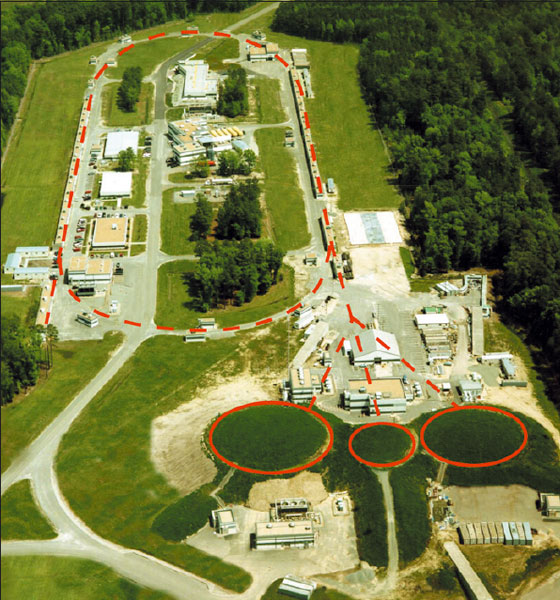
On 15 September, the Thomas Jefferson National Accelerator Facility (Jefferson Lab) received approval from the US Department of Energy (DOE) to begin construction of a $310 million upgrade to the 12 GeV Continuous Electron Beam Accelerator Facility (CEBAF). The upgrade project has been a high priority for the DOE’s Office of Science since it published its landmark report, Facilities for the Future of Science: A Twenty Year Outlook, in 2003.

The construction approval, known as Critical Decision 3, concludes an exhaustive, multi-year review process that clearly established the scientific need, merit and quality of the 12 GeV CEBAF upgrade project that will see DOE’s Jefferson Lab double the energy of its accelerated electron beam from 6 GeV to 12 GeV.

It will also construct a new experimental hall and upgrade the equipment in its three existing experimental halls. Construction funds are requested in the US president’s fiscal year 2009 budget request and project completion is planned for 2015.

With the upgrade, researchers at Jefferson Lab plan to investigate quark confinement further and to map in detail the distributions of quarks in space and momentum, culminating in measurements that will provide a 3D picture of the internal structures of protons and neutrons. They also plan to study the role of quarks in the structure and properties of atomic nuclei, as well as how these quarks interact with a dense nuclear medium. Once completed, the upgraded facility will allow studies of the limits of the Standard Model.

JINST provides open access to LHC articles

Seven major articles on the LHC and its detectors have been published electronically in a special issue of the Journal of Instrumentation (JINST). Together they form the complete scientific documentation on the design and construction of the LHC machine and the six detectors (ALICE, ATLAS, CMS, LHCb, LHCf and TOTEM), and thus on the entire LHC project.

This landmark publication is probably the first time for a major new accelerator project to be documented in such a comprehensive, coherent, and up-to-date manner prior to going into operation. The papers should for many years to come serve as key references for the stream of scientific results that will begin to emerge from the LHC after the first collisions next year. They provide a much-needed update of the Technical Design Reports, some of which are now 10 years old.

Although published in a refereed scientific journal, the articles are completely free to download and read online under an Open Access scheme, without requiring a journal subscription. JINST is an online-only journal published jointly by the International School for Advanced Studies in Trieste, Italy, and the IOP Publishing in Bristol, under the scientific direction of Amos Breskin from the Weizmann Institute of Science in Rehovot. Since commencing in 2006, it has quickly become popular in the LHC community as a platform for publishing techincal papers.

With 1600 pages authored by 8000 scientists and engineers the special issue is the most significant manifestation of CERN’s Open Access policy thus far. It is an important milestone on the road to converting all particle-physics literature to Open Access under the initiative of the Sponsoring Consortium for Open Access Publishing in Particle Physics (SCOAP3).

ASPERA names its magnificent seven

In the same room that hosted the first Solvay conference in 1911 at the Hotel Metropôle in Brussels, on 29–30 September the AStro Particle ERAnet (ASPERA) network presented the European strategy for astroparticle physics. As a result of two years of intensive coordination and brainstorming work, the document highlights seven large-scale projects that should shed light on some of the most exciting questions about the universe.

Questions surrounding dark matter, the origin of cosmic rays, violent cosmic processes and the detection of gravitational waves are among those that the “magnificent seven” of ASPERA’s roadmap will address. Specifically, the projects are: CTA, a large array of Cherenkov Telescopes for detection of cosmic high-energy gamma rays; KM3NeT, a cubic-kilometre-scale neutrino telescope in the Mediterranean sea; tonne-scale detectors for dark matter searches; a tonne-scale detector for the determination of the fundamental nature and mass of neutrinos; a megatonne-scale detector for the search for proton decay, neutrino astrophysics and the investigation of neutrino properties; a large array for the detection of charged cosmic rays; and a third-generation underground gravitational antenna.


Each of these large-scale projects may cost several hundred-million euros, and therefore needs to gather funds through large international collaborations that extend beyond Europe. The ASPERA conference gathered about 200 scientists and officials from funding agencies around the world. Representatives from Canada, China, the EU, India, Japan, Russia and the US agreed on the importance of defining a global strategy and coordinating efforts worldwide. In line with this approach, the Astroparticle Physics European Coordination (the initiator of the ASPERA network) is starting negotiation with the OECD Science Global Forum.

The EU will nevertheless remain a major actor, having funded ASPERA and will fund the follow-up, ASPERA2. It also supports the European Strategy Forum on Research Infrastructures (ESFRI). The ESFRI committee released a first road map in 2006 and is expected to release an updated road map at the end of 2008, including some of the projects selected by ASPERA.

Nobel rewards for work on broken symmetry

Broken symmetry in particle physics is the underlying theme for the 2008 Nobel Prize in Physics. Yoichiro Nambu, emeritus professor at the University of Chicago, has received a half share of the prize “for the discovery of the mechanism of spontaneous broken symmetry in subatomic physics”; Makoto Kobayashi, emeritus professor at KEK, and Toshihide Maskawa, former director of the Yukawa Institute for Theoretical Physics at Kyoto University, share the other half “for the discovery of the origin of the broken symmetry which predicts the existence of at least three families of quarks in nature”. The work of the three theoreticians underpins significant parts of the current Standard Model of particle physics, and is also reflected in key questions that are driving current experimental research in the field.

Nambu left his native Japan for the US in 1952, and has been at the University of Chicago since 1958. He has made several important contributions to particle physics, but it was the theory of superconductivity published in 1957 by John Bardeen, Leon Cooper and Robert Shrieffer that led Nambu towards spontaneous symmetry breaking in particle physics. In 1960 he looked at how to maintain gauge invariance (the underlying symmetry of electromagnetism) in a field theory of superconductivity – a phenomenon that spontaneously breaks gauge invariance (Nambu 1960). He went on to develop these ideas in field theories for elementary particles, and to bring in the concept of spontaneously broken symmetry not just in matter but in empty space (CERN Courier January/February 2008 p17). In particular, this led to ideas about the generation of mass (Nambu and Jona-Lasinio 1961).

Three of the people who took note of these ideas were Robert Brout, François Englert and Peter Higgs, whose work is now encapsulated in the Brout–Englert–Higgs (BEH) mechanism for generating mass through spontaneous symmetry breaking in the Standard Model (CERN Courier October 2008 p83). All three acknowledge Nambu’s influence on their work in 1964. Some 40 years later, the search for the scalar boson (Higgs particle) associated with the field required by the BEH mechanism is an important element in the physics to be studied at the LHC at CERN.

In 1972 two Japanese theorists at the University of Kyoto began to look at a different broken symmetry. Kobayashi and Maskawa decided to investigate the violation of CP symmetry in weak interactions (which had been discovered in the neutral kaon system in 1964) in the context of renormalizability. At the time only three quarks were known, but building on work on unitary symmetry in weak decays by Nicola Cabibbo and the need for four states to suppress strangeness-changing neutral currents, Kobayashi and Maskawa concluded that “no realistic models of CP violation exist in the quartet scheme without introducing any other new fields” (Kobayashi and Maskawa 1973). However, one option that they showed would work was to broaden the quartet of states to six. This led to a 3 × 3 unitary mixing matrix, which included a phase that imposed CP violation in certain transitions. The paper did not arouse much excitement at first, but within the next two years, not only was the fourth quark, c, discovered, but also a third charged lepton, τ, indicating a third generation of leptons and hence a third generation of quarks.

Since then, not only have the fifth and sixth quarks, b and t, been discovered, but CP violation has also been found in the neutral b-quark system, the B-mesons. The Cabibbo–Kobayashi–Maskawa matrix has become an intrinsic part of the Standard Model, which is being tested with high precision with neutral kaons and in particular with B-mesons at the B-factories and in future at the LHC. At the same time, CP violation in general remains a puzzle, as the effect observed in weak interactions is by no means sufficient to account for the domination of matter over antimatter in the universe.

Introduction to 3+1 Numerical Relativity

by Miguel Alcubierre, Oxford University Press Series: International Series of Monographs on Physics, Volume 140. Hardback ISBN 9780199205677 £55 ($110).

41WmzcrGX9L._SX331_BO1,204,203,200_

An introduction to the modern field of 3+1 numerical relativity, this book has been written so as to be as self-contained as possible, assuming only a basic knowledge of special relativity. Starting from a brief introduction to general relativity, it discusses the different concepts and tools necessary for the fully consistent numerical simulation of relativistic astrophysical systems, with strong and dynamical gravitational fields. The topics discussed in detail include: hyperbolic reductions of the field equations, gauge conditions, the evolution of black hole space-times, relativistic hydrodynamics, gravitational wave extraction and numerical methods. There is also a final chapter with examples of some simple numerical space–times. The book is for graduates and researchers in physics and astrophysics.

Zero to Infinity: The Foundations of Physics

by Peter Rowlands, World Scientific Series of Knots and Everything, Volume 41. Hardback ISBN 9789812709141 £48 ($88).

41I-jIRHCjL._SX332_BO1,204,203,200_

This book uses a methodology that is entirely new, creating the simplest and most abstract foundations for physics to date. The author proposes a fundamental description of process in a universal computational rewrite system, leading to an irreducible form of relativistic quantum mechanics from a single operator. This seems to be simpler, more fundamental, and also more powerful than any other quantum mechanics formalism available. The methodology finds immediate applications in particle physics, theoretical physics and theoretical computing. In addition, taking the rewrite structure more generally as a description of process, the book shows how it can be applied to large-scale structures beyond the realm of fundamental physics.

Quantum Field Theory of Non-equilibrium States

by Jørgen Rammer, Cambridge University Press. Hardback ISBN 9780521874991 £45 ($85). E-book format ISBN 9780511292620, $68.

31WOV88NE-L._SX346_BO1,204,203,200_

This textbook presents quantum field theoretical applications to systems out of equilibrium. It introduces the real-time approach to non-equilibrium statistical mechanics and the quantum field theory of non-equilibrium states in general. It offers two ways of learning how to study non-equilibrium states of many-body systems: the mathematical canonical way and an intuitive way using Feynman diagrams. The latter provides an easy introduction to the powerful functional methods of field theory, and the use of Feynman diagrams to study classical stochastic dynamics is considered in detail. The developed real-time technique is applied to study numerous phenomena in many-body systems, and there are numerous exercises to aid self-study.

Physics of Semiconductors in High Magnetic Fields

by Noboru Miura, Oxford University Press. Hardback ISBN 9780198517566 £65 ($150).

412iNZOeaDL._AC_SY580_

This book describes the basic concepts of various physical phenomena in semiconductors and their modulated structures under high magnetic fields. The topics cover magneto-transport phenomena, cyclotron resonance, far-infrared spectroscopy, magneto-optical spectroscopy, diluted magnetic semiconductors in high magnetic fields, as well as the recent advances in the experimental techniques needed for high field experiments. Starting from the introductory part describing the basic theoretical background, each chapter introduces typical experimental data, obtained in very high magnetic fields mostly in the pulsed field range at 20–100 T. The book will serve as a useful guide for researchers and students with an interest in semiconductor physics or in high magnetic fields.

Elements of String Cosmology

By Maurizio Gasperini, Cambridge University Press. Hardback ISBN 9780521868754 £45. E-book format ISBN 9780511332296 $68.

41XcPvk5gJL

The standard cosmological picture of our universe emerging from a Big Bang leaves open many fundamental questions, which string theory, a unified theory of all forces of nature, should be able to answer. The first book dedicated to string cosmology, this contains a pedagogical introduction to the basic notions of the subject. It describes the new possible scenarios suggested by string theory for the primordial evolution of our universe and discusses the main phenomenological consequences of these scenarios, stressing their differences from each other, and comparing them to the more conventional models of inflation. It is self-contained, and so can be read by astrophysicists with no knowledge of string theory, and high-energy physicists with little understanding of cosmology. Detailed and explicit derivations of all the results presented provide a deeper appreciation of the subject.

bright-rec iop pub iop-science physcis connect