by Mario Conte and William W MacKay, World Scientific. Hardback ISBN 9789812779601 £86 ($46). Paperback ISBN 9789812779618 £29 ($55).
This text offers a concise and coherent introduction to the physics of particle accelerators, with attention being paid to the design of an accelerator for use as an experimental tool. In this edition, new chapters on the spin dynamics of polarized beams, as well as instrumentation and measurements, are included with a discussion of frequency spectra and Schottky signals. The additional material also covers quadratic Lie groups and integration, highlighting new techniques using Cayley transforms, detailed estimation of collider luminosities and new problems. Graduates and advanced undergraduates in physics will find this book a useful resource.
by Massimo Giovannini, World Scientific. Hardback ISBN 9789812791429 £48 ($89).
In the past 15 years, various areas of high-energy physics, astrophysics and theoretical physics have converged on the study of cosmology. Today, therefore, any graduate student in these disciplines needs a reasonably self-contained introduction to the cosmic microwave background (CMB). This book presents the essential theoretical tools necessary to acquire a modern working knowledge of CMB physics. The style, falling somewhere between a monograph and a set of lecture notes, is pedagogical and the author uses the typical approach of theoretical physics to explain the main problems in detail, while also touching on the main assumptions and derivations of a fascinating subject.
by Helmut Hofmann, OUP Series: Oxford Studies in Nuclear Physics, Volume 25. Hardback ISBN 9780198504016 £65 ($130).
This book offers a comprehensive survey of basic elements of nuclear dynamics at low energies and discusses their similarities to mesoscopic systems. It addresses systems with finite excitations of their internal degrees of freedom so that their collective motion exhibits features typical of transport processes in small and isolated systems. The importance of quantum aspects is examined with respect to both the microscopic damping mechanism and the nature of the transport equations, and a critical discussion of the use of thermal concepts is included. The book is considerably self-contained and presents existing models, theories and theoretical tools, from both nuclear physics and other fields, which are relevant to an understanding of the observed physical phenomena.
edited by Yurij Holovatch, World Scientific. Hardback ISBN 9789812707673 £46 ($85).
This is the second volume of review papers on advanced problems of phase transitions and critical phenomena, following the success of the first volume in 2004. Broadly, it aims to demonstrate that there is still a good deal of work to be done in phase transition theory, both at the fundamental level and with respect to applications. Topics include critical behaviour as explained by the non-perturbative renormalization group; critical dynamics; a space–time approach to phase transitions; self-organized criticality; and exactly solvable models of phase transitions in strongly correlated systems. Like the first volume, this one is based on the review lectures that were given in Lviv (Ukraine) at the Ising Lectures – a traditional annual workshop on phase transitions and critical phenomena that brings together scientists in the field working with university students and others interested in the subject.
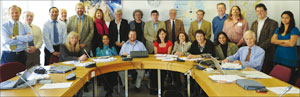
On 16–17 October members of a new four-year, EU-funded project met at CERN for the kick-off meeting of the Particle Training Network for European Radiotherapy (PARTNER). co-ordinated by CERN, the project received €5.6 m as part of the European Commission’s Marie Curie funding scheme.
The aim of PARTNER is to train researchers in the rapidly emerging field of hadron therapy, thus paving the way for improved cancer treatments. Hadron therapy uses beams of protons or carbon ions instead of X-rays to target malignant tumours. The technique penetrates deeper and more precisely into the body, creating minimal harm to surrounding tissue.
The project brings together 10 participating academic institutes, research centres, and leading European companies in particle therapy, and it has funding for 25 doctoral and postdoctoral researchers. In this way the network institutes enrich international co-operation and contribute to the quantity, quality and mobility of European researchers, while benefiting from the efforts and new ideas that the young people bring to the research programmes.
In turn the researchers receive excellent training opportunities, through formal programmes and hands-on experience of state-of-the-art equipment, under the supervision of world-class experts.
The start of the project is particularly timely, because two new hadron-therapy facilities are about to open in Europe: HIT in Heidelberg and CNAO in Pavia. These will be the first centres of this kind to be built in Europe, and they will benefit hugely from PARTNER as it trains a new generation of researchers.
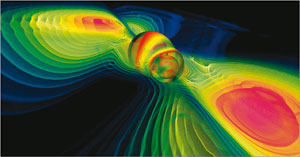
The European Commission (EC) has allocated €3 million within the Seventh Framework Programme for preliminary studies for the development of the Einstein Telescope – a major new gravitational-wave observatory. The Einstein Telescope is one of the “magnificent seven” European projects recommended by the ASPERA network for the future development of astroparticle physics in Europe.
With this grant, the commission confirms the importance of gravitational-wave research for both basic and applied scientific research in Europe. The direct detection of gravitational waves will allow new insights into the universe that are inaccessible to any other technology – including clues to its origin.
The funds granted now by the EC will be used in a design study for the Einstein Telescope over the next three years. This is an important step towards the third generation of gravitational-wave observatories. It will define the specifications for the required site and infrastructure, the necessary technologies, and the total budget.
Currently, several first-generation gravitational-wave detectors are operational worldwide. The German-British GEO600 observatory operates close to Hanover while the French-Italian-Dutch Virgo project is located in Cascina near Pisa. These interferometers pool their data with the three LIGO interferometers in the US and are currently doing extensive searches for gravitational waves from astrophysical systems.
During the next decade all interferometric gravitational-wave detectors will be upgraded to second-generation instruments. Virgo and LIGO will gain a factor of about 10 in sensitivity at lower frequencies (up to about 1 kHz). GEO will pioneer high-frequency wide-band observing above 1 kHz, again deploying new technologies. If the current instruments do not make the first detection of gravitational waves, the second-generation interferometers should succeed.
The Einstein Telescope project fits well into this scenario. After the completion of the design study and a subsequent technical preparation phase, construction could begin (probably in 2017 or 2018) after the second-generation observatories have started operating. As a third-generation observatory, Einstein should be 100 times as sensitive as current detectors, increasing the observable volume of the universe by a factor of a million. Additionally, it should cover the frequency range between 1 Hz and 10 kHz.
• The Einstein Telescope is a joint project of eight European research institutes, under the direction of the European Gravitational Observatory (EGO). The participants are EGO, an Italian-French consortium located near Pisa, INFN, the Centre National de la Recherche Scientifique, the Albert Einstein Institute in Hannover, the Universities of Birmingham, Cardiff and Glasgow and the Vrije Universiteit, Amsterdam.
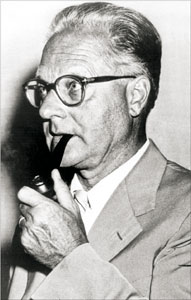
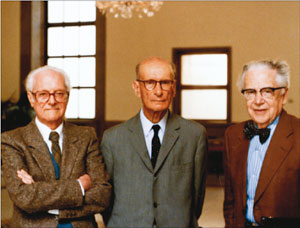
Edoardo Amaldi was a leading figure in Italian science in the 20th century, particularly in fundamental experimental physics. He contributed to nuclear physics in the 1930s and 1940s, and to cosmic rays and particle physics in the post-war years, then became a pioneer in the experimental search for gravitational waves in the 1970s. It is largely thanks to his drive that Italian physics emerged successfully from the slump following the Second World War. He was also one of the main players in the process that turned the dreams of large European scientific projects into reality, most notably CERN.
In Rome with Fermi
Amaldi was born in Carpaneto Piacentino, northern Italy, on 5 September 1908. He was the son of Ugo, a distinguished mathe-matician and university professor. Ugo’s academic career led him from Modena to Padua and finally to the University of Rome in 1924, where he joined the outstanding Italian mathematicians Vito Volterra, Tullio Levi-Civita, Guido Castelnuovo and Federigo Enriques. Edoardo enrolled at the University of Rome as a student of engineering in 1925. Two years later he moved to physics, attracted by the presence of Enrico Fermi, as were a few other brilliant students, including Emilio Segrè and Ettore Majorana. Amaldi took his degree in physics in July 1929, with a dissertation on the Raman spectrum of the benzene molecule. His thesis advisor was Franco Rasetti, who had moved from Florence to join Fermi in Rome. By the end of the 1920s a strong group of young physicists had become established at the institute in via Panisperna and their research efforts deliberately steered towards the new frontier of nuclear physics.
Under Fermi’s leadership, it became common practice to send young people abroad to stay for extended periods at leading research centres. In 1931 Amaldi spent 10 months in Peter Debye’s laboratory in Leipzig learning X-ray diffraction techniques in liquids. He later spent short periods at the Cavendish Laboratory at Cambridge, Columbia University and the Carnegie Institution.
Following the discovery by Frédéric Joliot and Irène Curie of radio activity induced by alpha particles, Fermi and his collaborators started a methodical search in March 1934, bombarding samples of different elements with neutrons emitted by a radon-beryllium source. Their experiments culminated in October 1934 with the discovery of the efficiency of slow neutrons in activating nuclear fission. The published papers carried the signatures of all team members (Fermi, Rasetti, Amaldi, Segrè, the chemist Oscar D’Agostino and, later, the young Bruno Pontecorvo). Fermi was clearly the intellectual leader and driving force, and for these results he would receive the Nobel Prize in Physics in 1938. In the meantime, Fermi and Amaldi did most of the work for the next few years following the discovery; Rasetti and Pontecorvo were mostly out of Rome and Segrè had moved to a professorship in Palermo. Amaldi thus acquired a competence in nuclear physics, particularly in the subject of neutron properties, that turned him into a leading authority in the field.
In 1937 Amaldi won a professorship at the University of Cagliari, but he was immediately called to the chair of experimental physics in Rome, which had been left vacant by the sudden death of Orso Mario Corbino. Amaldi kept this position until retirement. He continued to work on neutron physics with Fermi and Rasetti. They designed and built a Cockcroft–Walton accelerator, which was completed in 1939 at the Istituto Superiore di Sanità. By the late 1930s, however, the general situation in Italy was deteriorating rapidly. The lack of support necessary to keep research competitive, the alignment of fascism with Hitler’s Germany and the racial laws promulgated in 1938 led directly to the forced or voluntary emigration of many Italian physicists. When the Second World War began, Amaldi was the only member of the original Panisperna group still in the country.
Left alone in Rome with a small group of younger researchers, Amaldi concentrated his research efforts on nuclear fission, working with physicists from the physics institute and the Istituto di Sanità, while Gian Carlo Wick replaced Fermi on the theory side. This work was interrupted when Amaldi was sent for a few months to the African front in 1940. On his return to Rome, research on fission continued. However, by 1941 suspicion arose that working on fission exposed the group to the risk of being recruited for war-related research. As a consequence, the experimental work shifted focus to the problem of proton–neutron scattering, while some of the younger graduates started research on cosmic rays.
Though research conditions were difficult during the war, Rome was still in a better situation than research facilities in northern Italy, especially after liberation in June 1944. By war’s end, most of what had been left of active research in Italy, in terms of both expertise and people, was concentrated in Rome. In collaboration with Wick and Gilberto Bernardini from Florence, Amaldi steadfastly took it upon himself to reconstruct Italian physics, starting from the vantage point offered by his location in the capital. The first move, completed successfully in October 1945, was to obtain from the reconstituted Consiglio Nazionale delle Ricerche (CNR) the establishment of a research centre for nuclear and elementary particle physics at the physics institute in Rome.
The years of reconstruction
During a trip to the US in 1946, Amaldi was offered a chair at the University of Chicago by none other than Fermi, but he declined because he felt a duty to take care of scientific development in his homeland. During the visit, Amaldi was confronted by the restrictions imposed on results and topics in “his” physics because of real or supposed military interest. He realized that, beyond a certain limit, it was impossible for him to talk freely even with Fermi about problems in nuclear physics. Amaldi found this disturbing on ethical grounds and detrimental to scientific progress. The experience strengthened his conviction acquired during the war years that genuine scientific collaboration is planned free from military control – a general policy to which he adhered strictly in the following years.
The scale of prestige acquired by nuclear and particle physics in the US after the war convinced Amaldi that the best course of action for Italian physics would be to concentrate on those research sectors where good results could be obtained with the modest means available. As a consequence, emphasis was placed on the relatively inexpensive research field of cosmic rays, where Italian physicists could rely on the solid tradition initiated by Bruno Rossi. The first step, in 1947, was to construct a high-altitude laboratory in the Italian Alps. New research centres followed: Padua in 1948, Turin in 1951 and Milan in 1952. Meanwhile, Amaldi promoted the development of applied nuclear research, training young engineers and physicists, and raising support among politicians – a programme that led to the construction of Italy’s first nuclear reactor.
Amaldi’s active role in the physics community and with politicians and administrators in Rome was decisive in winning a site close to Rome for the new laboratory.
Amaldi, Gustavo Colonnetti and Bernardini, relying on the strength of this active network and on the support of CNR’s president, were able to achieve a significant goal: the establishment in 1951 of the Istituto Nazionale di Fisica Nucleare (INFN). Bernardini was its first president and Amaldi took charge between March 1960 and January 1966.
The first important activity for INFN physicists was their participation in three international collaborations, which between 1952 and 1954 launched high-altitude balloons carrying photographic emulsions for the study of cosmic rays. Amaldi’s group in Rome took part in the first and second collaborations. Soon after, a more ambitious INFN programme was initiated for the construction of a competitive accelerator for high-energy physics. The project became reality in less than five years: the electron synchrotron of the Laboratori Nazionali in Frascati started operating in February 1959. Amaldi’s active role in the physics community and with politicians and administrators in Rome was decisive in winning a site close to Rome for the new laboratory. This was in line with a general scheme that assigned the development of nuclear facilities for civil purposes to the northern areas of the country and concentrated fundamental research at the nation’s capital.
Building European science
Soon after the war, physicists throughout Europe came to realize that only a collaborative effort between several countries could give Europe a competitive role in fundamental research. The proposal for a great European particle accelerator was put forward by Isidor Rabi in 1950, and Amaldi was one of the strongest advocates from the beginning. He took advantage of his capacity as vice-president of the International Union of Pure and Applied Physics to back the idea. The ambitious plan quickly took form using the institutional support of UNESCO. Amaldi and French physicist Pierre Auger, director of the scientific section of UNESCO, were the driving force for a project that was attractive to the younger generations of European physicists, but which had to overcome difficulties and opposition at both the scientific and the governmental levels.
By May 1951 a selected team of experts from eight countries approved a detailed plan, and by early 1952 an intergovernmental conference established a provisional organization, which took the name of the Conseil Européen pour la Recherche Nucléaire (CERN). Amaldi was elected general secretary of the provisional CERN and he supervised all of the crucial phases in the infancy of the new institution, including the early stages of work on the laboratory site, on grounds allocated by the city of Geneva. He left the position when CERN entered into official existence in September 1954, led – among other reasons – by the desire to revert to more active research work in physics. Paralleling the development of the laboratory in Frascati, the big CERN proton synchrotron was successfully completed in 1959, reaching a record energy of 28 GeV.
Amaldi always kept strong ties with CERN, maintaining a place in the scientific bodies that helped to shape its policy. In 1963 he created the European Committee for Future Accelerators, which was an independent body charged with planning new machines to be built in Europe (both at CERN and elsewhere), and he was president until 1969. He headed up the particular group that planned the new 300 GeV proton synchrotron for CERN in the late 1960s – a project approved by the member states in 1971, with Amaldi in charge as president of CERN Council. Simultaneously occupying important positions both at INFN and at CERN, Amaldi sometimes had to make delicate choices, balancing resources between domestic developments and international co-operation. This was evident when a decision had to be taken between launching a great effort for a new Italian proton synchrotron or giving Italy’s support to the project for the 300 GeV machine in Geneva. In this instance he was strongly in favour of the CERN project, convinced that priority in big science had to be granted to Europe.
In the early 1960s, when the project of a joint European effort in space was being discussed, a network of scientists and politicians similar to the one that had contributed to the success of CERN was formed, which included the French physicist Hubert Curien. Amaldi took an important role in launching the idea and pushing it through scientific and political circles. As a result, in 1964 the European Space Research Organisation was established, which later gave birth to the European Space Agency.
Research in cosmic rays and particle physics
In the time left over from academic and administrative duties, as well as acting as an organizer and planner of science, Amaldi stayed in active research, leading groups of young collaborators and moving his interest towards cosmic-ray physics. A high point came in the mid-1950s with work on one of the emulsions exposed to the cosmic radiation during the 1953 high-altitude balloon collaboration. The group found a track that could be interpreted as evidence of the annihilation of an antiproton – a particle the existence of which was taken for granted on a theoretical basis but that had not yet been observed. To gain better support for the evidence offered by the single track, Amaldi turned to Segrè at Berkeley, proposing a joint research programme aimed at the detection of similar events in emulsions exposed to the proton beam of the Bevatron. At the time this was the most powerful accelerator in the world and the only one that could reach an energy above the threshold needed to produce a proton–antiproton pair. The Rome–Berkeley collaboration lasted for a couple of years, yielding important results on antiprotons and their annihilation properties. However, the first confirmation of such a process – clearly visible in the emulsion tracks – came a few weeks after Segrè and his group had independently detected the antiproton by a different experiment that relied on counters instead of emulsions. For this discovery, Segrè and Chamberlain were awarded the Nobel Prize in Physics in 1959.
Amaldi’s interest in the experimental detection of gravitational waves began with a course on gravitational-wave antennas given by Joe Weber, the pioneer of this instrumentation, at Varenna in 1962. In 1970, under Amaldi’s leadership, a group formed in Rome with the aim of designing and building cryogenic detectors for gravitational waves. Initially, small-scale antennas were planned and put into operation; then larger detectors were built in succession in Rome, Frascati and at CERN – where the cryogenic antenna Explorer was installed in the 1980s, attaining by 1989 the highest sensitivity reached for many years. While leaving the direct responsibility to others, Amaldi played an active role throughout this period in both the planning and the execution of the experiments, as well as in recruiting young students to the field. The detection of gravitational waves is still an open problem almost 20 years after Amaldi’s passing. Huge facilities have been built for the purpose in large international collaborations, involving many Italian physicists – the legacy of a tradition borne out of Amaldi’s initial foresight.
In his mature years, Amaldi increasingly devoted part of his time to collecting his memoirs and putting on paper those moments in the history of physics that he had witnessed. He started with commemorations of friends and colleagues, then worked on recollections of important events. Amaldi’s reconstructions evolved into writings with growing insight into the more general historical context, with a care for sources and documentation not usually found in similar works by scientists. He was helped by a habit developed in his early days of keeping all relevant documentation related to his work and to the institutions that he was involved with. His personal archive helped him to produce works that went far beyond the traditional scientist’s recollection, resembling more the scope of scholarly research by an independent historian.
Working for peace and arms control
Amaldi’s concern for peace, and his strong feeling for the responsible role that the scientific community should play in this respect, was always a natural complement to his unshakable belief in the open nature of science and the need for international co-operation. By remaining in Italy during the war, he was spared the difficult decision about whether to take part in projects related to the military use of science. He later admitted that, had this been the case, he would in the end have put his competence to the service of what looked to him, beyond any doubt, the right side on which to fight.
After the war he followed with interest the first attempts of American physicists to establish some sort of organization aimed at the control of the arms race. Following the 1955 Einstein–Russell appeal, Amaldi was involved in the Pugwash movement from the moment it was created in 1957 and became a member of the executive committee at the second Pugwash meeting in 1958, a position that he held until 1973. In 1966, with his physicist colleague Carlo Schaerf, he founded the International School on Disarmament and Research on Conflicts, which he chaired until his death.
In 1982 Amaldi led a delegation of Italian physicists to the president of the Italian Republic, presenting a resolution of concern with the ongoing arms race and the danger to Europe created by the deployment of cruise missiles. As a follow-up to this document, the Unione Scienziati Per Il Disarmo was founded – an active group that has since then kept the discussion on disarmament issues alive in Italy. One of Amaldi’s last public official speeches was in 1987, when he led a delegation of Italian scientists to the international forum in Moscow organized by the soviet leader Mikhail Gorbachev at a time when a new climate of liberation was opening up.
Amaldi was married to Ginestra Giovene, one of the few women among the physics students in Rome during the 1930s. They bore three children: Ugo, Francesco and Daniela. Ugo followed in his father’s steps as a high-energy physicist, leading to a career at CERN. Edoardo Amaldi was a member of a number of academies and learned societies and was the president of the Accademia dei Lincei, Italy’s national academy, between 1988 and 1989. It was at the end of a day’s work in his office at the Lincei, still in his full capacities, that a heart attack killed him in 1989, at the age of 81.
“I have dealt with many different transformations with various periods of time, but the quickest that I have met was my own transformation in one moment from a physicist to a chemist.” Ernest Rutherford (Nobel banquet 1908).
I have always been fascinated by Ernest Rutherford. He came from a poor scientific environment and yet rose to occupy “the highest position in the British Empire” (Arrhenius 1924). He was an exceptionally impressive physicist – detector-constructer, experimentalist, theorist – and a Nobel laureate in chemistry. To put the issue of his Nobel Prize into context, I will briefly describe his history.
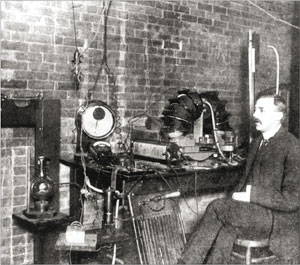
Born in New Zealand in modest surroundings, Rutherford was one of a large family but was exceptionally talented and “had no difficulty in obtaining scholarships and prizes” (Eve 1939). In October 1895 we find the 24-year-old Rutherford in Cambridge, England, where he is welcomed to the Cavendish Laboratory by its leader, Joseph John Thomson (1906 Nobel Prize in Physics). Rutherford’s exceptional talents are quickly recognized, and he is invited to give talks at several distinguished gatherings, including the Royal -Society. He demonstrates his magnetic detector for sensing electrical waves at what were then large distances.
Late in 1898, at the age of 27, Rutherford becomes Macdonald professor of physics at McGill University, Montreal, Canada. Here he makes a sensational discovery: atoms are not necessarily eternal but can transform into one another. This is transmutation of the elements. He proposes the “genealogical tree” of the uranium family where he postulates the existence of a yet unseen intermediate state in the chain. This is a revolutionary idea.
A great authority at the time, William Thomson (later Lord-Kelvin), and Scottish physicist Peter Tait had reported (1867): “The inhabitants of the Earth cannot continue to enjoy the light and heat essential to their life for many million years longer, unless sources now unknown to us are prepared in the great storehouse of creation.” However, Rutherford applies his findings in radioactivity and discovers that the Sun will shine much longer than that. He makes the front pages with headlines such as “Doomsday postponed”. He is also the guest of honour at important events, receives prizes and medals, and is elected into distinguished societies such as the Royal Society.
To be eligible for a Nobel Prize in Physics or Chemistry, the candidate must have been nominated for the year in question. All that is required is one valid nomination (i.e. from someone who has been invited to nominate). In 1907, Rutherford has seven nominations for the Nobel Prize in Physics and one for the chemistry prize. His nominators for the physics prize are Adolf von Baeyer (1905 chemistry Nobel), Hermann Ebert, Vincenz Czerny, Emil Fischer (1902 chemistry Nobel), Philipp Lenard (1905 physics Nobel), Max Planck (1918 physics Nobel) and Emil Warburg. All of these nominations come from Germany. His nominator for the chemistry prize is Svante Arrhenius from Sweden, a member of the Nobel Committee for -Physics from 1900 to 1927.
In 1908 Rutherford receives five nominations for physics and three for chemistry. His nominators for the physics prize is -Arrhenius, John Cox, Lenard, Planck and Warburg. The “newcomer”, Cox, is a professor at McGill. Rutherford is nominated for the 1908 Nobel Prize in -Chemistry by Arrhenius, Oskar Widman (a Swede) and Rudolf Wegscheider (an Austrian).
This Rutherfordian idea is of such importance to chemistry that I have no problem recommending him for the chemistry prize even though he is a physicist.
Rudolf Wegscheider
Most of these nominations are composed of just a few lines. Some of the nominators attach references, but others assume that the Nobel committee know Rutherford’s work. The nominations state that he deserves the prize for his work on radioactivity. Planck nominates him for his experiments and research on radioactivity and “for having to some extent swept away the blanket of darkness that still enwraps the nature of these processes”. -Wegscheider writes: “This Rutherfordian idea is of such importance to chemistry that I have no problem recommending him for the chemistry prize even though he is a physicist.” The chemistry nomination from -Widman differs from the others because he proposes that Rutherford should share the prize with his former research student Frederick Soddy.
The longest nomination letter is from Cox, one of the two headhunters who had interviewed Rutherford for the professorship at McGill. Dated 8 February 1907, the letter arrives after the 31 January deadline and so is not valid for 1907. It is saved as a nomination for 1908.
You may wonder about Thomson, who was always supportive of Rutherford. Why doesn’t he nominate his great student? Actually, he does. He submits a nomination in 1908, but this also arrives too late and is therefore saved for 1909. By then, however, Rutherford has received the 1908 prize, making Thomson’s nomination invalid. The Nobel rules do not allow the nomination of someone who has received the prize within the previous two years. Thus in 1907, Rutherford had no nominations from England or France, where his work was well known and where there were qualified nominators, among them several Nobel laureates.
Rutherford is nominated for his work on radioactivity, the essential issue being the decay of radium. The Nobel Committee for Physics, in its 1907 report to the Royal Swedish Academy of Sciences (referred to here as the Academy), brushes him aside quickly by stating: “his observation of the decay of a chemical element (radium) should be awarded with the chemistry prize rather than the physics prize. Therefore, we deem we should not suggest him as a recipient of this year’s Nobel Prize in Physics.” In other words, radium is a chemical element and that’s chemistry. This matter is not trivial. The 1904 Nobel Prizes in Physics and Chemistry are awarded to John William Strutt (Lord Rayleigh) and William Ramsay, respectively. Both of them receive the prize for the discovery of chemical elements (inert gases); Strutt is a physicist and Ramsay a physical chemist.
The Nobel Committee for Chemistry, in its 1907 report to the Academy, states: “Rutherford has been nominated for his studies of radioactivity, by seven nominators for the physics prize and by one nominator for the chemistry prize. This is understandable, taking into account that Rutherford uses physical methods while the results, so far as they are concerned with chemical elements, must be considered to be of fundamental importance for chemistry as well.” The committee then opts for a wait-and-see strategy.
In 1908 the Nobel committees for physics and chemistry meet and decide that Rutherford’s work is more relevant to chemistry than to physics. Arrhenius is worried that Rutherford might fall between two stools at the academy’s plenum, where the final decision is made. He writes to the academy proposing: “If the Academy should decide that it is not appropriate to give him the chemistry prize, he should be awarded the 1908 physics prize.”
Nobel deliberations
Contrary to the physics committee, the chemistry committee takes Rutherford’s candidacy very seriously. Their report to the -academy contains about 15 pages about him, so I will give only a few excerpts. For example, the committee says: “Rutherford’s theoretical work contains the formulation and development of the so-called decay hypothesis, for describing the transformation of elements and deducing the laws that govern them; he has proposed that alphas are doubly charged helium atoms; [he] has insisted on the material nature of the emanation process, and has done experiments to verify his hypothesis.” The chemistry committee’s report continues on and on about Rutherford’s ingenious experiments and his deep insight regarding what was going on in the complicated chain of the emanation processes. Rutherford has shaken the foundations of chemistry by replacing its assumption of the immutability of chemical elements with a new and more general hypothesis.
The report also describes the theory of Rutherford and Soddy, and their introduction of the exponential decay law, lifetimes, etc. Ultimately it states: “Rutherford deserves the Nobel Prize in -Chemistry without a shadow of doubt. A more difficult question concerns whether any of Rutherford’s collaborators should share the prize with him.”
A closer study of Rutherford’s work shows that most of his assistants help him with specific tasks and that their contributions are secondary to his. The only exception is Soddy, who is not only a collaborator on some of Rutherford’s most important experimental studies from 1902 to 1903 but also participates in formulating the theory of disintegration of elements. Naturally, the question of their individual contributions in formulating this theory cannot be accessed by outsiders, but it is remarkable that none of the nominators other than Widman suggests that Soddy should share the prize with Rutherford. Finally, the committee argues against honouring Soddy together with Rutherford because “a shared prize could easily be misinterpreted as an underestimation of the eminent importance of Rutherford’s work for chemistry and more generally for modern natural sciences, especially since the chemistry prize, up to now, has only been awarded to one laureate at a time.”
In the end, Rutherford “eclipses” his competitors for the chemistry prize. He is judged to be an epoch maker; a solid, precise scientist; and an undisputed leader. We don’t know what goes on at the -academy when the case of Rutherford is brought up by the physicists and chemists because no minutes are taken on such occasions. The outcome is all we know: Rutherford is awarded the 1908 Nobel Prize in Chemistry “for his investigations into the disintegration of the elements, and the chemistry of radioactive substances”.
The nucleus and more
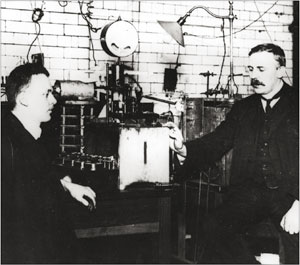
At McGill in 1901, Rutherford writes to Thomson: “The laboratory is everything that can be desired (I) greatly miss the opportunities of meeting men interested in physics.” So when the opportunity of a professorship at the University of Manchester arises, Rutherford takes it. Here, he is, in his own words, very fortunate to find a most competent assistant, Johannes (Hans) Geiger.
In a letter to Otto Hahn in 1911, Rutherford writes: “I have been working recently on scattering of alpha and beta particles and have devised a new atom to explain the results, and also a special theory of scattering. Geiger is examining this experimentally, and finds so far it is in good agreement with the facts.” This alludes to -Rutherford’s famous model of the atom, with a compact nucleus inside, and to his scattering formula.
Rutherford then makes another striking discovery. On bombarding nitrogen with his beloved alpha particles, he discovers a new particle, which he calls the proton. He publishes this just before leaving Manchester in 1919 to return to Cambridge, where he succeeds Thomson as director of the Cavendish Laboratory. He continues his work on protons by shooting alpha particles at light atoms. -Rutherford predicts the existence of the neutron, deuteron, tritium and helium-3.
Having received the 1908 Nobel Prize in Chemistry, Rutherford subsequently makes even more stunning discoveries in physics. So, one might have expected him to be nominated for the physics prize. After all, Marie Curie was awarded both prizes. However, Nobel laureates are not usually nominated for a second prize: Albert Einstein, for example, was never nominated again after he received the 1921 physics prize.
The archives reveal that Rutherford is nominated for a second prize, in physics, but by only three people: Theodor -Svedberg in 1922 and 1923; David S Jordan in 1924; and Johannes Stark in 1931, 1932, 1933, 1935 and 1937. He also receives a nomination for a second prize in chemistry, from the 1911 Nobel laureate in physics Wilhelm Wien. This nomination is marked as invalid because the discoveries for which Rutherford is nominated are considered to be outside the realm of chemistry.
Svedberg, a distinguished member of the academy, nominates Rutherford in 1922 for his atomic model. He wants Rutherford to be awarded the physics prize before Niels Bohr (11 nominations), because Bohr was being nominated for his atomic model, which is based on Rutherford’s model. The award committee argues against -Svedberg’s proposal on the grounds that “giving Rutherford a prize in physics would imply that the 1908 decision to award him the prize in chemistry was wrong because the methods used in these discoveries are similar and the Bohr model of the atom is superior to Rutherford’s”. The outcome is that Bohr gets the 1922 Nobel Prize in Physics and Einstein (17 nominations) receives the 1921 prize.
In 1923, Svedberg repeats his nomination, adding another superb discovery of Rutherford’s: the proton. This means that the matter has to be considered more seriously, and Arrhenius is charged with looking into it. He produces a report for the -academy in which he argues against a second prize for Rutherford. -The report includes the following statements: “There is very little sympathy for giving the same person two Nobel prizes.” “None of -Rutherford’s countrymen have nominated him for the prize.” “Sir Ernest’s meritorious contributions are so great and widely known that his standing and possibilities to do research would hardly be affected by a second prize.” and “He already occupies the highest position in the British Empire.”
For the 1924 prize, Rutherford receives a nomination from Jordan, an ichthyologist and the first president of Stanford University. Then there are no further nominations until 1931, when Stark (1919 physics Nobel) nominates Rutherford for his work on alpha rays and atomic structure. The response of the committee to this nomination is strange, to say the least: “With all due respect for the importance of Rutherford’s work, the committee is of the opinion that these lie so close to the work for which he has been given the chemistry prize that the awarding of a further prize is not justified.” Stark repeats his nomination four times (1932, 1933, 1935 and 1937) – that is, until Rutherford dies.
Was Rutherford disappointed at not receiving a second prize? We don’t know, but I believe that if he had wanted one, he could have given a hint to his distinguished colleagues. He was a generous person who gave a great deal of credit to his collaborators, such as James Chadwick and Soddy, as well as many other people. His Nobel nominations for these and for other scientists testify that he played down his own role. Those who knew him seem to have really “loved” him. His research fellows admired him, and several of them rose to great heights in society – for example, Sir Ernest Marsden in New Zealand and Sir Mark Oliphant in Australia. Many would have gladly nominated him, but only one person from the then British Empire – Cox – nominated him for his first Nobel Prize, and no one did so for a second. He was knighted in 1914, appointed to the Order of Merit in 1925 and in 1931 he was created First Baron Rutherford of Nelson (in honour of his birthplace in New Zealand). His ashes were interred in London’s Westminster Abbey in 1937, where they joined the remains of -William Thomson and Sir Isaac Newton.
The member-state representatives, including Swiss president Pascal Couchepin, French prime minister François Fillon and several ministers, applaud CERN’s director-general, Robert Aymar, during the opening presentation. “The LHC is a marvel of modern technology, which would not have been possible without the continuous support of our member states,” he said. “This is an opportunity for me to thank them on behalf of the world’s particle-physics community.”
The LHC inauguration ceremony officially marked the end of 24 years of conception, development, construction and assembly of the biggest and most sophisticated scientific tool in the world. After the LHC was proposed in 1984, it was 10 years before Council approved the project. “Its construction has taken more than 14 years and there have been many challenges, which have all been overcome,” said the LHC project leader, Lyn Evans, in his speech at the ceremony. “We are now looking forward to the start of the experimental programme, where new secrets of nature will undoubtedly be revealed.”
A highlight of the presentation by Lyn Evans was an excerpt from a recording made on 12 October when the Morriston Orpheus Choir from Swansea was joined by Welsh first minister Rhodri Morgan in the CERN Control Centre and blessed the LHC with song.
François Fillon (third from right), prime minister of France, in the LHC tunnel near the CMS experiment, together with Philippe Lebrun (right), head of the Accelerator Technology Department at CERN. In his speech later, Fillon said: “When the decision was taken to construct the LHC, I was minister for higher education and research. I fought for this project, which some regarded as an impossible dream. I believe that this dream can be realized. That was 14 years ago. Today the facility exists and it is spectacular.”
Director-general Robert Aymar (centre) with leaders of CERN’s two host states: Pascal Couchepin (left), president of the Swiss Confederation, and François Fillon, prime minister of the Republic of France.
Ján Mikolaj, deputy prime minister and minister of education of the Slovak Republic, during his presentation at the ceremony. “We know of the importance of fundamental research,” he said. “We also know that CERN is a driving force for development of new technologies.”
Annette Schavan, Germany’s federal minister of education and research, being greeted by Robert Aymar. One of three ministers who gave speeches during the ceremony, she noted that CERN: “Reflects the strength of research in a special way: the strength that lies behind people’s yearning to find out more about the origins of the universe.”
Ministers wait in line to take their turn as José Mariano Gago (left), Portuguese minister for science, technology and higher education, signs the commemorative electronic plate, watched by CERN’s Carlos Lourenço. During his speech, which was very well received, Gago referred to CERN as “a miraculous scientific laboratory that is a decisive attractor of talent from all over the world”.
This Daruma Doll was originally painted with only one eye to mark the start of the LHC project. It was presented to former CERN director-general Christopher Llewellyn Smith 13 years ago. To mark the end of the project, Toshio Yamauchi (left), senior vice-minister of education, culture, sports, science and technology in Japan, added the second eye and presented the completed doll to current director-general, Robert Aymar (right). Llewellyn Smith witnessed the ceremony together with Swiss president Pascal Couchepin. The Daruma Doll Ceremony is a Japanese tradition that symbolizes the completion of a project.
Carolyn Kuan conducts the Orchestre de la Suisse Romande in Origins, an audiovisual concert specially commissioned for the LHC inauguration. It featured the imagery of National Geographic photographer Frans Lanting and the music of Philip Glass, adapted from Life: A Journey Through Time, which was originally produced in California. The visual score charted the history of the universe from the Big Bang to the present day, and it included imagery from CERN’s experiments.
After the ceremony, guests were treated to a buffet of molecular gastronomy. Chef Ettore Bocchia collaborated with the physics and chemistry departments of Parma and Ferrara universities in Italy to create a scientific feast of Italian cuisine, which was optimized for both taste and health.
Image credit: M Struik.
Musical highlights of the LHCfest for CERN personnel, which followed the official inauguration, included a live performance of the “LHC rap” by AlpineKat, who was joined on stage by a very special backing dancer – none other than the LHC project leader Lyn Evans.
Image credit: M Struik.
A wall of fame in particle physics greeted VIPs as they entered the ceremony, with photos from the exhibition Accelerating Nobels, beginning (right) with Donald Glaser, inventor of the bubble chamber, who received the Nobel Prize in Physics in 1960. Between 2006 and 2008, photographer Volker Steger, with the help of CERN and the Lindau Meetings Foundation, photographed more than 40 Nobel laureates and invited each of them to draw their most important discoveries.
Image credit: M Struik.
Accelerating Nobels is an exhibition that centres on 19 laureates whose work is closely related to CERN and the LHC. The exhibition has been on view at CERN in the Globe of Science and Innovation, where CERN’s Nobel laureates, including Carlo Rubbia (left) and Simon van der Meer, took pride of place.
Over the past decade, industry has played an important part in developing, building and assembling the LHC, its experiments and the computing infrastructure. To thank industry for its exceptional contributions to the LHC project, CERN organized a special industry day on 20 October. More than 70 companies attended. Here Lucio Rossi, who led the LHC magnet construction, addresses the assembled participants.
Ten firms were honoured on the industry day for their fundamental contributions to the LHC machine, detectors and computing grid: Ineo GDF Suez, Air Liquide, Alstom, ASG Superconductors, ATI Wah Chang, Babcock Noell, Intel, Linde Kryotechnik, Luvata Group and Oracle. A plaque in the lobby area near CERN’s main auditorium, unveiled by the director-general during the day, commemorates their exceptional contributions.
When David Gross first came to CERN in the late 1960s, student protests across Europe, the Vietnam War and the Apollo Program were among the topics dominating world news. In particle physics the jury was still out as to the nature of quarks and the strong interaction, while not quite terra incognita, was hostile territory for theorists – full of wild and untamed beasts. In early 1969, Gross, who had recently taken up a faculty position at Princeton, and Chris Llewellyn Smith, a fellow in the theory division, worked together at CERN on a paper with the hot title of “High-energy neutrino–nucleon scattering, current algebra and partons”. In it, they laid down a sum rule that allowed the number of valence quarks in the proton to be measured with the neutrino beam and the Gargamelle bubble chamber at CERN (Gross and Llewellyn Smith 1969).
Today, the leading edge of research in particle theory, in its continuing search for a quantum field theory of gravity, treats fundamental objects not as the point-like partons of the Standard Model but as extended objects such as strings and membranes. The first ideas about string theory formulated in 1969, and it was strings that drew Gross back to CERN this summer. A key figure in the first “superstring revolution”, he is a member of the international advisory committee for the Strings conference series and he gave the outlook talk and a public presentation at Strings 2008 at CERN in August (CERN pulls Strings together).
Fond memories of CERN
Gross remembers his first visit to CERN as being an exciting time, especially in the theory division, which celebrated the publication of its 1000th paper during his stay. “CERN was the centre of theory,” he recalls, “unique in Europe, with lots of good young people.” He enjoyed his time a great deal, writing some six or so papers on various topics, including the Gross–Llewellyn Smith sum rule. He has since returned to CERN for several summer visits, with longer spells in 1974 and 1993, and he has had the opportunity to work with theorists such as Gabriele Veneziano, Julius Wess, Sheldon Glashow, Sidney Coleman, Gerardus ’t Hooft, John Bell&ellip;to name but a few.
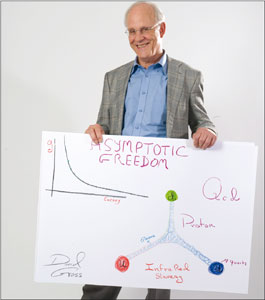
Gross is now director of the Kavli Institute of Theoretical Physics (KITP) at the University of California, a position that he has held since 1997, after nearly 30 years at Princeton. He is best known for his major role in taming the dragons of the strong interaction in the 1970s. Some 40 years on from his first visit to CERN, quarks and the strong interaction are now part of the fundamental fabric of particle physics, and are well understood within the context of the Standard Model. They feature not only in high-school textbooks but also in magazines and TV programmes for the general public. The role that Gross played in establishing the theory of QCD as the pillar of the Standard Model that describes the behaviour of quarks and gluons – particularly his work with his student Franck Wilczek on asymptotic freedom in 1973 – was to lead to the Nobel Prize in Physics. He and Wilczek shared the prize in 2004 with David Politzer of Caltech, who arrived at the same conclusion independently – that strong interactions become weaker at shorter distances, allowing calculations within the context of perturbation theory.
It is not surprising that this is the work of which Gross remains most proud. “How inconceivable,” he says, “that we could actually have a theory, not just a phenomenology of strong interactions&ellip;it was mind-boggling that we did it.” He moved on to string theory in the early 1980s, when, he says, the “easy things” had been done in QCD. “Solving QCD seemed too hard; it was easier to look for a way to solve everything.” Ed Witten, another brilliant student who worked under Gross at Princeton, also joined the superstring revolution and became a leader in the field. “Ed developed an extraordinary skill in finding mathematical structures,” Gross recalls. “Trying to keep up with him was quite a challenge,” he admits, but adds that “it’s always good to be able to learn from your students.” He notes that, in particle physics today, “it’s amazing how mathematically educated young people are”.
Indeed, Gross sees this as a major shift in the field since he started out in theoretical particle physics in the 1960s. “The differences,” he says, “are like day and night. Experiment was king in 1969.” He describes working in theory then as “pretty miserable”, while the experimental side of things was constantly discovering “incredible surprises”. Then, in around 1970, the situation began to change, with a shift in experiments towards confirming the Standard Model. Prior to that, mathematics in particle physics was relatively primitive, but then along came input from mathematically talented young theorists who were extremely successful. This was “much to the chagrin of a generation or two of experimenters”, Gross smiles, and created a “generation of middle-aged theorists who didn’t know what the underlying theory was”.
What does he see now for the future of particle physics, particularly in light of the LHC start-up? He believes that it is a “safe bet” that experiments will confirm the Higgs mechanism, and a “good bet” that supersymmetry will be discovered. Beyond that, he says, the LHC is in the right energy region to deliver surprises, although he adds that the abandoned Superconducting Super Collider with its reach to 40 TeV in the centre of mass would have been better. The nightmare, in his view, will be if there are no surprises, which would leave the subject in “deep trouble”. It will be difficult in the absence of real clues from the LHC to argue the case for an expensive next stage. It could, he says, be like asking for “lots of money to go 1 km into a 100 km desert”.
In the past, the development of new accelerator techniques has often helped to keep down the cost of the advance into unexplored energy regions. “We need to stay on the Livingston plot,” Gross comments, in reference to the well known plot of the evolution of accelerators in energy. He notes that physicists working on space-based instruments face a similar problem.
Meanwhile, theoretical physicists remain relatively inexpensive, which allows them to continue to cover a broad scope of research. At KITP, Gross has been fortunate to build up a theoretical physics centre of the kind that he experienced at CERN as he was entering the field. With some 1000 visitors a year from around the world, the institute forms the basis of one “big family” and a stimulating environment for research. Particle physicists, there as elsewhere, are eagerly waiting for the LHC to reveal what nature has in store at higher energies – and, who knows, it may tip the balance back towards experiments again.
To provide the best experiences, we use technologies like cookies to store and/or access device information. Consenting to these technologies will allow us to process data such as browsing behavior or unique IDs on this site. Not consenting or withdrawing consent, may adversely affect certain features and functions.
Functional
Always active
The technical storage or access is strictly necessary for the legitimate purpose of enabling the use of a specific service explicitly requested by the subscriber or user, or for the sole purpose of carrying out the transmission of a communication over an electronic communications network.
Preferences
The technical storage or access is necessary for the legitimate purpose of storing preferences that are not requested by the subscriber or user.
Statistics
The technical storage or access that is used exclusively for statistical purposes.The technical storage or access that is used exclusively for anonymous statistical purposes. Without a subpoena, voluntary compliance on the part of your Internet Service Provider, or additional records from a third party, information stored or retrieved for this purpose alone cannot usually be used to identify you.
Marketing
The technical storage or access is required to create user profiles to send advertising, or to track the user on a website or across several websites for similar marketing purposes.