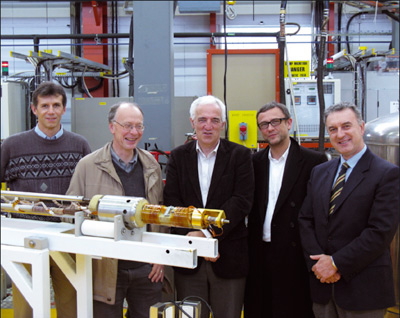
A new international player has entered the arena of intense short-pulse coherent light technology, with the latest developments in the Extreme Light Infrastructure (ELI) European project, which was launched in November 2007 in its preparatory phase and involves nearly 40 research and academic institutions from 13 EU member states. At the end of 2009, ELI decided to create a pan-European Extreme Light Facility based at several research sites. The first three sites have been selected and a decision on a fourth site, to deal with “ultrahigh peak power”, will be taken in 2012 after validation of the technology.
The field of “extreme light” is opening up a new direction in fundamental and applied research. It is currently carried out in Europe – mainly in France, Germany, Russia and the UK – as well as in China, Japan, South Korea and the US. With the new initiative, other European countries hosting the three sites for the new facility are set to take a leading role.
The site in Prague, Czech Republic, will focus on providing ultrashort-pulse beams of energetic particles (10 GeV) and radiation (up to a few mega-electron-volts) produced from compact pulsed-laser plasma accelerators with a planned overall laser peak-power reaching 50 PW. In Hungary, a site in Szeged will be dedicated to extremely fast dynamics, taking snap-shots at the attosecond scale (10–18 s) of electron dynamics in atoms, molecules, plasmas and solids based on an optical few-femtosecond laser with an average power of several kilowatts.
The third site in Magurele, near Bucharest, Romania, will produce radiation and beam particles at energies high enough to address nuclear processes. With this facility a renaissance in the field of nuclear physics is expected. The planned laser peak-power will reach 30 PW. Intense radiation created at ELI could help to clarify the processes limiting the lifetime of nuclear power reactors, offer new avenues to control the lifetime of nuclear waste, fabricate new nuclear pharmaceutical products, and lead to laser-driven hadron therapy, and phase-contrast imaging as a medical diagnostic tool.
Completion of the fourth ELI site will afford new fundamental investigations into particle physics, nuclear physics, acceleration physics and ultrahigh-pressure physics, leading on to applications in astrophysics and cosmology. It will offer new research directions in high-energy physics relating to particle acceleration and the study of the vacuum structure and critical acceleration conditions.
ELI’s host countries have been mandated to form a pan-European Research Infrastructure Consortium (ERIC), which will be open to all European countries, and possibly others, willing to contribute to the realization of the project. A unique centralized management will preside over the integrated infrastructure. The host countries are to provide about 15% of the funding, while the EU is contributing the balance under its infrastructure investment programme. A total of €750 million is currently earmarked for the initial three sites.
On 30 November, representatives from Denmark, Germany, Greece, Hungary, Italy, Poland, Russia, the Slovak Republic, Sweden and Switzerland signed the “Convention concerning the Construction and Operation of a European X-ray Free-Electron Laser Facility”. Six language versions each of the Convention and the Final Act now carry the signatures of 11 government representatives, including two from the Federal Republic of Germany. These two documents lay the foundations of the European XFEL project, define the financial contributions of the current partner countries, and confer the responsibility for the construction and operation of the X-ray free-electron laser facility on the nonprofit company European XFEL GmbH.
For internal reasons France and Spain will sign the Convention later and China plans to join within the next six months.
The fourth meeting of the Steering Committee of the CERN/ITER Collaboration Agreement took place at CERN on 19 November. It marked not only the end of a second year of successful collaboration between ITER and CERN on superconducting magnets and associated technologies but also the establishment of CERN as the ITER reference laboratory for superconducting strand testing for the next five years.
The implementation agreement for 2009 encompassed a variety of topics. These included expertise in stainless steel and welding, high-voltage engineering, the design of high-temperature superconductor current leads, and testing and consultancy in cryogenics and vacuum technology.
The main role of CERN as the ITER reference laboratory will be: to carry out yearly benchmarking of the acceptance test facilities at the six domestic agencies involved in superconducting strand production; to help in the training of the personnel involved in these tests around the world; and to carry out third-party inspection and expertise in case of problems during production. To this end, CERN will use the facilities that were set up for strand qualification for the LHC, but with an important modification: the upgrade of magnetic fields from 10 T to 15 T to properly test samples of niobium-tin (Nb3Sn) superconductors.
This programme has considerable synergy with the study for high-gradient quadrupoles in Nb3Sn that CERN is pursuing to prepare new technology for the LHC luminosity upgrade. Nb3Sn has a superior performance to the niobium-titanium alloy employed in the LHC. However, the brittleness of Nb3Sn and the need for high-temperature heat treatments mean that much R&D is still required. ITER will see the first large-scale use of Nb3Sn: some 400 tonnes of the conductor will be used for the toroidal field coils and the central solenoid.
by David Lyth and Andrew Liddle, Cambridge University Press. Hardback ISBN 9780521828499, £40 ($75). E-book ISBN 9780511536922, $60.
In the early 1990s, the discovery of minute inhomogeneities in the temperature of the cosmic microwave background (CMB) marked the beginning of an observational endeavour that continues today thanks to dedicated satellite missions, such as the Wilkinson Microwave Anisotropy Probe and Planck. Current observations seem to suggest that the CMB anisotropies and polarization stem from inhomogeneities of the spatial curvature, which are related via general relativity to the fluctuations of the energy density. The latter fluctuations are often called, in the jargon, density perturbations. This monograph by David Lyth and Andrew Liddle unveils the different facets of the interplay between density inhomogeneities, quantum field theory and observational astrophysics. It follows (and partly overlaps with) Cosmological Inflation and Large-Scale Structure, written less than nine years ago by the same pair of authors.
The Primordial Density Perturbation is organized into three parts. The first and second parts provide a swift reminder of concepts connected to relativity (both special and general) and the Standard Cosmological paradigm (sometimes dubbed the ΛCDM model where Λ stands for the dark-energy component and CDM is the acronym for cold dark matter). The third part of the book, titled “Field Theory”, collects all of those aspects of quantum-field theory that are germane to the evolution and normalization of cosmological perturbations. The section’s main focus is organized around the description of space–time geometry in its most relativistic regime, i.e. when the typical wavelengths of the fluctuations in the spatial curvature are comparable with the Hubble radius, whose size is a million times larger than the extension of a typical spiral galaxy, such as the Milky Way.
Despite the excellent effort made by the authors, it seems necessary – especially for students and novices – to keep other dedicated books about quantum field theory on hand as well as books about cosmology (appropriately quoted through the 29 chapters of the text), such as the monumental Cosmology by Steven Weinberg (Oxford University Press 2008) and the reference treatise of the early 1990s Principles of Physical Cosmology by Jim Peebles (Princeton University Press 1993).
The rich literature that is flourishing these days on the mutual interplay between the microphysics probed by particle accelerators and the macrophysics scrutinized by astrophysics and cosmology suggests an increasing interest in these themes among a community that ranges from undergraduate students to skilled practitioners of the field. The different treatises are in agreement on one aspect: the unknown territory to be charted by the LHC will influence not only the forthcoming path of particle physics but also the development of cosmology and high-energy astrophysics during the next two decades.
by Howard Burton, Key Porter Books. Paperback ISBN 9781554701759, $24.95.
Science, usually an also-ran in the major funding stakes, is nevertheless occasionally surprised by generous benefactors. Just before the Wall Street crash in 1929, the Bloomberger family sold their department store to Macy’s of New York and altruistically invested the proceeds in what would become the Institute for Advanced Study (IAS), Princeton. This was not to be a university, and its research would not be dictated or contracted. With mathematical science high on its agenda, early members included Albert Einstein, John von Neumann and Kurt Gödel.
The IAS soon became a template for other research centres, both in the US and abroad. One of these was Israel’s Weizmann Institute, whose initial benefactors were the Sieff family, from another retailer, Britain’s Marks and Spencer. Another was India’s Tata Institute, supported by the mighty eponymous industrial combine. More recently came the foundation established by the Norwegian-American innovator Fred Kavli.
Another fresh venture is the Perimeter Institute (PI) for Theoretical Physics in Waterloo, Ontario, established in 1999 by Mike Lazaridis, co-founder of Research in Motion, the developers of the ubiquitous BlackBerry handsets. Lazaridis thrust an unsuspecting Howard Burton into the role of PI’s first executive director, with the job of getting the new institute up and running. This book is Burton’s memoirs of those heady days.
After labouring towards a PhD in theoretical physics, and with financial organizations snapping up numerate scientists, in 1999 Burton started looking for a job. The covering letter for his CV concluded with the line: “Please help save me from a lucrative career on Wall Street.” One CV went to Research in Motion. To Burton’s surprise a prompt and enthusiastic reply came from Lazaridis, who had an idea at the back of his mind and was looking for help to make it crystallize. Burton vividly conveys the difficulties of trying to sound enthusiastic in an interview for a job he didn’t even begin to understand.
Nevertheless, he was hired. To clarify his own ideas, he went far and wide to explore possibilities and seek out recruits. One early candidate was Roger Penrose at Oxford, whose foreword to the book is characteristically stimulating and enigmatic by turns. There is a hilarious anecdote about trying to make a telephone call from Penrose’s office. Another amusing episode comes when Burton goes to ask his former teacher at Guelph University to join the board of the new institute. On arrival, Burton is wrong-footed by being offered a postdoc position, which he immediately has to turn down and instead make his counter-offer to an even more surprised former teacher.
Soon, Burton was seeking other recruits and looking for suitable premises. With the first physicists in residence, attention turned towards establishing a working environment. Burton’s initial confusion was now inherited by scientists unused to Lazaridis’ work style. Burton’s chapter, “The trouble with physicists”, illustrates the culture shock when the brash commercial world meets the passive serenity of academia. Commendably, outreach was soon identified as a major objective at PI, with a successful series of public lectures and other events.
The book’s “crazy” subtitle and the offbeat cover illustration could be misleading: at first glance it is easy to assume that the book is eccentric. However, its informal style masks serious issues. PI aims to redress the balance in a world dominated – culturally, intellectually, technologically and economically – by scientific research, but which is nevertheless largely uncaring and unappreciative of the importance of science.
Because PI is an institute for theoretical physics, theorists especially will enjoy the book, and many well known figures flit across the pages. There is no official collective noun for theoretical physicists, but Burton’s acknowledgements include a list of about 200 of them, which surely qualifies for one (“galaxy”, “group”, “resonance”?).
by Anton Radevsky and Emma Sanders, Papadakis. Hardback ISBN 9781906506063, £20.
You would never guess from the title that Voyage to the Heart of Matter is a pop-up book about the Large Hadron Collider. And that is a shame because it is an extraordinary work of paper engineering that deserves to stand out on the soon-to-be crowded shelf of popular books about the LHC.
Written by pop-up-book author Anton Radevsky and manager of CERN’s Microcosm exhibition Emma Sanders, Voyage is only eight pages long yet each turn of the page reveals a pop-up spread that will have you gasping with joy. Most of the corners open up to reveal yet more 3D delights, including delicate reproductions of the ATLAS tracking detectors and a miniature control room, complete with physicists. Others reveal movable elements showing how matter and antimatter annihilate or how showers of particles develop in a calorimeter.
Voyage exploits all three dimensions to wonderful effect. A glorious pop-up universe charts cosmic evolution from the first microsecond, chock-full of quarks and leptons, to the galaxies of present day. Readers are even given the chance to unfurl the ATLAS detector and install the inner detectors and muon chambers.
What is so charming about Voyage is the level of detail in the illustrations. You are guaranteed to spot something new each time you read it: the tiny human standing next to ATLAS; the trigger room; and event displays on the physicists’ computer screens.
Voyage does have its flaws, though. For instance, some of the pop-up structures need a helping hand as you open and close the pages. A more serious problem is that the authors know too much about ATLAS and haven’t simplified the words enough for ordinary readers. This is all the more apparent because of the book’s layout: the words need to be read in order yet the book has so many flaps that there is no clear order. The various detector components would benefit from being labelled too. (One of the pop-up structures remains a mystery to me.)
On balance, the book’s charms outweigh its faults. It is somehow fitting that its complex paper engineering reflects the engineering achievements of ATLAS and the LHC. Voyage is an enchanting book.
by Paul Halpern, Wiley. Hardback ISBN 9780470286203, €24.90 (£18.99, $27.95).
As well as opening a new era of fundamental physics research, the LHC is also making its mark on science publishing. There are already several books on the LHC – soon there will be more. Paul Halpern of Philadelphia’s University of the Sciences is a prolific author and has produced a book aimed at the North American market.
After a tourist’s introduction to CERN, Collider charts the history of the quest to discover and explain the structure of matter. Any book on particle physics has to shoulder this burden. Thus, in a book about 21st-century science, the first illustration is a portrait of Ernest Rutherford.
Unification, as a means to understand as much as possible from a minimal subset of axioms, is a central theme in physics. Halpern points out the aptness of CERN having its home in Switzerland. Just as the country successfully unifies different languages, religions and geographies, so can it be with physics: with imagination and insight, what superficially seems to be highly disparate, in fact reveals deep parallels.
As well as this theoretical understanding, Halpern also traces the history of the particle accelerators that probe the depths of the atomic nucleus and the detectors needed to capture and record their outcomes. After the Second World War, this science became very much a US speciality, with CERN trying to play catch-up as best it could.
With colliding-beam machines providing an additional stage for this research, it was Carlo Rubbia who helped propose the idea of a proton–antiproton collider. However, Fermilab in the US was committed to equipping its ring tunnel with superconducting magnets, so Rubbia knocked on CERN’s door instead.
There, prescient minds saw the value of the scheme. In 1983 came the landmark discovery of the W and Z particles – the carriers of the unified electroweak force (the Nobel path to a unified electroweak theory). With this collider, Europe had not only caught up but overtook the US, where it was a blow to national scientific prestige. As Halpern writes: “Like baseball, accelerator physics had become an American pastime, so it was like losing the World Series to Switzerland.”
Piqued, the US mobilized for the mother of all colliders, its Superconducting Supercollider (SSC). Halpern recalls the SSC era and points out how the machine, primarily a US venture, was handicapped by its limited international horizon.
After the sudden cancellation of the SSC, the less ambitious LHC collider was alone on the world stage and CERN, itself an international organization, knew how to manage such ventures. The SSC had been a green-field site: CERN had the advantage of an existing tunnel, built to house its electron–positron collider, LEP. More credit should be given to the CERN pioneers who had presciently stressed right at the start that this tunnel should be made wide enough to accommodate big magnets for a later, more ambitious machine. Thanks to such foresight, the LHC could fit inside CERN’s existing subterranean real estate.
In 2008 the commissioning of the LHC was overshadowed by a puerile phobia: black holes from the machine would swallow the planet. Halpern creditably blows away such absurdity. It often appears as though the human race is not happy unless it has something to worry about. In 2009 the panic about purported black holes at the LHC seems to have become obscured by other worries.
Collider is timely, instructive and comprehensive. However, its transatlantic view of Europe sometimes gets a little out of focus. With a population of 7600, the thriving French town of Ferney-Voltaire near CERN is not “little touched by modernity”. This “village” gives France the novelty of separate access to Geneva airport, and its proximity to the international scene in neighbouring Geneva has played a key role in the development of French secondary-school education. On a more important historical note, Isidor Rabi may have suggested the idea of what eventually became CERN, but he did not create it.
The founding father of DESY, Willibald Jentschke, was a Viennese nuclear physicist who had built a successful career in the US by the time he accepted a professorship at Hamburg University in 1955. He arrived with a plan to build a substantial laboratory for which he managed to secure unprecedented start-up funding worth about €25 million in today’s money. Jentschke discussed his ideas with leading German nuclear physicists, including Wolfgang Gentner, Wolfgang Paul and Wilhelm Walcher, at the 1956 Conference on High-Energy Particle Accelerators at CERN. Together they conceived the idea to create a laboratory serving all German universities, thus making good use of Jentschke’s “seed money”. This would enable German physicists to participate in the emerging field of high-energy physics where similar laboratories were planned or already in existence in other European countries. With the backing of influential personalities such as Werner Heisenberg and the firm support of the authorities of the City of Hamburg, the plan eventually materialized and Jentschke became the first director of the Deutsches Elektronen-Synchrotron, DESY, which came into being in December 1959.
DESY’s founders wisely opted for a 6 GeV electron synchrotron – the highest electron energy they could expect to reach with contemporary technology. In this way the machine would be complementary to CERN’s proton accelerators, the Synchrocyclotron and the Proton Synchrotron. The DESY synchrotron started operations in 1964. At the time, physics with electron and photon beams was considered a niche activity, but under Jentschke’s direction DESY managed to perform new and beautiful measurements of the nucleon form factors and the photoproduction of hadrons. It also earned renown for having “saved QED”, with an experiment led by Sam Ting that corrected earlier results from the US on wide-angle electron-pair production.
In the early 1960s, the laboratory developed plans to build a large electron–positron storage ring. The motivation was to try something new, but the physics prospects did not appear exciting. Few people at the time took quarks seriously, so the physics community expected hadron production to be dominated by time-like form factors and to decrease dramatically with energy. It was a bold move to base the future of DESY on electron storage rings as the main facility to follow the synchrotron. After controversial discussions, the laboratory nevertheless took the step towards an uncertain future: the construction of DORIS, a two-ring electron–positron collider with 3 GeV beam energy, began in 1969.
Exciting times
Good news followed with the discovery at the storage rings Adone in Frascati and the low-beta bypass of the Cambridge Electron Accelerator in Massachusetts that cross-sections for electron–positron collisions decrease only mildly with increasing energy. This was finally interpreted as evidence for quark–antiquark pair production and went a long way in establishing the quark model. The bad news was that beam instabilities, in particular in two-ring storage machines, were much stronger than expected; moreover, SPEAR, the simpler one-ring machine at Stanford, had started up some years before DORIS. So the J/Ψ and the τ-lepton were found at SPEAR. The experiments at DORIS were nevertheless able to contribute substantially towards charm spectroscopy, for example by discovering the P-wave states of charmonium and finding evidence for leptonic charm decays. The real opportunity for DORIS came later, however, after the discovery of the b quark in 1977. DESY made a big effort to upgrade DORIS in energy so that B mesons could be pair produced. The experimenters were able to perform a rich programme on the physics of the B particles, culminating in 1987 in the discovery of the mixing of neutral B mesons.
Plans for a bigger ring surrounding the whole DESY site were already under discussion during the construction of DORIS, and the discovery of the J/ψ in November 1974 provided the final impetus. Under the guidance of the director at the time, Herwig Schopper, and an energetic accelerator division leader, Gustav-Adolf Voss, PETRA – an electron–positron collider with an initial centre-of-mass energy of 30 GeV – was completed in 1978, far ahead of schedule and below budget. PETRA was later upgraded to 46 GeV and, for the eight years of its lifetime, was the highest-energy electron–positron collider in the world. The year 1979 saw the first observation of three-jet events at PETRA, leading to the discovery of the gluon and a measurement of its spin. Other important results concerned the comparison of the production of quark and gluon jets with the predictions of QCD perturbation theory to second order, leading to a measurement of the strong coupling constant αS and the first measurements of electroweak interference in muon- and τ-pair production.
An event recorded by the ARGUS detector at the DORIS storage ring shows the decay of the Υ(4S) resonance into a pair of B mesons, identified by their decay. This is evidence of B–B̅ mixing.
Image credit: DESY.
It was an exciting time in which experimenters and theorists worked together closely on the new fields that PETRA had opened up. By the time the experiments were completed in 1986, they had contributed greatly to establishing the Standard Model as a generally accepted theory. With PETRA, DESY had grown into a leading centre for particle physics, reflected by the international nature of its user community, with as many as 50% of the visiting scientists coming from outside Germany.
A three-jet event, registered at the PETRA storage ring; such events were a direct evidence for the existence of gluons.
Image credit: DESY.
So what was to come after PETRA? As a guiding principle, complementarity with the programme at CERN had always been central to DESY’s strategy. So, when CERN opted for the Large Electron–Positron (LEP) collider, the next big project for DESY became HERA – the world’s only electron–proton collider. Bjørn Wiik had been pursuing plans for such a machine for years and these gathered full momentum when Volker Soergel became DESY’s director in 1981. Together, Wiik and Soergel succeeded in convincing colleagues and funding agencies in Canada, France, Israel, Italy and the Netherlands to contribute to HERA as a joint project through the provision of machine components to be manufactured by the respective home industries or laboratories. In addition, physicists and technicians from universities and institutes not only in Germany but in many other countries, foremost China and Poland, came to DESY to participate in the construction of the machine. Eventually almost half of the manpower used to build HERA was from outside DESY. This “HERA model” of how to realize a big accelerator facility became an outstanding success. HERA was also unique in being situated underground in a residential area, but it took little more than six years from the start of construction to obtain the first electron–proton collisions at the full centre-of-mass energy of 300 GeV, in 1991. Two big detectors, H1 and ZEUS, started taking data immediately; HERMES and HERA-B followed a few years later.
Further expansion
A deep inelastic electron–proton scattering event, recorded by the H1 detector at HERA. The proton beam comes from the right, the electron beam from the left. The electron is back-scattered off a quark inside the proton and emerges to the left upwards. The quark is knocked out of the proton and produces a shower at the lower left.
Image credit: H1/DESY.
HERA was operated successfully until 2007. While spectacular “new physics” failed to appear, the experiments revealed the structure of the proton with unprecedented beauty. Their results will define our knowledge of the nucleon for the foreseeable future and will be invaluable for interpreting the data from the LHC experiments (CERN Courier January/February 2008 p30 and CERN Courier p34); they also offer some of the most precise tests yet of QCD and of the electroweak interaction.
A view inside the 6.3-km tunnel of HERA shows the superconducting magnets – used to guide the proton beam – installed above the normally conducting magnets of the electron ring.
Image credit: DESY.
Wiik succeeded Soergel as DESY’s director in 1993 and he soon initiated another vision: TESLA, a linear electron–positron collider of 500 GeV centre-of-mass energy employing superconducting accelerating cavities. It would, at the same time, provide the beam for an X-ray free-electron laser. An international collaboration was formed to develop the project and it had made substantial progress when, in 2003, a decision by the German government forced a drastic change of plan. While the government agreed to the realization of the X-ray free-electron laser part of the project within an international framework, it did not at the time support building the high-energy collider in Hamburg and decided to await the course of international developments before recommending a site for the collider. The German government did, however, renew its support for R&D work for a linear collider, which enabled DESY to proceed with this and maintain its involvement in the international co-ordination and decision process. By endorsing the realization of one of the world’s most powerful X-ray lasers in the Hamburg area, this decision in effect contributed to strengthening the second “pillar” of DESY’s research: photon science.
Measuring station in the experimental hall of the new PETRA III synchrotron radiation source at DESY – one of the most brilliant storage-ring-based X-ray sources in the world.
Image credit: Dominik Reipka, Hamburg.
Photon science – a modern term for research with synchrotron and free-electron laser radiation – was not new to DESY. On the initiative of research director Peter Stähelin, DESY had already built laboratories and instruments for utilizing synchrotron radiation at the original synchrotron and had made them available to a wide community of users in the 1960s. Later, the storage ring DORIS offered a continuous beam with much improved conditions, in particular for X-rays. The quality was enhanced further by insertion devices such as wigglers and undulators. In 1980 DESY created HASYLAB, a big laboratory to provide the growing community of users with all of the facilities they required. The research spanned a wide area, from materials science, physics, chemistry and geology to molecular biology and medical applications. Among the most active users were the European Molecular Biology Laboratory (EMBL) – which operated its own outstation at DESY – and special groups that the Max Planck Society established for applying the synchrotron radiation at DESY to research in structural biology. One prominent Max Planck group was led by Ada Yonath from the Weizmann Institute in Israel, who won the 2009 Nobel Prize in Chemistry for unravelling the structure of the ribosome. Part of this work was done with the help of synchrotron radiation from DORIS.
In 1993, after an upgrade with additional insertion devices, DORIS became entirely dedicated to the generation of synchrotron radiation and, with more than 40 beamlines, became a leading X-ray facility. By 1995 PETRA’s performance as a pre-accelerator for HERA was so smooth that this machine could also be used as a source for hard X-rays. The rising demand for such beams led to the rebuilding of PETRA as a dedicated synchrotron-radiation source, once the operation of HERA ceased in 2007. PETRA III was completed in 2009 together with a large new experimental hall (CERN Courier September 2008 p19). As one of the most brilliant light sources of its kind, it will be a world-leading facility for research with hard X-rays and provide high intensity for very small probes.
The big challenge for the DESY accelerator experts in the forthcoming years will be the construction of the X-ray free-electron laser, the European XFEL. Having grown out of the TESLA project, this 3 km-long facility will be equipped with superconducting accelerating cavities and precision undulators. It will allow users to study dynamic processes with atomic-scale resolution in space and time, opening exciting research opportunities. A similar but smaller self-amplifying spontaneous-emission laser, FLASH, has already been operating at DESY for a few years. It generates ultrashort laser pulses of vacuum-ultraviolet and soft X-ray radiation and is in high demand by experimenters because of its unique properties (CERN Courier January/February 2007 p8).
With around 2000 users, photon science is now a major activity at DESY. No longer having a high-energy accelerator on site, DESY’s particle physicists have turned to the LHC and become partners in the ATLAS and CMS collaborations. This revives a tradition, as in past decades, of DESY physicists participating strongly in experiments at CERN, such as with bubble chambers and muon beams. DESY is also setting up a National Analysis Facility – a computing and analysis platform for LHC experiments. Studies relating to a possible International Linear Collider (ILC), which will make use of superconducting cavities as developed for TESLA, also remain on the agenda. DESY has formed a close relationship with the German universities and institutes that are involved in the LHC or the ILC studies within the national Helmholtz Association alliance, “Physics at the Terascale”, which extends to theoretical particle physics and cosmology (CERN Courier May 2008 p11). The DESY theory group is also strongly engaged in lattice calculations.
In 1992 the Institute of High-Energy Physics of former East Germany, in Zeuthen near Berlin, became part of DESY. Besides its involvement in high-energy-physics experiments, particle theory and the development of electron guns for free-electron lasers, the institute brought astroparticle physics into DESY’s programme. DESY Zeuthen is currently a strong partner in the construction of the 1 km3 IceCube neutrino telescope at the South Pole, which should soon deliver results (CERN Courier March 2008 p9).
In its 50th year, with the prospect of photon sources of unprecedented quality, an active role in particle and astroparticle physics and the involvement of a wide international scientist community, DESY is looking forward to a continuing bright future.
DESY came to my attention for the first time in 1963 through a poster advertising its new summer student programme. Although I did not go to Hamburg that summer, this triggered my awareness of the laboratory. It took 11 more years before I finally went there, as a member of a group from Heidelberg, to work on the electron–positron storage rings, DORIS and then PETRA. It was 1974, the year of the discovery of the J/Ψ and it was in the midst of the related “November revolution” that DORIS started to provide its first collisions. The contributions that this machine was able to make in the understanding of the properties of the bound states of the charm and anti-charm quarks, as well as in the mass measurement of the τ-lepton, created a very stimulating atmosphere – which became the springboard for the next DESY project, the 2.3 km-circumference storage ring, PETRA.
PETRA, originally proposed as a proton–electron collider, was quickly converted into a positron–electron collider. Approved in 1976, it was built in the record time of two years and eight months, while staying 20% under the original budget. With the PETRA experiments being realized in international co-operation, DESY for the first time became a truly international laboratory and laid the foundation for its future development. The main drivers at DESY at that time were Herwig Schopper, Gustav-Adolf Voss, Erich Lohrmann and the many scientists, engineers and technicians from DESY, Germany and the partners abroad. For DESY, this international flavour was new and stimulating. The scientific programme for PETRA was broad, but interestingly enough did not contain what was to become the machine’s major highlight – the discovery of the gluon.
It was while working on JADE, one of the four experiments at PETRA, that I lived through the worst moment of my professional career, when early in 1979 the beams were lost in the middle of the detector, breaking many wires of the “jet” chamber on which I was working. But I also experienced extremely exciting, hard-working and very rewarding moments while trying to establish the true nature of the 3-jet events that proved to be the gluon’s signature. The scientific success of PETRA, and with it JADE, was paradoxically the reason for me to leave DESY in around 1980 – to work on the next electron–positron collider, the 27 km LEP at CERN. There I joined the OPAL experiment, the big brother of JADE.
I was called back to Hamburg, the university and DESY just as the hadron–electron storage ring, HERA, was getting ready to operate in 1991. HERA was built by three great personalities: Volker Soergel, Bjørn Wiik and (again) Gustav-Adolf Voss. This time not only the experiments but also the accelerator had been built through international collaboration, in a very successful way that became known as the “HERA model”. Although I had moved from working on an experiment to science management, I kept close contact with the experiments and the physics at HERA. When HERA operations came to a close in 2007, we could look back on an impressive and unique harvest of scientific results, from the structure of the proton to the properties of the fundamental forces. Only one wish had not come true, the discovery of the unforeseen.
New technology
Around 1990, work on linear colliders started around the globe inspired by the continuing success of electron–positron colliders. It had become clear that circular machines would no longer be feasible and that a new concept with many challenges had to be tackled. By the mid-1990s DESY decided to concentrate on superconducting accelerator technology and the TESLA collaboration was formed with many international partners. Combining the world know-how in this area, the collaboration made major progress in raising acceleration gradients and also solved many other problems. To put the technology to the test under realistic conditions, the collaboration built the TESLA Test Facility (TTF) at DESY, which demonstrated the feasibility of the technology and its reliable operation.
At a major meeting in 2001, the collaboration presented a proposal for a 500 GeV linear collider with an integrated X-ray laser (XFEL), to be realized as an international project at DESY. Two years later, the German government decided to approve the XFEL, together with the conversion of PETRA into a synchrotron light source, and to fund continuing R&D for a linear collider. At the same time the TTF was turned into FLASH, a soft X-ray laser facility for science and a test-bed for future linear-collider work. In the same year the International Committee for Future Accelerators unanimously decided that the technology for the linear collider, now called the International Linear Collider, should be based on superconductivity. Together with its partners from the TESLA Collaboration, DESY thus continues to be one of the main players in the R&D work for the next major project of particle physics.
I have focused mainly on the particle physics aspect of DESY. At the same time, however, the lab has been a pioneer in the generation and use of synchrotron radiation. First experiments started in 1964 and the Hamburg Synchrotron Radiation Laboratory (HASYLAB) was founded in 1977 around DORIS – still the work horse, serving more than 2000 scientists a year. Today, with the new light sources PETRA III and FLASH, and as host for the European XFEL, DESY is building and operating a remarkable suite of new tools for photon science.
As a former director of DESY, I am delighted that the laboratory, despite its age, has remained young, flexible, ambitious and successful on a world scale. I hope for DESY, my former colleagues, and all of the guest scientists, that the same can be said in another 50 years.
The fundamental questions about the origins and the future of the universe motivated me to choose physics as a course of study when I was 18 years old. My career as a scientist then led me to do research in solid-state physics and finally to investigate solid-state boundaries and nanomaterials using synchrotron radiation and neutrons. As a result, I have more or less closed a circle through my work at DESY. Here, both focuses of my research are united under one roof: particle physics with its fundamental questions, and structural research using cutting-edge light sources – both are fields that provide us with the knowledge base for technological and medical progress.
In an anniversary year, it is time not only to cast a backward glance but also to look forward at a clear objective: working together with all of the people at DESY to strengthen further the lab’s world-class international position. Now that HERA has been decommissioned, the focus for our facilities in Hamburg and Zeuthen clearly lies on the new and innovative light sources that are being realized in the Hamburg metropolitan region. “Insight starts here” is the slogan that we have chosen for DESY’s research – insight based on top-quality accelerator facilities and an important role as a partner in international projects.
With PETRA III, we have built a synchrotron-radiation source that will outperform all other competitors that use storage-ring technology. As the most brilliant light source of its kind, PETRA III will offer outstanding opportunities for experimentation. It will be of particular benefit to scientists who need strongly focused, very short-wave X-ray radiation to gain high-resolution insights at the atomic level into biological specimens or new high-performance materials. There is a tremendous demand from researchers aiming to develop new materials in the area of nanotechnology or new medicines based on molecular biology. A new interdisciplinary centre for structural systems biology is being set up in the direct vicinity of PETRA III.
This equips us perfectly to deal with the challenges of today and tomorrow. But the DESY tradition is also to keep in mind the challenges of the day after tomorrow – in other words, to build the light sources of the future. With the free-electron lasers, DESY has again assured itself a place in the world’s leading ranks when it comes to the development of a new key technology. On the basis of the superconducting TESLA technology, we have created light sources that are entering completely new territory by generating high-intensity, ultrashort, pulsed X-ray radiation with genuine laser properties. With this kind of radiation, scientists can for the first time observe processes in the nano-cosmos in real time. They can, for instance, view “live broadcasts” of the formation and dissolution of chemical bonds. That is why there is such a great demand for the FLASH free-electron laser at DESY. The expectations concerning the European X-ray laser, the European XFEL, which is now being built in the Hamburg area, are correspondingly high. DESY is playing a key role regarding this new beacon for science. Among other things, it is building the heart of the facility: the accelerator, which is approximately 2 km long.
International scope
In the fields of high-energy and astroparticle physics, DESY is facing the challenges of the future, which are becoming increasingly global; the era of national accelerator facilities is now a thing of the past. The field is dominated by internationally oriented “world machines” such as the LHC at CERN. So it is quite appropriate that the laboratory already has a long tradition of international co-operation across cultural and political boundaries. At its two locations in Hamburg and Zeuthen, DESY is involved in a number of major facilities that are no longer supported by one country alone, but are implemented as international projects. For example, DESY is participating in the experiments at the LHC and computer centres are being built on the DESY campus to monitor the data-taking and analysis. DESY is also playing a major role in the next future-oriented project in particle physics, the design study for the International Linear Collider.
DESY researchers are also active in astroparticle physics, in projects that include the neutrino telescope IceCube at the South Pole and the development work for a future gamma-ray telescope facility, the Cherenkov Telescope Array. With these two projects, the researchers are taking advantage of the fastest and most reliable messengers from the far reaches of the cosmos – high-energy neutrinos and gamma radiation – to investigate the early stages of the universe.
This broad international orientation is one element of the base that will continue to support DESY in the future. We will go on systematically developing the three main research pillars of DESY: accelerator development, photon science and particle physics. Another important element is the promotion of young scientists, an activity in which DESY engages intensely in co-operation with universities. Our goal is to be a magnet for the best and most creative brains and to co-operate with them in the future to do what we do best: ensuring that insight starts here.
To provide the best experiences, we use technologies like cookies to store and/or access device information. Consenting to these technologies will allow us to process data such as browsing behavior or unique IDs on this site. Not consenting or withdrawing consent, may adversely affect certain features and functions.
Functional
Always active
The technical storage or access is strictly necessary for the legitimate purpose of enabling the use of a specific service explicitly requested by the subscriber or user, or for the sole purpose of carrying out the transmission of a communication over an electronic communications network.
Preferences
The technical storage or access is necessary for the legitimate purpose of storing preferences that are not requested by the subscriber or user.
Statistics
The technical storage or access that is used exclusively for statistical purposes.The technical storage or access that is used exclusively for anonymous statistical purposes. Without a subpoena, voluntary compliance on the part of your Internet Service Provider, or additional records from a third party, information stored or retrieved for this purpose alone cannot usually be used to identify you.
Marketing
The technical storage or access is required to create user profiles to send advertising, or to track the user on a website or across several websites for similar marketing purposes.