Roberto Petronzio, president of INFN has announced that the SuperB Factory, will be built at the University of Rome ‘Tor Vergata’. The facility tops the list of 14 flagship projects of the National Research Plan of the Italian Ministry for Education, Universities and Research.
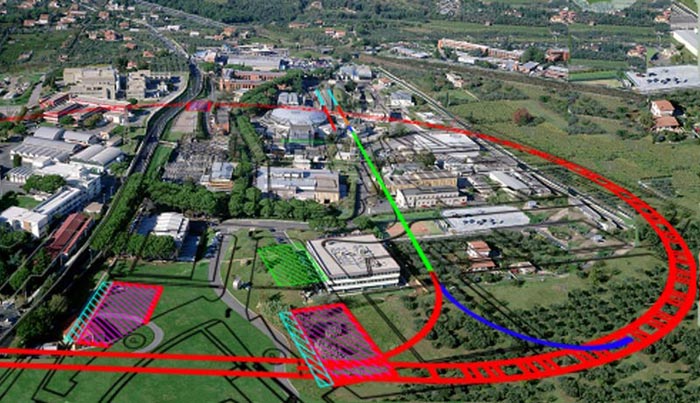
The SuperB project involves the construction underground of a new asymmetric high-luminosity electron–positron collider. It will occupy approximately 30 hectares on the campus of the University of Rome ‘Tor Vergata’ and be closely linked to the INFN Frascati National Laboratories, located nearby. The project, which will ultimately cost a few hundred-million euros, obtained funding approval for €250 million in the Italian government’s CIPE Economic Planning Document. It has also attracted interest from physicists in many other countries. At the end of May, some 300 physicists from all over the world gathered on the island of Elba for a meeting that started the formal formation of the SuperB collaboration, a crucial milestone on the road towards realization of the accelerator.
SuperB will be a major international research centre for fundamental and applied physics. The high a design luminosity of 1036 cm–2 s–1 will allow the indirect exploration of new effects in the physics of heavy quarks and flavours through the studies of large samples of B, D and τ decays. The same infrastructure will also provide new technologies and advanced experimental instruments for research in solid-state physics, biology, nanotechnologies and biomedicine.
The second annual meeting of the European Co-ordination for Accelerator Research and Development (EuCARD) project took place on 11–13 May at the headquarters of the Centre National de Recherche Scientifique in Paris, attended by more than 120 participants. EuCARD is a four-year project co-funded by the European Union’s Framework Programme 7 and involves 37 European partners.
Among the many results and issues discussed was the progress of the engineering design for a 13 T niobium-tin (Nb3Sn) dipole. The first results on its high-temperature superconductor coil insert showed the need for a second iteration; the Nb3Sn undulator also requires optimization with respect to instabilities. New materials have been identified for more robust collimators; intelligent collimators for the LHC and cold collimators for the Facility for Antiproton and Ion Research are undergoing beam tests.
Linear collider technologies are on the move as well and new findings were reported on the origin of breakdowns in cavities. Stabilization to below 0.5 nm at 1 Hz has been demonstrated and there have been advances in instrumentation and femtosecond synchronization. Several superconducting bulk or coated cavities are in either final design, construction or test stages. These include crab cavities for both the LHC and the Compact Linear Collider study. Finally, novel concepts are progressing, including the new crab-waist crossing being tested at DAFNE, the commissioning of EMMA (the fixed-field alternating gradient machine at Daresbury) and the emittance measurement of tiny laser-driven, plasma-accelerated beams.
The networking activities in neutrino facilities, accelerator performance and RF technologies have confirmed their efficiency as exchange platforms. They have made the case for their expansion in the EuCARD2 proposal, which is under preparation and will be submitted by November 2011. Transnational access to the UK Science and Technology Facilities Council’s MICE facility (precision beams and muon-ionization cooling equipment) is continuing. HiRadMat at CERN, which offers pulsed irradiation, will open this autumn. Potential external users can benefit from financial support from the European Commission.
This year, the meeting dedicated one day to accelerator research and development in France, as well as to topics outside the scope of EuCARD, including the SuperB project (SuperB Factory set to be built at the University of Rome ‘Tor Vergata’), neutrino facilities and Siemens medical accelerators. There was also a visit to the large accelerator platforms at the Institut de Physique Nucléaire d’Orsay and CEA-Saclay.
The European Network for Novel Accelerators (EuroNNAc) was formally launched at a workshop held at CERN on 3–6 May as part of the EuCARD project. The aim was to form the network and define the work towards a significant Framework Programme 8 proposal for novel accelerator facilities in Europe.
The workshop was widely supported, with 90 participants from 51 different institutes, including 10 from outside Europe, and had high-level CERN support, with talks by Rolf Heuer, Steve Myers and Sergio Bertolucci. There were also contributions from leading experts in the field such as Gerard Mourou of the Institute Lumiere Extreme and Toshi Tajima of Ludwig Maximilians Universität, two senior pioneers in this field.
The field of plasma wakefield acceleration, which the new network plans to develop, is changing fast. Interesting beams of 0.3–1 GeV, with 1.5–2.5% energy spread, have now been produced in several places including France, Germany, the UK and the US, with promising reproducibility. Conventional accelerator laboratories are now interested to see if an operational accelerator can be built with these parameters. To avoid replication of work, a distributed test facility spread across many labs is envisaged for creating such a new device.
If a compact, 1 GeV test accelerator were pioneered, it could be copied for use around the world. Possible applications include tests in photon science or as a test beam for particle detectors. This could ease the present restrictions on beam time experienced by many researchers. These developments are currently being restricted to electron accelerators because they can be useful even when not fully reliable. Proton machines for medical purposes would, however, need to be more reliable.
In addition to the R&D aspects, the network discussed plans to create a school on Conventional to Advanced Accelerators – possibly linked to the CERN Accelerator School – and to establish a European Advanced Accelerator Conference.
The network activities will be closely co-ordinated with the TIARA and ELI projects. There is currently high funding support for laser science in Europe – about €4 billion in the next decade. EuroNNAc will help in defining the optimal way towards a compact, ultra-high-gradient linac. CERN will co-ordinate this work with help from the École Polytechnique and the University of Hamburg/DESY.
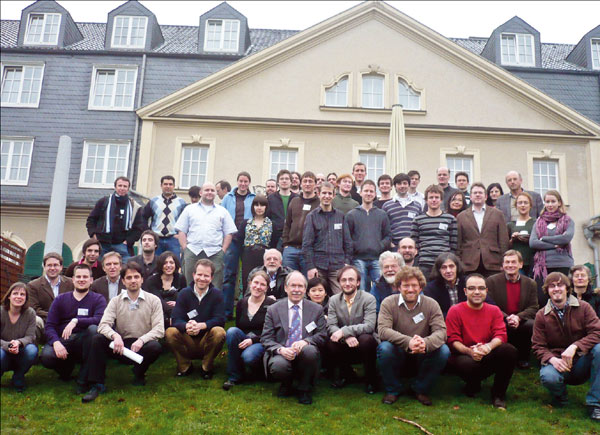
At the end of March, the first Spring School on Philosophy and Particle Physics took place in Maria in der Aue, a conference resort of the archbishopric of Cologne in the rolling hills of the area called Bergisches Land, between Cologne and Wuppertal. It was organized by the members of the Deutsche Forschungsgemeinschaft’s interdisciplinary research project, “Epistemology of the Large Hadron Collider”, which is based at the Bergische Universität Wuppertal. Part of the time was reserved for lecture series by distinguished representatives of each field, including: Wilfried Buchmüller, Gerardus ’t Hooft, Peter Jenni and Chris Quigg from physics; Jeremy Butterfield, Doreen Fraser and Paul Hoyningen-Huene from philosophy; and Helge Kragh from the history of science. The afternoons were devoted to five working groups of philosophy and physics students who discussed specific topics such as the reality of quarks and grand unification. The students then presented their results at the end of the school.
The large number of applications – more than 100 for 30 available places – from PhD students and young post-docs from all over the world demonstrated the strong interest in this interdisciplinary dialogue. There was an almost equal share of applicants from physics and philosophy. The pairing of students and lecturers from such different backgrounds made the school a great success. Almost all of the students rated it “very good” or “excellent” in their evaluations.
Theory and reality
The diverse academic backgrounds of the participants stimulated plenty of discussions during the lectures and working groups, as well as late into the night over beer. They centred on the main lecture topics: the reality of physical theories and concepts, experimental and theoretical methods in particle physics, and the history and philosophy of science.
For example, one of the working groups was concerned with the question, “Are quarks real?” Most physicists would, of course, answer “yes”. But then again, the existence of quarks is inferred in a way that is indirect and theory laden – much more than for, say, chairs and tables. Are there different levels of reality? Or are quarks just auxiliary constructs that will be superseded by other concepts in the future, as happened with the ether in the 19th century, for example? A comprehensive picture of philosophical attitudes towards the reality content of physical theories was discussed by the philosopher Hoyningen-Huene of the University of Hannover. His lecture series also presented critically other aspects of the philosophy of science, focusing on the classic ideas of Karl Popper and Thomas Kuhn: What qualifies as a scientific theory? Are physical theories verifiable? Are they falsifiable? How do physical theories evolve over time?
Fraser, of the University of Waterloo, and Butterfield, of the University of Cambridge, discussed the scope and applicability of particle and field concepts in the interpretation of quantum field theory (QFT), an area that is certainly one of the most successful achievements in physics. However, Fraser pointed out that the need for renormalization in QFT, as used in particle physics, reflects a conceptional problem. On the other hand, the more rigorous algebraic QFT does not allow for an interpretation in terms of particles, at least in the traditional sense.
Another topic that has attracted the attention of philosophers in recent years concerns gauge theories and spontaneous symmetry breaking, as Holger Lyre, of Otto-von-Guericke-Universität Magdeburg, discussed in his lecture. He asked whether it is justified to speak of “spontaneous breaking of a gauge symmetry” given that gauge symmetries are unobservable, a theme that was also discussed in a working group. Again, most physicists would take the pragmatic view that it is justified as long as all physical predictions are observed. Philosophers, however, look for the aspects of gauge theories that can count as being “objectively real”.
The contrarian attitudes between physicists and philosophers were put in a nutshell when a renowned physicist was asked whether he considers the electron to be a field or a particle, and the physicist replied: “Well, I usually think of it as a small yellow ball.” Pragmatism – motivated by a remarkably successful theoretical and experimental description of particle physics – clashed with the attempt to find unambiguous definitions for its basic theoretical constructs. It was one of the goals of the school to understand each other’s viewpoints in this context.
The physics lectures covered both experiment and theory. On the experimental side, Jenni, of CERN, and Peter Mättig, of the University of Wuppertal, discussed methods and basic assumptions that allow us to deduce the existence of new particles from electronic detector signals. As also discussed in one of the working groups, the inference from basic (raw) detector signals to claiming evidence for a theory is a long reach. The related philosophical question is on the justification of the various steps and their theory-ladenness; i.e. in which sense do theoretical concepts bias experimentation, and vice versa. Close to this is the additional question addressed in the discussion as to what extent the LHC experiments are fit to find any new particle or interaction that may occur.
The theory lectures of Robert Harlander, of the University of Wuppertal, Michael Krämer, of RWTH Aachen, and Quigg, of Fermilab, focused on the driving forces for new theories beyond the Standard Model. Apart from cosmological indications – comprehensively reviewed by DESY’s Buchmüller in one of the evening sessions – there is no inherent need for such a theory. Yet, almost everyone expects the LHC to open the door to a more encompassing theory. Why are physicists not happy with the Standard Model and what are the aims and criteria of a “better” theory? One of the working groups discussed specifically the quest for unification as one of the driving forces for a more aesthetic theory.
A current, highly valued guiding principle for model building is the concept of “naturalness”. To what extent are small ratios of natural parameters acceptable, such as the size of an atom compared with the size of the universe? As Nobel laureate ’t Hooft discussed in an evening talk, again there is no direct physics contradiction in having arbitrarily small parameters. But the physicists’ attitude is that large hierarchies are crying out for an explanation. Naturalness requires that a small ratio can arise only from a slightly broken symmetry. This is the background for many models that increase the symmetry of the Standard Model to justify the smallness of the weak scale relative to the Planck scale. Another idea that ’t Hooft discussed is to invoke anthropic arguments fuelled, for example, by the discovery of the string landscape consisting of something like 10500 different vacua.
Closely related to the philosophy of science is the history of science. The development of the Standard Model was the subject of one of the working groups and was also comprehensively discussed by Kragh, of the University of Aarhus. Looking at the sometimes controversial emergence of the Standard Model revealed lessons that may well shape the future. Kragh reminded the audience that what is considered “certain” today only emerged after a long struggle against some “certain facts” of former times.
At first glance, philosophical questions may not be directly relevant for our day-to-day work as physicists. Nevertheless, communication between the two fields can be fruitful for both sides. Philosophy reminds us to retain a healthy scepticism towards concepts that appear too successful to be questioned. In return, the developments of new experimental and theoretical methods and ideas may help to sharpen philosophical concepts. Looking into the history of physics may teach us how sudden perspectives can change. Coming at the brink of the possible discovery of new physics at the LHC, the school was a great experience, reflecting about what we as physicists take for granted. The plan is to have another school in two years.
Historically, imaging detectors have played a crucial role in particle physics. In particular, bubble-chamber detectors – such as Gargamelle at CERN – were an incredibly fruitful tool, permitting the visualization and measurement of particle interactions in an unprecedented way and providing fundamental contributions, in particular in neutrino physics. However, in the search for rare phenomena, bubble chambers are limited mainly by the impossibility to scale their size to larger masses and by their duty cycle, which is intrinsically limited by the mechanics of the expansion system.
The concept of the liquid-argon time-projection chamber (LAr-TPC) was conceived more than 30 years ago: it allows the calorimetric measurement of particle energy together with 3D track reconstruction from the electrons drifting in an electric field in sufficiently pure liquid argon (Rubbia 1977). The LAr-TPC successfully reproduces not only the imaging features of the bubble chamber – its medium and spatial resolution being similar to those of heavy-liquid bubble chambers – but it also has the further achievement of being a fully electronic detector, which is potentially scalable to multikilotonne masses. In addition, it provides excellent calorimetric measurements, with the big advantage of being continuously sensitive and self-triggering.
The ICARUS T600, the largest LAr-TPC ever built, contains 760 tonnes of liquid argon (LAr). It represents the state of the art of this technique and marks a major milestone in the practical realization of large-scale LAr detectors. Installed in Hall B of the underground Gran Sasso National Laboratory (LNGS) of the Instituto Nazionale di Fisica Nucleare (INFN), it is collecting neutrino events from the beam of the CERN Neutrinos to Gran Sasso (CNGS) project. Produced at CERN, the neutrinos reach Gran Sasso after a journey of around 730 km. The detector also acts as an underground observatory for atmospheric, solar and supernovae neutrinos. In addition it will search for proton decay (in particular into exotic channels) in one of its 3 × 1032 nucleons, with zero background.
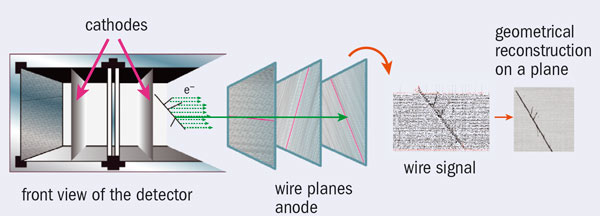
The ICARUS T600 detector consists of a large cryostat that is split into two identical, adjacent half-modules (with internal dimensions of 3.6 × 3.9 × 19.6 m3), which are filled with ultrapure liquid argon (Amoruso et al. 2004). Each half-module houses two TPCs separated by a common cathode, with a drift length of 1.5 m. Ionization electrons, produced by charged particles along their paths, are drifted under a uniform electric field (ED = 500 V/cm) towards the TPC anode made of three parallel wire planes that face the drift volume (figure 1). A total of approximately 54,000 wires are deployed with 3 mm pitch, orientated on each plane at a different angle (0°, +60° and –60°) with respect to the horizontal direction. By appropriate voltage biasing, the first two planes (the induction-1 and induction-2 planes) provide signals in a non-destructive way; finally, the ionization charge is collected and measured on the last plane (the collection plane).
The relative time of each ionization signal, combined with the electron drift-velocity information (vD ˜ 1.6 mm/μs), provides the position of the track along the drift coordinate. Combining the wire coordinate on each plane at a given drift time, a 3D image of the ionizing event can be reconstructed with a remarkable resolution of about 1 mm3. The absolute time of the ionizing event is provided by the prompt UV-scintillation light emitted in the LAr and measured through arrays of photomultiplier tubes (PMTs), installed in the LAr behind the wire planes.
The electronics for data acquisition allow continuous read-out, digitization and independent waveform recording of signals from each wire of the TPCs. The electronic noise is 1500 electrons r.m.s. to be compared with around 15,000 free electrons produced by a minimum-ionizing particle in 3 mm.
To permit electrons produced by ionizing particles to travel “unperturbed” from the point of production to the wire planes, electronegative impurities (mainly O2, H2O and CO2) in the LAr must be kept at a low concentration level (below 0.1 ppb). Therefore, both gaseous and liquid argon are continuously purified by recirculation through standard Hydrosorb/Oxysorb filters.
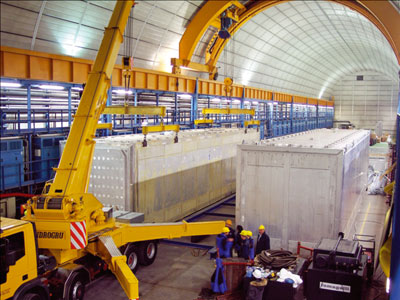
Preassembly of the ICARUS T600 detector began in 1999 in Pavia and one of the two 300-tonne half-modules was brought into operation in 2001 and tested with cosmic rays at the Earth’s surface. To meet safety and reliability requirements for underground operation in Hall B at LNGS, the ICARUS T600 module – illustrated in figure 2 – was equipped with dedicated technical infrastructures. Assembly of the complete detector was achieved in the first months of 2010 and it was finally brought into operation with its subsequent commissioning.
Operation at LNGS
In the spring of 2010, the detector was filled with ultrapure LAr and activated immediately. Events from the CNGS neutrino beam and cosmic rays were observed with a trigger system that relied on both the scintillation light signals provided by the internal PMTs and the CNGS proton-extraction time. The “early warning” signal, sent from CERN to LNGS some 80 ms before the first proton spill extraction, allows the opening of two gates of around 50 μs, corresponding to the predicted extraction times. The first observed CNGS neutrino event is shown in figure 3 other beautiful events with a muon crossing both chambers of a module and two neutral pions are shown in the middle and bottom parts of figure 3, respectively.
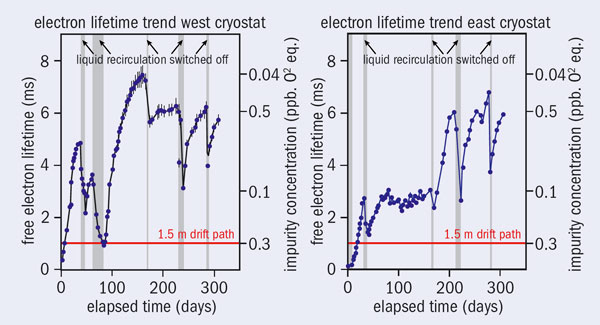
LAr purity is monitored continuously by measuring the charge attenuation along the tracks of ionizing cosmic muons that cross the full drift path. With the liquid recirculation turned on, the LAr purity steadily increased, the value of the free-electron lifetime exceeding 6 ms in both half-modules after a few months of operation (figure 4). This corresponds to a maximum free-electron yield attenuation of 16%. Sudden degradations of purity owing to periodic pump stops for maintenance are always recovered promptly within a few days.
The performance of LAr-TPCs has been studied progressively over the past two decades by exposing different detectors to cosmic rays and neutrino beams, culminating in the successful achievement of the T600 operation. The high resolution and granularity of the detector imaging allow the precise reconstruction of event topology, which is completed by a calorimetric measurement.
Particles are identified by studying both the dE/dx versus range and the decay/interaction topology. Electrons are identified by the characteristic electromagnetic showering, being well separated from π0 via γγ reconstruction, dE/dx signal comparison and the π0 invariant mass measurement at the level of 10–3. This feature guarantees a powerful identification of the charged current (CC) electron-neutrino interactions, while rejecting neutral-current (NC) interactions to a negligible level. The electromagnetic energy resolution σ(E)/E = 0.03/√(E(GeV)) ⊕ 0.01 is estimated in agreement with the π0 → γγ invariant mass measurements in the sub-giga-electron-volt energy range, while σ(E)/E = 0.30/√(E(GeV)) has been inferred for hadronic showers.
For long muon tracks that escape the detector, momentum is determined by measuring the displacements arising from multiple scattering along the track. The procedure, implemented through a Kalman filter algorithm and validated on stopping muons, allows a resolution of Δp/p that can be as good as 10%.
During the 2010 CNGS run, the T600 acquired neutrino interaction events with steadily increasing efficiency, a live time of up to 90% and increasing quality. In the last 2010 period, about 100 neutrino CC events were collected and classified, in agreement with expectations.
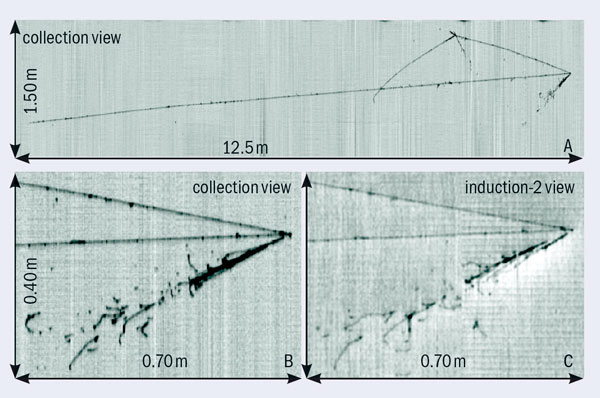
As an example of the detector capabilities, figure 5 shows a CNGS νμ CC event with a 13 m-long muon track, together with zoomed projections on the collection and induction-2 planes. The use of two different views allows the recognition of two distinct electromagnetic showers pointing to – but detached from – the primary vertex. Even though the two photons overlap in the collection view it was possible to determine the associated invariant mass m12* = 125±15 MeV/c2, which is compatible with the π0 mass. The initial ionization of the closer photon amounts to 2.2 minimum ionizing particles. This is a clear signature for pair conversion, thus confirming the expected e/π0 identification capabilities of the detector.
The momentum of the long muon track in figure 5 has been measured to be via the multiple-scattering method pμ = 10.5±1.1 GeV/c. The other primary long track is identified as a pion that interacts to give a secondary vertex. A short track from the secondary vertex is identified as a kaon, decaying in flight into a muon. From the decay topology and energy deposition, the kaon momentum can be evaluated as 672±44 MeV/c.
The capability for identifying and reconstructing low-energy kaons is a major advantage of the LAr-TPC technique for proton-decay searches. In the event described, the kaon momentum is not far from the average (300 MeV/c), for instance in the p → ν– K+ channel. Also, the ability to identify π0s, as in this event, is effective for many nucleon-decay channels, as well as for the discrimination of NC events when looking for νμ → νe oscillations.
The missing transverse-momentum reconstructed is 250 MeV/c. Despite the non-full containment of the event, this value is consistent with the theoretical expectation from the Fermi motion of target nucleons. The reconstructed total energy is 12.6±1.2 GeV, well within the energy range of the CNGS beam (Bailey et al. 1999).
One of the most generous schemes to support women returning to physics – and possibly the most valuable to result from a personal bequest – is the M Hildred Blewett Fellowship of the American Physical Society (APS). When Hildred died in 2004, she left nearly all that she had to the APS to set up the scholarship, which funds a couple of women a year in the US or Canada to the tune of up to $45,000. So far, nine recipients have benefited from the bequest, including two in nuclear and particle physics – not far removed from Hildred’s own field of work in accelerator physics. Indeed, she played an important role in the design of accelerators on both sides of the Atlantic, as well as in the organization of their exploitation.
Hildred Hunt was born in Ontario on 28 May 1911. Her father, an engineer who became a minister, supported her interests in mathematics and physics, although the family did not have much money and Hildred had to take a time out from college – a factor that appears to have influenced the future bequest. Nevertheless, by 1935 she had graduated from the University of Toronto with a BA in physics and maths. Stints of research followed, first at the University of Rochester, New York, and then at Cambridge’s Cavendish Laboratory – which was still under Ernest Rutherford – together with her husband John Blewett, who had also studied in Toronto. After returning to the US, in 1938 Hildred joined Cornell University as a graduate student, with Hans Bethe as her thesis supervisor. Writing in APS News more than 60 years later, physicist Rosalind Mendell recalled Hildred saying that as John was working on magnetrons at General Electric (GE) “she had gone back for her doctorate because she loved physics and could no longer endure life as a ‘useless’ company wife” (Mendell 2005). Rosalind had arrived at Cornell in 1940, when she was just short of 20 years old, joining 50 men plus Hildred – “the cheerful, confident and breezy Canadian blonde”. Hildred took the younger woman under her wing, a characteristic that was seen later with other junior colleagues and was also reflected in her final bequest.
The entry of the US into the Second World War changed everything and by the summer of 1942, Bethe was working with Robert Oppenheimer in California on some of the first designs for an atomic bomb. In November Hildred joined GE’s engineering department; her thesis work was left behind, never to be fulfilled. While at GE she developed a method of controlling smoke pollution from factory chimneys. However after the war, a bright future opened up for scientific research in the US and in 1947 both Blewetts were hired by the newly established Brookhaven National Laboratory to work on particle accelerators. Hildred’s forte was in theoretical aspects, while John had already worked with betatrons at GE.
The Blewetts were part of the team that worked on the design and construction of a new accelerator that would reach an energy of 3 GeV, an order of magnitude higher than in any previous machine and in the range of cosmic-ray energies, hence the name of “Cosmotron”. The machine came into operation in 1952 and Hildred edited a special issue of Review of Scientific Instruments, which contained articles on many key aspects, some of which she also co-authored (Blewett 1953a).
Birth of the PS
That same year saw the emergence of the alternating gradient or “strong-focusing” technique, which offered the possibility for an accelerator to go up to much higher energies and gave birth to the Alternating Gradient Synchrotron (AGS) at Brookhaven. The idea was also conveyed to a group of physicists from several European countries who visited Brookhaven in the summer of 1952 to learn about the Cosmotron and how they might build a similar but somewhat larger machine for the nascent organization that would become CERN. Following the visit, and a busy period of study, the decision was indeed taken to build a strong-focusing machine of 25–30 GeV, the future Proton Synchrotron (PS). The group invited the two Blewetts and Ernest Courant – one of the inventors of the principle of strong focusing – to Europe to help plan the new laboratory.
By the end of March 1953, the provisional Council had agreed to build the strong-focusing machine, but as CERN did not yet officially exist, the work was split among groups in several European institutions. On six months’ leave from Brookhaven, the Blewetts went to Odd Dahl’s institute in Bergen, where they contributed to the initial design of the PS. The arrangement turned out to be more complex than initially thought, and they pushed to have everything moved to Geneva, once the site had been selected and ratified by the cantonal referendum in June 1953. The advance guard of the PS group, including the Blewetts, arrived there at the beginning of October. At the end of the month Geneva hosted a conference on the theory and design of an alternating-gradient proton synchrotron; Hildred edited the proceedings (Blewett 1953b).
Both Blewetts were full members of the PS group, engaged in all aspects, from theoretical research to cost estimates, and their collaboration continued, even after they returned to the US. By January 1954, the decision had been taken to build the 33 GeV AGS at Brookhaven, so the collaboration between the US and Europe was important to both. Hildred commented later that there were even times when “in many ways Brookhaven got more from the co-operation than CERN did” (Krige 1987). She returned to Geneva to attend accelerator conferences in 1956 and 1958, and visited CERN for three months in 1959, when the PS was near completion. Well known photos record her presence in the PS control room on the magical evening of 24 November when the “transition” took place; her written recollections still bring the day vividly to life (CERN Courier November 2009 p19).
Back in Brookhaven Hildred made major contributions to the design of the AGS, in particular she “presided over the design of the magnets” (Blewett 1980). Courant also recalls that she devised an elaborate programme to make detailed field measurements of each of the 240 magnets, which enabled the team to assign the positions of the magnets in the ring so as to minimize the effects of deviations from the design fields.
The AGS began operation in 1960, a few months after the PS at CERN. Alan Krisch, then a graduate student at Cornell, worked on a large-angle proton–proton scattering experiment, which was one of the first to be approved. Hildred “sort of adopted” him and he remembers her as a “formidable woman from whom he learnt much”. She was the one, for example, who suggested that the Cornell group acquire a trailer to provide a cleaner environment where they could collect their data near their AGS experiment. “It was a great idea,” he says, “and soon everyone had trailers.”
The Blewetts split up around that time, as professional divergences increased. These included, Krisch recalls, a disagreement about whether the AGS should add a high-intensity linac or colliding beams. After the divorce, Lee Teng, a colleague and friend, invited Hildred to the Argonne National Laboratory, where he had become director of the Particle Accelerator Division. “I remembered that at Brookhaven she got along very well with and was respected by all of the AGS users,” he says, so he suggested that Hildred become the liaison with the users of Argonne’s Zero Gradient Synchrotron (ZGS). She took on the work with characteristic dedication, bringing all of her experience from Brookhaven, taking care of the needs of the users. One of these was Krisch, who at 25 was a newly appointed assistant professor at the University of Michigan and spokesperson for one of the first experiments on the ZGS. Under Hildred, the experimental areas worked well, “probably the best of any place I’ve worked at”, he says. During this time at Argonne, papers by Hildred show that she continued to work on magnet design, as well as on costings for experimental facilities.
By 1967, on leave from Argonne, she was already involved with the 300 GeV project at CERN, for example as co-ordinator of utilization studies across the member states to look into the exploitation of the machine that would become the Super Proton Synchrotron (ECFA 1967). She joined the CERN staff in 1969 and collaborated in the Intersecting Storage Rings (ISR), which started up in 1971. That same year she was heavily involved in the organization of the 8th International Conference on High-energy Accelerators in Geneva, nearly a quarter of a century after the conference (also in Geneva) that had foreshadowed the PS. She ran the finances of the ISR Division, keeping a careful eye on how resources were spent, as well as being secretary of the ISR Committee (ISRC), serving the new community of users at CERN. Again, the users included Krisch, this time as the first US spokesperson on a CERN experiment, together with a trailer flown over from Argonne; and again Hildred’s expertise proved invaluable, advising on how to run the cabling etc. By the time she retired she had been secretary for 60 meetings of the ISRC and left behind her a perfect organization, in the words of her successor.
She retired in August 1976, but remained at CERN until July 1977 as a scientific associate. During this final year, reports were published on the concept for a 100 GeV electron–positron machine and on studies of 400 GeV superconducting proton storage rings – the future Large Electron–Positron collider and Large Hadron Collider, respectively – both of which involved Hildred (Bennet et al. 1977 and Blechschmidt et al. 1977). She also organized the 1st International School of Particle Accelerators “Ettore Majorana” in Erice, which laid the foundations for the CERN Accelerator School.
The recollections of some of the people who knew Hildred not only paint a picture of a strong woman who cared a great deal for others, but also give some insight into her interests beyond physics. Mendell remembers that they walked together on the Physics Department hikes at Cornell and Courant recalls that she was “an avid folk dancer”, organizing weekly classes in which he and his wife participated enthusiastically. Krisch recalls that during his third encounter with Hildred at CERN, she invited him to Geneva’s English Theatre Club to see her star as the Bulgarian heroine in George Bernard Shaw’s Arms and the Man.
After a few years in Oxford, which suited her interests in music, amateur dramatics and fine arts, Hildred returned to Canada to be closer to her brother and his family. She died in Vancouver in June 2004, at the age of 93. Her career was characterized by her concern that others too should be able to make the most of their time in the field she clearly enjoyed – from the young people she mentored to the user communities she served in several major laboratories and to the beneficiaries of her generous bequest.
The European Physical Society (EPS) was founded at CERN in 1968. Today it represents more than 100,000 physicists through its 41 national member societies and it provides a scientific forum for more than 3000 individual members from all fields of physics.
Around 50 universities, research institutes, laboratories and enterprises that are active in physics research are also present as EPS associate members. CERN was the first to join and has supported the EPS since the very beginning. Many leading personalities from CERN have been EPS presidents: Gilberto Bernardini, the founder and first president of the EPS, who at the time was CERN’s research director; Antonino Zichichi; Maurice Jacob and Herwig Schopper.
The EPS is a non-profit association whose purpose is to promote physics in Europe and across the world. In 1968, when European integration was still rather vague, the establishment of the EPS was, to quote Bernardini’s inaugural address in the CERN Council Chamber, “a demonstration of the determination of scientists to make their positive contribution to the strength of European cultural unity.”
Today the EPS continues to play an important role in fostering the scientific excellence of European physicists, through high profile activities, in enhancing communication among physicists in Europe and across the world, and in bringing major issues in physics, and science in general, to the attention of the public and policymakers.
So how is the EPS organized? EPS members decide the priorities of the society, allocate resources for its activities and hold positions of responsibility. The scientific activities of the EPS segment into divisions and groups, which are governed by boards. Such activities include renowned topical conferences, seminars and workshops.
The divisions and groups also develop outreach activities, for students and for the general public, and support measures to help physicists from less-favoured regions of Europe and from scientifically emerging countries worldwide to participate in EPS initiatives.
A number of prestigious prizes are awarded by the EPS divisions and groups in recognition of outstanding achievements in all fields of physics. These often anticipate the Nobel awards.
The EPS has 11 divisions, covering specific fields of physics research: Atomic, Molecular and Optical Physics, Environmental Physics, High Energy and Particle Physics, Nuclear Physics, Physics in Life Sciences, Plasma Physics, Quantum Electronics and Optics, Solar Physics, Statistical and Nonlinear Physics.
In addition there are seven groups that look at questions of common interest to all physicists, such as: Accelerators, Energy, and Technology; but also the History of Physics and Physics for Development. Finally, a number of committees deal with social questions: European Integration, Gender Equality in Physics, Mobility, Physics and Society and Young Minds.
Like all learned societies the EPS publishes a letters journal (Europhysics Letters), a scientific bulletin (Europhysics News) and, more recently, an electronic newsletter (e-EPS). These are produced in partnership with a number of member societies and their respective publishing houses.
As a consequence of its expansion and evolution over the past 40 years, the EPS has undergone several revisions to assess and define its two-fold role of learned society and federation of national societies, so that it can act as an authoritative, scientific opinion-maker.
In 2010 the society sketched out its new strategy plan and identified new guidelines. The EPS needs to gain more visibility, to strengthen and highlight the activities of its divisions and groups and to generate a greater spirit of belonging and cohesion among its members. It also needs to bring added value and provide a louder common voice to its member societies and associate member institutions. It should increase its potential for co-operation and solidarity with less-favoured countries.
The preservation of the quality of European publications, in particular EPS journals and those related to or recognized by the EPS, and their integration into the context of global publishing is another main objective. Finally, establishing and strengthening links with other scientific societies worldwide – physical, astronomical and chemical – is among the new EPS priorities.
In this perspective, further intensifying the good relations and privileged interactions between CERN and the EPS would be highly desirable. Both institutions are on the same wavelength, share the same vision and support excellency in joint fundamental and applied research. They are concerned with technology transfer and industry’s involvement in physics research and they care deeply about education matters, outreach, knowledge dissemination and public awareness.
As CERN’s director-general Rolf Heuer repeatedly emphasizes, “We must bring science closer to society.” A tighter collaboration between the unique European research laboratory that is CERN and the EPS could serve this common goal; moreover CERN could help considerably to boost the future of the EPS.
The Quantum Story provides a detailed “biography” of the 111-year-old quantum physics, from its birth with Planck’s quantum of action all of the way up to superstrings, loop quantum gravity and the start of the LHC – a machine that is expected to put physics back on the right track, with experimental measurements forcing some “figments of the theoretical mind” to confront reality.
The first chapters are simply delicious and ideally suited for summer reading on a sunny, late afternoon with a fresh drink close by. I was pleased to revisit most of the stories and characters I met as a teenager when reading books by or about Einstein, Bohr, Pauli, Heisenberg, de Broglie, Schrödinger, Dirac and many other universal heroes. Baggott explains the basics and wonders of quantum physics in a surprisingly clear way, despite its intrinsically “unsettling” and “wholly disconcerting” nature. A multitude of advances and a fair share of dead ends are exposed with excitement and suspense, almost as in a detective story, and the pace of the action is such that I was often reminded of Dan Brown’s novels. You begin to wonder if some of the main characters ever slept, such as during the Solvay conference in 1927, when each breakfast time Einstein would attack with a new gedankenexperiment, which Bohr would counter throughout dinnertime in Brussels’ “Hotel Britannique”.
We all know about Einstein’s “year of miracles” when, perhaps inspired by not having a respectable position to lose in the academic world, he revolutionized physics with an incredible succession of amazing papers. It is less known that he also wrote several “unpublished papers”, some of which influenced new and important ideas, such as Born’s probabilistic view of Schrödinger’s wavefunctions, submitted for publication in June 1926. This “hastily written” paper was followed one month later by a second one giving a “more considered” perspective, complemented by a note added to the proofs of the first, mentioning that the probabilities are proportional to the square of the wavefunctions.
Somehow, it had not crossed my mind that even in those days many physicists were in a hurry to get their ideas in print. The “publish or perish” motto has long applied. Pauli submitted a paper deriving Balmer’s formula from matrix quantum mechanics just five days before Dirac did the same; maybe Dirac’s delay was caused by his proverbial perfectionism with clear language. Baggott mentions other notes added by the authors in the proofs of their papers, as when Heisenberg writes that: “Bohr has brought to my attention that I have overlooked essential points in the course of several discussions in this paper [on uncertainties].” Ouch… this must have hurt. It continues: “I owe great thanks to Professor Bohr for sharing with me at an early stage the results of these more recent investigations of his.” The Copenhagen interpretation did not have an easy birth.
The topic of quantum reality strikes back later in the book, in chapters 30 to 35, where the reader needs a higher level of concentration to follow detailed developments regarding the topics of hidden variables, Bell’s and Leggett’s inequalities, entanglement and the surprisingly accurate experimental work recently made in this area. In chapters 18 to 29, the reader learns the crucial steps in the development of quantum field theories, quantum electrodynamics, quantum chromodynamics, quark asymptotic freedom and infrared confinement, the J/Ψ revolution, the discovery of the intermediate vector bosons, etc. This must be the nicest introduction to the Standard Model that I have read so far.
Given the style (and target audience) of the book, the almost complete absence of mathematics is quite understandable and I should say that the author succeeds remarkably well in explaining many leading-edge physics topics without the help of equations. It is true that “modern theoretical physics is filled with dense, impenetrable, complex mathematical structures”, which often obscure the deep meaning of what is being done. Nevertheless, and with the confidence gained after reading the 410 pages of main text plus several end-of-book notes, I dare to express the wish of seeing this book reprinted in a “special illustrated edition” (following the nice examples of Bill Bryson’s A Short History of Nearly Everything and Stephen Hawking’s A Brief History of Time), with more diagrams, pictures and equations.
In summary, this is a truly exceptional book, which I highly recommend. It will be enjoyable reading for many professional physicists as well as for bright high-school students waiting for something to trigger a decision to follow a career in physics.
Mathematician and science writer Amir D Aczel is well known for his factually convincing and captivating story of Fermat’s Last Theorem. His recent book on CERN follows a similar recipe for writing a gripping story: impressions from several visits to the laboratory – notably witnessing the LHC restart from the CERN Control Centre on 5 March 2010 and from the CMS Control Centre earlier in the day – as well as interviewing respective experts and leading physicists, including 13 Nobel laureates.
The story develops in 14 chapters that are illustrated with colour photographs, black-and-white line drawings, photographs and tables. An afterword, notes and a bibliography complete the picture, together with three more “technical” appendices: how an LHC detector works; particles, forces and the Standard Model; and the key physics principles used in the book. Aczel covers the LHC and its potentialities and risks, the four big detectors, symmetries of nature and Yang–Mills theory, the Standard Model, the Higgs particle, string theory, dark matter, dark energy and the fate of the universe. The result is a splendid effort to inform a wider public of CERN’s achievements set in an appropriate context.
As would be expected, Aczel is at his best when explaining mathematical theories such as that of Yang and Mills. Given the breadth of the material covered, it is not surprising that there are some lacunae and even errors. What struck me as an accelerator physicist was the erroneous explanation for the PS Booster synchrotron in the accelerator chain that feeds the LHC, which he attributes to the limited increase of particle velocity in a given synchrotron. In fact, the need for the Booster arose from the luminosity requirements of the Intersecting Storage Rings (and successive storage rings) – that is higher beam intensity and (phase space) densities or, in other words, limited transverse and longitudinal beam emittances. It would have been helpful if Aczel had been able to interview the late Nobel laureate Simon van der Meer.
Altogether, however, it is a book that can be highly recommended to anybody who wants to know “everything” about CERN and who likes a narrative style. I would personally be interested to know how much a complete newcomer understood after a first reading.
When I received the book, I was eager to start reading it, particularly because of its subtitle: How We Can Use Science to Read the Early-Warning Signs. How can we? In fact, after reading the book, the conclusion is that we cannot.
Although realizing it caused some disappointment, I can confirm that, even without the million-dollar answer, the book is an interesting read. Len Fisher is an experienced writer, capable of explaining difficult concepts with simplified – but never simplistic – language. The book talks about equilibrium states, physical and mathematical models, negative feedback etc. When you study such topics in textbooks, you can quickly become bored that everything seems so obvious. However, the mathematics that formalizes all of this is far from being obvious; and the million-dollar question has no answer precisely because of this.
Fisher’s writing is engaging because it moves the hard concepts into everyday life, giving them a framework that makes the reader forget about the complex physics and mathematics behind them. Thus, the equilibrium states that remain theoretical in textbooks, are here explained in real and contextual situations, so that the reader learns about the evolution of biological species, the main facts that determine the solidity of a newly constructed bridge (but it could be your house) and even the factors that lead the dynamics between two people who become a couple.
I found this enjoyable reading and the disappointment of the missing conclusion was partly compensated for by the genuine attention that the author pays to the reader’s entertainment. I recommend the book to a non-scientific readership, which, I believe, will greatly profit from Fisher’s explanation of how and why things work, or, conversely, why they don’t work and can break down.
To provide the best experiences, we use technologies like cookies to store and/or access device information. Consenting to these technologies will allow us to process data such as browsing behavior or unique IDs on this site. Not consenting or withdrawing consent, may adversely affect certain features and functions.
Functional
Always active
The technical storage or access is strictly necessary for the legitimate purpose of enabling the use of a specific service explicitly requested by the subscriber or user, or for the sole purpose of carrying out the transmission of a communication over an electronic communications network.
Preferences
The technical storage or access is necessary for the legitimate purpose of storing preferences that are not requested by the subscriber or user.
Statistics
The technical storage or access that is used exclusively for statistical purposes.The technical storage or access that is used exclusively for anonymous statistical purposes. Without a subpoena, voluntary compliance on the part of your Internet Service Provider, or additional records from a third party, information stored or retrieved for this purpose alone cannot usually be used to identify you.
Marketing
The technical storage or access is required to create user profiles to send advertising, or to track the user on a website or across several websites for similar marketing purposes.