As 2012 approaches, and with it the centenary of Victor Hess’s famous discovery, it really is time that we found out where cosmic rays originate. Gamma-ray astronomy has shown that most of the particles come from the Galaxy, but even this discovery was 63 years in coming (Dodds et al. 1975). Supernova remnants (SNR) have long been suspected to be the source of cosmic rays below about 100 PeV, the production mechanism being Fermi acceleration in shock-borne magnetic fields. The energies involved are reasonable: about 1043 J into cosmic rays per SNR per century. However, there are doubts, with pulsars or extended sources being other possibilities.
The origin problem arises because magnetic fields on a variety of scales in the Galaxy cause particles at these energies to pursue tortuous paths, so that their arrival directions at Earth bear virtually no relationship to the directions of the sources. Solving the problem therefore requires other approaches. Structure in the energy spectrum could provide such a possibility.
Clues from the energy spectrum
The only feature of the cosmic-ray energy spectrum that researchers currently agree on is a steepening that starts in the region of 3–5 PeV. First observed by German Kulikov and George Khristiansen at Moscow University around 50 years ago (Kulikov and Khristiansen 1958), this so-called “knee” has been confirmed time and again from the 1960s onwards. It was not until 13 years ago, however, that we pointed out that the “knee” is too sharp for a conventional explanation in which the galactic magnetic field gradually “loses its grip” on the particles (Erlykin and Wolfendale 1997). We argued instead that it results from a dominant contribution from a single, nearby source. The idea is that particles from the single source provide a component that pokes through the background arising from an amalgam of many differing sources (figure 1).
The single-source model has had a rough ride, with most researchers being unwilling to accept that there could be “fine structure” in the spectrum caused by nuclei heavier than protons from this source. Our early analysis was based on extensive air-shower (EAS) data from a variety of EAS arrays. While these results are still valid, we have recently analysed new data from some 10 arrays, thus extending the reach to higher energies than before. Remarkably, and importantly, a new feature has appeared at about 70 PeV.
When the energy spectrum is plotted as log(E3I(E)) versus logE, a “knee” will appear as a peak and it is a new peak in the spectrum plotted in this way that is of interest (figure 2). It was first reported by the GAMMA collaboration led by Romen Martirosov, using the GAMMA EAS array of the A I Alikhanyan National Science Laboratory at Mount Aragats in Armenia (Garyaka et al. 2008). Our own survey shows that it is also present in most of the other reported spectra (Erlykin and Wolfendale 2010). It is interesting to note that our first paper on the single-source model showed a small excess at the level of 2.6σ just where the GAMMA collaboration finds its 70 PeV peak. However, we did not claim that this small peak was significant at the time.
We have now used these recent spectra to investigate the case for SNRs in general as the source of cosmic rays at energies below 100 PeV. The model for the acceleration of the cosmic rays predicts that those with charge Z should have a differential energy spectrum, with a negative slope of about 2, up to a maximum energy proportional to Z. Nuclei are conventionally grouped into the following nuclear bands: P, He, CNO, M(Ne, Mg, Si) and Fe (actually Fe and Ni). The spectrum expected at some distance from the single source differs from that at the SNR itself because of propagation effects, but these can be calculated. This is what we have done, assuming that the single source is Monogem, a “recent” SNR with an age of 85–115 ky, at a “local” distance of 250–400 pc (Erlykin and Wolfendale 2003).
Figure 3 shows a synthesis of the 10 reported spectra from the EAS arrays from which the (predicted) smooth background, also shown, has been subtracted. The resulting “spectrum” is thus our estimate of the extra contribution from the single source. The figure also shows our fits of the individual single-source spectra in the different nuclear bands to the observations. Inevitably, there is no question of a perfect fit: although the He and Fe peaks seem well founded, those for CNO and P are less well so. Peaks for P and He have been seen in other experiments, however. The whole range is thus reasonably well represented.
Our calculations give the relative abundances at a fixed energy per particle of the various nuclear groups on ejection from the single source as: P(0.477), He(0.406), CNO(0.081), M(0.010) and Fe(0.026). Remarkably, with the exception of the M group, these abundances are close to those inferred for the ambient cosmic radiation at 103 GeV, an energy where direct measurements are available. We interpret this as showing that the majority of the galactic sources are SNR, like Monogem, but of course with different ages and distances.
The search for confirmation
The identification of the peaks in figure 3 could be confirmed by searching for discontinuities in those entities that have given rise to estimates of the mean mass of the ambient cosmic radiation. However, such a search is bedevilled by two facts. First, it is in the nature of things that at any energy the mean mass of the single-source particles should be close to that of those injected for the ambient cosmic radiation. Second, the different analyses of the variety of EAS parameters used in deriving the mean masses give, notoriously, different results. Our conclusion, however, is that there is no evidence against our identifications.
These differences provide a happy hunting ground for searches for changes with increasing energy in the nature of the interactions between cosmic rays and nuclei in the atmosphere. It must also be said, however, as we have pointed out, that recent results from CERN show no significant change in at least some of the interaction characteristics over the range 0.4–26 PeV. This is just where the cosmic-ray energy spectrum has its knee; LHC data on forward physics are eagerly awaited.
The CMS experiment at CERN recently published first measurements of the cross-section for top-antitop pair production at a centre-of-mass energy of 7 TeV. The top quark is the heaviest known fundamental particle, with a mass of about 172 GeV, almost 185 times that of the proton. Until recently the production of top quarks was the privilege of the Tevatron at Fermilab.
Top quarks decay instantly and almost exclusively into a heavy W boson and a bottom quark (b). The b quark then “hadronizes” into a jet of particles, which can often be distinguished from a jet originating from a lighter quark or gluon by the presence of a secondary vertex in the event. The W boson can decay into either two jets or two leptons. The recent CMS analysis relies on the W bosons from both of the top quarks decaying into two leptons, i.e. either to a muon plus a neutrino, or into an electron plus a neutrino. This leads to a signature for top-antitop (tt) consisting of two b-quark jets, two charged leptons and two neutrinos. The neutrinos will pass through the detector without leaving any trace but their presence can be induced from the missing (transverse) energy in the collision.
Such a signature is very distinct and relatively free of background. The CMS collaboration performed this first analysis on a sample of data taken in the first few months of LHC operation at 7 TeV, corresponding to an integrated luminosity of around 3 pb–1. They identified 11 candidate events and calculated the number of jets per event thought to originate from bottom quarks, as shown in the figure, which also indicates the expectations for signal and background. The latter is indeed very small. The analysis of this event sample yields a top cross section of 194 ± 72 (stat.) ± 24 (syst.) ± 21 (lumi). Within the measurement uncertainties, this value for the cross-section is in good agreement with calculations in higher-order perturbative QCD.
While the top quark is an interesting object to study in itself, it will also play an important role as background in searches for new physics. Therefore an early measurement of its cross-section at this new centre-of-mass energy is an important step towards exploring the unknown.
In the 20 years since the first International Tau Workshop there has been remarkable progress, through work by experiments such as CLEO, BaBar, Belle, those at the Large Electron-Positron collider and the Tevatron, as well as several neutrino experiments, not to mention the work by theorists. The early efforts saw the acceptance of the τ as a standard lepton, a heavy copy of the electron and the muon. But the τ is massive enough to decay into hadrons as well as leptons, so its decays provide a rich laboratory for studies of a large range of physics topics. More recently, the τ has come into use as a tool to search for physics beyond the Standard Model, for example through lepton-flavour violation, charge-parity violation or the production of the τ in decays of possible new particles produced at the Tevatron and the LHC.
Tau 2010, the 11th International Workshop on Tau Lepton Physics, took place at the University of Manchester on 13–19 September. Some 80 delegates from 20 countries participated in a lively meeting that covered many topics in τ physics, including lepton-flavour violation, QCD, the muon-anomalous magnetic moment, τ neutrino physics, τ physics at the Tevatron and the LHC, as well as the outlook for the field. The workshop had a programme of more than 60 talks.
New physics signatures
The τ lepton is important as a potential way to observe the violation of lepton flavour (LFV). Apostolos Pilaftsis of Manchester stressed in his introduction to the LFV session that any observation of it would be an unambiguous signature for physics beyond the Standard Model. While the τ cannot be produced in such copious quantities as the muon, a significant advantage comes from its relatively large mass. The session contained a number of theory contributions and updates on searches for LFV from BaBar and Belle. In his summary of work by the Heavy Flavour Averaging Group, Swagato Banerjee of Victoria showed the recent enormous progress that these B-factory experiments have made in this area (figure 1). Huge improvements on the limits for LFV in τ decays to many possible final states have been made in comparison with those from the CLEO experiment, which had previously been the leader in this area. Further progress is to be expected at Belle II and at the proposed SuperB facility. For LFV in muon decays, the MEG collaboration – searching for muon decays to an electron plus a photon – reported an analysis of its first data, with tantalizing evidence for some possible candidates. Plans for the proposed Mu2e, COMET and PRISM/Prime experiments were also outlined at the workshop.
New physics might also be found in the τ sector through unexpected violations of charge-parity (CPV). This well known phenomenon in K and B physics reflects subtle differences in nature between the behaviour of matter and antimatter. Both the BaBar and Belle experiments have new, complementary results from the decay τ → πK0ν. A small amount of CPV is expected in this process from the properties of the K0 system, but neither experiment has found any excess and each has set limits on the strength of any possible CP-violating contributions.
Measurements of the decays of B→ τν were presented from both BaBar and Belle, each reporting an excess above the rate expected in the Standard Model. Such an excess could come from mediation of the decay by a virtual charged Higgs particle. However, the excess is small, and more data are needed to confirm its existence.
The mass of the τ is a fundamental parameter in the Standard Model of particle physics, and therefore important to measure in its own right. Also, a precise value for the mass is needed for testing lepton universality, by relating the lepton electroweak couplings and the muon and τ lifetimes. The most precise measurement to date, from the KEDR experiment at the VEPP-4M electron–positron collider in Novosibirsk, was reported at the workshop. The measurement comes from a threshold scan of the τ-pair cross-section using the technique of resonant depolarization to obtain a precise measurement of the beam energy. The new result for the τ mass is 1776.69 GeV with a precision of 0.013%. Plans are in place to improve this further at the BES III experiment in Beijing.
In his introductory talk for the QCD session, Antonio Pich of Valencia stressed the great value of the hadronic decays of the τ as a laboratory for studying QCD. With naive counting of possible fermionic final states, the τ would decay about 60% of the time via qqν. The hadronic decays make up about 65% of the total – the small difference from 60% arising mainly from QCD effects. It turns out that the non-perturbative contribution to the QCD corrections is small despite the low mass of the τ.
The workshop saw some lively discussion of the various approaches to the calculation of the perturbative terms, with recent developments in contour-improved perturbation theory challenging the approaches based on fixed-order perturbation theory. Despite the theoretical uncertainties, the value of the strong coupling constant, αs, obtained from the τ decay data remains the most precise experimental measurement and provides a low-energy measurement with a small uncertainty that helps to confirm the running of αs expected in QCD.
Also in the quark sector, τ decays to strange final states allow for determination of the Cabibbo-Kobayashi-Maskawa matrix element Vus. The measurement reported from BaBar, based on the ratio of the rate for τ → Kν to that for τ → πν, agrees well with results from other methods, while a more inclusive method based on the use of all strange decay modes gives a lower result. This may be a result of missing decay modes and/or problems with the underlying theory. More progress is expected.
It has been known for some years that the measured value of the muon’s anomalous magnetic moment, g-2, deviates from theory by a few standard deviations. The measurement, made by the E821 experiment at Brookhaven, remains one of the few hints for new physics. While electroweak theory and perturbative QCD allow for precise calculations of the principal contributions to the muon g-2, the non-perturbative QCD part from vacuum polarization effects (when a virtual photon fluctuates to a hadronic system) has to be based on experiment.
Andreas Hoeker of CERN introduced the session on this topic, showing how data on τ decays can be used to help with the calculations of the non-perturbative part via the use of conserved vector current to relate the isovector, spin-1 component of the τ decays to the hadronic systems produced in low-energy electron–positron annihilation. A great deal of recent experimental and theoretical progress was reported and while some discrepancies remain to be resolved, the difference between theory and experiment in the value of the muon’s anomalous magnetic moment remains at over 3σ. The workshop heard about plans for improved measurements of g-2 at both Fermilab and the Japan Proton Accelerator Research Complex.
William Marciano from Brookhaven introduced the session on neutrino oscillations, noting that there is great potential for major discoveries and surprises in the present and future neutrino experiments. There were reports from the OPERA experiment, including strong evidence for ντ appearance, searches for atmospheric ντ in SuperKamiokande, the status of the T2K experiment, searches for astrophysical ντ in the IceCube detector and latest results from the MINOS experiment.
The session on τ physics at the Tevatron and the LHC produced a particularly lively discussion. Among the highlights were limits on Higgs production from the DØ experiment at the Tevatron, a reconstructed candidate for the decay W → τν in ATLAS and a signal of some 20 events in CMS for the decay Z → ττ (figure 2). These were seen as encouraging indications of the thorough work done to develop suitable triggers and algorithms for τ selection at the hadron colliders. Clearly a rich harvest of τ-related physics is yet to come from the Tevatron and, in particular, from the LHC. The last session at the workshop pointed to exciting future potential for much new τ physics from Belle II and the proposed SuperB facility.
Michel Davier of the Laboratoire de l’Accélérateur Linéaire, Orsay, gallantly gave up a visit to Chatsworth House and the Derbyshire Peak District, as well as dinner in the Manchester Museum of Science and Industry, to prepare what was an excellent summary talk of the workshop. The series of Tau Workshops, which Davier in fact initiated in 1990, will now continue into its third decade, with Tau 2012 scheduled to take place in Nagoya, late in 2012.
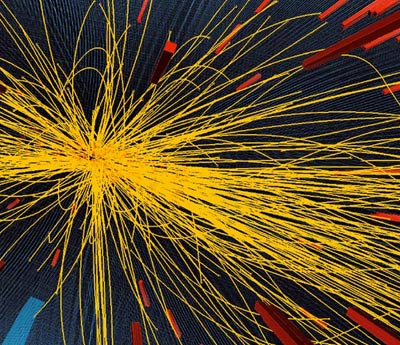
After almost six months of operation in a new energy region, the experiments at the LHC are yielding papers on physics at 7 TeV in the centre-of-mass. They include results aired at the International Conference on High-Energy Physics in Paris in July.
At the end of September, the CMS collaboration announced the observation of intriguing correlations between particles produced in proton–proton collisions at 7 TeV. It measured two-particle angular correlations in collisions at 0.9, 2.36 and 7 TeV – the three centre-of-mass energies at which the LHC has run. At 7 TeV, a pronounced structure emerges in the two-dimensional correlation function for particle pairs in high-multiplicity events, with at least 100 charged particles and a transverse momentum of 1–3 GeV/c. The ridge-like structure occurs at ΔΦ (a measure of the difference in transverse angle) near zero and spans a rapidity range of 2.0 <|Δη| <4.8 (CMS collaboration 2010). This implies that some pairs of particles emerging with a wide longitudinal angle (which is related to Δη) are closely correlated in transverse angle. The effect bears some similarity to those already seen in heavy-ion collisions at the Relativistic Heavy Ion Collider at the Brookhaven National Laboratory, which have been linked to the formation of hot, dense matter in the collisions. However, as the CMS collaboration stresses, there are several potential explanations.
These developments will be of interest to the ALICE collaboration, whose detector is optimized for the study of heavy-ion collisions at the LHC, the first period of which is scheduled to begin in November. In the meantime, one of the interesting results from ALICE in proton–proton collisions concerns the ratio of the yields of antiprotons to protons at both 0.9 TeV and 7 TeV. The measurement relates to the question of whether baryon number can transfer from the incoming beams to particles emitted transversely (at mid-rapidity). Any excess of protons over antiprotons would indicate such a transfer, which would be related to the slowing down of the incident proton. The results show that the ratio rises from about 0.95 at 0.9 TeV to close to 1 at 7 TeV and is independent of both rapidity and transverse momentum (ALICE collaboration 2010). These findings are consistent with the conventional model of baryon-number transport, setting stringent limits on any additional contributions.
In the search for new physics, the ATLAS experiment recently set new limits on the mass of excited quarks by looking in the mass distributions of two-jet events, or dijets. Now, the collaboration has also produced the first measurements of cross-sections for the production of jets in proton–proton collisions at 7 TeV. It has measured inclusive single-jet differential cross-sections as functions of the jet’s transverse momentum and rapidity and dijet cross-sections as functions of the dijet’s mass and an angular variable Χ. The results agree with expectations from next-to-leading-order QCD, so providing a validation of the theory in a new kinematic regime.
The LHCb collaboration is also measuring cross-sections in the LHC’s new energy region. With its focus on the physics of b quarks, the experiment has looked, for example, at the decays of b hadrons into final states containing a D0 meson and a muon to measure the bb production cross-section at 7 TeV (LHCb collaboration 2010). While some earlier results on the production of b-flavoured hadrons at 1.8 TeV at the Tevatron appeared to be higher than theoretical predictions, more recent measurements there at 1.96 TeV by the CDF experiment were consistent with theory. Now, LHCb’s results have extended the measurements to a much higher centre-of-mass energy – and again show consistency with theory, this time at 7 TeV. Such measurements of particle yields are vital to LHCb in assessing the sensitivity for studying fundamental parameters, for example, in CP violation.
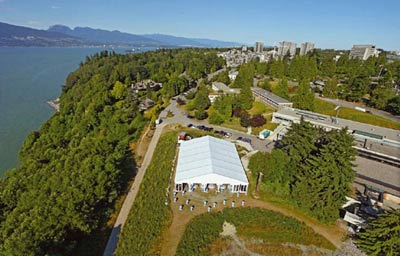
The 25th International Nuclear Physics Conference (INPC) took place on 4–9 July at the University of British Columbia, hosted by TRIUMF, Canada’s national laboratory for particle and nuclear physics in Vancouver. As the main conference in the field, this triennial meeting is endorsed and supported by the International Union for Pure and Applied Physics (IUPAP). This year it attracted more than 750 delegates – including 150 graduate students – from 43 countries and covered topics in nuclear structure, reactions and astrophysics; hadronic structure, hadrons in nuclei and hot and dense QCD; new accelerators and underground nuclear-physics facilities; neutrinos and nuclei; and applications and interdisciplinary research. Participants found many opportunities to connect with fellow nuclear physicists from across the globe. At conferences such as the INPC, which span an entire discipline, many unexpected links emerge, often leading to fruitful new discussions or collaborations.
Impressive progress
INPC 2010 opened with an afternoon public lecture by Lawrence Krauss of Arizona State University. In his talk, “An atom from Vancouver”, the renowned cosmologist and public speaker gave a broad perspective on why nuclear physics is key to a deeper understanding of how the universe was formed, as well as the birth, life and death of stars. The next morning, Peter Braun-Munzinger of GSI opened the scientific plenary programme with a talk that highlighted progress since the previous INPC in Tokyo in 2007, with theoretical and experimental examples from around the world. All topics at the conference were then well represented in both the plenary programme and the well attended afternoon parallel programme, where more than 250 invited and contributed talks were presented, as well as more than 380 posters. The poster presentations were among the most lively of the sessions, with many graduate students and post-doctoral fellows participating.
The scientific high points included the presentations in the field of hot and dense QCD, which reported on experimental and theoretical progress at Brookhaven’s Relativistic Heavy Ion Collider. The session on nuclear reactions provided highlights from many new and exciting facilities, including the Radio Isotope Beam Factory at the RIKEN centre in Japan, as well as an outlook of what can be expected from the Facility for Antiproton and Ion Research in Germany and the Facility for Rare Isotope Beams in the US. The quest towards the “island of stability” in the superheavy-element community is still ongoing, and new progress was reported with the identification of element 114.
There is also impressive progress being made in the theoretical sector, in particular with new ab initio approaches to calculations. Applications of these methods and progress in nucleon–nucleon interactions, where three-body interactions are now considered state of the art, were presented in the sessions on nuclear structure. The predictions of such calculations can be tested by experiments, for example laser experiments and ion-trap measurements give access to the ground-state properties of exotic nuclei. In-beam or in-flight experiments pave the way to even more exotic isotopes, where new magic numbers for the nuclear-shell model are appearing. This will also prove relevant for nuclear astrophysics, where there has been significant experimental progress with new measurements of direct-capture reactions using rare-isotope beams and background-suppressed facilities located in underground laboratories. Presentations in this field also covered research on neutron stars and new results from the modelling of core-collapse supernovae, which clearly indicate the need for neutrino interactions to be included.
Neutrinos played a large role in other sessions, for example on new facilities, where progress from the deep underground facilities was presented, together with other exciting new projects. The first results from long-baseline oscillation experiments show progress in this field, while double-beta-decay experiments are coming close to first results. These are keenly awaited not only by the community of nuclear physicists but by many others as well.
The sessions on fundamental symmetry are always one of the highlights of the INPC series, where tests of the Standard Model using atomic nuclei or nuclear physics methods can probe sectors complementary to those investigated by large particle-physics experiments, for example in experiments that measure atomic and neutron electric-dipole moments. Recent progress was reported in nuclear beta decay in the context of the testing of the unitarity of the Cabibbo–Kobayashi–Maskawa matrix, as well as measurements of the mass of the W-boson and the weak mixing-angle. Talks on the muon anomalous magnetic moment and its sensitivity for probing “new physics” showcased the burgeoning activity in this field.
One of the keenly anticipated presentations was given in a session on hadron structure, in which the collaboration that has measured the Lamb shift in muonic hydrogen at the Paul Scherrer Institute presented their results. Their measurement of the rms charge radius of the proton indicates a 5σ deviation from the established value, spawning a flurry of new experimental and theoretical activity.
The conference also featured discussions on the growing importance of nuclear physics in near-term societal and economic arenas. David Dean of the US Department of Energy shared an interesting perspective on the future of the field in relation to growing concerns about energy production and consumption. From India, Swaminathan Kailas of the Bhabha Atomic Research Centre talked about the utilization of nuclear technologies in the development of thorium-based nuclear reactors. Andrew Macfarlane of the University of British Columbia described the application of nuclear physics to probing magnetic behaviours at the nanoscale level in regimes relevant for condensed-matter physics.
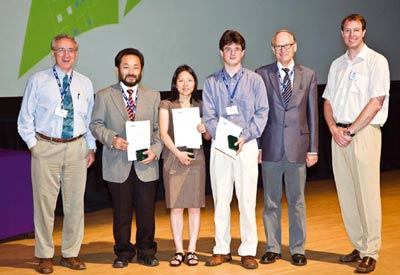
The large programme of the oral and poster sessions was extended to include special presentations by the winners of the IUPAP Young Scientist prizes, which are awarded in the field of nuclear physics every three years during the INPC conference. This year’s winners were: Kenji Fukushima of the Yukawa Institute for Theoretical Physics, Kyoto University; Peter Müller of Argonne National Laboratory; and Lijuan Ruan of Brookhaven National Laboratory. These three researchers represent the future excellence in nuclear physics, in the fields of theoretical QCD, precision experiments in low-energy nuclear-halo physics and experimental techniques related to quark-gluon plasma.
The organizers of INPC 2010 made a special effort to attract many graduate students and post-doctoral fellows to the conference. For example, TRIUMF combined its traditional summer school with the US National Science Foundation’s summer school for nuclear physics, directly prior to the conference. This not only allowed the school to recruit some of the INPC delegates as lecturers, but also gave students a broad overview of the field of nuclear physics before the conference. In addition, INPC 2010 teamed up with Nuclear Physics A to provide awards for the best student oral presentation and the top three poster presentations at the conference. An international panel of judges together with members from the editorial board of Nuclear Physics A decided on the following award winners from a strong field of applicants: Paul Finlay (Guelph) for oral presentation; Young Jin Kim (Indiana), Evan Rand (Guelph) and Thomas Brunner (Munich) for posters.
A treat of a different kind awaited delegates at the conference banquet at Vancouver’s famous Museum of Anthropology. Olivia Fermi, the grand-daughter of the famed nuclear physicist Enrico Fermi, was among the guests and in the after-dinner speech she shared anecdotes from her life growing up in the Fermi household. The first-nation artefacts and art pieces, together with the museum’s setting overlooking the Pacific Ocean and the skyline of Vancouver, made this venue a perfect fit to a very special conference. The field clearly presented itself in a healthy and dynamic state, with many young people eagerly anticipating the advent of new experiments, theory and facilities. At the end of the conference, IUPAP announced the location of the next in the series, which will be held in Florence in 2013.
Sixty years ago, particle physics was in its infancy. In 1950 Cecil Powell received the Nobel Prize in Physics for the emulsion technique and the discovery of the charged pions, and an experiment at Berkeley revealed the first evidence for the neutral version. In New York, the first in a new series of conferences organized by Robert Marshak took place at the University of Rochester with 50 participants. The “Rochester conference” was to evolve into the International Conference on High-Energy Physics (ICHEP) and this year more than 1100 physicists gathered in Paris for the 35th meeting in the series.
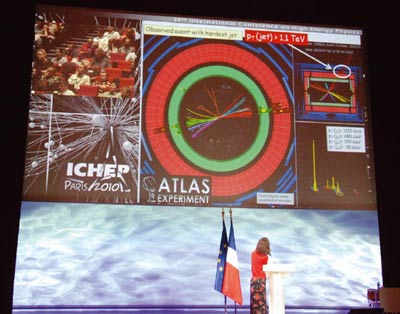
ICHEP’s first visit to the French capital was in 1982. CERN’s Super Proton Synchrotron had just begun to operate as a proton–antiproton collider and the UA2 collaboration reported on the first observations of back-to-back jets with high transverse momentum. This year, as ICHEP retuned to Paris, jets in a new high-energy region were again a highlight. This time they were from the LHC, one undoubted “star of the show”, together with the president of France, Nicolas Sarkozy.
Given the growth in the field since the first Rochester conference, this report can only touch on some of the highlights of ICHEP 2010, which took place on 22–28 July at the Palais des Congrès and followed the standard format of three days of parallel sessions, a rest day (Sunday) and then three days of plenary sessions. The evening of 27 July saw Parisians and tourists well outnumber physicists at the “Nuit des particules”, a public event held at the Grand Rex theatre (see box). On the rest day, in addition to various tours, there was the opportunity to watch the final stage of the 2010 Tour de France as it took over the heart of Paris.
A tour of LHC physics
The LHC project has had similarities to the famous cycle race – participants from around the world undertaking a long journey, with highs and lows en route to a thrilling climax. In the first of the plenary sessions, Steve Myers, director for accelerators and technology at CERN, looked back over more than a year of repair and consolidation work that led to the LHC’s successful restart with first collisions in November 2009. With the collider running at 3.5 TeV per beam since March this year, the goal is to collect 1 fb–1 of integrated luminosity with proton collisions before further consolidation work takes place in 2012 to allow the machine to run at its full energy of 7 TeV per beam in 2013. The long-term goal is to reach 3000 fb–1 by 2030. This will require peak luminosities of 5 × 1034 cm–2 s–1 in 2021–2030 for which studies are already underway, for example on the use of crab cavities.
The proposed long-term schedule envisages one-year shutdowns for consolidation in 2012, 2016 and 2020, with shorter periods of maintenance in December/January in the intervening years, and 6–8 month shutdowns every other year after 2020. Heavy-ion runs are planned for each November when the LHC is running, starting this year. Myers also provided glimpses of ideas for a 16.5 TeV version of the LHC that would require 20 T dipole magnets based on NbSn3, NbAI and high-temperature superconductors.
What many at the conference were waiting for were the reports from the LHC experiments on the first collision data, presented both in dedicated parallel sessions and by the spokespersons on the first plenary day. Common features of these talks revealed just how well prepared the experiments were, despite the unprecedented scale and complexity of the detectors. The first data – much of it collected only days before the conference as the LHC ramped up in luminosity – demonstrated the excellent performance of the detectors, the high efficiency of the triggers and the swift distribution of data via the worldwide computing Grid. All of these factors combined to allow the four large experiments to rediscover the physics of the Standard Model and make the first measurements of cross-sections in the new energy regime of 7 TeV in the centre-of-mass.
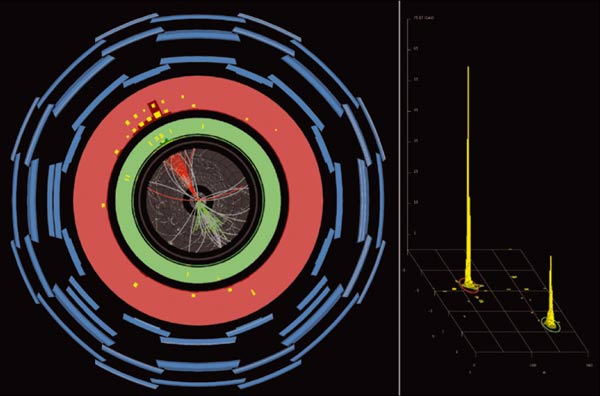
The ATLAS and CMS collaborations revealed some of their first candidate events with top quarks – previously observed only at Fermilab’s Tevatron. They also displayed examples of the more copiously produced W and Z bosons, seen for the first time in proton–proton collisions, and presented cross-sections that are in good agreement with measurements at lower energies. Lighter particles provided the means to demonstrate the precision of the reconstruction of secondary vertices, shown off in remarkable maps of the material in the inner detectors.
Both ATLAS and CMS have observed dijet events, with masses higher than that of the Tevatron’s centre-of-mass energy. The first measurements of inclusive jet cross-sections in both experiments show good agreement with next-to-leading-order QCD (The window opens on physics at 7 TeV). In searches for new physics, ATLAS has provided a new best limit on excited quarks, which are now excluded in the mass region 0.4 <M <1.29 TeV at 95% CL. For its part, by collecting data in the period between collisions at the LHC, CMS derived limits on the existence of the “stopped gluino”, showing that it cannot exist with lifetimes of longer than 75 ns.
The LHCb collaboration reported clear measurements of several rare decays of B mesons and cross-sections for the production of open charm, the J/ψ and bb states. With the first 100 pb–1 of data, the experiment should become competitive with Belle at KEK and DØ at Fermilab, with discoveries in prospect once 1 fb–1 is achieved.
The ALICE experiment, which is optimized for heavy-ion collisions, is collecting proton–proton collision data for comparison with later heavy-ion measurements and to evaluate the performance of the detectors. The collaboration has final results in charged multiplicity distributions at 7 TeV, as well as at 2.36 TeV and 0.9 TeV in the centre-of-mass. These show significant increases with respect to Monte Carlo predictions, as do similar measurements from CMS. ALICE also has interesting measurements of the antiproton to proton ratio.
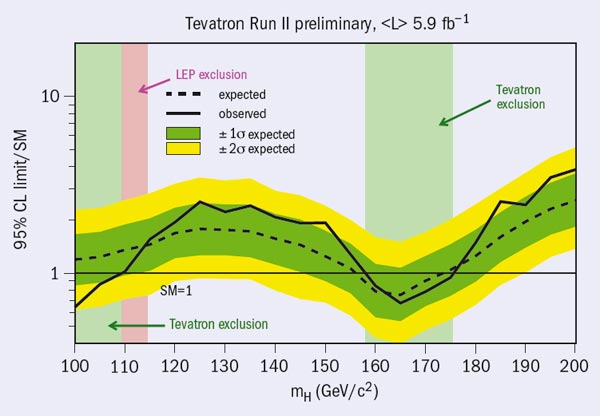
While the LHC heads towards its first 1 fb–1, the Tevatron has already delivered some 9 fb–1, with 6.7 fb–1 analysed by the time of the conference. One eagerly anticipated highlight was the announcement of a new limit on the Higgs mass from a combined analysis of the CDF and DØ experiments. This excludes a Higgs between 158–175 GeV/c2, thus eliminating about 25% of the favoured region from analysis of data from the Large Electron–Positron collider and elsewhere. As time goes by, there is little hiding place for the long-sought particle. In other Higgs-related searches, the biggest effect is a 2σ discrepancy found in CDF for the decay to bb of the Higgs in the minimal supersymmetric extension to the Standard Model.
Stressing the Standard Model
The strongest hint at the Tevatron for physics beyond the Standard Model comes from measurements of the decays of B mesons. The DØ experiment finds evidence for an anomalous asymmetry in the production of muons of the same sign in the semi-leptonic decays of Bs mesons, which is greater than the asymmetry predicted by CP violation in the B system in the Standard Model by about 3.2σ. While new results from DØ and CDF for the decay Bs→J/ψ+Φ show a better consistency with the Standard Model, they are not inconsistent with the measurement of Absl,.
Experiments at the HERA collider at DESY, and at the B factories at KEK and SLAC, have also searched extensively for indications of new physics, and although they have squeezed the Standard Model in every way possible it generally remains robust. Of course, the searches extend beyond the particle colliders and factories, to fixed-target experiments and detectors far from accelerator laboratories. The Super-Kaminokande experiment, now in its third incarnation, is known for its discovery of neutrino oscillations, which is the clearest indication yet of physics beyond the Standard Model, but it also searches for signs of proton decay. It has now accumulated data corresponding to 173 kilotonne-years and, with no evidence for the proton’s demise, it sets the proton’s lifetime at greater than 1 × 1034 years for the decay to e+π0 and greater than 2.3 × 1034 years for νK+.
The first clear evidence for neutrino oscillations came from studies of neutrinos from the Sun and those created by cosmic rays in the upper atmosphere, but now it is the turn of the long-baseline experiments based at accelerators and nuclear reactors to bring the field into sharper focus. At accelerators a new era is opening with the first events in the Tokai-to-Kamioka (T2K) experiment, as well as the observation of the first candidate ντ in the OPERA detector at the Gran Sasso National Laboratory, using beams of νμ from the Japan Proton Accelerator Research Complex and CERN respectively.
While T2K aims towards production of the world’s highest intensity neutrino beam, the honour currently lies with Fermilab’s Neutrino beam at the Main Injector, which delivers νμ to the MINOS experiment, with a far-detector 735 km away in the Soudan Mine. MINOS now has analysed data for 7.2 × 10²⁰ protons on target (POT) and observes 1986 events where 2451 would be expected without oscillation. The result is the world’s best measurement for |Δm2| with a value of 2.35+0.11/–0.08 × 10–3 eV2, and sin22θ> 0.91 (90% CL). MINOS also finds no evidence for oscillations to sterile neutrinos and puts limits on θ13. Recently, the experiment has been running with an anti-neutrino beam, and this has proved to hint at differences in the oscillations of antineutrinos as compared with neutrinos. With antineutrinos, the collaboration measures |Δm2|= 3.36+0.45/–0.40 × 10–3 eV2 and sin22θ = 0.86±0.11. As yet the statistics are low, with only 1.7 × 10²⁰ POT for the antineutrinos, but the experiment can quickly improve this with more data.
The search for direct evidence of dark-matter particles, which by definition lie outside the Standard Model, continues to have tantalizing yet inconclusive results. Experiments on Earth search for the collisions of weakly interacting massive particles (WIMPs) in detectors where background suppression is even more challenging than in neutrino experiments. Recent results include those from the CDMS II and EDELWEISS II experiments, in the Soudan Mine and the Modane Underground Laboratory in the Fréjus Tunnel, respectively. CDMS II presented its final results in November 2009, following a blind analysis. After a timing cut, the analysis of 194 kg days of data yields two events, with an expected background of 0.8±01(stat.)±0.2 (syst.) events. The collaboration concludes that this “cannot be interpreted as significant evidence for WIMP interactions”. EDELWEISS II has new, updated results, which now cover an effective 322 kg days. They have three events near threshold and one with a recoil energy of 175 keV, giving a limit on the cross-section of 5.0 × 10⁻⁸ pb for a WIMP mass of 80 GeV (at a 90% CL).
Higher energies, in nature and in the lab
Looking to the skies provides a window on nature’s own laboratory of the cosmos. The annihilation of dark matter in the galaxy could lead to detectable effects, but the jury is still out on the positron excess observed by the PAMELA experiment in space. Back on Earth, the Pierre Auger Observatory and the High-Resolution Fly’s Eye (HiRes) experiment in the southern and northern hemispheres, respectively, detect cosmic rays with energies up to 1020 eV (100 EeV) and more. Both have evidence for the suppression of the highest energies by the Greisen-Zatsepin-Kuzmin (GZK) cut-off. There is also evidence for a change in composition towards heavier nuclei at higher energies, although this may also be related to a change in cross-sections at the highest energies. The correlation of the direction of cosmic rays at energies of 55 EeV or more with active galactic nuclei, first reported by the Pierre Auger collaboration in 2007, has weakened with further data, from the earlier value of 69 + 11/–13% to stabilize around 38 + 7/–6%, now with more than 50 events.
Cosmic neutrinos provide another possibility for identifying sources of cosmic rays. The ANTARES water Cherenkov telescope in the Mediterranean Sea now has a sky map of its first 1000 neutrinos and puts upper limits on point sources and on the diffuse astrophysical neutrino flux. IceCube, with its Cherenkov telescope in ice at the South Pole, also continues to push down the upper limits on the diffuse flux with measurements that begin to constrain theoretical models.
In the laboratory, the desire to push further the exploration of the high-energy frontier continues to drive R&D into accelerator and detector techniques. The world community is already deeply involved in studies for a future linear e+e– collider. The effort behind the International Linear Collider to reach 500 GeV per beam is relatively mature, while work on the more novel two-beam concept for a Compact Linear Collider to reach 3 TeV is close to finishing a feasibility study. Other ideas for machines further into the future include the concept for a muon collider, which would require muon-cooling to create a tight beam, but could provide collisions at 4 TeV in the centre-of-mass. Reaching much higher energies will require new technologies to overcome the electrical breakdown limits in RF cavities. Dielectric structures offer one possibility, with studies showing breakdown limits that approach 1 GV/m. Beyond that, plasma-based accelerators still hold the promise of still greater gradients, as high as 50 GV/m.
Particle physics has certainly moved on since the first Rochester conference; maybe a future ICHEP will see results from a muon collider or the first plasma-wave accelerator. For now, ICHEP 2010 proved a memorable event, not least as the first international conference to present results from collisions at the LHC. Its success was thanks to the hard work of the French particle-physics community, and in particular the members of the local organizing committee, led by Guy Wormser of LAL/Orsay. Now, the international community can look forward to the next ICHEP, which will be in Melbourne in 2012.
• Proceedings of ICHEP 2010 are published online in the Proceedings of Science, see http://pos.sissa.it.
The ATLAS experiment at the LHC has set the world’s best known limits for the mass of a hypothetical excited quark, q*. The analysis, accepted for publication by Physics Review Letters, represents ATLAS’s first exclusion of physics outside the Standard Model and extends the scientific reach of previous experiments. The existence of such a state would indicate that a quark is a composite particle as opposed to an elementary one as the Standard Model assumes.
The search was based on a sample of 315 nb–1 of proton–proton collision data collected at 7 TeV in the centre-of-mass. Looking at the mass distribution of measured dijets – events with two jets – the analysis used six different model-independent statistical tests to hunt for narrow resonances that could indicated the production of new heavy particles. The lack of evidence for such resonances allows the collaboration to set limits on the existence of the hypothesized q*, in particular, because predictions indicated a chance that it could be observed in the first samples of data at the LHC.
The results exclude at the 95% confidence level the existence of a q* with a mass in the range 0.40–1.26 TeV. With further data ATLAS will continue its searches to exclude or discover hypothesized particles such as the q* over greater ranges in mass.
Measurements by the Pierre Auger Observatory may provide evidence of natural nuclear accelerators at work in the local galaxy, the Milky Way. Alexander Kusenko of the University of California, Los Angeles, his student Antoine Calvez, and Shigehiro Nagataki, from Kyoto University, have found that possible sources such as gamma-ray bursts (GRBs) or rare types of supernova explosions could produce the observed energy-dependent composition of ultrahigh-energy cosmic rays.
Earlier this year, the Pierre Auger Collaboration published an analysis of cosmic rays with energies above 1018 eV (1 EeV), which indicated a gradual increase in the average mass of the cosmic rays with energy, up to about 59 EeV (Abraham et al. 2010). In other words, these ultrahigh-energy cosmic rays appear to be heavier nuclei, rather than protons. Previous results, such as the lack of anisotropy in their arrival direction have indicated an extragalactic origin for the highest-energy cosmic rays. However, it seemed surprising that nuclei would travel such long journeys without disintegrating into protons. Moreover, it is unlikely that a cosmic accelerator could accelerate nuclei better than protons at these high energies.
Kusenko and colleagues have now proposed an explanation in which the nuclei originate from sources within the Galaxy (Calvez, Kusenko and Nagataki 2010). Stellar explosions, such as GRBs, can accelerate protons and nuclei but, while the protons leave the Galaxy promptly, the heavier and less mobile nuclei become trapped in the turbulent magnetic field of the source, lingering longer than protons. As a result, the local density of nuclei is increased, so they bombard Earth in greater numbers, as seen by the Pierre Auger Observatory. The nuclei detected will have been trapped by Galactic magnetic fields for millions of years, so their arrival directions have been completely randomized. However, protons escaping from other galaxies should still be seen at the highest energies, and should point back to their sources.
The Fifth International Conference on Beyond the Standard Models of Particle Physics, Cosmology and Astrophysics (BEYOND 2010) took place earlier this year in Cape Town. With 87 participants from all over the world and 73 presentations, it gave a broad view of the status and future of particle physics beyond the Standard Model. Although the meeting took place just before the LHC entered a new energy region at 7 TeV in the centre of mass, it allowed the presentation of some first results from 2009 and a look at what lies in store. Other highlights centred on areas beyond the Standard Model that are already under investigation, either theoretically or experimentally. This report, however, can mention only part of the broad range of topics and a few of the excellent speakers.
With the prospect of a few 100 pb–1 integrated luminosity to be delivered by the LHC during 2010, Claude Guyot of Saclay discussed the discovery potential of the ATLAS experiment. Silvia Costantini of CERN and the CMS experiment pointed out the challenges of the search for a fourth generation of quarks and for exotic partners of the top quark. An additional quark generation could account for the asymmetry between matter and antimatter; and natural, nonsupersymmetric solutions of the hierarchy problem generally require fermionic partners of the top quark with masses that are not much heavier than about 500 GeV. The LHC also has exciting potential in the areas of B physics and CP violation, particularly with the LHCb detector, as Jacopo Nardulli of the Rutherford Appleton Laboratory outlined. On the theoretical side, Thomas Appelquist of Yale reviewed recent work on the role of approximate conformal symmetry in strongly coupled theories, on which the LHC will begin to shed light. Flavour physics in warped extra dimensions is another topic on this level, with hidden sectors and hidden extra dimensions discussed by CERN’s Ignatios Antoniadis. More down to Earth, the Minimal Supersymmetric Standard Model allows estimates of the possible production rates at the LHC of long-lived superparticles.
From neutrinos to Q balls
Neutrinos have already provided the first hints of new physics through their non-zero mass, which leads to neutrino oscillations. The study of their elusive properties continues in experiments on double-beta-decay, tritium-decay and reactor neutrinos, as well at accelerators. Present and near future double-beta-decay experiments, including a variant of the Cryogenic Underground Observatory for Rare Events (CUORE) called LUCIFER, are still far from being able to test the 6.4 σ evidence for neutrinoless double-beta decay observed in the Heidelberg-Moscow experiment, which took data in the Gran Sasso National Laboratory for 13 years. Even the huge KATRIN tritium-decay experiment at Karlsruhe can check for a neutrino mass of 0.2 eV – the lower limit for the electron-neutrino mass from the Heidelberg-Moscow experiment – only at the 1 σ level. The fastest independent measurement of the neutrino mass (and independent confirmation of the Heidelberg-Moscow result) might come from the PLANCK mission and – eventually – the Experimental Probe of Inflationary Cosmology (EPIC), NASA’s post-PLANCK mission. EPIC should have a neutrino-mass sensitivity of Σmν <0.05 eV and should test Super-Kamiokande’s result of Δm2 = 2 × 10⁻³ eV2, from atmospheric-neutrino oscillations.
Reactor-neutrino experiments aim to determine the mixing angle Θ13 in the Maki-Nakagawa-Maskawa matrix. The Double Chooz experiment is expected to improve the current limit of sin22Θ13 <0.15 down to 0.03, and similar limits of 0.02 and 0.01 are expected from the Reactor Experiment for Neutrino Oscillation (RENO) at Younggwang and the Daya Bay experiment, respectively. This would allow, in three years or so from now, a check of the first hints for a non-vanishing Θ13, which were obtained in 2008 in a global fit of all neutrino-oscillation data to a three-flavour scenario. At accelerators, the long-baseline experiments OPERA and MINOS have not yet yielded results. The T2K experiment, using an intense muon-neutrino beam generated by the new J-PARC facility at Tokai, with the detector 295 km away at Kamioka, aims at measuring Θ13 down to sin22Θ13 <0.008. This ambitious experiment started operation in March. In the more distant future, neutrino factories (producing neutrinos by muon decay) will be important for determining Θ13 if the sensitivity of T2K proves to be insufficient, as Osama Yasuda of Tokyo Metropolitan University discussed. Neutrino factories will also tackle topics such as violation of unitarity arising from heavy particles, or schemes with light and sterile neutrinos.
Leptogenesis can provide a solution to the baryon asymmetry of the universe and here, as Marta Losada of Bogota outlined, the focus has moved from understanding the qualitative features to detailed quantitative analysis. Neutrino masses and mixings consistent with recent neutrino data can lead to the correct baryon/photon ratio of 10–10. The special case of electromagnetic leptogenesis considers the electromagnetic dipole-moment coupling between the light and heavy neutrinos, instead of the minimal Yukawa interactions, and again there is a strong connection between light-neutrino parameters and leptogenesis, as Sandy Law of Chung-Yuan University explained.
The decay μ→eγ, which is under study by the MEG experiment at PSI, is radiatively induced by neutrino mass and mixings, and extensions of the Standard Model enhance the rate through mixing in the high-energy sector of the theory. The result of the 2008 run, presented at the conference, gives the branching ratio for the decay as 3 × 10–11, with a limit of 5 × 10–12 expected for this year’s data. A positive result would yield evidence for physics beyond the Standard Model.
The search for exotic particles continues at accelerators and in cosmic rays. The best limit for penetrating grand-unified theory monopoles in cosmic radiation is still provided by the MACRO detector at Gran Sasso, and is close to the extended Parker bound, except at very high energies, where the best limits come from the AMANDA experiment at the South Pole and the Lake Baikal experiment. At the LHC, the MoEDAL detector – housed in the cavern of the LHCb detector – will search for magnetic monopoles. In the case of nuclearites, MACRO and the SLIM experiment (at a height of 5230 m at Chacaltaya, Bolivia) give the best limits, as Laura Patrizii of INFN Bologna outlined. The best limits for strangelets also come from the SLIM detector, with improvements expected from the Alpha Magnetic Spectrometer (AMS-02) mission, to be launched in February 2011. For charged Q balls, the best limits are from AMS-01, SLIM and MACRO.
Dark matter provided a vibrant topic for discussion. Rita Bernabei of Rome presented data taken over 13 years by the DAMA/LIBRA (Large sodium Iodide Bulk for Rare processes) experiment, which show behaviour consistent with an annual modulation signature from dark matter in the galactic halo at a confidence level of 8.8 σ. The Cryogenic Dark Matter Search (CDMS) II ended operations in March 2009. This experiment looked for elastic scatters of weakly interacting massive particles (WIMPs) from germanium nuclei in a detector array of a few kilograms. From the start it was somehow the object of debate for its selection of data. After 612 kg days searching for WIMPs between July 2007 and September 2008 (compared with 317 697 kg days, or 0.87 tonne years collected by DAMA/LIBRA), the final result shows no significant signal for dark matter.
Imaging atmospheric Cherenkov telescopes (IACTs) can search for annihilations of WIMPs that could occur in high-density regions of our galaxy, such as the galactic centre. They look for high-energy gamma rays produced by effects of constraints on subhalo formation scenarios, such as spikes of dark matter around black holes of intermediate mass. Other theoretical candidates for dark matter, beyond the neutralinos that are a natural explanation in supersymmetry, include Kaluza-Klein particles, which arise in models with extra dimensions. Annihilation of such particles, gravitationally bound to the Sun, would produce neutrinos that could then give rise to muons and antimuons in Earth’s matter. The ICECUBE detector, at the South Pole, can put constraints on the parameter space for models with only one of two types of the lightest Kaluza-Klein particles.
Dark energy was another hot topic. QCD provides an exciting approach that avoids the long-known discrepancy of the order of 10120 between the usual quantum vacuum-energy predictions of particle theory and the observed cosmological constant. QCD contains a massless dipole (the Veneziano “ghost”) that contributes to the vacuum energy and could make it numerically close to what is observed, as Federico Urban of British Columbia described. Lattice tests could confirm the existence of a Casimir QCD energy. A next step would be to gain a better theoretical understanding of the dynamics of the “ghost” in the expanding universe and to work out the consequences of its magnetic field in more detail. Another approach, presented by Gerard Stephenson of the Los Alamos theory group, investigates a connection between interacting Majorana fermions and cosmic acceleration. A system of fermions interacting through scalar exchange exhibits negative pressure when perturbed to densities less than the equilibrium density. On the basis of an adiabatic approximation, there are parameter ranges compatible with cosmic acceleration; the lightest supersymmetric particle could be a viable candidate fermion. A Majorana neutrino of mass around 0.26 eV would also be a candidate, which may be exciting in view of the neutrinoless double-beta-decay result from the Heidelberg–Moscow experiment.
An interesting, nonmainstream view of understanding dark energy was presented by Chris Clarkson of Cape Town. He argues that the huge Hubble-scale inhomogeneity has not been investigated in detail and could conceivably be the cause of apparent acceleration. If this is indeed the case, then we exist in a highly exceptional corner of the universe. The void models offer the possibility of describing dark energy as a radical inhomogeneity in a dynamically predictable model, rather than as an unknown dynamical degree of freedom in a postulated homogeneous model.
Astroparticle physics
A highlight of the conference was the presentation by NASA’s Malcolm Niedner of the potential of the rejuvenated Hubble Space Telescope and some early results. The Hubble Ultra Deep Field Infrared Survey is entering new territory in the redshift region z = 8–10. Within just a few weeks of operation, the new Cosmic Origin Spectrograph will probe more of the cosmic web than all previous Hubble spectrographs combined.
Back on Earth, at the South Pole the ICECUBE detector will start operation in 2011, following on from AMANDA, which was decommissioned in 2009, to study high-energy neutrino astronomy, atmospheric neutrinos and nonstandard oscillations. The ANTARES experiment, running in the Mediterranean Sea since 2006, has similar goals, focusing on high-energy cosmic neutrinos, the production mechanism of high-energy cosmic rays, high-energy processes in gamma-ray bursts and the study of binary systems and micro-quasars. ANTARES and ICECUBE cover complementary regions of the sky.
At lower energies, the BOREXINO experiment at Gran Sasso has new results on solar neutrinos. With the first real-time and simultaneous measurement of solar neutrinos from the vacuum-dominated region (7Be-neutrinos) and from the matter-enhanced oscillation regions (8B-neutrinos), the experiment claims to confirm the Mikheyev-Smirnov-Wolfenstein large mixing-angle solution of solar-neutrino oscillations at a 4 σ level. It has also improved the best limit on the neutrino magnetic moment. Future plans include a check of the 7% seasonal variation of the neutrino flux so as to confirm its solar origin.
The direct detection of gravitational waves would test general relativity in the strong-field regime and provide essential new information on objects such as neutron stars, black holes and the Big Bang.
Understanding the origin and composition of ultrahigh-energy cosmic rays (UHECRs) may shed light not only on astrophysical acceleration processes but also on fundamental particle interactions – hence the excitement surrounding the Pierre Auger Observatory in South America. However, the latest results on the energy spectrum of UHECRs beyond the Greisen-Zatsepin-Kuzmin (GZK) cut-off show that there is still no hint of physics beyond the Standard Model. The strategy for the future lies in Auger North, an array that is seven times larger, which is hoped will be sufficient for discovering new physics.
Very high-energy, gamma-ray observation of supernova remnants interacting with molecular clouds seems to be a new way to reveal cosmic-ray accelerators. Thanks to a high sensitivity and good angular resolution, the HESS IACT array in Namibia produces detailed images of galactic sources in the tera-electron-volt energy range. Several supernova remnants show a similar pattern, where an excess of very high-energy photons coincides with a maser (or possibly laser) signal, typical of a shocked molecular cloud, situated on the rim of the supernova remnant.
In the search for gravitational waves the first generation of interferometers is now operating at the design sensitivity. The direct detection of gravitational waves would test general relativity in the strong-field regime and provide essential new information on objects such as neutron stars, black holes and the Big Bang. As Peter Aufmuth of the Max Planck Institute for Gravitational Physics in Hannover explained, while no signal has yet been seen, the detectors should be close to making observations. As for the future, an advanced LIGO/Virgo detector is scheduled for 2014, to be followed in 2025 by the Einstein Gravitational Wave Telescope, with 10 times higher sensitivity, as well as NASA’s Laser Interferometer Space Antenna in 2022. All models for the unification of general relativity with quantum-field theory lead to (small) deviations from general relativity, which are least constrained experimentally at small and large scales. The CAsimir FORce and Gravitation (FORCA-G) experiment allows the exploration of gravity at short range using complementary physics to existing experiments, while the Search for Anomalous Gravitation with Atomic Sensors (SAGAS) investigates gravitation at large scales.
Back to Earth
Andrej Popeko of Dubna and Fritz-Peter Hessberger of GSI reported on the formation of superheavy elements at their respective laboratories, with exciting results that extend our understanding of element synthesis in the universe. The naming of the new element copernicium (112Cn) was celebrated at GSI shortly after the conference. The elements 113 to 118 synthesized at Dubna have also been recently independently confirmed at GSI. Physics beyond the Standard Model may become accessible in nuclear physics through measurements of correlation coefficients in neutron decay. Possible topics include the search for right-handed weak currents, for scalar and tensor interactions (leptoquarks, charged Higgs bosons), for supersymmetric particles (via loop corrections in the beta-decay coupling constants), and tests of the unitarity of the Cabibbo-Kobayashi-Maskawa matrix. The new spectrograph aSPECT at the Institut Laue-Langevin will help to exploit this potential.
Ideas for future high-energy accelerators that could access physics beyond the Standard Model include an International Linear Collider (ILC), a muon acceleration facility and 100 TeV boson–boson collisions in the PETAVAC – a project proposed for the tunnel of the aborted Superconducting Super Collider and presented by Peter McIntyre of Texas A&M University. Yosuke Takubo of Sendai pointed out that one of the goals of the ILC would be to measure the parameters of heavy gauge-bosons, “little Higgs” partners of the Standard Model gauge-bosons, one of which is a dark-matter candidate. An intense cooled low-energy muon beam could provide extraordinarily precise lepton-flavour-violating experiments, while the same muons, accelerated and held in a storage ring, could be used for a neutrino factory.
In conclusion, the lively, enthusiastic and highly stimulating atmosphere of BEYOND 2010 raises the expectation of an exciting future for particle physics and cosmology beyond their standard models. The organizers thank all of the speakers and participants who made this meeting an unusually successful one scientifically.
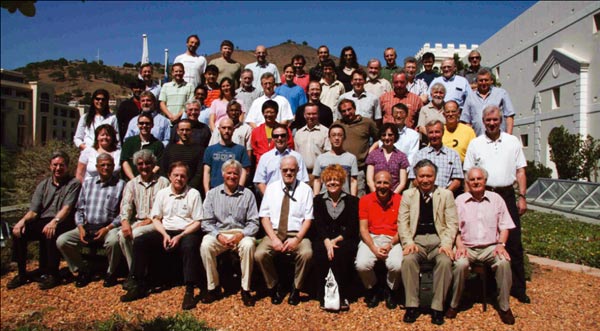
• The conference chairs were Hans Volker Klapdor-Kleingrothaus, Heidelberg, founder of the BEYOND series, and local host Raoul Viollier of the Centre for Theoretical Physics and Astrophysics, University of Cape Town. Irina Krivosheina of Heidelberg and Nishnij Novgorod was scientific secretary.
Experimental tests of relativity and theoretical developments in relativity violation have flourished over the past few years. This interest has been strengthened by recent results in particle physics that appear to deviate from the predictions of the Standard Model. Two examples are the evidence for anomalous CP violation in the Bs system and the indications that antineutrinos might not have the same properties as neutrinos. These and many other frontier topics were discussed at CPT ’10, the fifth Meeting on CPT and Lorentz Symmetry, which was held in Bloomington, Indiana, on 28 June – 2 July. Speakers from four continents presented dozens of new limits on coefficients for Lorentz violation in the Standard-Model Extension (SME). In the opening scientific talk, James Bjorken of SLAC not only delivered an analysis of vacuum structures associated with emergent QED and torsion but also took the opportunity to put the meeting in perspective by looking back at the development of the SME over the past 15 years, as well as referring to the opening presentation at the CPT ’01 meeting by Nobel Laureate Yoichiro Nambu.
From antimatter to Antarctica
The CERN antimatter collaborations ALPHA, ATRAP, ASACUSA and AEgIS all provided updates on recent progress. Makoto Fujiwara of TRIUMF described how the ALPHA group developed a technique for evaporative cooling of trapped antiprotons down to temperatures of 9 K. The group is designing the apparatus to enable future hyperfine spectroscopy in antihydrogen. The ATRAP collaboration has made a number of advances using trapping techniques. Spokesperson Gerald Gabrielse of Harvard discussed results gained from ATRAP and other projects with single, trapped particles, including an improved measurement of the electron’s magnetic moment and a method for cooling single, trapped protons. Masaki Hori of the Max Planck Institute of Quantum Optics discussed techniques developed for performing spectroscopy on a beam of antiprotonic helium by the ASACUSA collaboration. The group has developed a titanium sapphire laser that should reduce spectral-line widths in future experiments.
Antihydrogen will provide new opportunities to study the interaction of neutral antimatter with the gravitational field. Marco Giammarchi of INFN/Milan described how the AEgIS collaboration aims to measure the local gravitational acceleration of antihydrogen to about 1% by detecting the fall of an antihydrogen beam travelling at some 500 m/s over a distance of about 1 m. Alan Kostelecký of Indiana and Jay Tasson of Whitman College have recently completed a study of Lorentz violation involving gravitational couplings to matter and antimatter. They use toy models to demonstrate that Lorentz-violating effects could appear in antihydrogen spectroscopy without observable effects in hydrogen and could cause gravimetric properties of antihydrogen and hydrogen to differ. Gravitational experiments can also place limits on the a-type coefficients in the SME. These are unmeasurable with a single particle species in the Minkowski space–time context and in principle could be large without having been detected to date. Experiments with the potential for interesting results include ones involving free-fall gravimeters, as well as weak equivalence principle tests with free fall and with satellites. In this context, Paul Worden of Stanford described the latest developments from the Gravity Probe B and STEP satellite programmes.
Atom interferometers have the potential to explore untested regions in the matter-gravity sector of the SME coefficient space. The caesium interferometer built by Holger Müller’s group at the University of California, Berkeley, is currently the highest-resolution atomic gravimeter. It has generated improved limits on half a dozen pure-gravity SME coefficients during 2009, which Müller described in an overview of the current results and interests within his group.
Atom-based co-magnetometers built by groups at Princeton University, the Harvard-Smithsonian Center for Astrophysics and the University of Mainz have contributed a number of sharp bounds on SME coefficients in the fermion sector. The three groups presented the status of their programmes at CPT ’10. Mike Romalis’ group at Princeton has commissioned a new apparatus, CPT-II, which is mounted on a turntable and is more compact than the one presented at the last meeting in the series, CPT ’07. At this year’s meeting, Romalis presented results from the device, a K-He co-magnetometer, which was run for 143 days between July 2009 and April 2010, allowing sidereal signals to be separated from diurnal ones. These new data represent the highest energy-resolution to date of any spin-anisotropy experiment. A future improvement of two orders of magnitude is feasible by using neon in the magnetometer, and systematic effects due to the Earth’s rotation could be evaded by running the experiment at the Amundsen-Scott South Pole Station in Antarctica.
Mesons, neutrinos and gamma rays
Rick Van Kooten of Indiana gave an overview of the recent evidence from the DØ collaboration at Fermilab for anomalous B-system CP violation differing at the level of 3.2 σ from the prediction of the Standard Model (CERN Courier July/August 2010 p6). He and Kostelecký have recently demonstrated that this result also yields the first sensitivity to CPT violation in the Bs system. The analysis interprets the anomaly in terms of CPT violation, placing a first limit on a CPT-breaking SME-coefficient combination at the level of 10–12, a result that could be improved in the LHCb experiment at the LHC at CERN. Top-quark experiments at Fermilab have reached sufficient statistical power to produce first-time bounds on SME coefficients for the third generation of matter, while improved sensitivities may be possible with LHC statistics, as Fermilab’s Gaston Gutierrez described in his discussion of prospects for future results.
In Europe, new accelerator-based results have come from the GRAAL beamline at the European Synchrotron Radiation Facility (ESRF). Dominique Rebreyend of the Laboratory for Subatomic Physics and Cosmology, Grenoble, presented recent results published in Physical Review Letters, which improve the limits on parity-violating SME coefficients in the photon sector by an order of magnitude. Ralf Lehnert of the National University in Mexico City presented the theoretical underpinnings of this work.
Conventional theory attributes neutrino oscillations to mass and predicts that oscillations are controlled by the baseline-to-beam-energy ratio, L/E. A variety of other dependences arising from Lorentz and CPT violation occur in the SME framework, and these have the potential to model some of the anomalous behaviour seen in recent oscillation experiments. The MINOS collaboration at Fermilab has recently published the results of their search for sidereal variations in neutrino oscillation probabilities using the MINOS near detector. Brian Rebel of Fermilab presented this and the latest related work, in which the collaboration also searched for effects at the far detector located about 700 km away in northern Minnesota. Teppei Katori of Massachusetts Institute of Technology gave an account of preliminary results from an analysis using the SME coefficients for Lorentz violation to reconcile the data from the LSND experiment at Los Alamos and MiniBooNE at Fermilab. Jorge Diaz of Indiana provided a complementary theoretical overview of SME neutrino physics.
Gamma-ray bursts (GRBs) are particularly suited to providing limits on some of the nonminimal SME coefficients in the photon sector, owing to their high energies, long baselines and high variability. Vlasios Vasileiou of the NASA Goddard Space Flight Center presented the first bounds from GRB 090510 on certain SME coefficients of mass dimensions 6 and 8. These results are from data taken with the Large-Area Telescope and the Gamma-Burst Monitor on the Fermi Gamma-Ray Space Telescope. High sensitivity to Lorentz violation in the photon sector has also been achieved in laboratory experiments with resonators. The cavity-oscillator groups of Achim Peters at Humboldt University and Mike Tobar of Western Australia have plans to start a new international collaboration based in Germany. Recent years have seen the development of a full theory of higher-order SME operators for Lorentz violation in the photon sector. This work, by Kostelecký and Matt Mewes of Swarthmore College, systematically enumerates and classifies Lorentz-violating operators of arbitrary dimension in electrodynamics. More formal developments were described by Luis Urrutia of the National Autonomous University of Mexico, who discussed spontaneous Lorentz breaking in models of nonlinear electrodynamics that maintain gauge invariance.
Experimental advances in the neutron sector, reports on the steady progress of antihydrogen technology, intriguing developments in the meson and neutrino sectors, experimental results in the nonminimal photon sector and new work in the theory of Lorentz-breaking matter-gravity couplings are some of the highlights from this meeting. While there is still no compelling sign of Lorentz violation, hints of effects have appeared in several sectors. The lively exchange of ideas and information at CPT ’10 shows that the resolve of physicists in this field to dig more deeply into fundamental symmetries is stronger than ever.
To provide the best experiences, we use technologies like cookies to store and/or access device information. Consenting to these technologies will allow us to process data such as browsing behavior or unique IDs on this site. Not consenting or withdrawing consent, may adversely affect certain features and functions.
Functional
Always active
The technical storage or access is strictly necessary for the legitimate purpose of enabling the use of a specific service explicitly requested by the subscriber or user, or for the sole purpose of carrying out the transmission of a communication over an electronic communications network.
Preferences
The technical storage or access is necessary for the legitimate purpose of storing preferences that are not requested by the subscriber or user.
Statistics
The technical storage or access that is used exclusively for statistical purposes.The technical storage or access that is used exclusively for anonymous statistical purposes. Without a subpoena, voluntary compliance on the part of your Internet Service Provider, or additional records from a third party, information stored or retrieved for this purpose alone cannot usually be used to identify you.
Marketing
The technical storage or access is required to create user profiles to send advertising, or to track the user on a website or across several websites for similar marketing purposes.