In this issue, news from the LHC experiments focuses on a few highlights at the first big summer conference.
A wealth of physics results from ATLAS emerged at EPS-HEP 2011, ranging from detailed measurements of strong and electroweak processes to a spectrum of searches for new physical processes using the full 2011 dataset collected up until the end of June, and comprising up to 1.2 fb–1 of analysed data. As with the Higgs searches, constraints on other new processes now probe mass ranges that have substantially increased with respect to 2010 data alone, but no evidence has yet appeared for physics beyond the Standard Model. Several measurements also benefited by including the 2011 data, such as measurements of the cross-section for the production of pairs of top quarks with a precision of 8%, and a more than 7σ observation of electroweak production of single top quarks.
The collected integrated luminosity has now brought processes involving the dibosons WW, WZ and ZZ under the microscope at ATLAS. Diboson production at the LHC is of great interest because it tests the fundamental gauge structure of the Standard Model. The production of the pairs involves boson self-couplings that are precisely predicted by the Standard Model, so any deviation from the expected values would be an indication of new physics.
Of the three dibosons, the production of ZZ pairs is particularly rare. The Z bosons were observed in ATLAS via their decays to electrons or muons, giving a very clean signature of four isolated leptons with high transverse momentum. Electrons were identified from a cluster in the fine-granularity ATLAS electromagnetic calorimeter, muons from a track in the muon spectrometer, in each case matched to a track measured in the high-precision inner detector. In events with four leptons, pairs of oppositely charged electrons or muons were combined to form Z candidates.
The figure shows a plot of the mass of one electron or muon pair against the mass of the second pair. The ZZ signal is clearly seen as a cluster of events around the Z boson mass, 91 GeV, for both pairs. ATLAS thus sees 12 events that are consistent with ZZ production, with an expected background of 0.3 events, and measures a cross-section of 8.4+2.7–2.4 pb compared with the Standard Model prediction of 6.5 pb.
ATLAS has also measured cross-sections for WW and WZ production, again using leptonic final states. All values are in agreement with Standard Model expectations, and the WZ and ZZ measurements have been used to constrain gauge boson self-couplings. These constraints are comparable with, and in some cases tighter than, those from measurements at the Large Electron–Positron collider at CERN and at Fermilab’s Tevatron.
The CMS collaboration contributed more than 30 new or updated physics analyses at EPS-HEP 2011. The most eagerly awaited results probably concerned searches for the Higgs boson as well as for new physics beyond the Standard Model. A highly anticipated search is the one for supersymmetry (SUSY), and the corresponding search for the production of new heavy supersymmetry particles. If SUSY exists in nature at the tera-electron-volt scale, it could solve many of the outstanding issues in particle physics, such as the gauge hierarchy problem. It could also deliver a natural candidate particle to explain the high density of dark matter in the universe.
The CMS collaboration released several new analyses at EPS-HEP 2011 on the search for SUSY, based on the full data sample of about 1 fb–1 at 7 TeV in the centre-of-mass, collected by the end of June 2011 and analysed in time for the conference. These analyses search for a variety of characteristic event final-state topologies: e.g. events with a large missing transverse momentum plus either only jets, or leptons and jets. Techniques already used to analyse the 2010 data sample, based on 30 times less data, were further refined and used with the 2011 data.
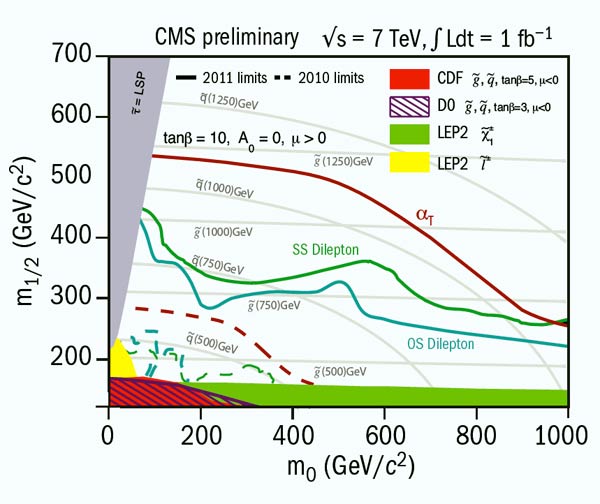
The results are remarkable, testing regions in the parameter space of SUSY theory where the squarks and gluinos (the supersymmetric partners of quarks and gluons) can be as heavy as 1 TeV. Unfortunately there is no sign so far of the production of SUSY particles. With these latest results, CMS has substantially reduced the phase space where SUSY can hide, particularly in the so-called constrained models such as the Constrained Minimal Supersymmetric extension of the Standard Model (CMSSM). Figure 1 illustrates the impressive reach of the CMS analyses with respect to other experiments in the plane of the universal scalar and gaugino masses at the GUT scale (m0 and m1/2, respectively) of the CMSSM.
The collaboration has also released its first paper based on the 2011 dataset of 1 fb–1, namely on the search for very high mass resonances in events that have at least two jets with a large transverse momentum in the final state. Jets are observed in the detectors as sprays of particles ejected from the interaction point in a given direction – that is, the direction of the original parton produced in the hard scattering of the collision, or in the decay of a heavy new particle. Examples of possible heavy new particles that can be studied in such di-jet invariant mass analyses are new gauge bosons, graviton resonances, string resonances, and more exotic objects that couple via the strong force, such as axigluons or colour octet states. Each one of these particles is predicted in one or more models for new physics beyond the Standard Model.
CMS has now examined the di-jet mass for mass values up to 4 TeV. No significant sign of di-jet resonances has been found and, as figure 2 shows, various other new particles have now been excluded in the range of 1–4 TeV, depending on the model and particle species.
The search for SUSY and other new physics signatures at the LHC is in a very early stage – an important increase in luminosity is expected before the end of 2012. These first data are beginning to disfavour the simplest and more constrained models, but the range of possibilities that need to be explored further is vast. As David Gross said in the concluding remarks at the conference: “Nobody promised it would be easy.”
The LHCb experiment has been designed to focus on B physics, which offers a rich hunting ground for new physics as the large numbers of B hadrons produced at the LHC allow the detailed study of rare processes. Two results presented at EPS-HEP 2011 show how quickly the experiment has been able to access this kind of physics. In one case, LHCb has made the first 5σ observation of a CP asymmetry at the LHC, in the mode B0→Kπ; in the other, the collaboration has made the most precise measurement to date of the forward-backward asymmetry of the rare decay B0→K*0μ+μ–, which is very sensitive to new physics.
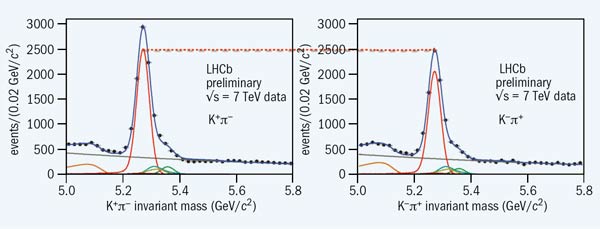
The CP asymmetry for the B0→Kπ decay is defined as ACP(B0→Kπ) = [Γ(B0→K–π+) – Γ(B0→K+π–)] / [Γ(B0→K–π+) + Γ(B0→K+π–)]. As figure 1 shows, the asymmetry is clearly visible in the raw invariant mass distribution measured by LHCb for a data sample corresponding to 320 pb–1 of integrated luminosity – i.e. most of the data taken up to the LHC’s technical stop in June, just a month prior to the conference. However, to correct for any asymmetry in the production of the B0 and B0 and in the detection of the different final states, the collaboration uses control channels, such as B0→J/Ψ K*0 and D*+→D0π+; they also compare results taken with opposite polarities of the detector’s magnetic field. The corrections are typically at the percent level and yield a corrected asymmetry of ACP = –0.088 ± 0.011 ± 0.008.
This result is a world best, with a significance of more than 5σ, and is in good agreement with the existing world average of ACP(B0→Kπ) = –0.098 +0.012–0.011. It is an important landmark for LHCb. The many CP asymmetries in B decays can be sensitive to physics beyond the Standard Model and form an important part of the physics programme for the experiment.
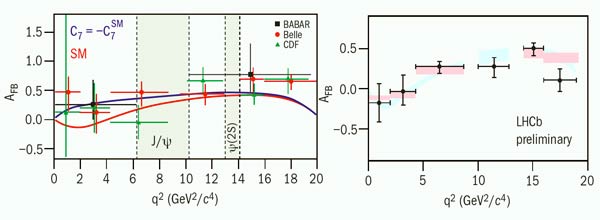
In a second study, LHCb has observed the decay B0→K*0μ+μ–. This is a rare mode involving a flavour-changing neutral current; it proceeds via a b→s transition through a loop diagram, with a branching ratio of order 10–6. New physics processes can therefore enter at the same level as the Standard Model processes, making the decay a sensitive probe of contributions from new physics. The partial rate as a function of the di-muon invariant mass squared (q2) and the di-muon forward-backward asymmetry (AFB) can both be affected in many new physics scenarios. Existing measurements of AFB vs q2, which are shown on the left side of figure 2, have all tended to be rather higher than the expectation from the Standard Model, hinting at possible new physics, although the individual statistical significance is small.
LHCb has already collected over 300 events for B0→K*0μ+μ–, with a signal-to-background ratio above three. This is the largest sample of such decays in the world, and is even cleaner than the samples used by the B factories. The right side of figure 2 shows the distribution of AFB vs q2 for these events, which is in good agreement with the Standard Model expectation (shown by the shaded bands). The collaboration plans to continue to study this channel in finer detail, with measurements that include more angular variables, and expects to achieve high sensitivity to any small deviation from the Standard Model.
Since the early 1980s, the Quark Matter conferences have been the most important venue for showing new results in the field of high-energy heavy-ion collisions. The 22nd in the series, Quark Matter 2011, took place in Annecy on 22–29 May and attracted a record 800 participants. Scheduled originally for 2010, it had been postponed to take place six months after the start of the LHC heavy-ion programme. It was hence – after Nordkirchen in 1987 and Stony Brook in 2001 – the third Quark Matter conference to feature results from a new accelerator.
The natural focus of the conference was on the first results from the approximately 108 lead–lead (Pb+Pb) collisions that each of the three experiments – ALICE, ATLAS and CMS –participating in the LHC heavy-ion programme have recorded at the current maximum centre-of-mass energy of 2.76 TeV per equivalent nucleon–nucleon collision. In addition, the latest results from the PHENIX and STAR experiments at Brookhaven’s Relativistic Heavy Ion Collider (RHIC) and its recent beam energy-scan programme featured prominently, as well as data from the Super Proton Synchrotron (SPS) experiments. The conference aimed at a synthesis in the understanding of heavy-ion data over two orders of magnitude in centre-of-mass energy.
The meeting also covered a range of theoretical highlights in heavy-ion phenomenology and field theory at finite temperature and/or density. And although, as one speaker put it, the wealth of first LHC data contributed much to the spirit that “the future is now”, there were sessions on future projects, including the programme of the approved experiment NA61/SHINE at the SPS, plans for upgrades to RHIC, experiments at the Facility for Antiproton and Ion Research under construction in Darmstadt, a plan for a heavy-ion programme at the Nuclotron-based Ion Collider facility in Dubna, as well as detailed studies for an electron–ion programme at a future electron–proton/electron–ion collider, e-RHIC, at Brookhaven, or LHeC at CERN.
Following a long-standing tradition, the conference was preceded by a “student day” featuring a set of introductory lectures catering for the particular needs of graduate students and young postdocs, who represented a third of the conference participants. The official conference inauguration was held on the morning of 22 May in the theatre at Annecy, the Centre Bonlieu, with welcome speeches from CERN’s director-general, Rolf Heuer, the director of the Institut National de Physique Nucléaire et de Physique des Particules (IN2P3), Jacques Martino, and the president of the French National Assembly, Bernard Accoyer. The same morning session featured an LHC status report by Steve Myers of CERN and a theoretical overview by Krishna Rajagopal of Massachusetts Institute of Technology.
Quark Matter 2011 also continued the tradition of scheduling summary talks of all of the major experiments in the introductory session. When the 800 participants walked in for a late lunch on the first day from the Centre Bonlieu along the Lake of Annecy to the Imperial Palace business centre, the site of the parallel sessions in the afternoon, they had listened to experimental summaries by Jurgen Schukraft for ALICE, Bolek Wyslouch for CMS, Peter Steinberg for ATLAS, Hiroshi Masui for STAR and Stefan Bathe for PHENIX. These 25-minute previews set the scene for the detailed discussions of the entire week.
This short report cannot summarize all of the interesting experimental and theoretical developments but it illustrates the breadth of the discussion with a few of the many highlights. Examples from three particular areas must therefore suffice to illustrate the richness of the new results and their implications.
The importance of flow
Heavy-ion collisions at all centre-of-mass energies have long been known to display remarkable features of collectivity. In particular, in semicentral heavy-ion collisions at ultra-relativistic energies, approximately twice as many hadrons above pT = 2 GeV are produced parallel to the reaction plane rather than orthogonal to it, giving rise to a characteristic second harmonic v2 in the azimuthal distribution of particle production. Only a month after the end of the first LHC heavy-ion run, the ALICE collaboration announced in December 2010 that this elliptic flow, v2, persists unattenuated from RHIC to LHC energies. The bulk of the up to 1600 charged hadrons produced per unit rapidity in a central Pb–Pb collision at the LHC seems to emerge from the same flow field. Moreover, the strength of this flow field at RHIC and at the LHC is consistent with predictions from fluid-dynamic simulations, in which it emerges from a partonic state of matter with negligible dissipative properties. Indeed, one of the main motivations for a detailed flow phenomenology at RHIC and at the LHC is that flow measurements constrain dissipative QCD transport coefficients that are accessible to first-principle calculations in quantum field theory, thus providing one of the most robust links between fundamental properties of hot QCD matter and heavy-ion phenomenology.
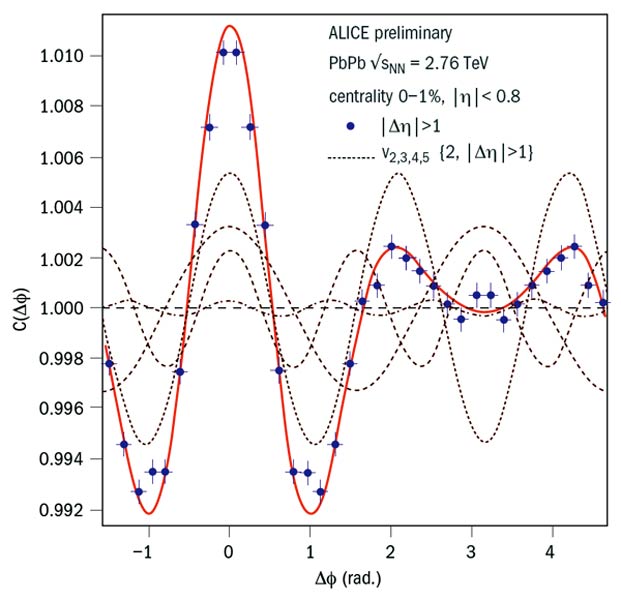
Quark Matter 2011 marks a revolution in the dynamical understanding of flow phenomena in heavy-ion collisions. Until recently, flow phenomenology was based on a simplified event-averaged picture according to which a finite impact parameter collision defines an almond-shaped nuclear overlap region; the collective dynamics then translates the initial spatial asymmetries of this event-averaged overlap into the azimuthal asymmetries of the measured particle-momentum spectra. As a consequence, the symmetries of measured momentum distributions were assumed to reflect the symmetries of event-averaged initial conditions. However, over the past year it has become clear – in an intense interplay of theory and experiment – that there are significant fluctuations in the sampling of the almond-shaped nuclear overlap region on an event-by-event basis. The eventwise propagation of these fluctuations to the final hadron spectra results in characteristic odd flow harmonics, v1, v3, v5, which would be forbidden by the symmetries of an event-averaged spatial distribution at mid-rapidity.
In Annecy, the three LHC experiments and the two at RHIC all showed for the first time flow analyses at mid-rapidity that were not limited to the even flow harmonics v2 and v4; in addition, they indicated sizeable values for the odd harmonics that unambiguously characterize initial-state fluctuations (figure 1). This “Annecy spectrum” of flow harmonics was the subject of two lively plenary debates. The discussion showed that there is already an understanding – both qualitatively and on the basis of first model simulations – of how the characteristic dependence on centrality of the relative size of the measured flow coefficients reflects the interplay between event-by-event initial-state fluctuations and event-averaged collective dynamics.
Several participants remarked on the similarity of this picture with modern cosmology, where the mode distribution of fluctuations of the cosmic microwave background also gives access to the material properties of the physical system under study. The counterpart in heavy-ion collisions may be dubbed “vniscometry”. Indeed, since uncertainties in the initial conditions of heavy-ion collisions were the main bottleneck in using data so far for precise determinations of QCD transport coefficients such as viscosity, the measurement of flow coefficients that are linked unambiguously to fluctuations in the initial state has a strong potential to constrain further the understanding of flow phenomena and the properties of hot strongly interacting matter to which they are sensitive.
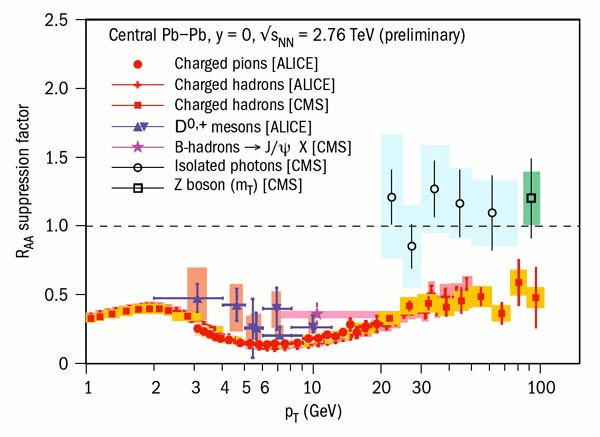
Quark Matter 2011 also featured major qualitative advances in the understanding of high-momentum transfer processes embedded in hot QCD matter. One of the most important early discoveries of the RHIC heavy-ion programme was that hadronic spectra are generically suppressed at high transverse momentum by up to a factor of 5 in the most central collisions. With the much higher rate of hard processes at the tera-electron-volt scale, the first data from ALICE and CMS have already extended knowledge of this nuclear modification of single inclusive hadron spectra up to pT = 100 GeV/c. In the range below 20 GeV/c, these data show a suppression that is slightly stronger but qualitatively consistent with the suppression observed at RHIC. Moreover, the increased accuracy of LHC data allows, for the first time, the identification of a nonvanishing dependence on transverse momentum of the suppression pattern from a factor of around 7 at pT = 6–7 GeV/c to a factor of about 2 at pT = 100 GeV/c, thus adding significant new information.
Another important constraint on understanding high-pT hadron production in dense QCD matter was established by the CMS collaboration with the first preliminary data on Z-boson production in heavy-ion collisions and on isolated photon production at pT up to 100 GeV/c. In contrast to all of the measured hadron spectra, the rate of these electroweakly interacting probes is unmodified in heavy-ion collisions (figure 2). The combination of these data gives strong support to models of parton energy loss in which the rate of hard partonic processes is equivalent to that in proton–proton collisions but the produced partons lose energy in the surrounding dense medium.
The next challenge in understanding high-momentum transfer processes in heavy-ion collisions is to develop a common dynamical framework for understanding the suppression patterns of single inclusive hadron spectra and the medium-induced modifications of reconstructed jets. Already in November 2010, the ATLAS and CMS collaborations reported that di-jet events in heavy-ion collisions show a strong energy asymmetry, consistent with the picture that one of the recoiling jets contains a much lower energy fraction in its jet conical catchment area as a result of medium-induced out-of-cone radiation. At Quark Matter 2011, CMS followed up on these first jet-quenching measurements by showing the first characteristics of the jet fragmentation pattern. Remarkably, these first findings are consistent with a certain self-similarity, according to which jets whose energy was degraded by the medium go on to fragment in the vacuum in a similar fashion to jets of lower energy.
This was the first Quark Matter conference in which data on the nuclear modification factor were discussed in the same session as data on reconstructed jets. All of the speakers agreed in the plenary debate that there will be much more to come. On the experimental side, advances are expected from the increased statistics of future runs, complementary analyses of the intra-jet structure and spectra for identified particles, as well as from a proton–nucleus run at the LHC, which would allow the dominant jet-quenching effect to be disentangled from possibly confounding phenomena. On the theoretical side, speakers emphasized the need to improve the existing Monte-Carlo tools for jet quenching with the aim of constraining quantitatively how properties of the hot and dense QCD matter produced in heavy-ion collisions are reflected in the modifications of hard processes.
Another highlight of the conference was provided by the first measurements of bottomonium in heavy-ion collisions, reported by the STAR collaboration for gold–gold (Au–Au) collisions at RHIC and the CMS collaboration for Pb–Pb collisions at the LHC. The charmonium and bottomonium families represent a well defined set of Bohr radii that are commensurate with the typical thermal length scales expected in dense QCD matter. On general grounds, it has long been conjectured that, depending on the temperature of the produced matter, the higher excited states of the quarkonium families should melt while the deeper-bound ground states may survive in the dense medium.
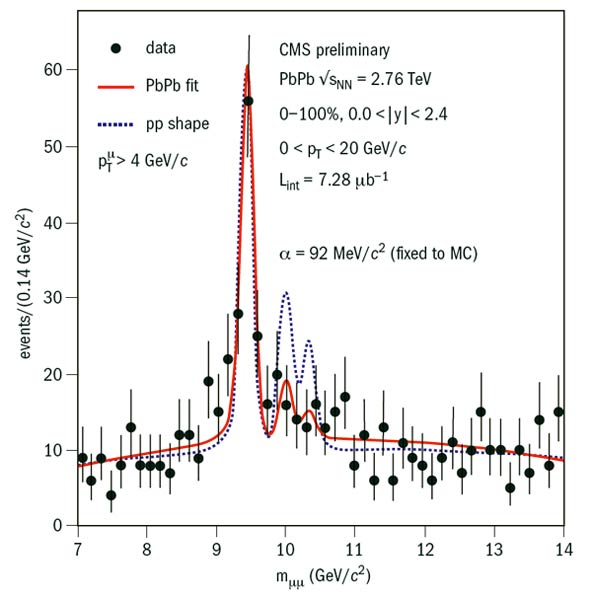
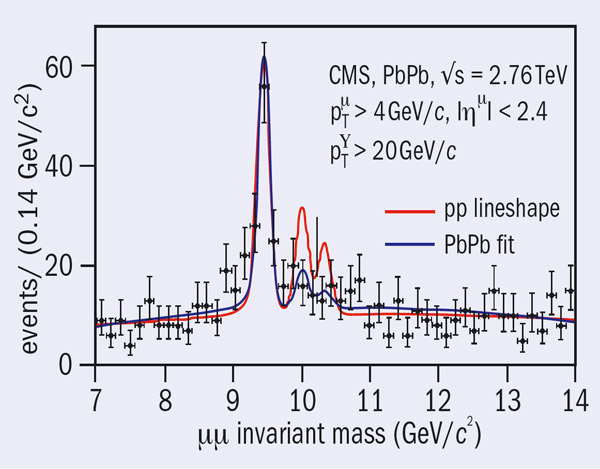
While the theoretical formulation of this picture is complicated by confounding factors related to limited understanding of the quarkonium formation process in the vacuum and possible new medium-specific formation mechanisms via coalescence, the CMS collaboration presented preliminary data of the Υ family that are in qualitative support of this idea (figure 3). In particular, CMS has established within statistical uncertainties the absence of higher excited states of the Υ family in the di-muon invariant mass spectrum, while the Υ 1s ground state is clearly observed. The rate of this ground state is reduced by around 40% (suppression factor, RAA = 0.6) in comparison with the yield in proton–proton collisions, consistent with the picture that the feed-down from excited states into this 1s state is stopped in dense QCD matter. STAR also reported a comparable yield. Clearly, this field is now eagerly awaiting LHC operations at higher luminosity to gain a clearer view of the conjectured hierarchy of quarkonium suppression in heavy-ion collisions.
In addition to the scientific programme, Quark Matter 2011 was accompanied by an effort to reach out to the general public. The week before the conference, the well known French science columnist Marie-Odile Monchicourt chaired a public debate between Michel Spiro, president of CERN Council, and Etienne Klein, director of the Laboratoire de Recherches sur les Sciences de la Matière at Saclay and professor of philosophy of science at the Ecole Central de Paris, attracting an audience of around 400 from the Annecy area. During the Quark Matter conference, physicists and the general public attended a performance by actor Alain Carré and the world-famous Annecy-based pianist Francois-René Duchable that merged classical music, literature and artistically transformed pictures from CERN. On another evening, the company Les Salons de Genève performed the play The Physicists, by Swiss writer Friedrich Dürrenmatt, in Annecy’s theatre. While the conference reached out successfully to the general public, participants encountered some problems in reaching out because the wireless in the conference centre turned out to be dysfunctional. However, the highlights were sufficiently numerous to reduce this to a footnote. As one senior member of the community put it during the conference dinner: “It was definitively the best conference since the invention of the internet.”
The nuclear shell model, one of the cornerstones in describing nuclear structure, was invented independently by Maria Goeppert-Mayer and Hans Jensen in 1949, who both received the Nobel prize in 1963. In the model, nuclei with “magic” numbers of protons or neutrons exhibit highly symmetric spherical configurations similar to the electron cloud in noble gases or the carbon atoms in C60 molecules (“buckyballs”). The traditional “magic” numbers in nuclear physics – 2, 8, 20, 28, 50, 82 (and 126 for neutrons) – are well established for stable nuclei. These emerged from a purely phenomenological approach, but modern nuclear theory can trace the magic numbers down to nucleon–nucleon forces derived from low-energy QCD.
Many current studies of nuclear structure with exotic radioactive nuclei focus on the question of whether these magic numbers persist or are altered in going away from the “valley of stability”, where the numbers of protons (Z) and neutrons (N) combine to give the most stable nuclides. Challenging the predictive power of nuclear theory, the aim is to lead the way towards a universal description of nuclear structure. Predictions for nuclei that lie beyond the reach of experiments are also important, for example, for the understanding of nucleosynthesis in exploding stars, at the origin of the chemical elements in the universe.
Such changes have already been observed experimentally in exotic nuclei. For example, the stable isotope 16O (Z=N=8) is an exemplary doubly magic nucleus. However, far from stability, 24O (the oxygen isotope that has the most neutrons while still being bound) behaves in a similar fashion, indicating that locally a new magic number, N=16, appears. Other examples are the disappearance of the magic number N=8 in 12Be and evidence for a new magic number, N=34, in 54Ca.
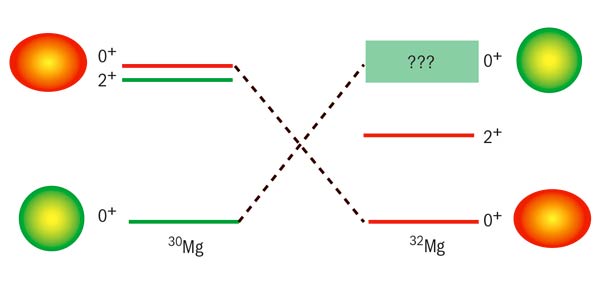
Anomalies in nuclear structure in the region around N=20 have been known of experimentally since 1975, when mass measurements of exotic sodium isotopes at CERN’s Proton Synchrotron revealed a tighter binding than expected. This was followed by the discovery in studies of magnesium isotopes that the energy of the first excited state, populated by the decay of sodium, drops from 1482.8 keV in 30Mg to 885.3 keV in 32Mg (N=20) – the opposite of what is expected on approaching a magic number. These features were then attributed to an unexpected onset of deformation, with the nuclei having most likely the shape of a rugby ball rather than being spherical.
Further evidence for this interpretation came from studies of electromagnetic transition strengths and ground-state properties, some of them performed at CERN’s world-leading ISotope OnLine separation (ISOL) facility, ISOLDE. In terms of the nuclear shell model, the nucleon–nucleon forces are believed to change the ordering of some single-particle orbitals, sometimes so drastically that orbitals are lowered even across a closed shell (in this case N=20). The neutron-rich nuclei in the N=20 region, whose ground-state configuration includes valence neutrons that occupy such “intruder” orbitals, form what is known as the “Island of Inversion”.
Shape coexistence
In 30Mg (N=18), all of the experimental and theoretical work points to the coexistence of a spherical ground state with spin (J) and parity (P), JP = 0+, together with a deformed excited 0+ state at 1788.2 keV, which has a wave function with a strong intruder contribution. The latter has been identified at ISOLDE by measuring the conversion electrons of the characteristic electric mono-pole (E0) transition between the two 0+ states, as in this particular case the emission of a gamma ray is forbidden because of angular momentum conservation. In 32Mg – in agreement with theory – all of the data indicate that inversion has taken place so that the energetically favoured intruder configuration dominates the deformed ground state. Consequently, a near-spherical excited 0+ state, the analogue of the ground state in 30Mg, is expected, as illustrated in figure 1. Despite numerous attempts, however, this state has never been observed experimentally – until now.
An experiment led by the Technische Universität München and the Katholieke Universiteit Leuven and involving 39 experimenters from 14 institutes in 9 countries has at last discovered the excited 0+ state in 32Mg (Wimmer et al. 2010). The experiment was performed in October 2008 at ISOLDE, where fundamental and applied research with radioactive ions is performed at CERN. Operating since 1967, ISOLDE has produced more than 700 isotopes of almost 70 elements as low-energy beams (60 keV). Starting in 2001, nearly 80 isotopes of elements from lithium to radium have been post-accelerated by the Radioactive Beam Experiment (REX) to energies up to 3 MeV/u, enabling the study of nuclear-reactions.
The key idea was that the addition of two neutrons to the spherical ground state of 30Mg should populate either the deformed ground state of 32Mg or the spherical excited 0+ state, depending on which orbital the additional neutrons occupy. Experimentally, this was achieved by a two-neutron transfer reaction in inverse kinematics. A beam of 30Mg impinged on a tritium (t) target from which the two neutrons were transferred to form a 32Mg nucleus in a (t,p) reaction.
The radioactive 30Mg (T1/2 = 335 ms) was produced by the 1.4 GeV proton beam from the PS Booster impinging on a thick, uranium carbide production target. The magnesium atoms were selectively ionized by the Resonant Ionisation Laser Ion Source and the singly charged ions were mass-separated to obtain a pure 30Mg beam. The energy of the ions was then boosted by the REX-ISOLDE facility to 1.83 MeV/u, with a final intensity of around 104 particles a second.
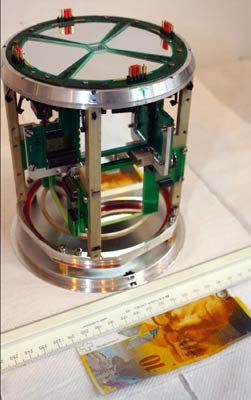
The experimental set-up consisted of MINIBALL – a high-resolution gamma-ray spectrometer with 24 segmented high-purity germanium detectors – in combination with the newly built Transfer reactions at REX (T-REX) array, which is the key detector for this experiment. T-REX is a 4π array with 58% coverage in solid angle. It consists of a box-like “barrel” of quadratic silicon-strip detectors together with an annular double-sided segmented silicon-strip detector, the “CD”; in both cases there are two layers of silicon detectors (figure 2). Energy and position are measured for charged, target-like particles – protons, deuterons and tritons; these are identified by measuring the energy loss in a thin detector, which is characteristic for a species at a given energy, and the remaining kinetic energy in a thick detector that stops the particles (the ΔE–E method). The compact set-up was housed in a cylindrical vacuum chamber with a diameter of 12 cm to fit inside MINIBALL.
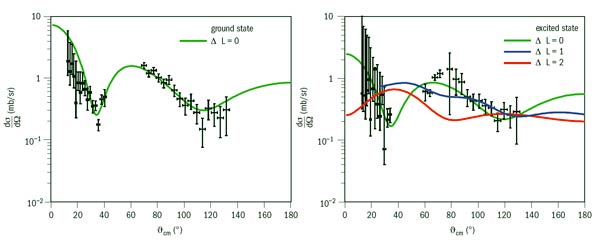
One of the experimental challenges was to make a thin radioactive tritium target, small enough to fit in the centre of T-REX. The technical solution was found in the form of a tritium-loaded titanium foil. The measured energies and angles of the protons emitted from the (t,p) reaction enabled the reconstruction of the excitation energy of the 32Mg nucleus. The angular distributions of the protons allowed for the determination of the transferred orbital angular momentum ΔL, from which the spins and parities of the populated states could be deduced (figure 3).
The shape of the measured angular distribution is characteristic for ΔL=0 and firmly establishes the 0+ assignment for the excited state, just as for the ground state (figure 3). An excitation energy of 1058 keV and a lower limit for its lifetime of 10 ns have been deduced. The population cross-sections for both states and results from recent knockout reactions contribute to a consistent picture of a deformed ground state and a spherical excited 0+ state.
Such a low-lying – lower than predicted by any calculation – and long-lived 0+ state poses a challenge to modern theory. An experimental challenge also remains: to determine the lifetime of the excited state as well as the strength of the E0 transition between the two 0+ states. However, bringing all of the existing pieces of the puzzle together is already enabling a deeper insight into the physics relevant for the formation of the Island of Inversion.
The fascinating phenomenon of different nuclear shapes coexisting at similar energies – the difference is less than 1 per cent of the total binding energy – is also present in other regions of the nuclear chart, the most prominent example being the triple shape coexistence in the neutron-deficient 186Pb isotope. Transfer reactions at REX-ISOLDE are currently limited by the available beam energy to nuclei with mass number A lower than 80, but the upgrade of the facility to HIE-ISOLDE is already on the horizon. This includes an incremental increase of beam energy to 10 MeV/u and will become available in 2015. In particular, at these energies one- and two-nucleon-transfer reactions with heavy radioactive-ion beams will become feasible, opening up a whole new field for studies of single-particle aspects, shape coexistence and the role of pairing interactions. The future of nuclear structure studies with radioactive ion beams at CERN looks bright.
Low-energy antiproton physics is an interdisciplinary field that spans particle, nuclear, atomic and applied physics, as well as astrophysics. It confronts directly the relationship between matter and antimatter, in particular CPT symmetry, one of the foundations of the theory of particle physics. CPT is so fundamental that its violation would require a complete rewriting of particle-physics textbooks. Precision studies with antiprotons may also shed light on the question of why the universe is made almost exclusively of matter but not antimatter. Recent months have witnessed dramatic breakthroughs in the field at CERN’s Antiproton Decelerator (AD), including the trapping of antihydrogen atoms and developments towards an antihydrogen beam. Satellite and balloon experiments are searching for cosmic antimatter, the results of which could have profound implications on cosmology. Antiprotons are also being used to study the properties and structures of atoms, nuclei and hadrons, for which the start of the Facility for Antiproton and Ion Research (FAIR) in Darmstadt will usher in a new era.
Dialogue across disciplines
It was against this stimulating backdrop that LEAP 2011 – the 10th International Conference on Low Energy Antiproton Physics – took place at TRIUMF in Vancouver on 27 April – 1 May. The conference was organized and supported by the Canadian institutions involved in the ALPHA experiment at the AD (the universities of British Columbia, Calgary, Simon Fraser, York and TRIUMF), with additional support from the Canadian Institute of Nuclear Physics, and was chaired by Makoto Fujiwara of TRIUMF/
Calgary, with Mary Alberg of Seattle as co-chair. LEAP 2011 was the first of the series in North America; the conferences have traditionally been held in Europe, with the exception of Yokohama in 2003. It attracted nearly 100 participants and featured more than 60 invited plenary speakers, with an emphasis on promoting young researchers. Several review talks by senior physicists facilitated dialogue across the disciplines. In addition, a dozen posters were presented and presenters were allowed a two-minute talk to advertise their work at a plenary, a format that worked quite effectively. This report presents some of the highlights of a packed programme.
The conference began with a session on antihydrogen physics, with reports on the recent trapping of antihydrogen by the ALPHA experiment and the ASACUSA collaboration’s developments towards an antihydrogen beam, both at the AD. The two results were together voted the number one physics breakthrough for 2010 by Physics World. Key techniques that enabled ALPHA’s trapping of antihydrogen are evaporative cooling and autoresonant excitation of antiproton plasmas. The conference heard how the collaboration’s work has led to the successful confinement of antihydrogen for 1000 s. The next major goal for ALPHA is to perform microwave spectroscopy on trapped antihydrogen. ASACUSA also has plans to use microwave spectroscopy to measure ground-state hyperfine splitting with an antihydrogen beam.
The ATRAP collaboration, again at the AD, presented new results on adiabatic cooling of antiprotons, with up to 3 × 10⁶ antiprotons cooled to 3.5 K, and described the first demonstration of centrifugal separation of antiprotons and electrons, suggesting a new method for isolating low-energy antiprotons. The team also has a scheme for improved antihydrogen production via interactions with positronium atoms, created in the interactions of excited caesium atoms with positrons. Other talks described new possibilities for antimatter gravity experiments with antihydrogen at the AD: AEGIS, already under preparation, and the proposed Gbar.
Ion traps with single-particle sensitivity are another powerful tool. A team from Heidelberg and Mainz has recently observed a single proton spin-flip, a result that paves the path for the comparison of the magnetic moments of protons and antiprotons. At TRIUMF, an ion trap system, TITAN, is being used at the ISAC facility for precision studies of radioactive nuclei.
Talks on applications and new techniques with antiprotons included the ACE experiment at the AD, which is studying the possible use of antiprotons for cancer therapy, and developments towards spin-polarized antiprotons. The session on atomic physics also covered some novel techniques that have possible applications to antihydrogen. One proposal concerns a new pulsed Sisyphus scheme for (anti)hydrogen laser cooling. Another involves using an atomic coil-gun, which can stop beams of paramagnetic species, to trap hydrogen isotopes, followed by single-photon cooling techniques. A Lyman-α laser for antihydrogen cooling is being developed at Mainz.
The positron, or anti-electron, is the other ingredient in antihydrogen atoms. A review on positron accumulation techniques was given by Clifford Surko of the University of California, San Diego – the inventor of the Surko trap now used by many of the antihydrogen experiments. Studies were reported using variations of the Surko trap by ATRAP and the University of Swansea groups. Measurement of hyperfine splitting in positronium could provide precision tests of QED. One experiment on positronium atoms at the University of Tokyo has made the first direct measurement of this splitting, employing a novel sub-THz source, while another aims at precise measurements via the Zeeman effect.
This year marks the 20th anniversary of the discovery of long-lived antiprotonic helium at KEK. Studies of such exotic atoms and fundamental symmetries are an important part of antiproton physics. ASACUSA has made recent progress on precision studies on antiprotonic helium and on microwave measurements of antiprotonic 3He atoms. Recent but still controversial results on muonic hydrogen spectroscopy at the Paul Scherrer Institute indicate a much smaller size for the proton radius than is generally accepted. Hadronic and radioactive atoms were featured in review talks at the conference, focusing on pionic and kaonic atoms, as well as on the fundamental symmetries programme at TRIUMF. The final results of the TWIST experiment at TRIUMF, a precision measurement of muon decay parameters, have greatly reduced systematic uncertainties, providing improved limits for constraining extensions to the Standard Model.
An important pillar of antiproton physics is hadron and QCD physics at “low energy”, ranging from stopped antiprotons to a beam of 15 GeV. At the lower energy end, ASACUSA is studying antiproton in-flight annihilation on nuclei. Following hints from an experiment at KEK, an experiment in a low-momentum antiproton beam at the Japan Proton Accelerator Research Complex (J-PARC) will search for a φ-meson–nucleus bound state using antiproton annihilation on nuclei. Also at J-PARC, a study of double anti-kaonic nuclear clusters in antiproton–3He annihilation has been proposed. Further into the future, the research programme for the major PANDA detector at FAIR, which is expected to start running in 2018, encompasses a breadth of physics that includes searches for exotic states and studies of double Λ hypernuclei. Back to the present, hot news from the Brookhaven National Laboratory concerned the discovery of the anti-alpha nucleus, the heaviest anti-nucleus observed.
The theory talks at the conference covered topics ranging from atomic collisions to cosmology. There were reviews on atomic collision physics with antiprotons and on interactions of antihydrogen with ordinary matter atoms. Calculations of gravitational effects on the interaction between antihydrogen and a solid surface suggest that the antiatoms would settle in long-lived quantum states, the study of which could provide a new way to measure the gravitational force on antihydrogen. Theoretical ideas based on the so-called Standard Model Extension, an effective theory that incorporates CPT and Lorentz violation, could offer the opportunity for probing Planck-scale physics as well as antimatter gravity in antihydrogen experiments. On the hadron physics side, antiproton–proton and antiproton–nucleus collisions provide ways to test theories of strangeness production, the latter offering a window onto the behaviour of strange particles in the nuclear medium that complements heavy-ion studies. In cosmology, baryon asymmetry – or the dominance of matter over antimatter – is a long-standing puzzle, as is the nature of dark matter. Could hidden antibaryons be the dark matter? Such a possibility could explain the two mysteries in one go.
LEAP 2011 featured two dedicated sessions on the universe. In the first, CERN’s John Ellis discussed the nature of dark matter and its connection to low-energy hadron physics and William Unruh, from the University of British Columbia, reported on fascinating experimental work that confirms aspects of Hawking radiation in an analogue system, confirming his own theoretical prediction from some 30 years ago. The second of the sessions focused on experimental searches for antimatter in the universe – a hot topic as the conference was held not long before the launch into space of the Alpha Magnetic Spectrometer. The latest results from the PAMELA detector, which has been in space since 2006, continue to show an anomaly in the positron flux at high energies (PAMELA’s quest for answers to cosmic questions). BESS-Polar II, the second flight of the Balloon-borne Experiment with a Superconducting Spectrometer (BESS) over Antarctica, has a new measurement of the antiproton spectrum based on 24.5 days in which 4.7 × 10⁹ cosmic-ray events were collected, yielding a sensitivity complementary to satellite experiments. The proposed General Antiparticle Spectrometer (GAPS) would be a balloon experiment to search for anti-deuterons from dark-matter annihilations using exotic atom techniques.
Looking to the future, the construction of FAIR at Darmstadt will allow for a dedicated Facility for Low-energy Antiproton and Ion Research (FLAIR), while Fermilab has a proposal to use its Antiproton Source – the world’s most intense – for low-energy experiments once the Tevatron programme comes to an end later this year. Finally the conference returned to the AD, when the proposal for the Extra Low ENergy Antiproton ring (ELENA) was described by Walter Oelert, from the Jülich Research Centre, whose experiment at CERN observed the first antihydrogen atoms in 1996. The conference ended with his remarks on the prospects for antiproton physics. Just a few weeks after the conference, CERN Council approved the construction of ELENA, which will provide significantly enhanced opportunities for antiproton physics at CERN in the coming decade (ELENA prepares a bright future for antimatter research).
This successful conference was capped off by a social programme that included a dinner cruise in Vancouver’s spectacular English bay, and a well-attended public lecture by John Ellis at the University of British Columbia. The future of low-energy antiproton physics appears bright. The next LEAP meeting is planned for Uppsala in 2013, chaired by Tord Johansson.
• For full details of the speakers and many of the presentations, see http://leap2011.triumf.ca. The proceedings will be published in Hyperfine Interactions.
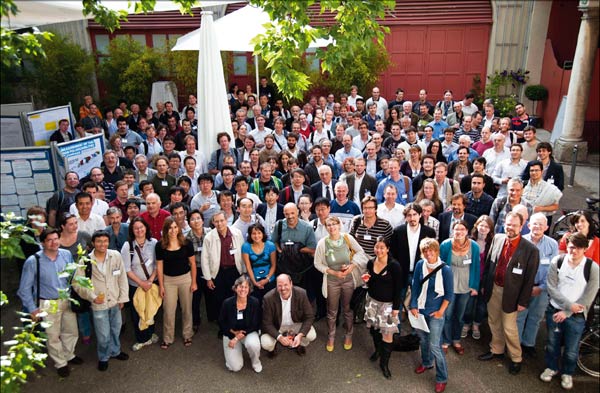
Hadron 2011, the 14th International Conference on Hadron Spectroscopy, was the latest in a long series that started in 1985 in Maryland. Originally conceived as a conference on light meson spectroscopy, it now covers all aspects of hadron physics, although spectroscopy and hadron production are still the topics that characterize the meeting. This year, 37 plenary talks, 128 presentations in parallel sessions and 37 posters offered ample possibilities to find out about the latest developments and results, from hypernuclear physics to meson and quarkonium spectroscopy, and from nucleon structure and the meson-baryon interaction to heavy-ion physics.
The conference began by looking at issues related to light mesons, with a summary of recent theoretical progress and experimental tests in chiral dynamics and low-energy ππ-scattering phenomena. There were new results on light meson spectroscopy from the BESIII experiment in Beijing and COMPASS at CERN. While COMPASS impressively confirmed previous findings on π1(1600), an exotic meson seen in high-energy diffraction, new structures have been observed in radiative J/Ψ decays that point towards new and narrow meson states between 1.8 and 2.5 GeV/c2, the details and nature of which have still to be unravelled.
Size and structure
Even after many years of precision experiments, the size of the proton is still a hot topic. New findings in laser spectroscopy of muonic hydrogen, which give the proton radius as more than 5σ smaller than previously determined, have opened the hunt for new explanations, although theory cannot offer effects large enough to solve the puzzle.
Research into nucleon structure has for years shifted to spin degrees of freedom. After precision measurements on the helicity contribution of quarks in polarized nucleons, COMPASS has also set new limits on spin effects resulting from polarized gluons. These findings are confirmed by spin experiments at the Relativistic Heavy Ion Collider (RHIC) at Brookhaven. With this, the focus now turns towards transverse-spin degrees of freedom (transversity). Noncollinear treatment of partons inside the nucleon offers a large number of new observables, which can link to quark angular momenta. Both COMPASS and RHIC have new physics programmes on transverse polarization effects, and measurements of Drell-Yan processes using polarized targets are also on the way. Hopes are high that the unexpected single-spin asymmetries that have been observed in pion production at RHIC may finally be understood.
On the low-Q2 side, big efforts at various laboratories – such as Bonn, Mainz, Jefferson Lab etc – are offering real or virtual photon beams. These allow a coherent set of (double-) polarized scattering and production experiments, also with many-body final states. Using the complete set of polarized measurements, the puzzle of baryon resonances, their identification and quantum numbers seem now to be within reach via new and sophisticated partial-wave analyses.
Quarkonium spectroscopy and the hunt for further quarkonium-like states that seem not to fit the qq– picture of the meson have been and still are highlights in hadron physics. Precision experiments finally allowed the BELLE and BaBar experiments at KEK and SLAC, respectively, to observe missing quarkonium states such as hb(1P), hb(2P), as well as ηc (1S) and ηc(2S). More precise determination of the mass and width, as well as unexpected decay patterns were revealed also by BESIII, which has observed about 109 J/Ψ decays. The puzzle of the mass and width of the D(Ds) meson states is on the way to being settled with their spin assignments being resolved. The conference also heard about the remarkable progress in achieving a comprehensive and unified theory description of quarkonium properties at zero and finite temperature in an effective field-theory framework.
The biggest puzzle currently in hadron physics concerns the large number of exotic quarkonium-like states with narrow widths and high excitation energies, as compared with the open-flavour meson channel. New work was reported on the X(3872) and other, partly new states. Theoretical investigations offer a rich choice of possibilities. The X(3872) has a good chance of just being the radial excitation of the χc state, but there is also a beautiful effective field-theory description in the molecular-interpretation case. However, further stunning observations were reported from the beauty sector. Two charged quarkonium-like states found by BELLE lie close in mass to the open b-threshold and have been dubbed Zb, in analogy to the charm sector.
Lattice calculations have shown huge progress with new algorithms, allowing the extraction of excited baryon and meson-state energies. A report from the Flavianet Lattice Averaging Group presented lattice results for kaon and pion physics with the aim of making them accessible to the community. There are also new calculations of hadron structure, the baryon and meson form-factors and the g-2 factor.
First and impressive results were reported from all of the LHC experiments. In particular, CMS and LHCb – offering the best mass resolutions – have confirmed the potential of hadron machines in this field. In addition to the usual quarkonium states, exotic states have also been observed and the elusive Bc mesons have already been seen. At this stage, the focus is on the production cross-section of heavy quarkonia, which can now be understood at LHC energies, assuming colour octet contributions and next-to-leading order (NLO) processes to be relevant. The descriptions follow data up to transverse momenta as high as 20 GeV/c. One of the uncertainties comes from unknown polarization effects that influence acceptance calculations. On the theoretical side, huge progress has been achieved with the full NLO calculation of the J/Ψ cross-section in non-relativistic QCD (NRQCD) and a combined global data analysis of all existing experiments that hints at the universality of the long-distance NRQCD matrix elements.
Hadron machines are unique in the production of b-baryons and Fermilab’s Tevatron has so far been leading this field. The CDF collaboration reported on recent progress with the observation of excited Σb states and a radially excited Λc. CDF and DØ also presented new precision measurements of the mass and width of other charmed baryons.
A thermal medium, of the type generated in heavy-ion collisions at the LHC, can modify hadron properties, especially in the case of quarkonia. The theory of such modifications was reviewed and first results of lead–lead collisions at the LHC presented. Results from ATLAS and CMS show the striking effects of jet-quenching and also the melting of the excited Y-states as compared with the ground-state partner. At lower energies, mass shifts and absorption cross-sections of vector mesons have been studied in the medium. Mass shifts – a long-standing issue, where many predictions have stimulated experimental efforts – have not been observed but small effects have been reported by the HADES experiment at GSI, Darmstadt, on the width of ω mesons in nuclei.
Recent and impressive progress in light meson and quarkonium spectroscopy is in good part a result of recent high-luminosity experiments, which offer 10–100 times the statistical sample of their predecessors. Heavy-meson physics, for long the domain of lepton colliders, is now seeing LHC experiments starting to compete in an impressive way and using their low luminosity data from 2010 to catch up with the Tevatron experiments. An interesting future lies ahead with even further increases in luminosity and precision being offered by future experiments such as BELLE II, the SuperB facility and the PANDA experiment at the Facility for Antiproton and Ion Research.
Two impressive summary talks concluded the conference. Stefano Bianco of Frascati/INFN reviewed the experimental situation, a challenging task in view of the large number of new results presented. On the theoretical side, Chris Quigg of Fermilab gave an inspiring outlook on hadron physics. He recognized the enormous diversity and reach of experimental programmes, which offer insights from unexpected quarters, while remarkable progress has been achieved in theory with the emergence of lattice QCD. However, many puzzles remain, leaving ample opportunities and much work to do, as there are still “simple” questions that the field cannot answer.
Participants enjoyed the coffee breaks in the sunny and secluded courtyard of the Künstlerhaus, a building erected more than 100 years ago for artists to meet and enjoy social events. Long and intense discussions also offered vital scientific exchange around the poster session, making this event a pleasant ending to the day. Long hours of sitting were compensated on Wednesday afternoon with a bicycle tour through the old town of Munich and the English garden, with refreshing drinks in the beer garden. Last but not least, the conference enjoyed a guest talk on neutrino physics by Thierry Lasserre of Saclay, who discussed the mass determination from flavour oscillation and reported fresh results from T2K on hints of νμ→νe oscillation.
Photons have an important role at the LHC, not only as tools for testing the Standard Model but also as heralds of new physics. The ATLAS collaboration has recently announced two measurements that in one case make use of photons as probes of QCD and in a second analysis use them to set limits on the production of the Higgs boson.
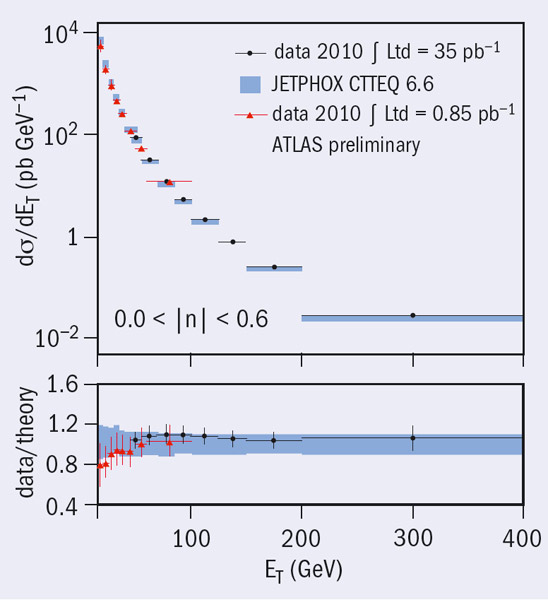
The production mechanism of photons in proton–proton collisions is sensitive to the density of the basic constituents within the colliding particles. This makes the measurement of their properties an excellent way to test the theoretical predictions of perturbative QCD, with a technique that is complementary to studies based on jets. One example is the new measurement made by the ATLAS collaboration of the inclusive production of isolated prompt photons.
The analysis uses the full 2010 data sample collected by ATLAS in LHC proton–proton collisions at 7 TeV, corresponding to an integrated luminosity of 35 pb–1. The result extends the measurement of the cross-section up to a photon transverse momentum of 400 GeV (figure 1), thus covering a kinematic region similar to that achieved at Femilab’s Tevatron and by the CMS collaboration at the LHC. QCD calculations performed at next-to-leading order (NLO) predict cross-sections that are in good agreement with the measured data across five orders of magnitude. Below 25 GeV, where the NLO predictions are less accurate, the predicted cross-section is larger than that measured in the data.
Photons are also important signatures of new physics, a familiar example being the production of a Standard Model Higgs boson decaying into a photon pair. If nature has chosen the Standard Model Higgs as the mechanism for electroweak-symmetry breaking, then about 10,000 Higgs bosons should already have been produced in ATLAS, assuming a light mass for the Higgs of about 120 GeV/c2. In this mass region, the decay into two photons remains the most promising channel for discovery, despite the small branching ratio of about 0.2%.
Using an integrated luminosity of 209 pb–1 from the full 2010 data sample, and the first part of the data collected in 2011, the ATLAS collaboration has studied the di-photon invariant mass spectrum in the mass range 100–150 GeV/c2 and looked for a possible excess of events that could be attributed to the decay of a new neutral particle. In this analysis, the different components associated to known processes were separated using the same data-driven technique as was used to measure the inclusive photon production cross-sections. The fluctuations observed in the di-photon invariant mass spectrum are compatible with the expected statistical fluctuations of the background. This translates into limits on the production cross-section of a Standard Model-like Higgs boson decaying into a pair of photons that range between 4 and 16 times the cross-section expected.
With the LHC delivering increasing amounts of data, both measurements are already set to improve.
The ALICE collaboration has measured the production of the charmed mesons D0 and D+ in lead–lead collisions at the LHC. In central (head-on) collisions they find a large suppression with respect to expectations at large transverse momentum, pt, indicating that charm quarks undergo a strong energy loss in the hot and dense state of QCD matter formed at the LHC. This is the first time that D meson suppression has been measured directly in central nucleus–nucleus collisions.
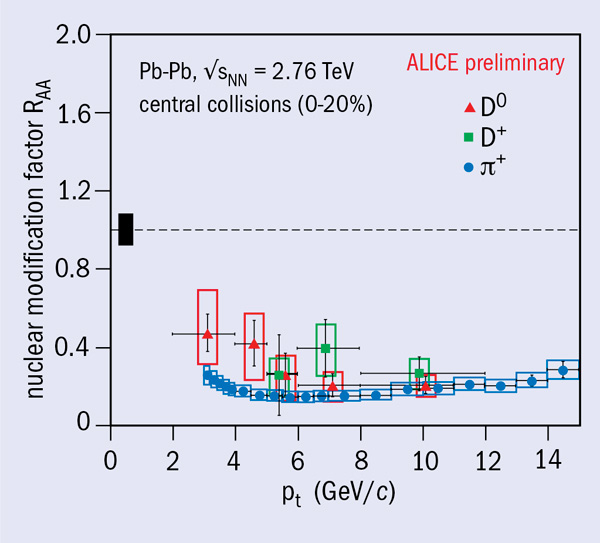
Heavy-flavour particles are recognized as effective probes of the highly excited system (medium) formed in nucleus–nucleus collisions; they are expected to be sensitive to its energy density, through the mechanism of in-medium energy loss. The nuclear modification factor RAA – the ratio of the yield measured in nucleus–nucleus collisions to that expected from proton–proton collisions – is well established as a sensitive observable for the study of the interaction of hard partons with the medium. Because of the QCD nature of parton energy-loss, quarks are predicted to lose less energy than gluons (which have a higher colour charge); in addition, the so-called “dead-cone” effect and other mechanisms are expected to reduce the energy loss of heavy partons with respect to light ones. Therefore, there a pattern of gradually decreasing RAA suppression should emerge when going from the mostly gluon-originated light-flavour hadrons (e.g. pions) to the heavier D and B mesons: RAA(π) < RAA(D) < RAA(B). The measurement and comparison of these different probes provides, therefore, a unique test of the colour-charge and mass dependence of parton energy-loss.
Experiments at the Relativistic Heavy Ion Collider at Brookhaven measured the suppression of heavy flavour hadrons indirectly in gold–gold collisions at 200 GeV through the RAA of the inclusive decay electrons. Using data from the first lead–lead run at the LHC (√sNN = 2.76 TeV), the ALICE collaboration has measured the production of prompt D mesons via the reconstruction of the decay vertex in the channels D0→K–p+ and D+→K–p+p+. The results show a suppression of a factor 4–5, as large as for charged pions, above 5 GeV/c (see figure). At lower momenta, there is an indication of smaller suppression for D than for π mesons. Data with higher statistics, expected from the 2011 lead–lead run, will allow the collaboration to study this region with more precision and address this intriguing mass-dependence in QCD energy-loss.
The result implies a strong in-medium energy loss for heavy quarks, as also suggested by the suppression measured by the ALICE collaboration for electrons and muons from heavy flavour decays, and by the CMS collaboration for J/Ψ particles from B meson decays.
The heavy-ion collision data collected in November 2010 at the LHC continue to provide exciting new physics results. Recently, at the time of the Quark Matter 2011 conference, the CMS collaboration released the first results on the observation of a suppression of the excited Υ resonances in the lead–lead collisions at 2.76 TeV per nucleon pair. The suppression of heavy quarkonia is considered to be one of the “candle” signatures for the possible formation of a quark gluon plasma (QGP).
The Υ, a quarkonium system consisting of a bottom and an antibottom quark, exists in three states known as 1S, 2S and 3S, in decreasing order of how tightly the quarks are bound. The 1S is the ground state of the Υ, while the others are excited states. Because they are more loosely bound, the 2S and 3S states are less likely to survive in QGP matter. This means that the number of Υ(2S) and Υ(3S) particles observed relative to Υ(1S) in heavy-ion collisions is expected to be less than the corresponding numbers from proton collisions.
CMS studied pairs of muons that are part of the post-collision debris in the detector, in which pairs of muons produced from the decays of particles such as the Υ will outnumber the pairs that are created by random processes. Thanks to the excellent momentum resolution of the CMS detector, a spectrum can be produced from the masses of each pair, with clear peaks corresponding to the masses of the particles from which they decayed.
The results show a dramatic difference in the number of Υ(2S) and Υ(3S) produced in the heavy-ion and proton–proton collisions. From the data collected from both runs at 2.76 TeV, CMS has observed that the relative production of the excited states of the Υ particle in heavy-ion collisions is only about 30% that of the comparable rates from proton collisions, with an uncertainty of about 20% (see figure). The probability of obtaining the measured value, or a lower one, if the true double ratio of the heavy ion and proton results is unity, has been calculated to be less than 1%.
The CMS collaboration is looking forward to the next lead–lead run later this year when more data will allow study of the suppression of the excited Υ states with even higher statistics.
To provide the best experiences, we use technologies like cookies to store and/or access device information. Consenting to these technologies will allow us to process data such as browsing behavior or unique IDs on this site. Not consenting or withdrawing consent, may adversely affect certain features and functions.
Functional
Always active
The technical storage or access is strictly necessary for the legitimate purpose of enabling the use of a specific service explicitly requested by the subscriber or user, or for the sole purpose of carrying out the transmission of a communication over an electronic communications network.
Preferences
The technical storage or access is necessary for the legitimate purpose of storing preferences that are not requested by the subscriber or user.
Statistics
The technical storage or access that is used exclusively for statistical purposes.The technical storage or access that is used exclusively for anonymous statistical purposes. Without a subpoena, voluntary compliance on the part of your Internet Service Provider, or additional records from a third party, information stored or retrieved for this purpose alone cannot usually be used to identify you.
Marketing
The technical storage or access is required to create user profiles to send advertising, or to track the user on a website or across several websites for similar marketing purposes.