Comsol -leaderboard other pages

Topics

CMS discovers the Ξb*0

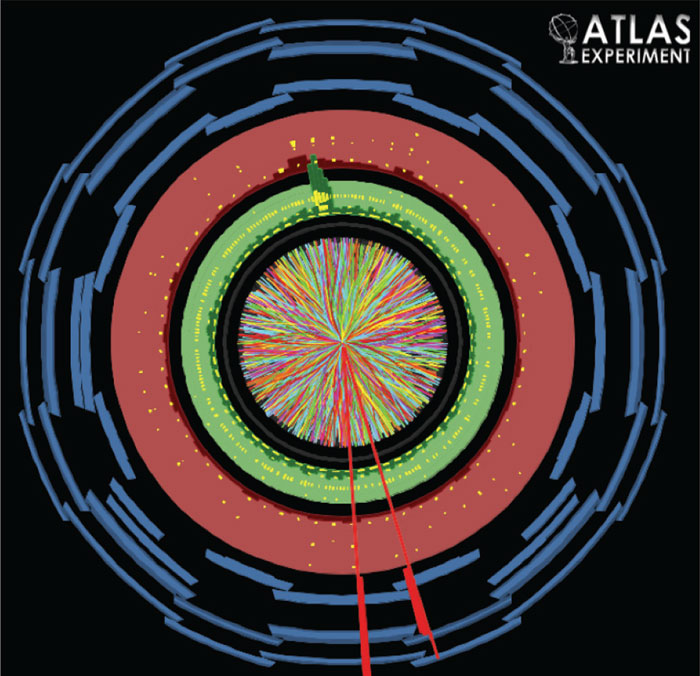
Display of typical event

The CMS experiment has discovered its first new particle. The new state is observed with a significance exceeding 5 σ and a mass of 5945.0 ± 2.8 MeV. This mass and the observed decay mode are consistent with its being the beauty-strange baryon known as Ξb*0.

Understanding the detailed spectroscopy of the various families of hadrons has been a quest of scientists ever since quarks were recognized as being the building blocks of protons, neutrons and other hadrons. Baryons are composed of three quarks and if they contain a beauty (b) quark and a strange (s) quark then they are members of the Ξb family. Depending on whether the third valence quark is a u or a d, the resulting baryon is either the neutral Ξb0 or the charged Ξb. While the charged and neutral lowest-mass states were already known, none of the heavier states had so far been seen. The newly discovered particle is probably the Ξb*0, with a total angular momentum and parity, JP = 3/2+. Its observation helps in understanding how quarks bind and in further validating the theory of strong interactions.

The observation was made in a data sample of 5.3 fb–1 proton–proton collisions at a centre-of-mass energy of 7 TeV, delivered by the LHC in 2011. Figure 1 shows a typical event, where a candidate Ξb*0 (also appropriately called the “cascade b baryon”) leads to a cascade of decays, Ξb*0 → Ξbπ+, Ξb → J/ΨΞ, J/Ψ → μ+μ, Ξ → Λ0π and Λ0 → pπ, ending in one proton, two muons, and three pions. The existence of the Ξb*0 is established by detecting all of these particles and measuring the charge, momentum and point of origin (the vertex) for each one. Requiring that the secondary decay vertices be displaced from the primary vertex reduces the background caused by random combinations of uncorrelated particles, which are copiously produced in high-energy proton–proton collisions.

New Baryon

The invariant-mass distribution of the J/ΨΞ pairs shows a clear peak corresponding to the Ξb signal, with a mass in good agreement with the world average. The Ξb*0 is expected to decay promptly to Ξbπ+ pairs, so candidates were sought by combining the reconstructed Ξb with a track (assumed to be a pion) coming from the primary vertex. To cancel measurement errors partially and so increase the sensitivity, the analysis looked at the mass difference Q = M(J/ΨΞπ+) – M(J/ΨΞ) – M(π). Figure 2 shows the mass difference for 21 events in the range 12 < Q < 18 MeV, which clearly exceed the 3.0 ± 1.4 events expected in the absence of a new particle.

The detection of this new particle was possible thanks only to the excellent tracking and vertexing capabilities of the CMS experiment, combined with high-purity dimuon triggers that identify decays of the J/Ψ meson “on the fly”, before storing the events. This measurement shows that CMS can unravel complicated chains of particle decays and bodes well for future discoveries of rare particles.

Dijets confirm the Standard Model

Dijet measurements provide an excellent tool not only to probe high transverse-momentum parton interactions to study QCD but also to look for signs of new phenomena beyond the Standard Model. Thanks to the outstanding performance of the LHC in 2011, the ATLAS experiment recorded nearly 30,000 events with dijet masses above 2 TeV and even observed dijet masses up to 4.6 TeV.

CCnew6_05_12

The collaboration has used the full 2011 data sample – corresponding to nearly 5 fb–1 of integrated luminosity – for a measurement of the dijet cross-section as a function of mass and rapidity difference. The data were first corrected for detector effects – paying particular care to the effect of possible multiple interactions per beam crossing – and the measured cross-sections were then compared with various predictions of QCD. While there are small deviations in some models at the higher end of the spectrum, overall the agreement with QCD is reasonably good.

QCD predicts that the cross-section falls steeply with dijet mass. New, as yet unobserved, particles would typically give rise to resonances or bumps on top of this smoothly falling spectrum. ATLAS observes no bumps, allowing limits to be set on a number of theories that predict such particles.

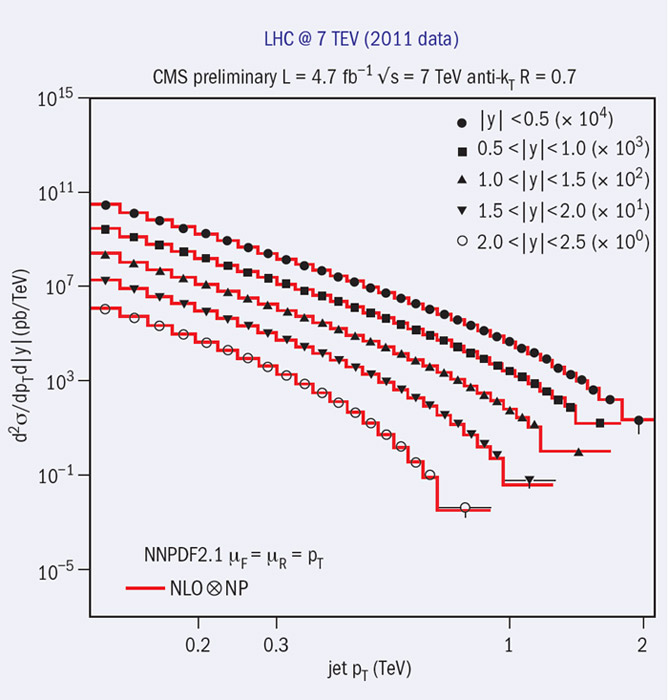
Angular distributions can also be used to search for deviations from the Standard Model. They are typically measured in bins of dijet mass, where the scattering angle is transformed into a variable known as χ (see figure). The Standard Model predicts that these distributions should be relatively flat, while many theories beyond the Standard Model predict a rise at low values of χ.

The measured distributions are found to be in agreement with QCD predictions, allowing limits to be set on various models for new physics. For one of these models, where quarks are no longer fundamental particles but are instead composite objects, this analysis sets a limit on the compositeness scale – the scale of the constituent binding energies – at 7.8 TeV.

RENO observes disappearance of electron-antineutrinos

The Reactor Experiment for Neutrino Oscillations (RENO) has performed a definitive measurement of the neutrino-oscillation mixing angle, θ13, by observing the disappearance of electron-antineutrinos emitted from a nuclear reactor, with a significance of 4.9 σ

RENO detects antineutrinos from six reactors, each with a thermal power output of 2.8 GWth, at Yonggwang Nuclear Power Plant in Korea. The reactors are almost equally spaced in a line about 1.3 km long and the experiment uses two identical detectors located at 294 m and 1383 m on either side of the centre of this line, beneath hills that provide, respectively, 120 and 450 m of water-equivalent of rock overburden to reduce the cosmic backgrounds. This symmetric arrangement of reactors and detectors is useful for minimizing the complexity of the measurement. RENO is the first experiment to measure θ13, the smallest neutrino-mixing angle and the last to be known, with two identical detectors.

In the 229-day data-taking period from 11 August 2011 to 26 March 2012, the far (near) detector observed 17,102 (154,088) electron-antineutrino candidate events with a background fraction of 5.5% (2.7%). During this period, all six reactors were operating mainly at full power, with two reactors being off for a month each for fuel replacement.

The two identical antineutrino detectors allow a relative measurement through a comparison of the observed neutrino rates. Measuring the far-to-near ratio of the reactor neutrinos in this way can considerably reduce several systematic errors. The relative measurement is independent of correlated uncertainties and helps in minimizing uncorrelated reactor uncertainties.

Each detector comprises four layers. At the core lies the target volume of 16.5 tonnes of liquid scintillator that is doped with gadolinium. An electron-antineutrino can interact with a free proton in the scintillator, ν + p → e+ + n. The positron from this inverse β-decay annihilates immediately giving a prompt signal. The neutron wanders into the target volume, eventually being captured by the gadolinium – giving a delayed signal. The delayed coincidence between the positron and neutron signals provides the distinctive signature of inverse β-decay.

The central target volume is surrounded by a 60 cm layer of liquid scintillator without gadolinium, which serves to catch γ-rays escaping from the target volume, thus increasing the detection efficiency. Outside this γ-catcher, a 70 cm buffer-layer of mineral oil shields the inner detectors from radioactivity in the surrounding rocks and in the 354 photomultiplier tubes (10-inch) that are installed on the inner wall of the buffer container. The outermost veto layer consists of 1.5 m of pure water, which serves to identify events coming from the outside through their Cherenkov radiation and to shield against ambient γ-rays and neutrons from the surrounding rocks. Both detectors are calibrated using radioactive sources and cosmic-ray induced background samples.

Based on the number of events at the near detector and assuming no oscillation, RENO finds a clear deficit, with a far-to-near ratio R = 0.920 ± 0.009 (stat.) ± 0.014 (syst.). The value of sin213 is determined from a χ2 fit with pull terms on the uncorrelated systematic uncertainties. The number of events in each detector after the background subtraction has been compared with the expected number of events, based on the neutrino flux, detection efficiency, neutrino oscillations and contribution from the reactors to each detector determined by the baselines and reactor fluxes. The best-fit value obtained is sin213 = 0.113 ± 0.013 (stat.) ± 0.019 (syst.), which excludes the no-oscillation hypothesis at 4.9 σ.

The RENO collaboration consists of about 35 researchers from Seoul National University, Chonbuk National University, Chonnam National University, Chung Ang University, Dongshin University, Gyeongsang National University, Kyungpook National University, Pusan National University, Sejong University, Seokyeong University, Seoyeong University and Sungkyunkwan University.

ALICE tracks charm energy loss in the QGP

An event display

When heavy nuclei collide at high energies, a high-density colour-deconfined state of strongly interacting matter is expected to form. According to lattice QCD calculations, the confinement of coloured quarks and gluons into colourless hadrons vanishes under the conditions of high energy-density and temperature that are reached in these collisions and a phase transition to a quark–gluon plasma (QGP) occurs.

The LHC, operating with heavy ions, is nowadays the frontier machine for exploring the QGP experimentally, but such studies began 25 years ago with fixed-target experiments at the Alternating Gradient Synchrotron at Brookhaven and the Super Proton Synchrotron at CERN. The field entered the collider era in 2000 with Brookhaven’s Relativistic Heavy-Ion Collider (RHIC). Experiments there showed that initial hard partonic collisions produce energetic quarks and gluons that interact with the hot and dense QGP, probing its properties and, more generally, those of the strong interaction in an extended many-body system. The abundant production of these “hard probes” constitutes one of the leading opportunities that have opened up at the LHC – where collisions of heavy ions have nearly a 14-fold increase in centre-of-mass energy with respect to RHIC – and their extensive study is a leading feature of the heavy-ion programmes of the ALICE, ATLAS and CMS experiments.

Heavy quark probes

High-momentum partons are created in hard-scattering processes that occur in the early stage of the nuclear collision. They subsequently traverse the hot QGP, losing energy as they interact with its constituents. This energy loss is expected to occur via inelastic processes (gluon radiation induced in the medium, or radiative energy loss, analogous to bremsstrahlung in QED) and via elastic processes (collisional energy loss).

The massive c and b quarks (mc ˜ 1.5 GeV/c2, mb ˜ 5 GeV/c2) are useful probes of these energy-loss mechanisms. In QCD, quarks have a lower colour coupling-strength than gluons, thus the energy loss should be smaller for quarks than for gluons. At LHC energies, hadrons containing light flavours originate mainly from gluons. Therefore, charmed mesons provide an experimental tag for a low colour-charge, quark parent. In addition, the “dead-cone effect” should reduce small-angle gluon radiation for heavy quarks that have moderate energy-over-mass values, i.e. for c and b quarks with momenta up to about 10 GeV/c.

Models based on parton energy loss describe well the measured suppression of high-momentum charmed mesons

The nuclear modification factor, RAA, is one of the observables that are sensitive to the interaction of hard partons with the medium. This quantity is defined as the ratio of particle production measured in nucleus–nucleus (AA) interactions to that expected on the basis of the proton–proton (pp) spectrum, scaled by the average number of binary nucleon–nucleon collisions occurring in the collisions of the nuclei. Loss of energy in the medium leads to a suppression of hadrons at moderate-to-high transverse momentum (pt > 2 GeV/c), so RAA < 1. In the range pt < 10 GeV/c, where the masses of the heavy c and b quarks are not negligible with respect to their momenta, the properties of parton energy-loss described above mean that an increase in RAA (i.e. a smaller suppression) is expected when going from the mostly gluon-originated light-flavour hadrons (such as pions) to D and B mesons with c quarks and b quarks, respectively: RAA(π) < RAA(D) < RAA(B).

The measurement and comparison of these different probes provides a unique test of how the energy loss of the partons depends on their colour charge and mass. Because these dependences are predicted by QCD, their experimental verification is a crucial step for the understanding of the properties of the strongly interacting medium.

Experiments at RHIC reported a strong suppression, by a factor of 4–5 at pt > 5 GeV/c, for light-flavour hadrons in central collisions of gold nuclei at a centre-of-mass energy √sNN = 200 GeV. The suppression of heavy-flavour hadrons, measured inclusively from their decay electrons by the PHENIX and STAR experiments, turned out to be similar to that of pions and generally stronger than most expectations based on radiative energy loss. This striking observation raised high expectations for the separate measurements of charm and beauty hadrons in the collisions of lead ions at √sNN = 2.76 TeV at the LHC. Such a study is favoured by the abundant production yields (e.g. about 50 cc pairs per central collision, according to perturbative QCD calculations) and by the design of the LHC experiments, all of which have excellent capabilities for the detection of heavy flavour.

Centrality dependence

Charmed meson suppression

In the ALICE experiment, the charmed mesons D0, D+ and D*+ are reconstructed in the central barrel through their decays to charged hadrons, namely D0 → Kπ+, D+ → Kπ+π+ and D*+ → D0π+, followed by D0 → Kπ+. The signal is extracted from the invariant-mass distributions of the combinations of charged tracks reconstructed in the inner tracking system (ITS) and the time-projection chamber (TPC). The high-multiplicity environment of lead–lead (PbPb) interactions, where about 1600 primary charged particles per unit of rapidity are produced for head-on collisions, is particularly challenging for the exclusive reconstruction of D-meson decays because of the large combinatorial background. However, the signal-to-background ratio can be enhanced by requiring the separation of the D0 and D+ decay vertices from the interaction vertex. This separation, typically of a few hundred microns, is resolved thanks to the high-spatial-precision hits measured by the six-layer silicon ITS. Background is reduced further using the excellent particle-identification capabilities provided by the measurement of the specific energy deposit in the TPC and of the particle time-of-flight (TOF) from the interaction vertex to the TOF detector. The D-meson yields are corrected for detector effects and for the contribution from B-meson decays. The nuclear modification factor RAA is then computed using as the pp reference the cross-section measured at 7 TeV centre-of-mass energy and scaled – via perturbative QCD calculations – to the PbPb energy of 2.76 TeV (ALICE collaboration 2012a).

Figure 1 shows the nuclear modification factor measured by ALICE in the transverse momentum interval 6 < pt < 12 GeV/c, as a function of the collision centrality for the three species of D meson (ALICE collaboration 2012b). The centrality of the collision is determined from the measured particle multiplicity and it is quantified by the average number of participant nucleons, 〈Npart〉, i.e. nucleons that suffered at least one inelastic scattering with a nucleon of the other nucleus. The more central the collision, the larger the number of participant nucleons. The observed suppression increases (RAA decreases) with increasing centrality – as expected because of the larger, hotter and denser medium created in more central collisions – reaching a factor of about four for head-on collisions.

Average RAA of D

Figure 2 shows the average RAA of the three D-meson species as a function of the transverse momentum for the most central collisions (ALICE collaboration 2012b). To study the expected dependences of the energy loss on colour charge and parton mass, the nuclear modification factor is compared with those of charged hadrons measured by ALICE and those of non-prompt J/ψ mesons (from B decays) measured by the CMS experiment for pt > 6.5 GeV/c (CMS collaboration 2012). The charged-hadron nuclear modification factor is dominated by light flavours and coincides with that of charged pions above pt ≈ 5 GeV/c. This comparison between the values of RAA for D mesons and charged hadrons shows that the average nuclear modification factor for the D mesons is close to that of charged hadrons. However, considering that the systematic uncertainties of D mesons are not fully correlated with pt, there is an indication for RAA(D) > RAA(charged). The suppression of J/ψ from B decays is clearly weaker than that of charged hadrons, while the comparison with D mesons is not conclusive and requires more differential and precise measurements of the transverse momentum dependence.

Apart from final-state effects, which are related to the formation of a hot and deconfined medium, initial-state effects are also expected to influence the nuclear modification factor, because it is nuclei rather than nucleons that collide. In particular, the modification of the parton distribution functions (PDFs) of the nucleons in the nuclei affects the initial hard-scattering probability and, thus, the yields of energetic partons, including heavy quarks. In the kinematic range relevant for charm production at LHC energies, the main effect is nuclear shadowing, which induces a reduction in the yields of D mesons at low momentum. As shown in figure 3, a perturbative QCD calculation supplemented with a phenomenological parameterization of the nuclear modification of the PDFs indicates that the shadowing-induced effect on RAA is limited to ±15% for pt > 6 GeV/c. This suggests that the strong suppression observed in the high-pt data is a final-state effect, arising predominantly from energy loss of c quarks in the medium.

Theoretical models based on parton energy loss describe well the measured suppression of high-momentum charmed mesons. Figure 3 displays the comparison with the data of some selected models that within the same framework compute the suppression of particles with heavy and light flavour. A thorough validation of the ingredients of the models, which differ from one another, requires a systematic comparison, extended to higher momentum, over a range in collision centrality for a variety particle species, in particular beauty hadrons. This will eventually provide important constraints on the energy density of the hot QGP formed at the LHC.

In conclusion, the first ALICE results on the nuclear modification factor RAA for charm hadrons in PbPb collisions at a centre-of-mass energy √sNN = 2.76 TeV indicate strong in-medium energy loss for charm quarks. There is a possible indication, which is not fully significant with the current level of experimental uncertainties, that RAA(D) > RAA(charged). The precision of the measurements will be improved in the future, using the large sample of PbPb collisions recorded in 2011. In addition, proton–lead collisions will provide insight into possible initial-state effects, which may play an important role, mainly in the low-momentum region.

Daya Bay collaboration observes a new kind of neutrino oscillation

CCnew4_04_12

The Daya Bay reactor antineutrino experiment has observed the disappearance of electron-antineutrinos at a distance of about 2 km from the reactors. As briefly reported earlier, this provides strong evidence for a new kind of neutrino oscillation through a nonzero neutrino-mixing angle, θ13.

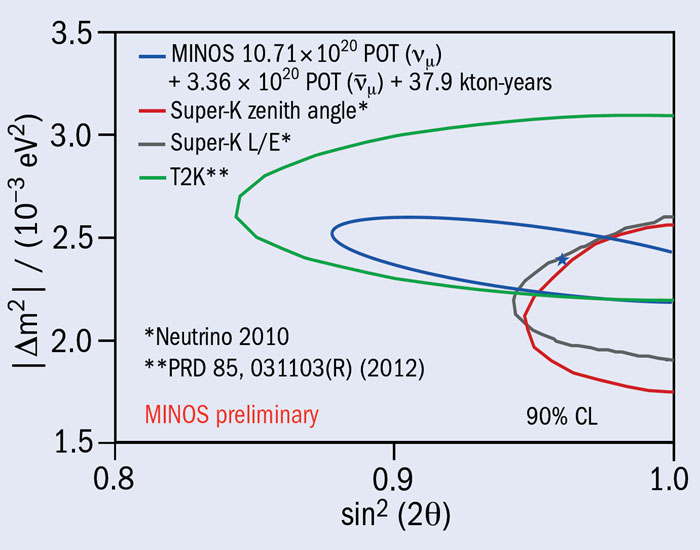
There has been good evidence for more than a decade that the electron-neutrino, muon-neutrino and tau-neutrino can morph into one another. This phenomenon of neutrino oscillation is a consequence of mixing between the three flavours of neutrinos, and oscillations between three neutrinos are described with three mixing angles, two mass-squared differences and one CP-violating phase. Two of the mixing angles, θ12 and θ23, have been measured to good precision but the third mixing angle, θ13, was poorly known.

A decade ago, the CHOOZ experiment set a limit of sin213 < 0.17. However, newer analyses of the measurements with solar neutrinos and by the KamLAND experiment – as well as data from the T2K, MINOS and Double Chooz experiments – hinted that θ13 could be larger than zero. On 8 March, based on an exposure of 43,000 tonne-GWth-days, the Daya Bay collaboration reported the result of their measurement, sin213 = 0.092 ± 0.016 (stat.) ± 0.005 (syst.), concluding that θ13 is significantly different from zero.

The Daya Bay experiment is located at the Daya Bay Nuclear Power Complex in China, 55 km northeast of Hong Kong. About 3.6 × 1021 low-energy electron-antineutrinos per second are produced by three pairs of nuclear reactors with a combined maximum thermal-power of 17.4 GWth. Three underground experimental halls connected by horizontal tunnels will eventually house eight antineutrino detectors (two in each near hall and four in the far site).

In each hall, the antineutrino detectors are submerged in a water pool that is partitioned optically into two zones. These two water-Cherenkov detectors tag cosmic-ray muons, which can generate background that mimics antineutrino interactions. The water also shields the detectors from ambient radiation that can generate background. The experiment identified electron-antineutrinos via the inverse beta-decay reaction νe + p → e+ + n, with 20 tonnes of 0.1% gadolinium-doped liquid scintillator in each antineutrino detector.

The data used for these first results were obtained with six antineutrino detectors – three deployed in the far hall, two in one of the near halls and one in the other near hall. When the number of detected electron-antineutrino events at the far site was compared with the expected number derived from the measurements in the near sites, a ratio of 0.940 ± 0.011 (stat.) ±0.004 (syst.) was found, indicating neutrino oscillation through θ13. Using the total number of detected events yielded a value of sin213 that was 5.2 σ from zero.

Figure 1 shows the disappearance of reactor electron-antineutrinos as a function of flux-weighted distance. Further evidence for this new kind of neutrino oscillation comes from the comparison of the observed and predicted energy spectra of the electron-antineutrinos at the far site. As figure 2 shows, the spectral distortion as a function of the prompt (positron) energy is also consistent with oscillation corresponding to sin213 = 0.092.

CCnew5_04_12

Since the announcement of Daya Bay’s measurement of a nonzero value for θ13, the RENO collaboration has reported the observation of the disappearance of electron-antineutrinos by their experiment based in Korea. The value that they find for sin213 is consistent with the results from Daya Bay.

A nonzero θ13 is crucial for designing experiments to search for CP-violation in the neutrino sector. These next-generation experiments will explore whether neutrinos oscillate differently from antineutrinos and answer the question of whether neutrinos can explain why matter is predominant in the universe. Furthermore, knowing the value of θ13 helps to complete the determination of the neutrino-mixing matrix and constrain models beyond the current Standard Model.

• The Daya Bay collaboration consists of 230 collaborators from 38 institutions worldwide. The experiment is supported by the funding agencies of China, the Czech Republic, Hong Kong, Russia, Taiwan and the US. Daya Bay is currently one of the largest collaborative scientific projects between China and the US.

The rarest B decay ever observed

As announced at the “Moriond” conference on 10 March, the LHCb collaboration has made the first observation of the decay B→ π+μ+μ. With a branching ratio of about 2 per 100 million decays, this is the rarest decay of a B hadron ever observed.

The LHCb experiment is designed to search for new physics in the rare decays and CP-violation of particles with heavy flavour, i.e. those containing the c or b quark. Such decays have previously been studied by the B-factory experiments BaBar and Belle, but LHCb is taking the field further as a result of two major advantages: not only are all of the varieties of heavy-flavour hadrons produced in the LHC’s high-energy collisions, but they are also produced at an enormous rate.

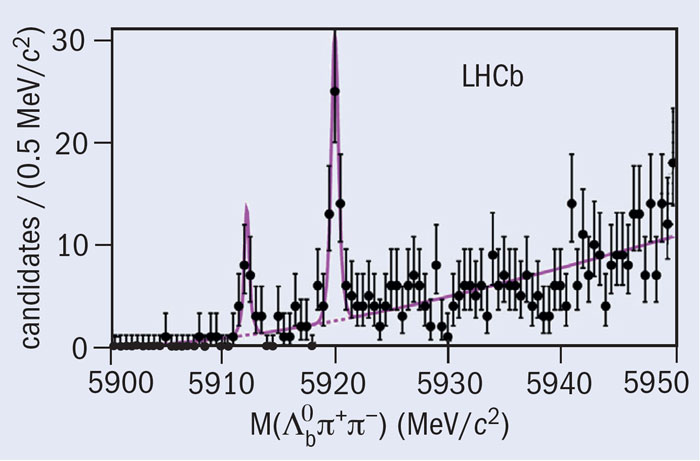
The B factories relied on the copious production of B+B and B0B–0 pairs in the decay of the Υ(4S) resonance. However, in addition to those particles, collisions at the LHC also produce Bs, Bc and b baryons, which may provide an alternative route to finding new physics. This has been illustrated by recent results from LHCb on the rare decay Bs → μ+ μ, where the strongest limit yet has been placed on the branching ratio of < 4.5 × 10–9 (at 95% CL), and the first evidence for CP-violation in the Bs system, as well as observation of new decay modes for Bc and the most precise measurements of the mass of a b-flavoured baryon.

CCnew6_04_12

However, the large cross-sections and luminosity at the LHC mean that even for B+ and B0 decays, LHCb can now overtake the B-factory results. The decay B+ → π+μ+μ is a good example: it is a flavour-changing neutral-current decay, which is strongly suppressed in the Standard Model as it proceeds via quark diagrams involving loops (box or penguin diagrams). The predicted branching ratio is (2.0 ± 0.2) × 10–8 in the Standard Model but could be enhanced by new physics. The best previous limit on this mode, from the Belle experiment at KEK, was < 6.9 × 10–8 (at 90% CL) (Belle collaboration 2008). Now LHCb has observed a clear signal for the decay, shown in the figure, with a significance of more than 5 σ. The measured branching ratio of (2.4 ± 0.6 (stat.) ± 0.2 (syst.)) × 10–8 is in good agreement with the expectation from the Standard Model. This observation opens the door to more detailed studies of rare b → d transitions, which will be possible with the increase in data in 2012.

ATLAS experiment’s winter round-up

CCnew9_04_12

The ATLAS experiment sent the results of more than 40 new analyses to “La Thuille”, “Moriond” and other winter conferences. These results covered the full scientific programme of the experiment, from precision measurements of Standard Model processes, through searches for the Higgs boson and new physical phenomena to the study of hot and dense matter probed in heavy-ion collisions.

The collaboration has made a great deal of progress since the seminar on 13 December where preliminary results on the Higgs search in both the ATLAS and CMS experiments were presented. ATLAS has since used the full 2011 data set to search for a Standard Model Higgs boson in 12 different decay channels. Combining all of these results has left only three remaining windows for the Higgs: 115.5–131 GeV, 237–251 GeV and above 520 GeV. The upcoming data at the new centre-of-mass energy of 8 TeV will increase the sensitivity of both CMS and ATLAS, and allow the collaborations to make more definitive statements on the existence and mass of a Standard Model Higgs boson by the end of the year.

At moderate to high masses, the most sensitive searches for the Higgs boson involve its decays to two heavy electroweak bosons, either WW or ZZ. Because this search looks for an excess of events over the background from other diboson production it is important to measure the diboson background as accurately as possible. This measurement is also important in its own right: it depends on the strength of the interaction between the W boson, the Z boson and the photon. This strength is a fundamental parameter of the Standard Model and distinguishes it from other theories. These new measurements use the full 2011 data set and are twice as precise as previous ATLAS measurements.

In the Standard Model, the Bs meson is predicted to decay to a μ+μ pair rarely: only 3 or 4 times in a billion. However, in various extensions of the Standard Model this rate can be increased by a factor of 10 or even a 100; it is one of the more sensitive indirect tests for new physics and complements some of the direct searches for new phenomena at the LHC. Other experiments both at Fermilab’s Tevatron and at the LHC have set upper limits on this decay in the range of 4.5–51 decays per billion. The ATLAS collaboration has now joined this search and has reported an upper limit of 22 decays per billion.

At the International Conference on High-Energy Physics (ICHEP) in Paris, ATLAS showed the first LHC results with sensitivity beyond that of previous experiments: limits on quark substructure obtained by studying events containing two jets. ATLAS has continued to investigate this category of events using the full 2011 data set. The additional data have provided extremely energetic events for ATLAS to study: in some cases the two jets have a combined mass above 4 TeV. There is still no evidence that quarks are made of smaller objects – but if they existed and were at least as large as 3 × 10–20 m, ATLAS would have detected them. This lack of observation allows the experiment to set a limit on the size of any quark substructure. In a complementary measurement looking for excited electrons or muons, which would also be an indication of substructure, ATLAS has set limits around 10–19 m.

Based on the new results previewed at these conferences, the ATLAS collaboration has sent more than 30 articles to scientific journals, with more in preparation. The next major round of conferences will be in summer and will include ICHEP 2012 in Melbourne. In addition to new results at a total collision energy of 7 TeV, the collaboration intends to show early results from 8 TeV collisions.

ATLAS and CMS search for new gauge bosons

The ATLAS and CMS collaborations are carrying out a large-scale hunt for hypothetical heavy partners of the Standard Model gauge bosons, the W and the Z. The two experiments were designed to be sensitive to the decays of such particles, which are called, appropriately, W’ and Z’. The latest findings presented at the recent winter conferences show that so far these searches probe for W’ and Z’ particles with masses more than 20 times larger than those of their well known Standard Model counterparts.

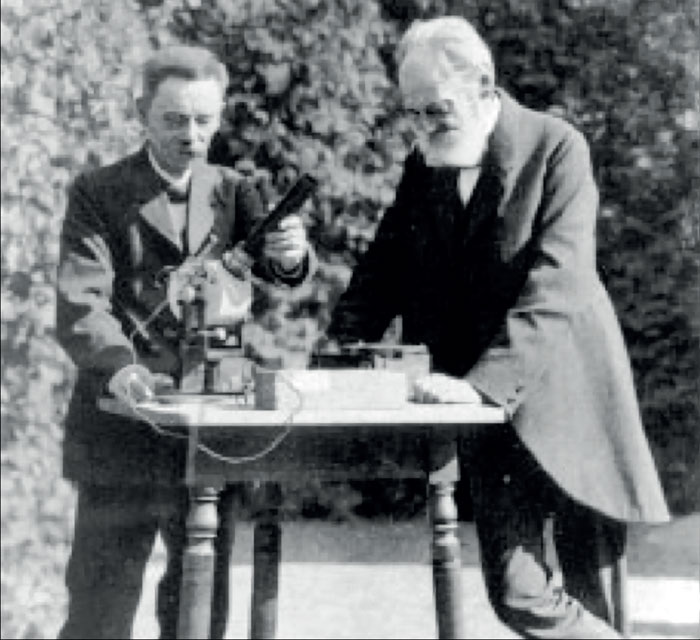
The W and Z bosons, mediators of the weak force, are almost 100 times heavier than the proton. Their discovery, which was announced in 1983, had awaited the conversion of CERN’s Super Proton Synchrotron into a proton–antiproton collider to form the first machine energetic enough to produce them. Various theories provide motivation for the heavier W’ and Z’ bosons, and their existence would provide answers to many fundamental questions. For example, the extreme weakness of gravity – when compared with electromagnetism – could be explained by theories that include additional spatial dimensions and in which new heavy particles like a Z’ appear.

CCnew12_04_12

Strongly motivated by such theoretical arguments, physicists at the LHC have been hunting for these heavy partners of the W and Z since the collider started up. Many theories predict that the new gauge bosons would be similar to their light partners, only with larger masses. For example, the Z’ boson could decay to a lepton–antilepton pair, the same channel in which the Z was discovered. ATLAS and CMS have carefully analysed all such events and classified them into mass distributions, such as the one in figure 1 for dimuons in the ATLAS experiment. The black points represent the data and the coloured areas represent contributions expected in the Standard Model. The prominent feature is the Z-boson peak on the left side of the spectrum. If a Z’ boson exists, it should peak in a similar manner somewhere on the right, in the mass region around 1500–2000 GeV, as shown by the thin coloured lines.

CCnew13_04_12

No clear evidence of the Z’ or W’ bosons has yet been observed, so the collaborations calculate the mass range where the existence of a hypothetical W’ or Z’ boson is excluded with 95% probability. Figure 2 shows the maximum allowed production rate (black points) as a function of the hypothetical Z’ boson mass, as allowed by the CMS data. The different theories, shown by continuous coloured lines, are excluded in the low-mass region where they predict a rate larger than that shown with the black line, but are still allowed in the high-mass region where they predict a lower rate. For example, the Standard Model-like Z’ boson predicted by the Sequential Standard Model is excluded up to 2300 GeV (2.3 TeV).

It might also be the case that the preferred decay channels of the Z’ bosons are different from those of the Z boson. For instance, the Z’ may prefer to decay into pairs of quarks or even a pair of the lighter partners – the W and Z of the Standard Model. It is therefore critical to explore all of the possible decay channels. These searches are about to be completed by the two collaborations using large data samples collected during the 2010–2011 runs. At the same time they are eagerly awaiting the 2012 data, with larger data samples of even more energetic collisions provided by the LHC. The hunt will then start anew and probe even higher masses

New developments in the search for SUSY

Although no sign of supersymmetry (SUSY) has been observed so far, it is still the front-runner as a signal for new physics that could be discovered at the LHC. Not only does it neatly solve several shortcomings of the Standard Model, it also provides a candidate for the as-yet undiscovered dark-matter particle. Unfortunately, the masses of the SUSY particles are not constrained by theory, but it does provide some interesting hints. For SUSY to solve in a natural way the fine-tuning problems that arise in the Standard Model from the presence of a low-mass Higgs, the lightest of the two supersymmetric partners of the top quark (stop quarks) should have a mass not too much beyond that of the Standard Model counterpart, and the mass of the gluon’s superpartner (gluino) should not be too far above that of the stop quarks.

Both the ATLAS and CMS collaborations have made significant progress in searching for possibly light third-generation squarks (stop and sbottom), produced either directly or in the decays of gluinos, and first results based on the full data set recorded in 2011, equivalent to about 5 fb–1, have been released. CMS has presented a search for events containing multiple b-quarks and two leptons of the same charge, thus effectively eliminating most of the Standard Model backgrounds. ATLAS has released a novel interpretation of its updated multi-jet analysis, which explores events with up to nine high-transverse-momentum jets.

CCnew16_04_12

The figures show the current constraints that both collaborations are imposing on the gluino, pushing its allowed mass above 850 GeV in some cases. In addition, constraints from experiments at Fermilab’s Tevatron on direct sbottom pair-production have been extended by both ATLAS and CMS, and first results constraining direct production of stop in a simplified model of stop decays were recently presented by ATLAS. These are just appetizers for more results that will be released by both collaborations over the next few months.

The collaborations have also updated the more canonical searches that look for multiple energetic jets, the eventual presence of leptons and large missing transverse momentum – a striking signature for the presence of a dark-matter particle that escapes the detectors. Both collaborations invested a large effort in refining their analysis techniques, thus boosting their sensitivities. In certain SUSY scenarios, gluinos and squarks with masses below 1.4 TeV are now excluded.

CCnew17_04_12

Last, the large data set produced by the LHC in 2011 allowed the collaborations to begin exploring the electroweak sector of the SUSY particle spectrum with the study of multilepton final states. New and updated results have been released for many other SUSY decay signatures, including photons and τ leptons, and also in the context of searches for long-lived particles, disappearing tracks, and signatures without missing momentum, which are becoming increasingly interesting as possible ways to discover SUSY.

While no indications for the presence of supersymmetric particles have been found in the LHC collisions so far, the hunt continues and more results from additional search channels will appear in the coming months. Only a small part of the SUSY parameter space has been challenged by direct searches so far. Relatively light stops and gluinos are still allowed by the present data, and more dedicated searches will show if “natural SUSY” prevails. The increase of the LHC centre-of-mass energy to 8 TeV and the foreseen increase of data to be delivered in 2012 will open a new window to search for the presence of SUSY particles. Combined with the collaborations’ ever-growing experience and new analyses dedicated to specific signatures, this guarantees exciting developments during the rest of the year.

MoNA makes first confirmed sighting of dineutron decay

CCnew18_04_12

Researchers in the Modular Neutron Array (MoNA) collaboration have found evidence for a new nuclear-decay mode at the National Superconducting Cyclotron Laboratory (NSCL) at Michigan State University. Artemis Spyrou, Zach Kohley and their colleagues have recently published results on the first confirmation of dineutron decay, which has long been hypothesized but never detected directly (A Spyrou et al. 2012).

Beginning with a beam of 17B at 53 MeV/u produced by the Coupled Cyclotron Facility, the nucleus of interest, 16Be, was created by knocking out a proton from the beam. The 16Be decayed immediately into a 14Be fragment and two neutrons. The charged fragment, 14Be, was deflected by the sweeper-dipole magnet and detected in a suite of position- and energy-sensitive detectors. The neutrons were detected in MoNA.

There are three decay-modes that the dineutron emission could proceed through: a sequential emission of the two neutrons through the intermediate system 15Be; a simultaneous emission of the two neutrons via a three-body break-up; and a dineutron decay, where the two neutrons are assumed to be clustered together inside the nucleus. Only the latter model was able to reproduce the experimental results and, in particular, the two-neutron correlation parameters. By observing a small angle between the two neutrons the team could demonstrate that these were emitted together as a cluster, and thus as a dineutron. 16Be was found to be a rare case where the two neutrons are emitted simultaneously because the decay through the intermediate system, 15Be, is not energetically favourable.

This experiment showed for the first time that a dineutron decay is possible in these extremely neutron-rich systems. The observation can improve understanding of nuclear binding, especially at the limits of nuclear stability, and help to create more reliable models for describing the astrophysical processes.

bright-rec iop pub iop-science physcis connect